Generic transceiver integrated circuits on a blue industrial communication circuit board
settings_input_componentInterface ICs

RS-485 & RS-422 Transceiver ICs

Compare transceiver options by interface standard, duplex mode, supply voltage, data rate, isolation, protection and package. Submit a BOM or RFQ for availability, pricing and lead-time confirmation.

Loading verified products...
Part Number Manufacturer Type Duplex Data Rate Supply Voltage Package Action
Loading product catalog...

RS-485 vs. RS-422: Technical Comparison

While both RS-485 and RS-422 use differential signaling to achieve high noise immunity and long-distance communication, they are designed for different network topologies. RS-422 is intended for multi-drop networks (one driver, multiple receivers), whereas RS-485 supports true multi-point networks (multiple drivers and receivers).

Specification RS-422 RS-485
Network Topology Point-to-Point or Multi-drop Multipoint
Transmission Mode Simplex or Full-Duplex (4-wire) Half-Duplex (2-wire) or Full-Duplex (4-wire)
Max Nodes One active driver; receiver capacity depends on the implementation Node capacity depends on unit load and the selected device
Max Distance Depends on data rate, cable, topology and termination Depends on data rate, cable, topology and termination
Termination Required at the far end of the cable Required at both ends of the main cable

How to Select a Transceiver

account_tree

Network Topology

Determine if you need Point-to-Point, Multi-drop (RS-422), or Multipoint (RS-485).

compare_arrows

Duplex (2/4-Wire)

Choose Half-Duplex (2-wire) for bidirectional comms on one pair, or Full-Duplex (4-wire) for simultaneous Tx/Rx.

speed

Data Rate & Distance

Higher data rates limit max cable length. Slew-rate limited parts reduce EMI for lower speeds.

hub

Node Count

Review the device unit-load rating and the full network loading before setting a node limit.

battery_charging_full

Supply Voltage

Match to your system. Common options are 5V, 3.3V, and wide-range supplies.

electrical_services

Isolation

Required to break ground loops or protect against high voltage differences between nodes.

cable

Termination

Consider integrated termination resistors to save board space and simplify design.

thermostat

Temperature Range

Match the operating-temperature range and qualification requirements to the application and datasheet.

Common Applications

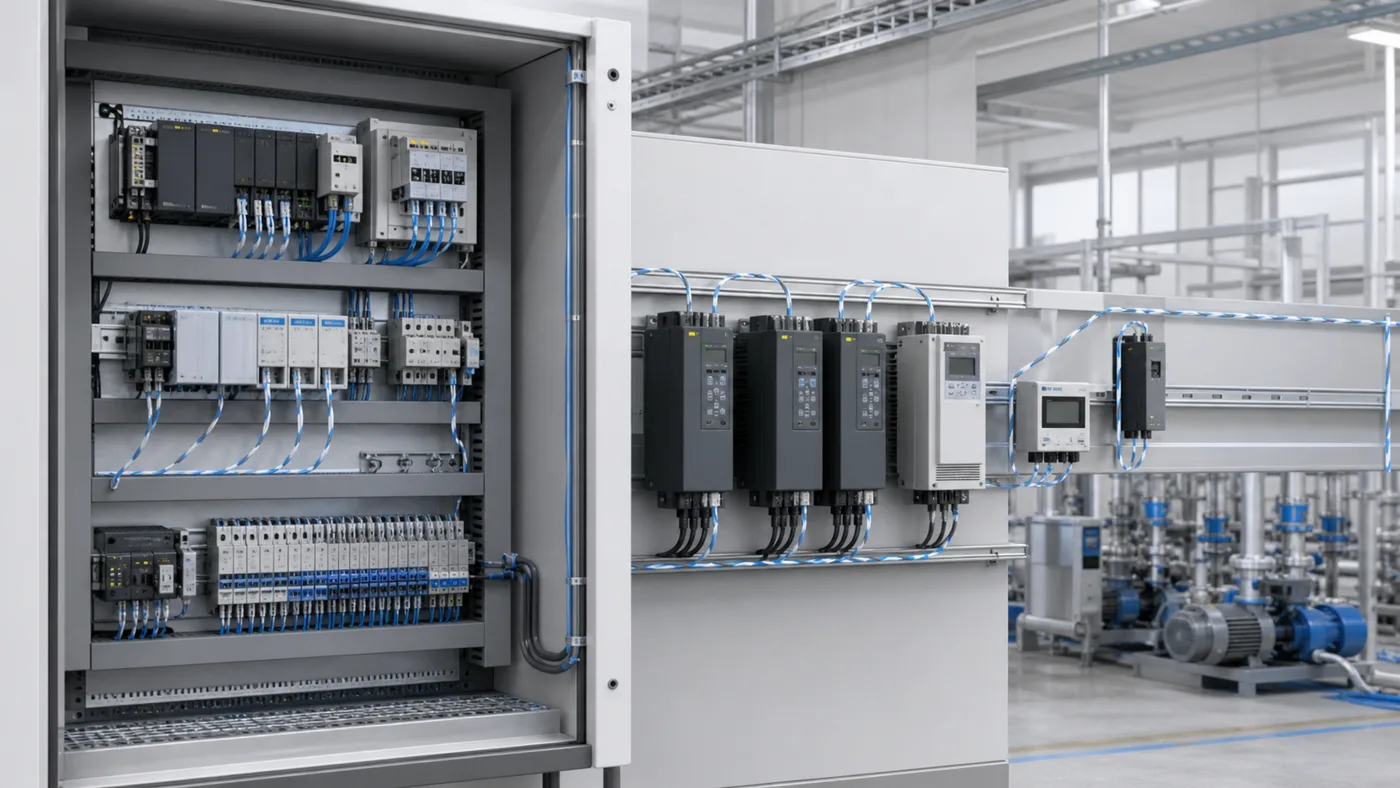
Industrial control cabinets, motor drives and instrumentation connected in an automation environment
Generated application visual · representative environment only
Application context

Connected control and instrumentation systems

Use the application environment to identify isolation, protection, topology and temperature requirements. Confirm every selected device against its manufacturer datasheet.

factoryIndustrial Automation
businessBuilding Automation
precision_manufacturingMotor Control
monitor_heartInstrumentation
solar_powerEnergy Systems
cableLong-distance Serial Links

Frequently Asked Questions

What is the difference between RS-485 and RS-422?expand_more

Both use differential signaling, but the supported topology and driver behavior differ. Select the standard from the actual network architecture and verify the chosen transceiver datasheet rather than assuming direct interchangeability.

When should I use an isolated transceiver?expand_more

Consider isolation where nodes may have ground-potential differences, significant electrical noise or a defined safety-isolation requirement. Confirm the required ratings and creepage/clearance against the system standard and datasheet.

Do I need termination resistors?expand_more

Termination depends on cable impedance, topology, length and edge rate. Validate the network as a complete transmission line rather than applying one fixed resistor rule to every design.

What is fail-safe biasing?expand_more

Fail-safe biasing establishes a known receiver state when no driver is actively controlling the bus. The required external network depends on the receiver’s built-in fail-safe behavior and the system termination.

Can RS-485 and RS-422 devices communicate with each other?expand_more

Possible interoperability depends on topology, driver control, voltage limits and the individual devices. Treat compatibility as an engineering review item, not a universal guarantee.

What does unit load mean?expand_more

Unit load describes how much receiver loading a device presents to the bus. Use the datasheet unit-load value when calculating the supported node count.

How do slew-rate-limited transceivers help?expand_more

Controlled edge rates can reduce high-frequency energy and simplify lower-speed networks, but the permitted data rate and cable conditions remain device-specific.

What affects the maximum cable length?expand_more

Data rate, cable properties, topology, termination, noise and receiver thresholds all affect practical distance. Confirm performance under the actual installation conditions.

Need a Large Quantity or Hard-to-Find Transceivers?

Upload your BOM or send the required manufacturer part numbers. Availability, pricing, lead time, lifecycle and alternatives are confirmed after review.