
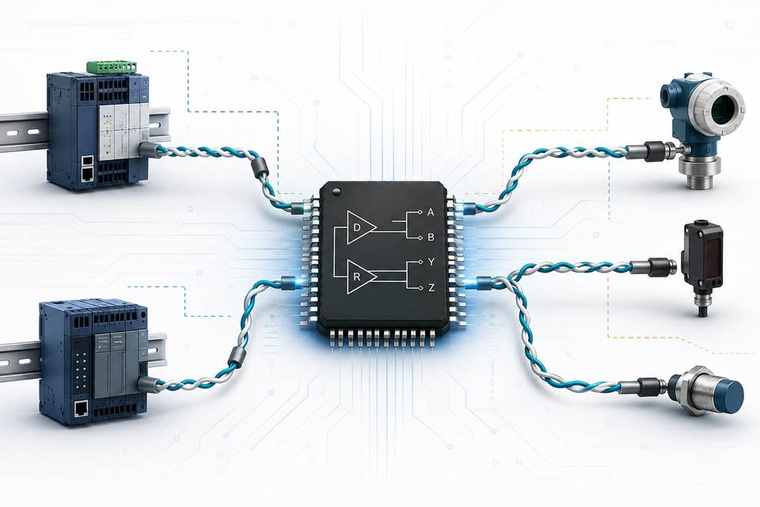
RS-485 and RS-422 transceiver ICs translate logic-level UART or controller signals into balanced differential bus signals for industrial communication. For sourcing work, the key question is not only "which chip supports RS-485?" The buyer also has to check supply voltage, half-duplex or full-duplex wiring, data rate, ESD protection, isolation, package, temperature grade, and replacement risk.
This guide is written for engineers and BOM buyers comparing RS-485 transceiver ICs such as MAX485, MAX3485, SP3485, and RS-422 transceiver options. It does not claim live inventory, price, lead time, or full drop-in compatibility. Those items must be confirmed against the exact part suffix, datasheet, and purchasing channel before quoting.
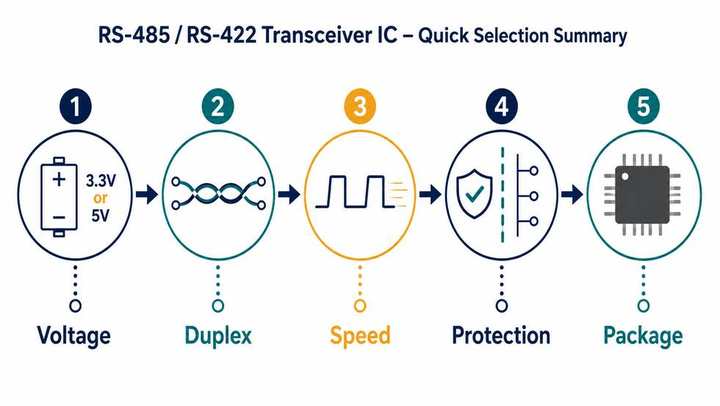
Quick Selection Summary
| Selection Need | Better Direction | What To Verify Before RFQ |
|---|---|---|
| 5 V half-duplex RS-485 bus | MAX485-class transceiver or newer equivalent | Supply range, pinout, package, data rate, ESD rating, temperature grade |
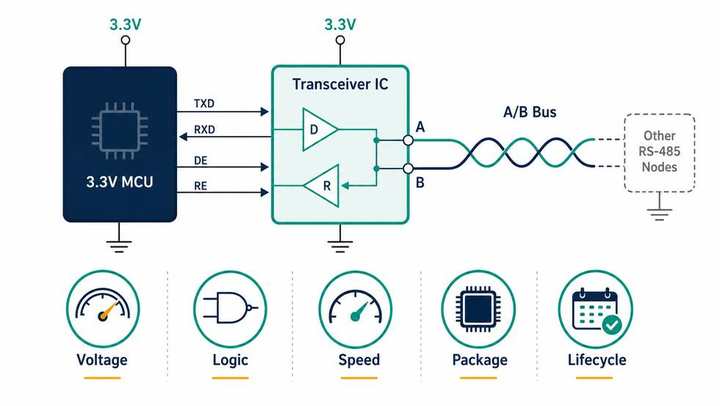
| 3.3 V MCU or low-voltage node | MAX3485 / SP3485-class RS-485 transceiver | 3.3 V operation, input thresholds, driver output level, package, lifecycle |
| Full-duplex or RS-422-style link | RS-422/RS-485 full-duplex transceiver | Separate driver/receiver pins, bus topology, termination, receiver count |
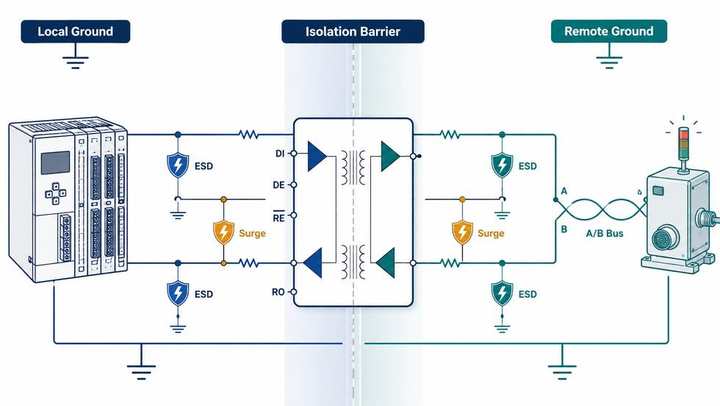
| Long cable or noisy industrial environment | Protected or isolated RS-485 transceiver | Isolation rating, surge/ESD level, creepage/clearance, power architecture |
| Replacement for an existing BOM line | Parametric and pinout cross-check | Manufacturer suffix, package code, pin compatibility, speed, thermal limits |
RS-485 vs RS-422: What Buyers Need To Know
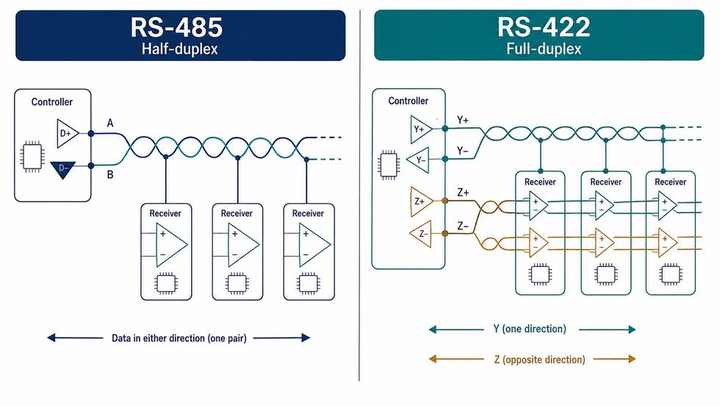
RS-485 and RS-422 both use differential signaling, which helps communication survive noise better than single-ended logic-level wiring. In product selection, the main difference is usually bus topology and duplex mode.
RS-485 is commonly used for multipoint industrial buses. Many common RS-485 transceivers are half-duplex, using one differential pair for both transmit and receive. Full-duplex RS-485 parts use separate driver and receiver pairs.
RS-422 is commonly used where a differential driver sends data to one or more receivers, often with separate transmit and receive paths. Many modern product categories group RS-485 and RS-422 together because the IC families overlap. That is why a sourcing request should specify topology, not just the standard name.
For a BOM quote, include the bus mode, voltage rail, required speed, operating temperature, and package. Without those details, a supplier can identify candidates, but cannot responsibly confirm an exact replacement.
MAX485: Useful, Popular, But Not Enough By Itself
MAX485 is one of the most searched RS-485 part numbers, and it is often used as the reference point for 5 V half-duplex RS-485 designs. The original MAX481/MAX483/MAX485 family is associated with low-power RS-485/RS-422 communication and slew-rate-limited options in the family, depending on the exact device.
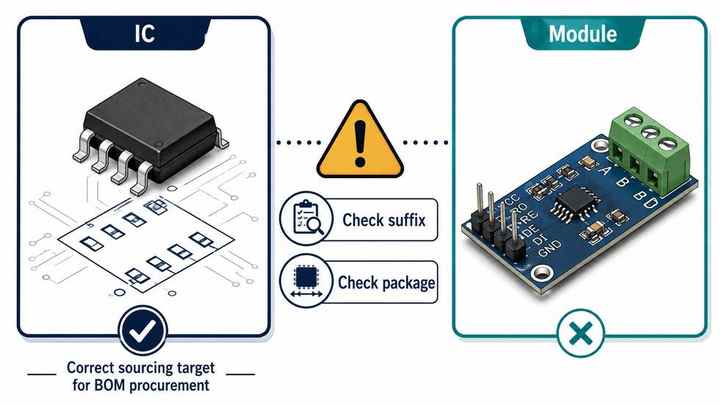
From a sourcing viewpoint, the trap is treating every "MAX485 module" or "MAX485 IC" result as the same item. A module listing may include a PCB, terminal block, resistors, and a clone or compatible transceiver. A BOM line for an IC needs the exact manufacturer, package, suffix, temperature grade, and reel or tube packaging.
Use MAX485-class devices when the design is built around a 5 V rail and a conventional half-duplex RS-485 bus. For new 3.3 V MCU systems, compare MAX3485-class or SP3485-class devices before assuming a 5 V part is suitable.
MAX3485 And SP3485 For 3.3 V Systems
These devices are commonly considered in low-voltage RS-485 designs, especially where a 3.3 V MCU or processor is used. The exact choice still depends on the datasheet conditions: supply voltage range, driver output, receiver threshold, data rate, shutdown behavior, ESD rating, package, and lifecycle.
For replacement work, do not write "MAX3485 replaces SP3485" or the reverse without checking pinout, suffix, speed grade, and environmental requirements. In procurement language, they may be candidate alternatives, not automatically full equivalents.
When To Choose An Isolated RS-485 Transceiver
Isolation becomes important when different equipment may sit at different ground potentials or when the bus is exposed to high common-mode noise. Industrial automation, motor drives, building control, energy systems, and long cable runs can all create this problem.
An isolated RS-485 transceiver can reduce ground-loop and transient risk, but it also changes the BOM. The design may need isolated power, correct PCB spacing, surge protection, and careful layout. If a buyer asks for an isolated RS-485 transceiver, request the isolation rating, working voltage, surge/ESD requirement, speed, package, and certification needs. If those are not supplied, mark the requirement as unverified.
Practical RS-485 / RS-422 Selection Checklist
| Question | Why It Matters | Buyer Note |
|---|---|---|
| Is the bus half-duplex or full-duplex? | It decides whether one or two differential pairs are needed. | Ask for schematic or bus topology if unclear. |
| Is the logic rail 5 V, 3.3 V, or lower? | A 5 V transceiver may not fit a 3.3 V design. | Match supply and logic thresholds. |
| What data rate is required? | Long cables, termination, and slew rate affect signal quality. | Use datasheet limits under real loading conditions. |
| Is isolation required? | Non-isolated parts may fail in high-noise or ground-shifted systems. | Confirm isolation and surge requirements. |
| What package is on the PCB? | SOIC, MSOP, TSSOP, DFN, and other packages are not interchangeable. | Compare footprint before replacement. |
| What protection level is needed? | ESD, EFT, and surge exposure vary by application. | Do not assume all RS-485 ICs have the same protection. |
| Is the part active and orderable? | Lifecycle and supply status can change. | Confirm current status before quotation. |
Common Mistakes In RS-485 Chip Sourcing
The first sourcing mistake is mixing up modules and ICs. Many listings for MAX485 are TTL-to-RS-485 modules, not the bare IC required for a PCB BOM. For an IC RFQ, provide the exact manufacturer, package, suffix, temperature grade, and required packaging.
The second mistake is ignoring voltage. MAX485-class 5 V parts are not automatically right for a 3.3 V MCU design. If the controller is 3.3 V, check 3.3 V transceivers such as MAX3485 or SP3485-class parts and verify logic compatibility.
The third mistake is assuming RS-422 and RS-485 are identical. They overlap in product categories, but the wiring mode and receiver/driver requirements can differ. A buyer should provide the topology before asking for an equivalent.
The fourth mistake is treating any pin-compatible part as fully compatible. Pinout is only one layer. Data rate, ESD rating, fail-safe behavior, temperature grade, package height, and lifecycle also matter.
Suggested RFQ Information
| RFQ Field | Example |
|---|---|
| Target part number | MAX485CSA+, MAX3485ESA+, SP3485EN-L/TR, or buyer-specified suffix |
| Interface | RS-485 half-duplex, RS-485 full-duplex, RS-422, or RS-485/RS-422 |
| Supply voltage | 5 V, 3.3 V, or other |
| Package | SOIC-8, MSOP, TSSOP, DFN, etc. |
| Quantity | Prototype, pilot run, or production batch |
| Replacement allowed? | Exact part only, pin-compatible candidate, or parametric alternative |
| Application condition | Industrial control, encoder, PLC, motor drive, building automation, metering |
| Extra requirements | Isolation, ESD/surge rating, temperature grade, RoHS/REACH, packaging |
Related Interface IC Resources
Browse the Interface ICs category for broader product discovery. For an RFQ, provide the exact part number, package, quantity, target application, and any required protection or isolation level.
For MAX485, MAX3485, SP3485, ADM485, SN65HVD485, or isolated RS-485 requests, confirm datasheet-grounded specifications and the exact suffix before selecting a source or candidate alternative.
FAQ
Is MAX485 the same as every RS-485 transceiver?
No. MAX485 is a well-known RS-485 transceiver family part, but RS-485 transceivers differ by voltage, speed, ESD protection, package, temperature grade, and pinout. Use it as a reference point, not as a universal replacement.
Should I choose MAX485 or MAX3485?
MAX485-class parts are commonly associated with 5 V RS-485 designs. MAX3485-class parts are commonly considered for 3.3 V systems. The final choice must be checked against the exact datasheet, package, and circuit requirements.
Can an RS-485 transceiver be used for RS-422?
Some transceiver families support RS-485 and RS-422 use cases, especially full-duplex devices, but the bus topology matters. Confirm whether the design needs half-duplex RS-485, full-duplex RS-485, or RS-422 before selecting a part.
When do I need an isolated RS-485 transceiver?
Use isolation when equipment may have different ground potentials or when the communication line is exposed to high common-mode noise or transient events. Industrial drives, long cable runs, and distributed control systems often need this review.
Can ApexComponent quote RS-485 and RS-422 transceiver ICs?
You can send the exact part number or upload a BOM for sourcing review. Inventory, price, lead time, and replacement suitability must be confirmed at the time of inquiry.
Request Quote / Upload BOM
If your BOM includes RS-485 transceiver ICs, RS-422 transceiver ICs, MAX485, MAX3485, SP3485, or isolated RS-485 interface parts, send the full part number, package, quantity, and target application. ApexComponent can help check sourcing options and candidate alternatives, but final availability, price, lead time, lifecycle, and compatibility require confirmation before purchase.
Upload BOM or contact ApexComponent for a sourcing review.