
Table of Contents
AD8221ARMZ Precision Instrumentation Amplifier: Features, Applications, and Buying Guide
Introduction
The AD8221ARMZ is a precision instrumentation amplifier from Analog Devices. It is designed for low-level signal measurement, especially where small sensor signals must be amplified while unwanted common-mode noise is rejected.
For hardware engineers, the AD8221ARMZ is useful in bridge sensors, strain gauges, precision data acquisition, industrial control, and medical instrumentation. For buyers and BOM managers, it is important to understand the package, grade, sourcing status, datasheet parameters, and possible replacement risks before purchasing.
This guide explains the main features, typical applications, selection points, and sourcing checks for the AD8221ARMZ.
1.What Is AD8221ARMZ?
The AD8221ARMZ is part of the AD8221 instrumentation amplifier family. An instrumentation amplifier is a precision analog IC used to amplify the difference between two input signals. It is often used when the useful signal is very small and surrounded by noise.
The AD8221ARMZ comes in an 8-lead MSOP package. MSOP is a small-outline surface-mount package that saves space compared with larger SOIC packages. This makes the device useful in compact analog signal conditioning modules and multi-channel measurement systems.
The “Z” in AD8221ARMZ indicates a RoHS-compliant part. RoHS compliance means the device follows restrictions on certain hazardous substances, which is important for many industrial and export products.
2.Key Features of AD8221ARMZ
Precision Instrumentation Amplifier Design
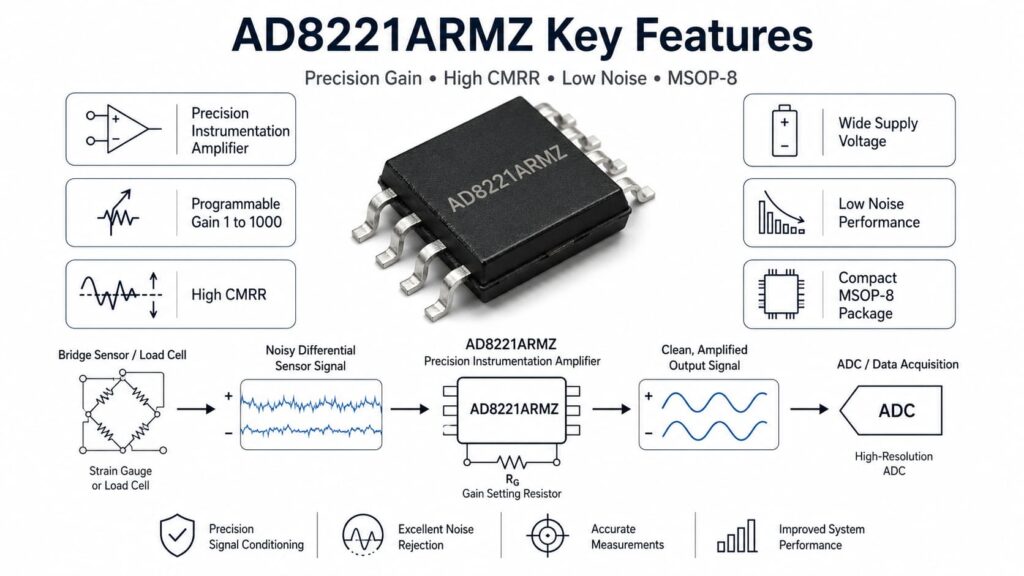
The AD8221ARMZ is built for precision signal amplification. It is suitable for applications where signal accuracy matters more than simple gain. Compared with a basic operational amplifier, an instrumentation amplifier provides better input matching and common-mode rejection.
This is useful when working with sensors that output small differential signals. Examples include bridge sensors, pressure sensors, load cells, and strain gauges.
Programmable Gain from 1 to 1000
The AD8221 gain is set by one external resistor. The gain range is from 1 to 1000. This gives engineers flexibility when one design may need different gain values for different sensor signal levels.
In simple terms, gain controls how much the amplifier increases the input signal. A low-gain setting may be used for larger sensor outputs, while a high-gain setting may be used for very small signals.
When selecting the gain resistor, engineers should check the datasheet formula and resistor tolerance. A low-tolerance resistor can help improve gain accuracy.
High CMRR for Noisy Environments
CMRR means common-mode rejection ratio. It describes how well the amplifier rejects noise that appears on both input lines at the same time.
The AD8221 family is known for strong CMRR performance over frequency. This is important in industrial environments where cables, motors, power systems, and digital circuits may introduce unwanted noise.
For applications such as precision data acquisition or bridge signal conditioning, high CMRR helps maintain measurement stability and reduces the need for heavy filtering.
Wide Supply Voltage Range
The AD8221 can operate from a wide power supply range. This allows it to work in both single-supply and dual-supply systems. Dual-supply operation is common in precision analog designs that need to handle signals above and below ground.
Before choosing AD8221ARMZ, engineers should confirm the expected input signal range, output swing, reference voltage, and ADC input range. The amplifier must have enough supply headroom to process the signal without clipping.
Low Noise Performance
Low noise is important when amplifying small sensor signals. If the amplifier adds too much noise, the final measurement can become unstable or inaccurate.
The AD8221 is suitable for precision signal paths where the input signal may be weak. It can be used before an ADC in data acquisition systems, where clean signal amplification is required before digital conversion.
Compact MSOP-8 Package
The AD8221ARMZ uses an MSOP-8 package. This package is smaller than the SOIC version of the AD8221. It is useful when space is limited or when multiple amplifier channels are placed close together in one design.
For procurement teams, package confirmation is critical. AD8221ARMZ is not the same package as AD8221ARZ or AD8221BRZ. Even if the electrical function is similar, the package footprint is different.
3.AD8221ARMZ Applications
Bridge Signal Conditioning
One of the most common uses of AD8221ARMZ is bridge signal conditioning. Bridge sensors are used in load cells, pressure sensors, torque sensors, and strain gauges.
These sensors often produce very small differential signals. The AD8221ARMZ amplifies the signal while rejecting common-mode noise. This helps the system capture more accurate sensor data.
Precision Data Acquisition Systems
In a data acquisition system, analog signals must be prepared before they enter an ADC. The AD8221ARMZ can amplify low-level signals and help maintain signal quality.
It is suitable for industrial measurement modules, test equipment, and monitoring systems where stable analog input performance is required.
Industrial Process Control
Industrial control systems often measure pressure, force, flow, temperature-related sensor outputs, or other analog signals. These signals may travel through long wires and may be affected by electrical noise.
The AD8221ARMZ can help improve measurement accuracy in these environments by rejecting common-mode interference and providing stable gain.
Medical Instrumentation
Medical devices often require precise analog front-end components. The AD8221 family is used in applications where low-level biological or sensor signals must be measured carefully.
For medical-related use, buyers should confirm all regulatory, traceability, and quality documentation requirements before ordering. Standard commercial parts may not be suitable for all regulated applications without full design and compliance review.
Strain Gauge and Transducer Interfaces
Strain gauges and transducers often produce small signals that must be amplified before processing. The AD8221ARMZ is a practical choice when the design needs precision gain, high input impedance, and good noise rejection.
4.AD8221ARMZ vs Other AD8221 Variants
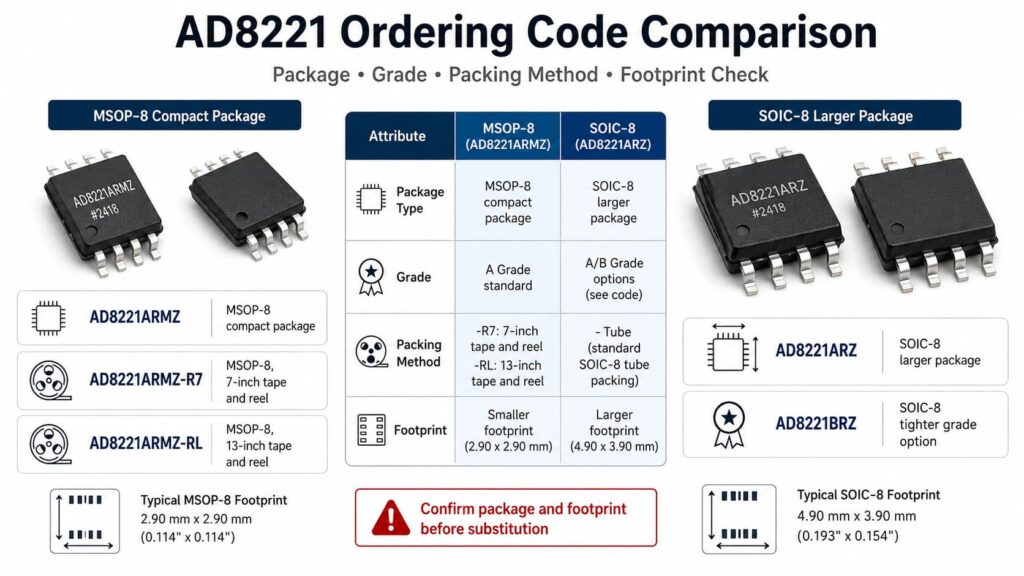
The AD8221 family includes multiple ordering codes. The main differences are usually package type, grade, and packing method.
| Part Number | Package | Key Point |
|---|---|---|
| AD8221ARMZ | MSOP-8 | Compact RoHS-compliant package |
| AD8221ARMZ-R7 | MSOP-8 | 7-inch tape and reel packing |
| AD8221ARMZ-RL | MSOP-8 | 13-inch tape and reel packing |
| AD8221ARZ | SOIC-8 | Larger package option |
| AD8221BRZ | SOIC-8 | Tighter grade option in SOIC package |
For small batch purchasing, tube or cut tape availability may matter. For production purchasing, tape and reel options are usually easier for automated handling and inventory control.
Engineers should not replace AD8221ARMZ with an SOIC version unless the package and footprint are compatible with the design.
5.Key Parameters to Check Before Selection
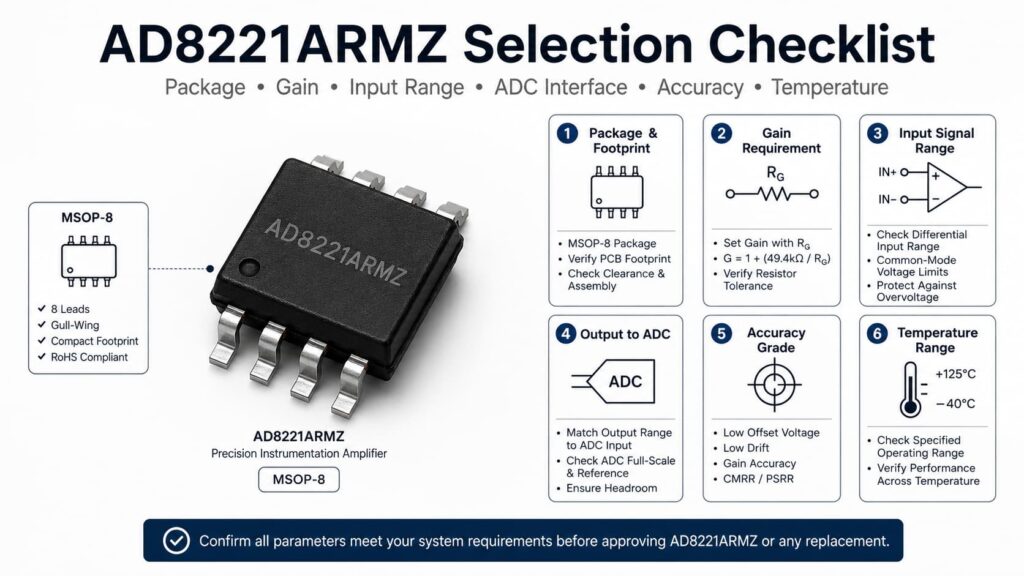
1. Package and Footprint
Confirm that the required part is AD8221ARMZ in MSOP-8. Do not only search for “AD8221,” because different package versions may appear in stock.
2. Gain Requirement
Check the target gain and calculate the correct external gain resistor. Also confirm the resistor tolerance and temperature coefficient, because these can affect measurement accuracy.
3. Input Signal Range
The amplifier must support the expected input common-mode voltage and differential input voltage. A mismatch between signal range and supply voltage can cause output saturation.
4. Output Interface
Many systems connect the amplifier output to an ADC. In this case, engineers should check the ADC input range, reference voltage, sampling rate, and required filtering.
5. Accuracy Grade
AD8221ARMZ is a precision device, but different AD8221 grades have different offset and accuracy specifications. If the design has strict offset requirements, compare the exact grade in the datasheet before approving a replacement.
6. Temperature Range
The AD8221 family is specified for industrial temperature performance. Buyers should still confirm the required operating conditions for the final application, especially for outdoor, industrial, aerospace, or medical equipment.
6.Buying Guide for AD8221ARMZ
Confirm the Exact Manufacturer Part Number
Use the full part number AD8221ARMZ, not only “AD8221.” The suffix defines package and compliance details. For example, AD8221ARMZ and AD8221ARZ are not the same physical package.
Check Datasheet Revision
Always confirm the current AD8221 datasheet before final design approval. Important parameters include gain formula, supply range, input voltage range, CMRR, noise, offset voltage, package outline, and ordering guide.
Review Lifecycle and PCN Status
Before production purchasing, check lifecycle status and PCN records. PCN means Product Change Notification. It informs customers about changes such as manufacturing site, material, process, or packaging updates.
For long-term programs, PCN review helps reduce supply chain risk.
Verify Package Marking and Traceability
Precision analog ICs are sometimes used in high-value equipment, so quality control is important. Buyers should request traceable supply channels, original packaging, date code information, and clear label photos when needed.
Avoid Unverified Substitutes
Instrumentation amplifiers are not always easy to replace. Even if two parts have the same pin count, they may differ in gain equation, offset, CMRR, input range, noise, and stability.
Before approving an alternative, compare:
Pinout
Package footprint
Gain-setting method
Supply voltage range
Input and output voltage range
CMRR
Offset voltage
Noise
Temperature range
Lifecycle status
7.Quality Control Tips for AD8221ARMZ Sourcing
For component sourcing teams, the AD8221ARMZ should be inspected like other precision analog ICs.
Key checks include:
Manufacturer label and part number
Package type: MSOP-8
Lot number and date code
Moisture sensitivity information
RoHS status
Packaging condition
Datasheet and ordering code match
Supplier traceability
For sensitive industrial or medical projects, additional inspection may include X-ray inspection, electrical sampling, or third-party testing.
8.Conclusion
The AD8221ARMZ is a compact precision instrumentation amplifier for low-level analog signal conditioning. It is suitable for bridge sensors, strain gauges, industrial control, precision data acquisition, and medical instrumentation.
For engineers, the most important selection points are gain setting, CMRR, noise, input range, output interface, and package compatibility. For buyers and BOM managers, the key points are exact part number confirmation, original sourcing, lifecycle review, PCN tracking, and quality inspection.
When sourcing AD8221ARMZ, do not treat all AD8221 variants as the same. Confirm the package, grade, packing option, datasheet parameters, and supply chain documentation before purchase.