
Table of Contents
STM32F103 Explained: Features, Applications, and Replacement Options
Introduction
The STM32F103 has long been a cornerstone of industrial and commercial hardware design, but recent supply chain volatility has forced engineering teams to rethink their sourcing strategies. For years, this highly popular embedded systems MCU has been the go-to choice for countless projects, offering a proven balance of performance, cost, and ease of use. However, as the global market changes, understanding its core specifications, best use cases, and how to navigate supply chain hurdles has never been more important. In this article, we will cover everything you need to know about the STM32F103, including its technical specs, common uses, and the best sourcing alternatives available today.
1.What is the STM32F103 Microcontroller?
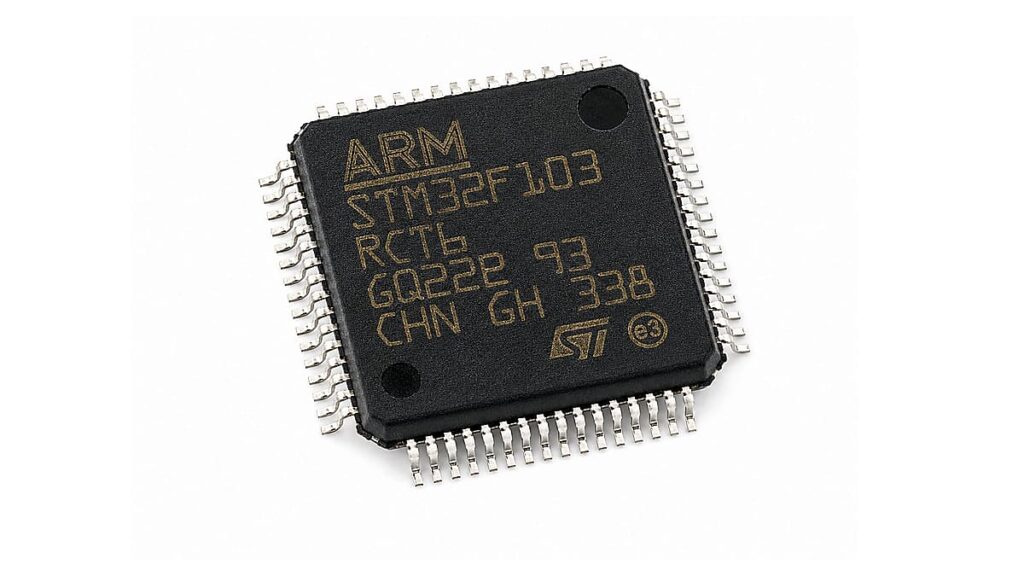
The STM32F103 microcontroller is a mainstream [32-bit microcontroller] STMicroelectronics. At its heart, it is an ARM Cortex-M3 microcontroller, designed to offer high performance while keeping power consumption low. This family of microcontrollers operates at a 72 MHz frequency, providing enough processing power to handle demanding tasks without draining the power budget.
One of the most famous variants in this family is the STM32F103C8T6. If you have ever worked with the popular “Blue Pill” development board, you have used the STM32F103C8T6. This specific chip brought 32-bit processing power to the masses, allowing engineers and developers to move away from older 8-bit architectures. By offering a robust set of peripherals and a powerful ARM core, the STM32F103 quickly became a standard building block in the world of modern electronics.
2.Key STM32F103 Features and Specifications
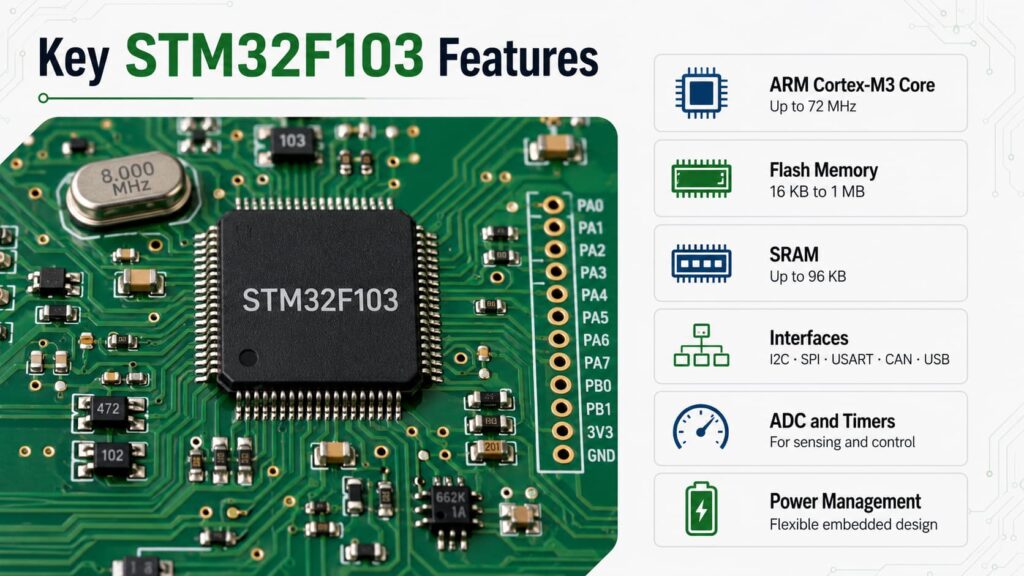
To understand why this chip is so popular, we need to look at the core STM32F103 features. As a versatile 32-bit microcontroller, it packs a wide array of specifications that make it suitable for almost any medium-complexity project.
First, the processing speed is a major highlight. The ARM Cortex-M3 core runs at a maximum clock speed of 72 MHz. This allows for fast data processing and quick response times in real-time applications.
Memory is another strong point. Depending on the specific model, the STM32F103 offers between 16 KB and 1 MB of Flash memory, giving you plenty of space to store your application code. It also includes up to 96 KB of SRAM, which provides ample room for variables and data manipulation during runtime.
What truly makes this embedded systems MCU shine, however, is its rich set of peripheral interfaces. The chip includes:
I2C and SPI: Essential for communicating with sensors, displays, and other external chips.
USART: Perfect for serial communication and debugging.
CAN (Controller Area Network): A must-have for automotive and industrial applications where reliable communication is critical.
USB 2.0 Full-Speed: Allows the device to easily connect to computers and other USB hosts.
Additionally, it features multiple timers, highly accurate Analog-to-Digital Converters (ADCs), and a flexible power management system. These features combine to make the STM32F103 a true workhorse for engineers.
3.Common STM32F103 Applications
Because of its impressive balance of speed, memory, and connectivity, STM32F103 applications span across multiple industries. Engineers rely on this chip to power a wide variety of devices.
Industrial Automation: In factory settings, reliability is key. The STM32F103 is frequently used in Programmable Logic Controllers (PLCs), motor drives, and sensor hubs. Its built-in CAN bus makes it easy to network multiple machines together on a factory floor.
Commercial and Industrial Equipment: You can find this microcontroller in many commercial systems. It is frequently used in HVAC control boards, 3-axis CNC controllers, and automated test equipment. The high processing speed ensures smooth system operation and fast response times.
Motor Control: Controlling motors requires precise timing and fast calculations. The advanced timers and fast ADCs on the STM32F103 make it an excellent choice for controlling stepper motors, servo motors, and brushless DC (BLDC) motors in automated guided vehicles (AGVs) and industrial robotics.
IoT Devices: The Internet of Things relies on smart, connected devices. While the STM32F103 does not have built-in Wi-Fi or Bluetooth, its numerous communication interfaces (like SPI and UART) make it incredibly easy to connect to wireless modules, acting as the main brain for IoT gateways and smart sensors.
4.The Challenge of STM32 Sourcing
Despite its incredible popularity, STM32 sourcing has become a significant headache for many engineering and procurement teams in recent years. The global electronics supply chain has faced severe disruptions, leading to long lead times, unpredictable inventory levels, and sharp price fluctuations.
When a critical component like the STM32F103 microcontroller goes out of stock, it can bring an entire production line to a halt. Engineers who designed their boards around this specific chip often find themselves stuck waiting months for new stock to arrive. Because of these ongoing supply chain challenges, relying on a single source for your embedded systems MCU is no longer a safe strategy. This has driven a massive industry shift toward finding a reliable STM32F103 replacement to keep production moving smoothly.
5.Top STM32F103 Alternatives and Replacements
If you are struggling to find stock or want to reduce costs, there are several excellent STM32F103 alternatives on the market. Many manufacturers have created microcontrollers that are designed to be highly compatible with the STM32 family.
I.GigaDevice GD32F103:
This is perhaps the most well-known STM32F103 replacement. The GD32F103 is designed to be pin-to-pin compatible with the STM32F103. In many cases, it is a true drop-in replacement. It also boasts a faster clock speed (up to 108 MHz) and zero-wait state flash access. Because the original STM32 requires wait states when operating at its maximum 72 MHz, the GD32’s zero-wait state architecture provides a tangible performance boost, allowing it to outperform the original ST chip in certain applications.
II. Artery AT32F403A
Artery offers a very powerful alternative. While it is based on the newer Cortex-M4 core, it maintains high compatibility with the STM32F103 series. It offers much higher clock speeds (up to 240 MHz) and more memory, making it a great upgrade path if your project needs more processing power but you want to keep a similar hardware footprint.
III. ApexMic APM32F103
Another strong contender, the APM32F103 offers excellent pin-to-pin and software compatibility. It is designed to match the electrical characteristics of the STM32F103 very closely, making the transition process as smooth as possible for hardware engineers.
6.Conclusion
The STM32F103 remains a legendary 32-bit microcontroller for good reason. Its blend of performance, memory, and versatile peripherals makes it a top choice for everything from industrial motor control to smart consumer devices. However, in today’s unpredictable market, smart procurement means having a backup plan. Exploring STM32F103 alternatives like the GD32F103 or APM32F103 can protect your production line from costly delays.
If you are facing STM32 sourcing challenges or need help finding the perfect embedded systems MCU for your next project, we are here to help. Contact Us for STM32 Alternatives today for real-time inventory checks, competitive quotes, and expert guidance on finding the right drop-in replacements.