
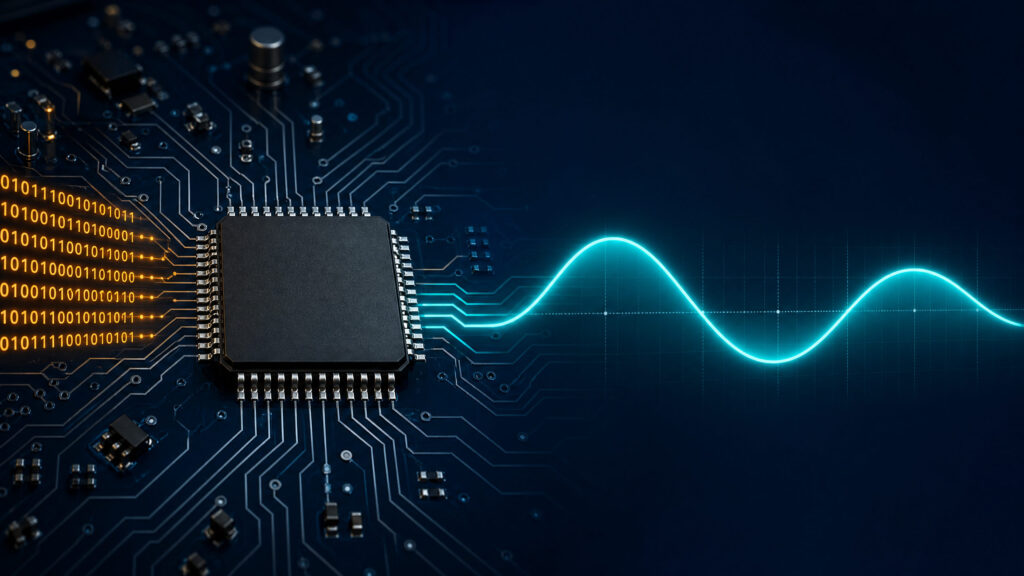
A digital to analog converter, usually shortened to DAC, is an electronic device that changes digital code into an analog voltage or current. In a control board, test instrument, MCU design, or industrial module, the DAC lets a digital controller create a real analog output instead of only sending logic high and logic low signals.
For component buyers, the important point is simple: a DAC is not just an audio accessory. A DAC IC may define a programmable voltage setpoint, waveform output, bias level, calibration signal, or current-loop command. If your design needs a stable analog output, start by reviewing digital-to-analog converter ICs by resolution, output type, interface, settling time, reference requirements, package, lifecycle status, and approved manufacturer list.
This guide explains what a DAC does, how a DAC converter turns digital codes into analog output, how DACs differ from ADCs, and what procurement teams should verify before adding a DAC IC to a BOM.
| Question | Practical Answer |
|---|---|
| What does DAC stand for? | Digital-to-analog converter |
| What does a DAC convert? | Digital code into analog voltage or current |
| Is a DAC the same as an ADC? | No. A DAC converts digital to analog; an ADC converts analog to digital |
| Is every DAC an audio adapter? | No. DAC ICs are widely used in embedded, industrial, control, instrumentation, and communication systems |
| What must buyers verify? | Exact part number, resolution, output range, interface, package, lifecycle, compliance, stock, price, lead time, and alternatives |
What Is a Digital-to-Analog Converter?
A digital-to-analog converter is a data converter that accepts a digital input word and produces a related analog output. That output may be a voltage, a current, or a signal that requires an external amplifier, filter, or current-to-voltage stage depending on the DAC architecture.
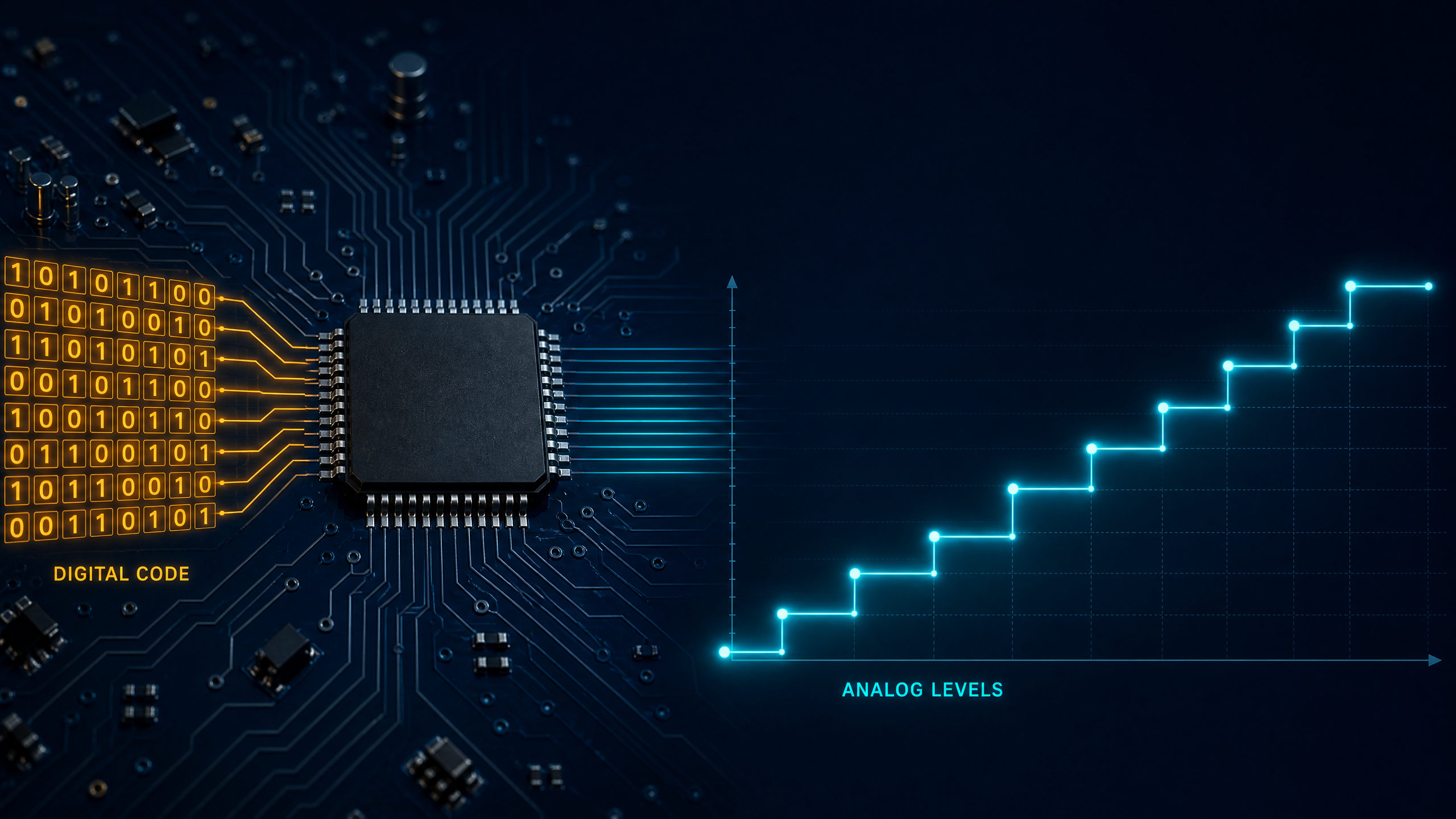
In simple terms, a processor writes a number to the DAC. The DAC maps that number to one of many possible output levels. More resolution means more available levels. For example, a 10-bit DAC has 210 = 1,024 possible code levels between its minimum and maximum output range. A 12-bit DAC has 4,096 code levels, and a 16-bit DAC has 65,536 code levels.
For an ideal voltage-output DAC, the transfer function is:
Vout = (D / 2^N) × Vref

D    = digital input code (0 to 2^N − 1)
N    = number of bits
Vref = reference voltageThat does not mean a higher-bit DAC is automatically the right part. Buyers and engineers also need to check accuracy, output range, voltage reference, settling time, noise, monotonicity, channel count, interface, power, package, and operating temperature. Those technical details should be taken from the selected datasheet or manufacturer product page; commercial items such as stock, price, lead time, date-code limits, and compliance documents must be confirmed for the exact orderable part during RFQ.
How a DAC Converts Digital Codes Into Analog Voltage or Current
A DAC works by connecting a digital input code to an internal analog network. The exact network depends on the DAC type. Common architectures include resistor-string DACs, thermometer-coded DACs, binary-weighted DACs, R-2R ladder DACs, segmented DACs, and current-steering DACs. Buyers do not always need to choose by architecture first, but architecture affects speed, glitch behavior, linearity, output type, die size, and cost.
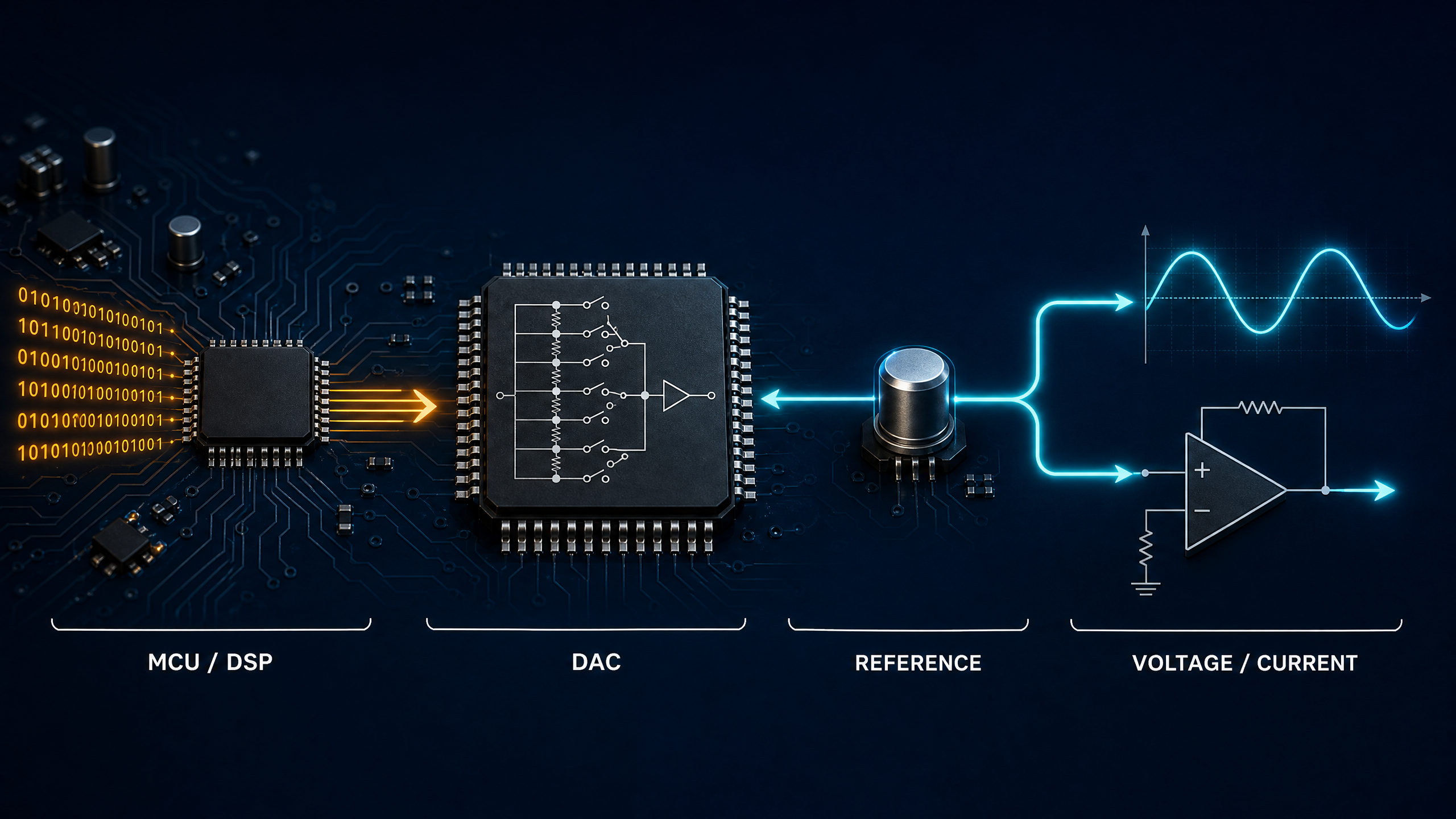
The basic transfer idea looks like this:
Digital code from MCU / DSP / FPGA
 -> DAC register and switching network
 -> reference-scaled analog level
 -> output buffer, current output, or external signal chain
For a voltage-output DAC, the digital code often represents a fraction of a reference voltage. If the reference is 2.5 V, a mid-scale code may produce an output near the middle of the configured range, subject to offset, gain error, linearity error, and output-buffer limits. For a current-output DAC, the output current may need an op amp or load network to become a usable voltage.
This is why a DAC IC cannot be selected from bit count alone. The digital interface may be I2C, SPI, parallel, or another protocol. The analog output may be rail-to-rail, buffered, unbuffered, unipolar, bipolar with support circuitry, voltage-output, or current-output. Settling time tells you how long the output takes to reach its final value after a code change. Reference quality affects output accuracy because the DAC output is tied to the reference.
For the related decision article, see when you need an external DAC IC.
DAC vs ADC: Opposite Conversion Directions
A DAC and an ADC are both data converters, but they work in opposite directions.
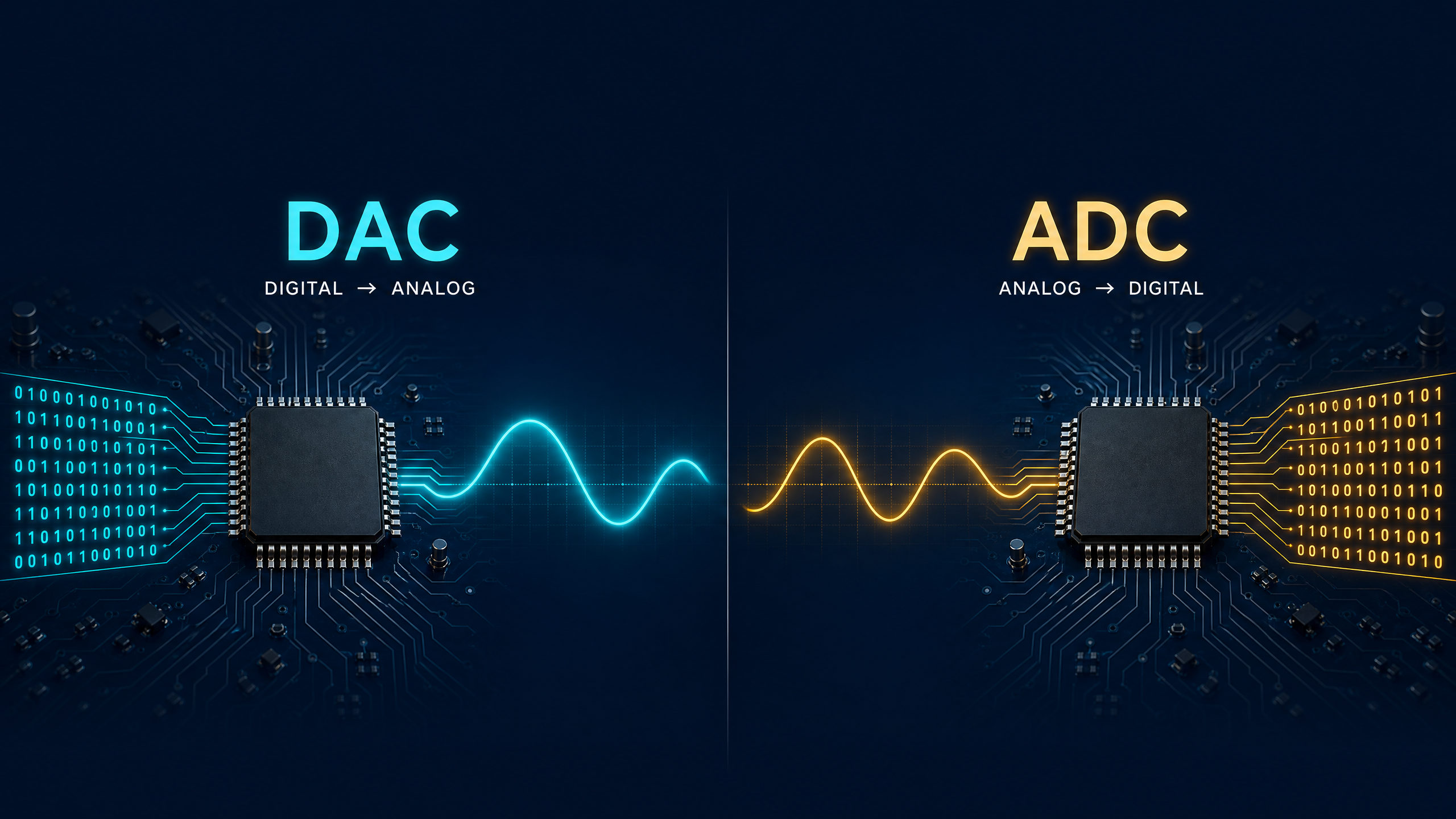
| Converter | Full Name | Input | Output | Main System Role |
|---|---|---|---|---|
| DAC | Digital-to-analog converter | Digital code | Analog voltage or current | Generate or control an analog output |
| ADC | Analog-to-digital converter | Analog voltage or current-derived signal | Digital code | Measure an analog input |
Use a DAC when firmware or digital logic must create an analog level. Use an ADC when the system must read an analog signal and turn it into data. A sensor measurement chain usually needs an ADC. A programmable voltage output, waveform generator, bias control node, or analog control output may need a DAC.
Analog signal -> ADC -> Digital code
Digital code  -> DAC -> Analog signal
If you are comparing both converter directions for a mixed-signal project, also see the analog-to-digital converter sourcing guide.
DAC ICs vs Consumer Audio DAC Adapters
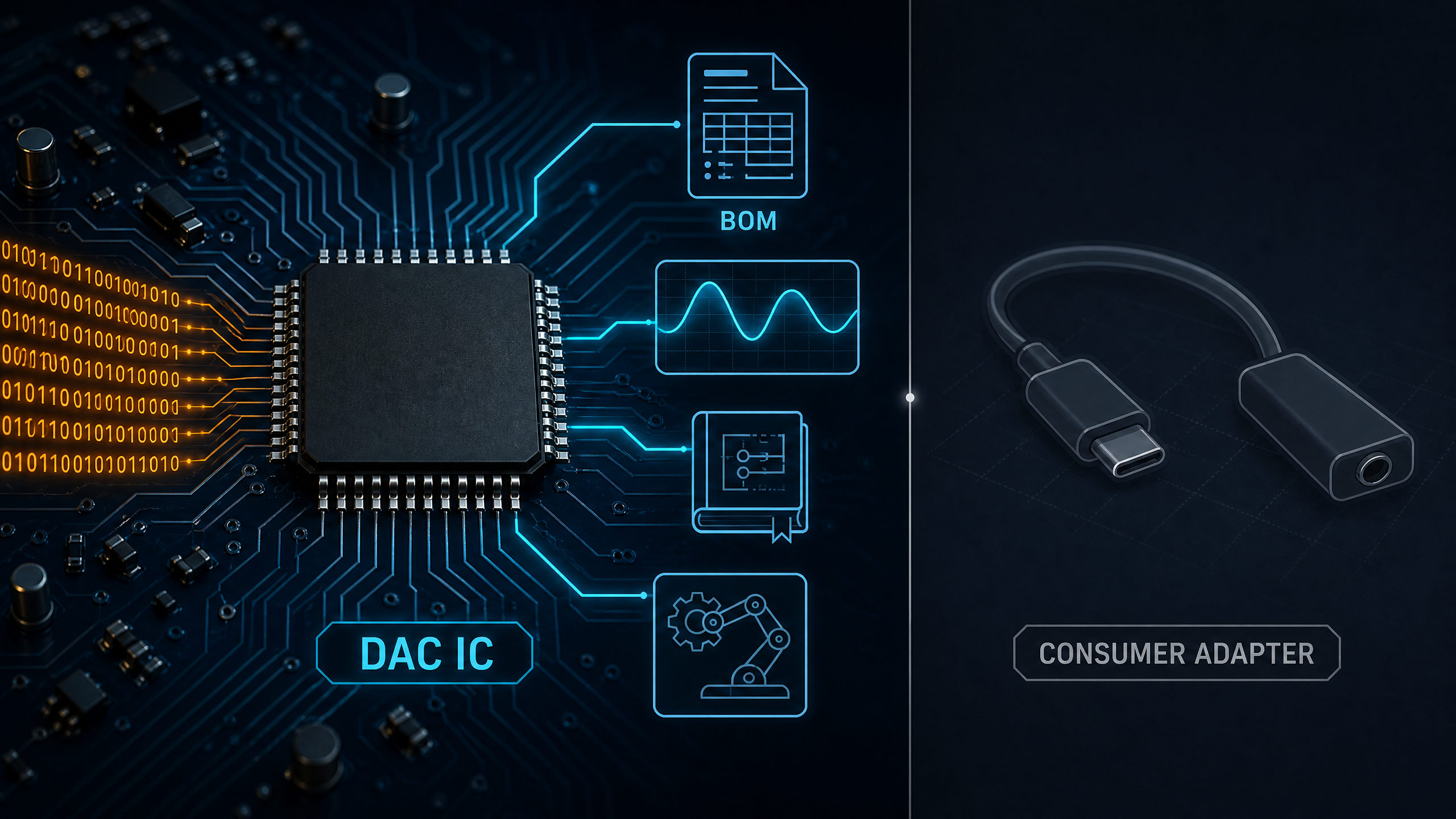
Search results for “dac converter” often mix two very different markets:
| Topic | Component-Buyer Meaning | Consumer-Audio Meaning |
|---|---|---|
| DAC IC | Semiconductor device used inside a circuit or product | Usually hidden inside an audio product |
| DAC adapter | Not covered as a BOM component in this catalog | Finished USB, optical, RCA, headphone, or speaker accessory |
| Selection criteria | Resolution, output type, reference, interface, package, lifecycle, supply chain | Audio format support, connector type, headphone power, brand preference |
| Procurement action | Compare part numbers and submit a BOM for review | Buy a retail accessory |
This article focuses on DAC ICs and engineering sourcing. It does not cover USB DACs, headphone DACs, DAPs, speakers, optical-to-RCA adapters, or retail audio DAC upgrades, which are finished consumer accessories rather than electronic components.
For engineering decisions, the better question is not “Which audio DAC sounds best?” The better question is: “Does this circuit need a DAC IC, and what electrical and sourcing requirements must the selected part meet?” See when you need a DAC IC for the external-DAC decision path.
Common DAC Applications in Industrial and Embedded Systems
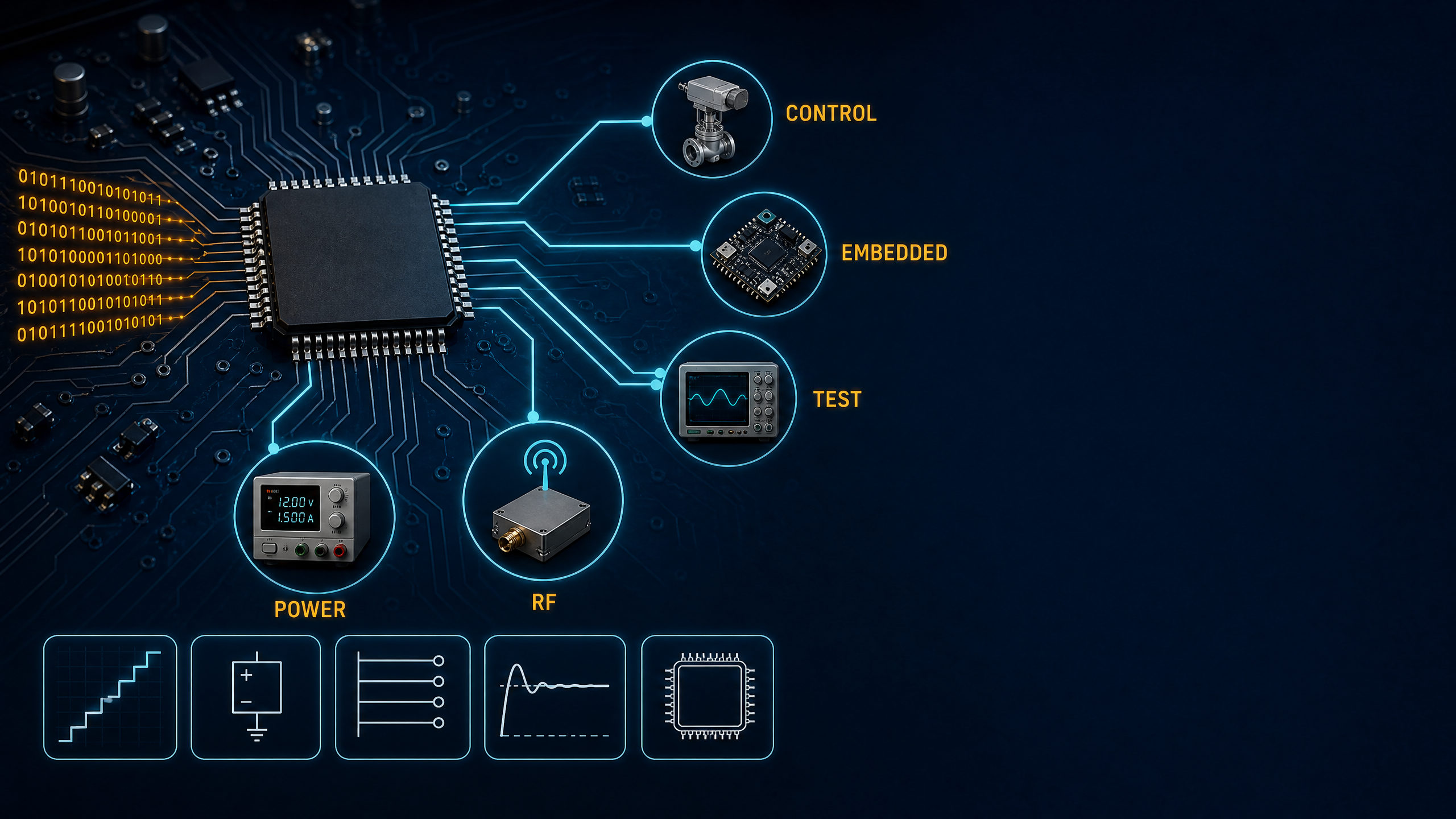
DACs appear anywhere a digital system must generate a controlled analog value. Common DAC applications include:
| Application Area | What the DAC Does | Buyer Notes |
|---|---|---|
| Industrial control | Produces analog setpoints for control loops, actuators, and process equipment | Confirm output range, isolation needs, temperature grade, package, and compliance |
| Embedded systems | Adds analog output to an MCU, FPGA, or processor board | Confirm interface, logic level, channel count, package, and reference design |
| Test and measurement | Generates stimulus signals, calibration levels, and programmable references | Confirm resolution, settling time, noise, linearity, and long-term availability |
| Power supplies | Sets programmable voltage or current targets | Confirm output accuracy, reference, drift, and fault behavior |
| Communication and RF support | Controls bias, tuning voltage, gain, or waveform-related nodes | Confirm update rate, glitch energy, settling, and layout guidance |
For the full DAC product range, browse the digital-to-analog converter IC category. For a procurement-oriented decision path, see when you need a DAC IC.
Key DAC Specifications Buyers Should Not Skip
| Specification | Why It Matters |
|---|---|
| Resolution | Defines the number of code steps, but not total accuracy by itself |
| Output type | Voltage-output and current-output DACs require different support circuits |
| Reference voltage | Strongly affects output range and accuracy |
| INL and DNL | Describe linearity errors between ideal and actual code behavior |
| Settling time | Determines how fast the analog output becomes valid after an update |
| Interface | I2C, SPI, parallel, or another interface must match the controller and firmware plan |
| Lifecycle | Active, NRND, EOL, and obsolete status must be verified before volume use |
Do not treat a product listing, short description, or distributor title as enough evidence for final selection. For a production BOM, confirm the manufacturer datasheet, ordering code, package, temperature grade, RoHS/REACH status, lifecycle status, and approved alternatives.
Sourcing Notes for DAC IC Buyers
When a BOM includes a DAC converter, procurement should collect more than the base part number. The RFQ should include manufacturer, full ordering code, package, grade, quantity, target delivery date, approved alternatives, and any compliance requirements.
Sourcing answer: Stock, price, lead time, date-code limits, region, packaging method, and compliance documents are order-specific sourcing data. Do not publish them as fixed technical facts. For a production quote, send the full manufacturer part number, package suffix, quantity, target delivery date, required date code, RoHS/REACH or automotive requirement, and approved alternates so the supplier can confirm current availability and terms.
Use the inquiry form when you have multiple DAC, ADC, op amp, reference, MCU, and passive line items that must be checked together.
Common Mistakes When Selecting a DAC
Mistake 1: Assuming Every DAC Search Is About Audio
Many searchers use “DAC” for consumer audio products, but engineering DAC IC selection is different. A BOM buyer should focus on electrical function, package, lifecycle, supply chain, and fit with the system design.
Mistake 2: Choosing Only by Bit Count
A 16-bit DAC is not automatically better for a given circuit than a 12-bit DAC. Output range, reference, linearity, noise, settling time, and system error budget may matter more than nominal resolution.
Mistake 3: Ignoring the Reference
The DAC output is usually tied to a voltage reference or reference input. A poor reference can limit accuracy even when the DAC has high resolution.
Mistake 4: Treating Similar DACs as Interchangeable
Two DAC ICs may share resolution and interface but differ in pinout, package, reference behavior, output stage, timing, power-up state, temperature grade, and compliance. Do not assume interchangeability from resolution or interface alone. Compare the exact datasheets for pinout, package drawing, supply rails, output type, reference input, code format, timing, power-up state, temperature grade, compliance, and software/register behavior; then approve the alternate only after board-level validation.
Related DAC Guides
FAQ
What is a digital-to-analog converter?
A digital-to-analog converter is an IC or circuit that converts digital code into an analog voltage or current. It lets a microcontroller, DSP, FPGA, or processor create a controlled analog output.
What is a DAC used for?
A DAC is used for analog setpoints, waveform generation, bias control, calibration signals, programmable references, industrial control outputs, audio output stages, and embedded-system analog expansion. In a sourcing context, the exact DAC IC depends on resolution, output type, interface, package, lifecycle, and availability.
Do you really need a DAC?
You need a DAC when the circuit requires a real analog output controlled by digital logic. You may not need an external DAC if PWM filtering, a built-in MCU DAC, a digital interface, or a simple logic output is accurate and stable enough for the design. See do you need a DAC IC for the detailed decision path.
Is a DAC the same as an ADC?
No. A DAC converts digital data to analog output. An ADC converts analog input to digital data. They are opposite conversion directions and are not interchangeable without full review.
Is a DAC converter only for sound?
No. Audio is only one use case. DAC ICs are also used in industrial control, instrumentation, programmable power, signal generation, calibration, embedded systems, and communication support circuits.
What should buyers check before sourcing DAC ICs?
Check the exact manufacturer part number and suffix, package, resolution, interface, output type, reference requirements, operating temperature, compliance status, lifecycle, stock, price, lead time, date-code requirement, and approved alternatives. Datasheet parameters should be backed by the manufacturer document; stock, price, lead time, and compliance files should be confirmed from a current RFQ for the requested quantity and delivery date.
Need Help Sourcing a DAC IC for Your BOM?
Send the part number, required resolution, output type, interface, reference voltage, package, quantity, and target application. We can help check availability and identify suitable alternative candidates subject to datasheet verification.
References and Further Reading
- Texas Instruments — Digital-to-Analog Converters (DACs) Portfolio Overview
- Texas Instruments — TI Precision Labs: Data Converters Video Series
- Microchip — MCP4725 Product Information
- Microchip — MCP4725 12-Bit Digital-to-Analog Converter with EEPROM Memory Datasheet
Technical note: ideal equations and examples in this guide explain the conversion principle. Production designs and BOM decisions should use the electrical characteristics, timing diagrams, transfer-function definitions, and layout recommendations in the exact DAC datasheet.