
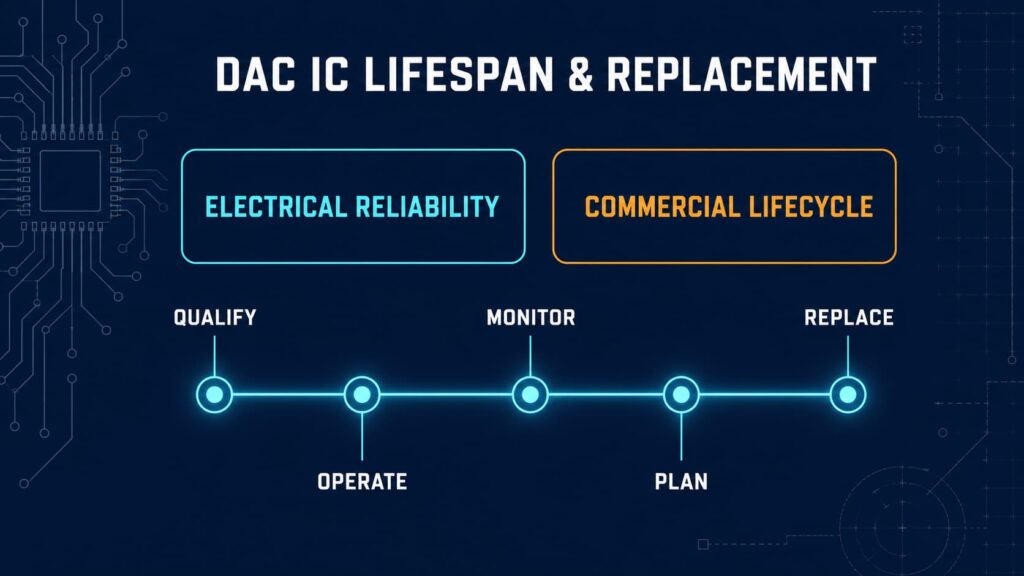
The lifespan of a DAC IC is not one fixed number. For a component buyer, dac lifespan means two different risks: how long the IC can operate electrically in the design, and how long the manufacturer and supply chain will continue supporting that part number. A DAC can still meet its electrical requirements while becoming hard to source, NRND, obsolete, or exposed to last-time-buy pressure.
For current and legacy projects, start by identifying the exact DAC part number, package, suffix, temperature grade, and lifecycle status. If the project still needs open-market sourcing, alternate qualification, or multi-line BOM review, browse ApexComponent's digital-to-analog converter ICs early instead of waiting until a production shortage appears.
Technical sources and current manufacturer lifecycle pages verified: September 1, 2026.
Quick Take: DAC Lifespan for Buyers and Engineers
| Question | Practical answer |
|---|---|
| Does a DAC IC have a fixed lifespan? | Not as a universal number. Lifetime depends on stress, temperature, voltage, ESD handling, package, assembly, and system duty cycle. |
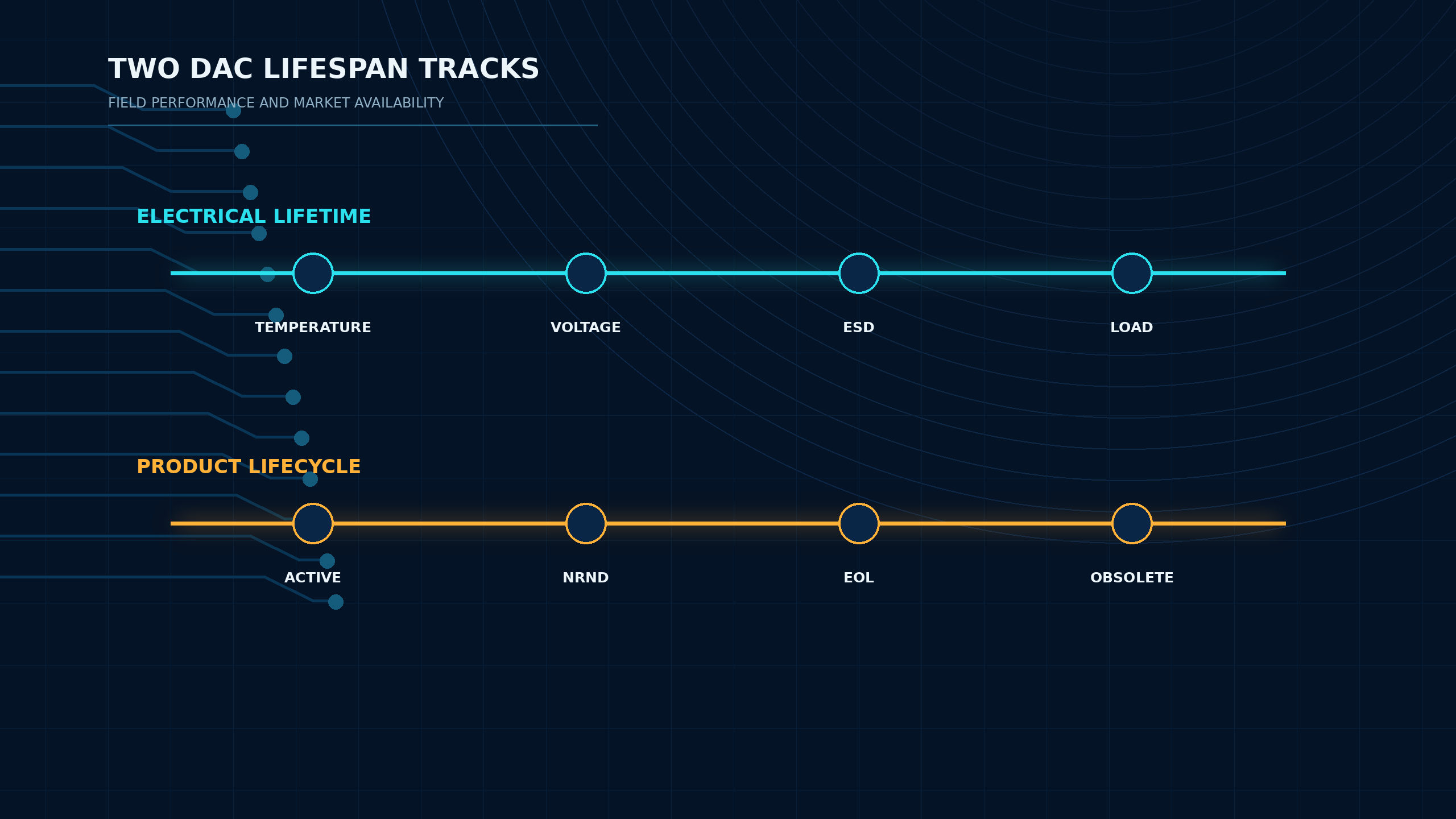
| Is electrical lifetime the same as product lifecycle? | No. Electrical lifetime is field reliability in the circuit. Product lifecycle is whether the part is Active, NRND, EOL, obsolete, or in last-time-buy. |
| Can an obsolete DAC still work? | Yes, but procurement risk, counterfeit risk, redesign risk, and documentation gaps usually increase. |
| Can DAC0800 or DAC0808 be replaced directly? | Do not treat DAC0800 and DAC0808 as automatic drop-in replacements for each other. Both are legacy 8-bit current-output DAC families, but a replacement must be checked by datasheet, pinout, package, supply rails, output architecture, reference current, timing, accuracy, and system testing. TI lists DAC0808 as a direct replacement for MC1508/MC1408, not as a blanket replacement for every DAC0800 design. |
| What should buyers do first? | Send the exact legacy part numbers, suffixes, target quantity, approved manufacturers, and BOM context for sourcing review. |
1. What Is the Lifespan of a DAC IC?
A digital-to-analog converter IC converts digital code into an analog voltage or current. In real equipment, its usable lifespan is determined by two parallel tracks: electrical and environmental lifetime, and commercial product lifecycle.
That distinction matters because a purchasing team may ask, "How long will this DAC last?" while the engineering team hears, "How many field years can it survive?" and the sourcing team hears, "Can we still buy this MPN next year?" A complete DAC lifecycle review should answer all three.
For new designs, lifespan planning starts during selection. Resolution, output type, reference requirements, supply rails, package, temperature grade, and interface all affect replacement flexibility later. For a structured selection view, see the related guide on how to choose a good DAC IC.
2. Electrical Lifetime vs Product Lifecycle
Electrical lifetime describes the probability that the IC continues operating within specification over time. Manufacturers typically qualify and monitor semiconductor reliability through stress testing, failure-rate modeling, process controls, and product qualification systems. These methods can help estimate risk, but they do not remove the need to validate the DAC in the final circuit.
Product lifecycle is different. A part can be electrically reliable but commercially risky. Texas Instruments' product lifecycle policy distinguishes Preview, Active, NRND, Last Time Buy, and Obsolete status.
| Lifecycle term | Meaning for sourcing |
|---|---|
| Active | The manufacturer currently supports the part, but buyers still need to confirm package, suffix, stock, price, and lead time. |
| NRND | Not recommended for new designs. Existing builds may continue, but future redesign planning should start. |
| EOL / Discontinued | Manufacturer support is ending or ended. Last-time-buy, bridge inventory, or replacement qualification may be needed. |
| Obsolete | Standard authorized supply may be limited or unavailable. Extra authentication and engineering review are usually required. |
| Last-time-buy | A defined final purchase window may exist. Buyers must estimate lifetime demand, repair demand, and redesign timing. |
TI describes lifecycle status as a way to communicate whether products are recommended for new designs, available for purchase, or moving toward discontinuance. The exact meaning and purchasing options must be checked on the manufacturer page and with the seller at the time of purchase because lifecycle and ordering data can change.
3. Temperature, Voltage Stress, ESD, Package, and Operating Conditions
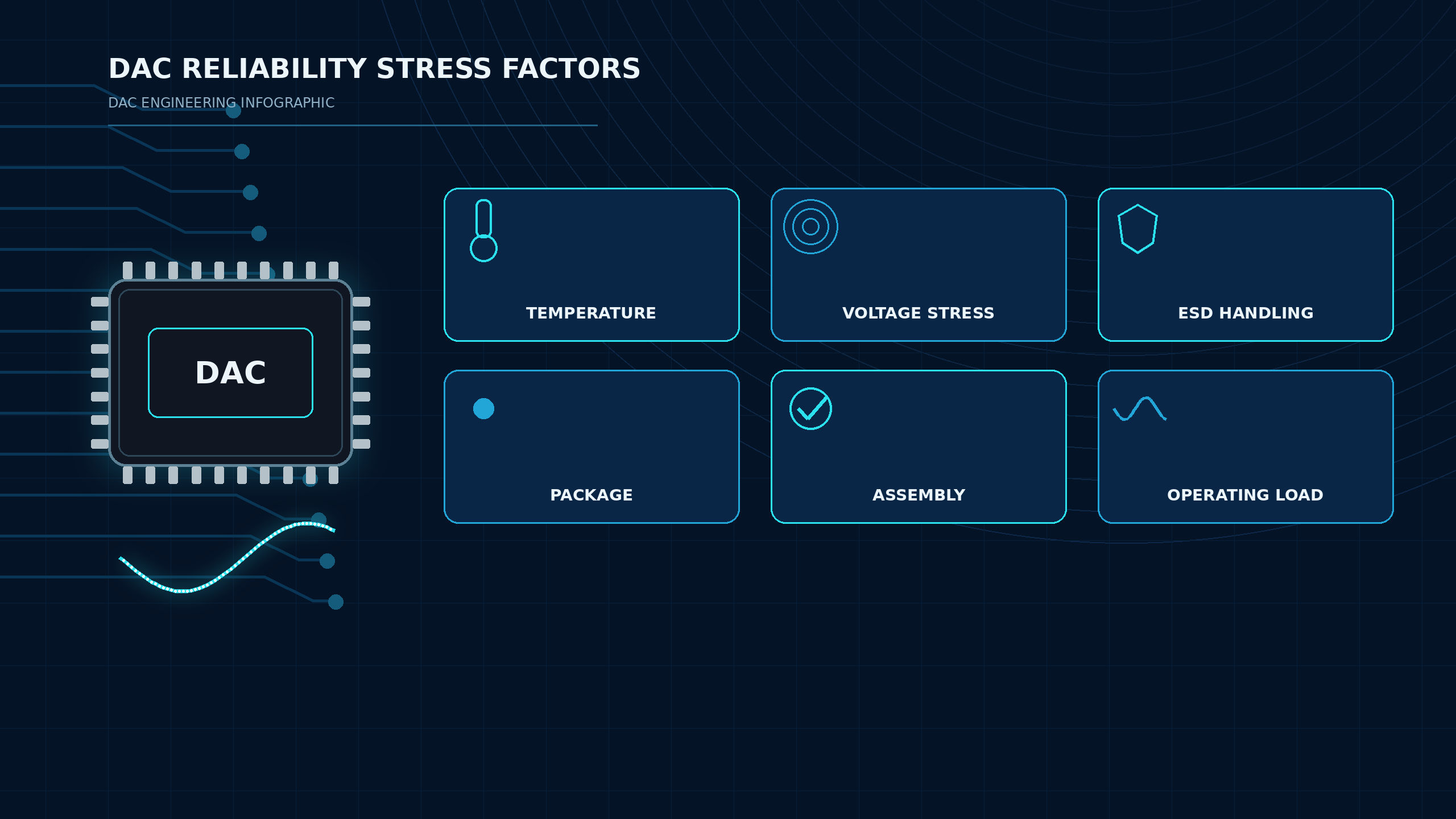
DAC IC reliability is strongly affected by how the device is used. A design that runs near absolute maximum ratings, sees frequent ESD events, or places the package in a hot enclosure has a different risk profile from a lightly loaded laboratory instrument.
Temperature is one of the most important lifetime factors. Higher junction temperature generally accelerates many semiconductor failure mechanisms. For procurement planning, this means an "industrial temperature" line item in a BOM is not enough; the design should also consider board temperature, enclosure airflow, power dissipation, nearby heat sources, and derating.
Voltage stress matters because DACs often connect to references, output amplifiers, analog rails, digital interfaces, and sometimes mixed-voltage systems. A replacement DAC must tolerate the same supply rails, logic levels, reference range, output compliance, and transient conditions. Absolute maximum ratings are not normal operating limits.
ESD and handling can create immediate or latent damage. For buyers, this turns into practical requirements: anti-static packaging, traceable handling, approved receiving inspection, and caution with parts from unknown channels.
Package and assembly also affect lifespan. Thermal resistance, moisture sensitivity, solder process, lead finish, board layout, mechanical stress, and rework history can all change field reliability. If a legacy DAC is available only in a different package, the risk is not just mechanical fit; the replacement may also change thermal behavior, layout parasitics, assembly process, and inspection criteria.
Operating conditions determine whether datasheet specifications are meaningful in the final system. Output load, reference noise, grounding, filtering, settling-time requirement, digital feedthrough, and layout can all affect the analog result. For performance-focused designs, read the related article on DAC specs that affect signal quality before approving a replacement.
4. Active, NRND, Obsolete, and Last-Time-Buy Risks
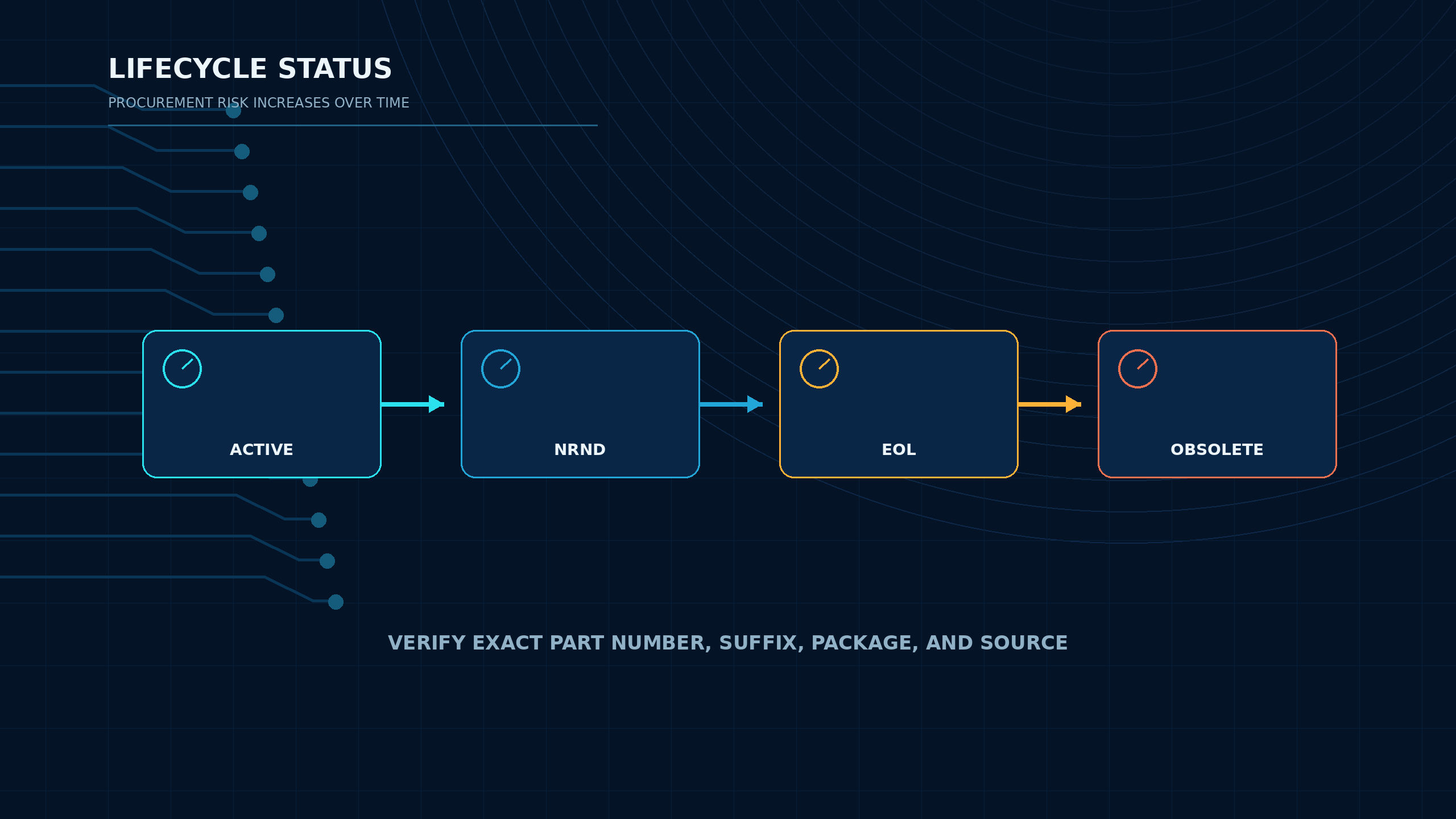
A lifecycle label is a purchasing signal, not a complete sourcing decision. The real question is what that status means for the project timeline.
For an Active DAC, buyers should still verify the full orderable part number. Many DAC families include multiple package, temperature, grade, and tape-and-reel options. The base family may be active while a specific suffix has limited availability. Stock, price, lead time, certifications, and package availability must be checked for the exact orderable suffix, requested quantity, date code, supplier channel, quote date, and delivery date because a family can be active while one package or grade is constrained.
For an NRND DAC, the part may still be purchaseable, but the project should avoid locking a new board to a component that the manufacturer does not recommend for new designs. For an obsolete DAC, procurement should confirm whether the need is production, repair, field service, or redesign bridge stock.
For a last-time-buy, the biggest mistake is guessing lifetime demand without repair and service assumptions. TI's product change notification policy explains that discontinuance notices identify affected products, last-order dates, final-delivery dates, and replacements when applicable. A buyer should estimate remaining production volume, expected scrap, field repair demand, shelf-life constraints, customer commitments, and redesign schedule before committing to a final buy.
5. DAC0800 and DAC0808 Sourcing Notes
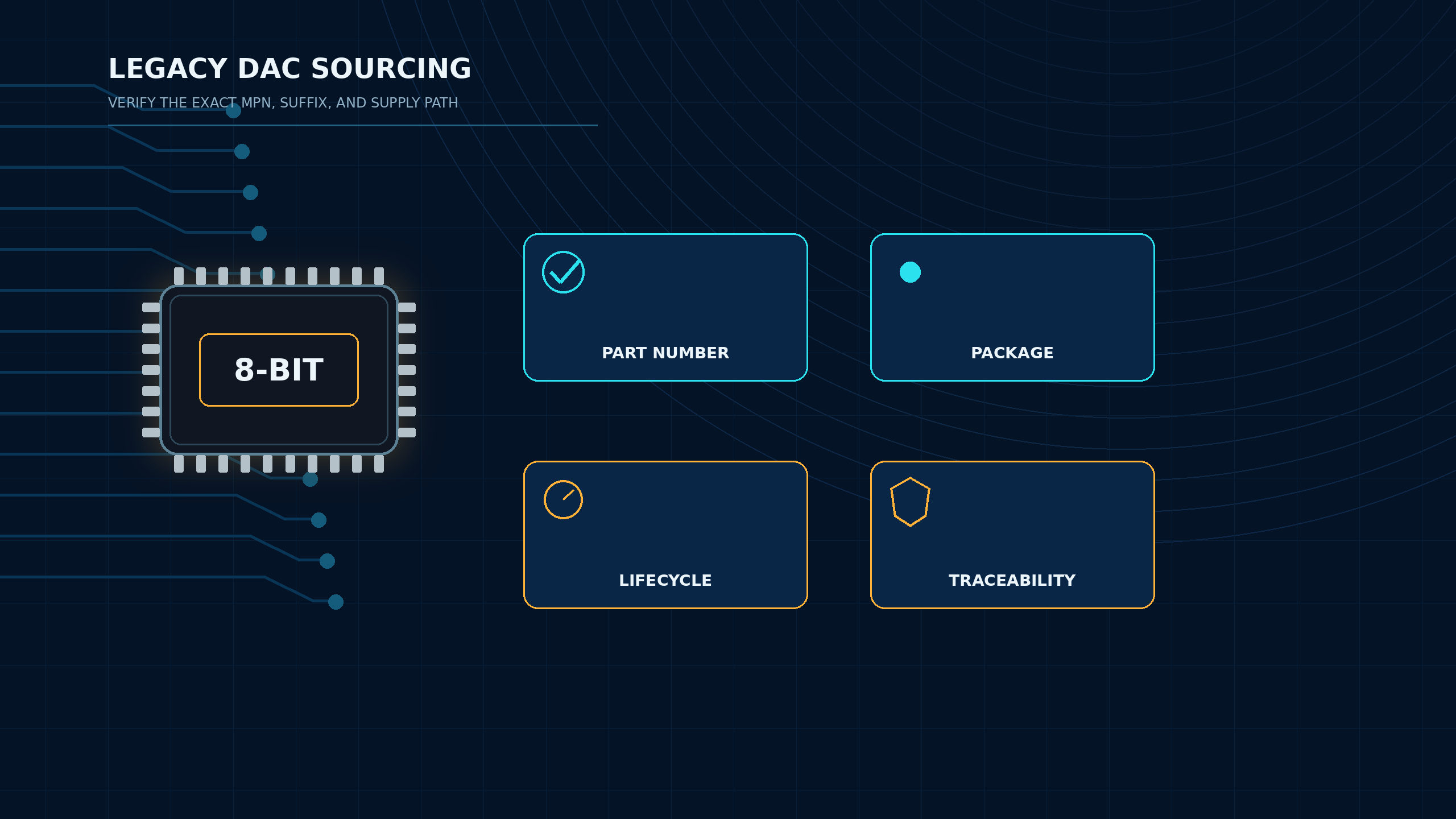
DAC0800 and DAC0808 are useful examples because they are widely recognized legacy-style 8-bit DAC part numbers, and buyers may still see them in maintenance BOMs, education equipment, older industrial boards, and analog control circuits.
TI's DAC0800 product page identifies the device as an 8-bit multiplying digital-to-analog converter, and TI's DAC0808 product page identifies DAC0808 as an 8-bit digital-to-analog converter. On September 1, 2026, both TI pages displayed GPN: ACTIVE. That observation does not confirm ApexComponent inventory, delivery, price, certification, or the status of every suffix or package option.
| Part number | Source-backed note | What remains unconfirmed |
|---|---|---|
| DAC0800 | TI describes the DAC0800/DAC0802 series as 8-bit high-speed current-output DACs with typical 100 ns settling time and ACTIVE product status. | Use it when the design needs a parallel, current-output, multiplying DAC architecture; confirm exact package, compliance, stock, price, and lead time by current RFQ. |
| DAC0808 | TI describes DAC0808 as an ACTIVE 8-bit monolithic D/A converter with 150 ns full-scale output-current settling time, unbuffered current output, and parallel interface. | Use it for legacy or cost-sensitive 8-bit current-output designs; confirm exact package, compliance, stock, price, and lead time by current RFQ. |
Do not treat "active" as "safe to ignore." Legacy DACs can still create purchasing risk if the approved vendor list is narrow, the exact suffix is hard to buy, the assembly uses an older package, or the project documentation does not define acceptable substitutes.
6. How to Evaluate DAC Replacements Without Overclaiming Compatibility
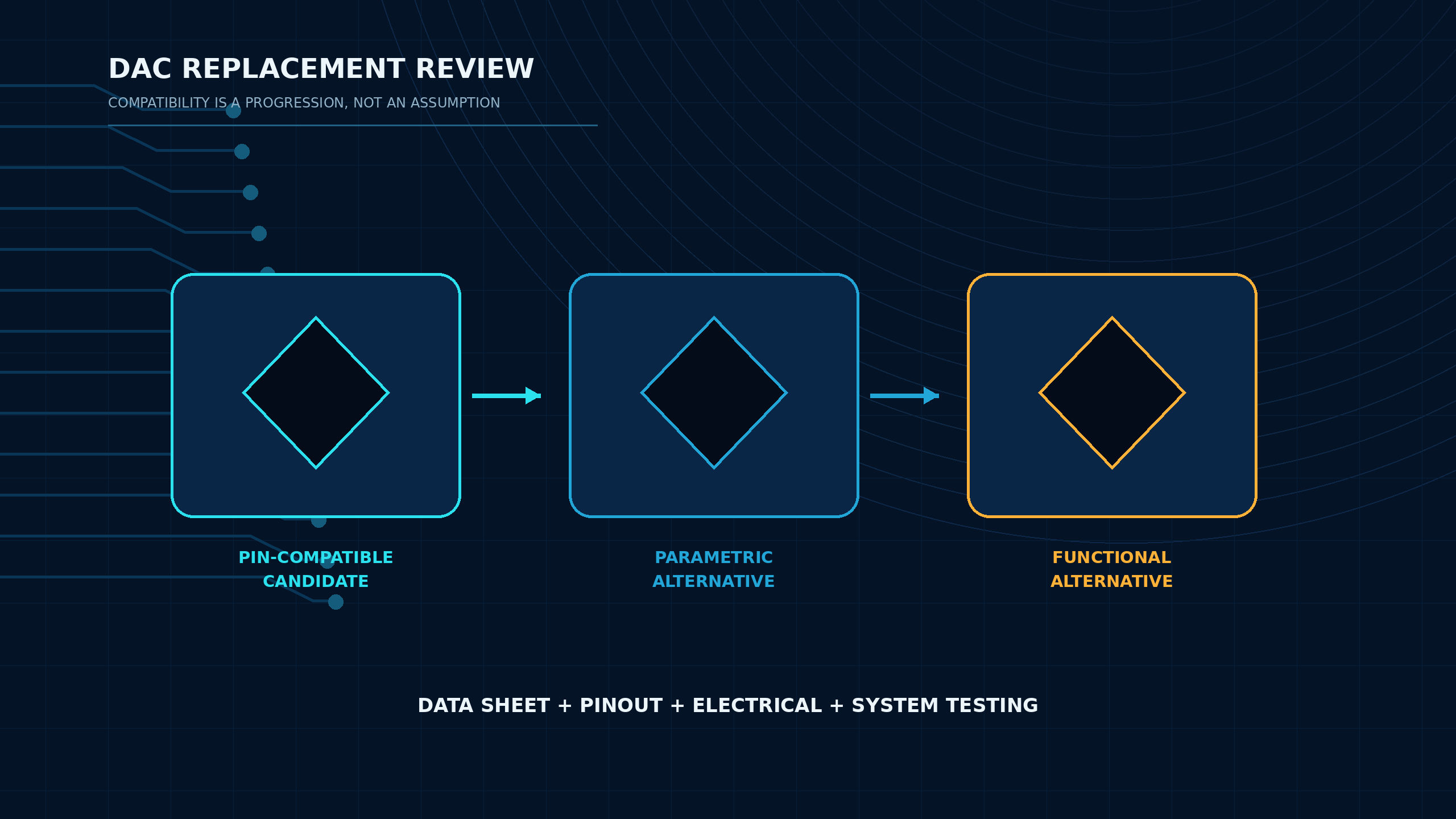
The safest replacement language is specific. A DAC can be a pin-compatible candidate, a parametric alternative, or a functional alternative. Those are not the same thing.
| Replacement level | What it means | What must be checked |
|---|---|---|
| Pin-compatible candidate | The package and pins appear to match. | Full pinout, no-connect pins, supply pins, reference pins, output pins, digital input pins, package dimensions, and PCB assembly rules. |
| Parametric alternative | Key specifications are close enough for review. | Resolution, INL, DNL, monotonicity, settling time, output current or voltage range, reference range, temperature range, and supply rails. |
| Functional alternative | The system could be redesigned to use it. | Firmware, interface, analog output stage, compensation, filtering, calibration, layout, qualification, and customer approval. |
Before approving a DAC replacement, check the exact MPN and suffix, manufacturer lifecycle status, package and pinout, output architecture, supply and reference range, accuracy and linearity, settling time, digital interface, temperature evidence, and compliance documentation. If any line is missing, the replacement should remain "under review." Do not describe it as equivalent or drop-in compatible until the evidence is complete.
Common Mistakes in DAC Lifecycle Planning
Mistake 1: using consumer DAC assumptions for IC sourcing.
USB DACs, headphone DACs, DAPs, speakers, and "expensive DAC" buying advice do not answer a BOM lifecycle question. A sourcing team needs the IC part number, package, lifecycle, documentation, and replacement path.
Mistake 2: treating obsolete as an electrical failure.
Obsolete does not mean the part stopped working in the field. It means the commercial supply path changed. The fix may be a last-time-buy, broker sourcing with inspection, approved replacement, or board redesign.
Mistake 3: approving replacements from resolution alone.
Two 8-bit DACs can differ in output type, pinout, supply requirements, timing, reference behavior, error specifications, package, and temperature grade.
Mistake 4: writing stock or lead time into engineering notes without evidence.
Stock, price, lead time, date-code limits, region, packaging method, and compliance documents are order-specific sourcing data. Do not publish them as fixed technical facts. For a production quote, send the full manufacturer part number, package suffix, quantity, target delivery date, required date code, RoHS/REACH or automotive requirement, and approved alternates so the supplier can confirm current availability and terms.
Sourcing Workflow for Legacy DAC ICs
- Confirm the exact original part number, manufacturer, suffix, package, and date-code restrictions.
- Check the current manufacturer product page, datasheet, PCN/PDN history, and lifecycle label.
- Identify whether the project needs the same part, a pin-compatible candidate, a parametric alternative, or a functional redesign option.
- Separate engineering approval from purchasing availability. A sourceable part is not automatically technically acceptable.
- Ask the buyer, engineer, and quality team to agree on acceptable evidence: datasheets, samples, test results, certificates, inspection reports, and customer approval.
- Keep commercial fields tied to a dated RFQ or supplier confirmation, because they can change after publication.
FAQ
What is the lifespan of a DAC IC?
A DAC IC does not have one universal lifespan. Its useful life depends on electrical stress, temperature, ESD handling, package and assembly conditions, operating duty cycle, and manufacturer product lifecycle status.
Is DAC lifecycle the same as DAC reliability?
No. DAC reliability concerns whether the IC keeps operating within specification. DAC lifecycle concerns whether the exact part remains active, supported, and sourceable for production or repair.
What does obsolete DAC mean?
An obsolete DAC is a part that is no longer normally supported or supplied through the original lifecycle path. It may still exist in equipment, but sourcing, inspection, and replacement planning become more important.
Are DAC0800 and DAC0808 obsolete?
TI product pages verified on September 1, 2026 displayed GPN: ACTIVE for DAC0800 and DAC0808. That does not verify every package or suffix, and it does not confirm ApexComponent inventory, price, lead time, certification, or compatibility with another design.
Can I replace DAC0800 with DAC0808 or another 8-bit DAC?
Do not assume drop-in compatibility from resolution or interface alone. Compare the exact datasheets for pinout, package drawing, supply rails, output type, reference input, code format, timing, power-up state, temperature grade, compliance, and software/register behavior; then approve the alternate only after board-level validation.
Related Reading
- Browse related components: Digital-to-Analog Converter ICs
- Read another article: How to Choose a Good DAC IC
- Read another article: Will a DAC Improve Signal Quality?
Send Legacy DAC Part Numbers for Sourcing Review
If a BOM contains DAC0800, DAC0808, or another legacy DAC IC, use Request a Quote with the exact part numbers, suffixes, package, target quantity, date-code preference, required documentation, application notes, and approved manufacturer constraints. This keeps sourcing review tied to the real orderable part instead of a generic DAC family name.
External Sources
- Texas Instruments, DAC0800 product page
- Texas Instruments, DAC0808 product page
- Texas Instruments, DAC0800 datasheet
- Texas Instruments, DAC0808 datasheet
- Texas Instruments, Product Life Cycle
- Texas Instruments, Product Change Notification
- Analog Devices, Failure-Rate and Reliability Prediction Overview
- Analog Devices, Absolute Maximum Ratings and Thermal Resistance