
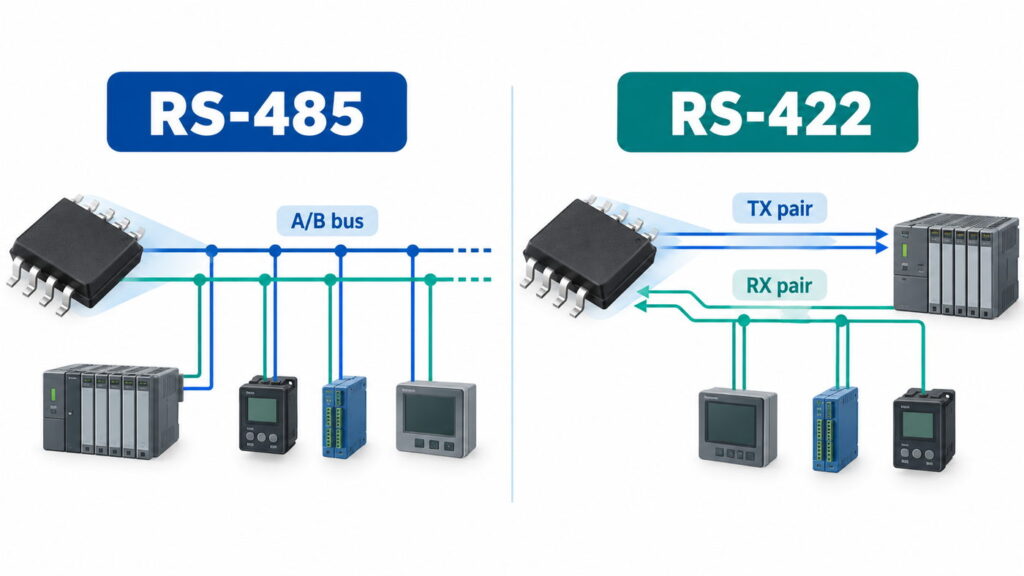
RS-485 and RS-422 are both differential serial interface standards, but they are not selected the same way at the transceiver IC level. RS-485 is commonly used for shared industrial buses with multiple nodes, while RS-422 is commonly used where a driver sends signals over one or more dedicated differential pairs to receivers.
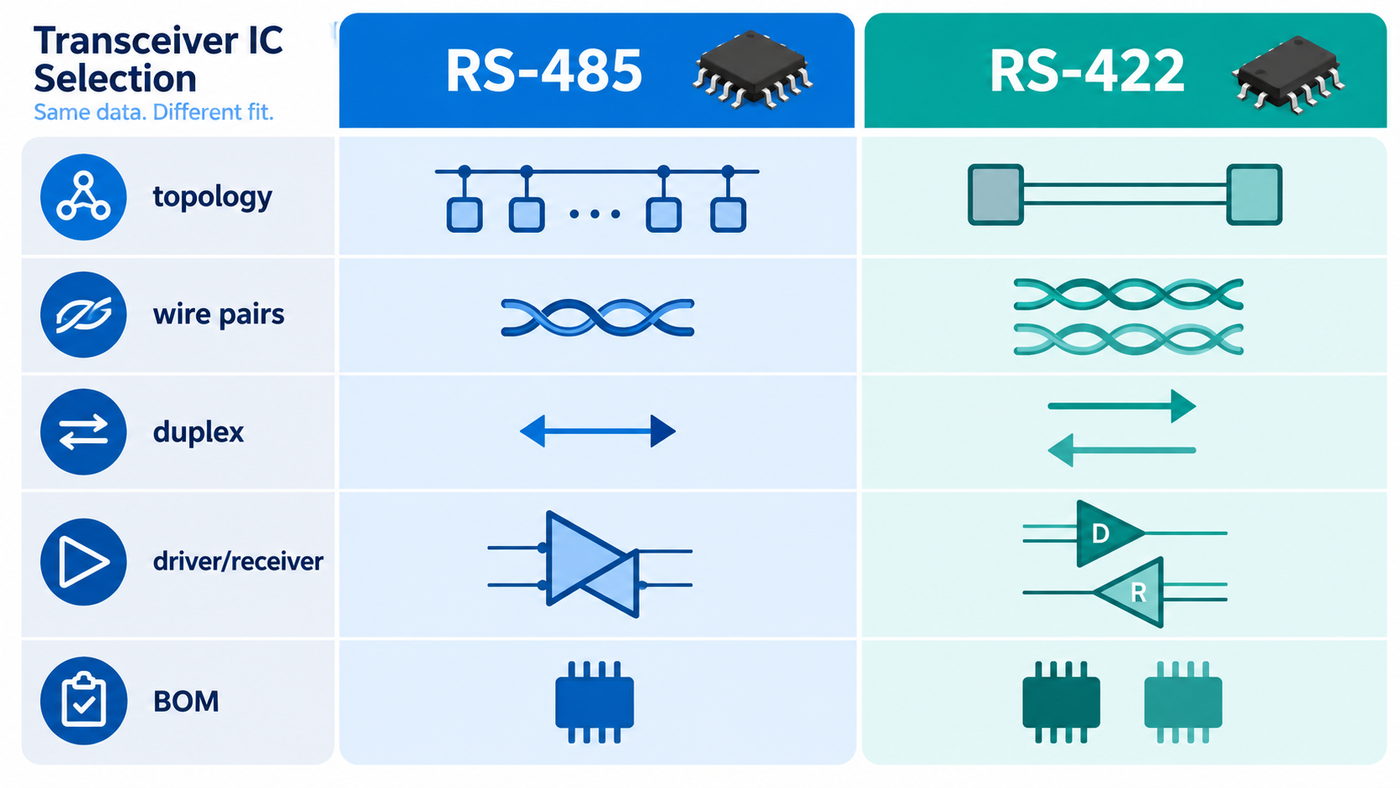
For sourcing, the practical question is not only "which standard is better?" It is whether the board needs a shared A/B bus, separate TX/RX pairs, half-duplex or full-duplex communication, correct logic voltage, suitable package, protection level, temperature grade, and an approved manufacturer part number.
| Selection Point | RS-485 Transceiver IC | RS-422 Transceiver / Driver / Receiver |
|---|---|---|
| Typical topology | Shared differential bus with multiple nodes | Dedicated differential links, often driver-to-receiver or driver-to-multiple-receivers |
| Common wiring | One A/B pair for half-duplex; four-wire variants exist | Separate transmit and receive differential pairs in many full-duplex links |
| Driver control | Direction-control pins are often important in half-duplex designs | Driver and receiver roles are usually more fixed in the link design |
| Procurement risk | Wrong duplex mode, voltage, package, protection, or isolation level | Wrong driver/receiver count, channel direction, package, or voltage family |
RS-485 vs RS-422 Quick Comparison
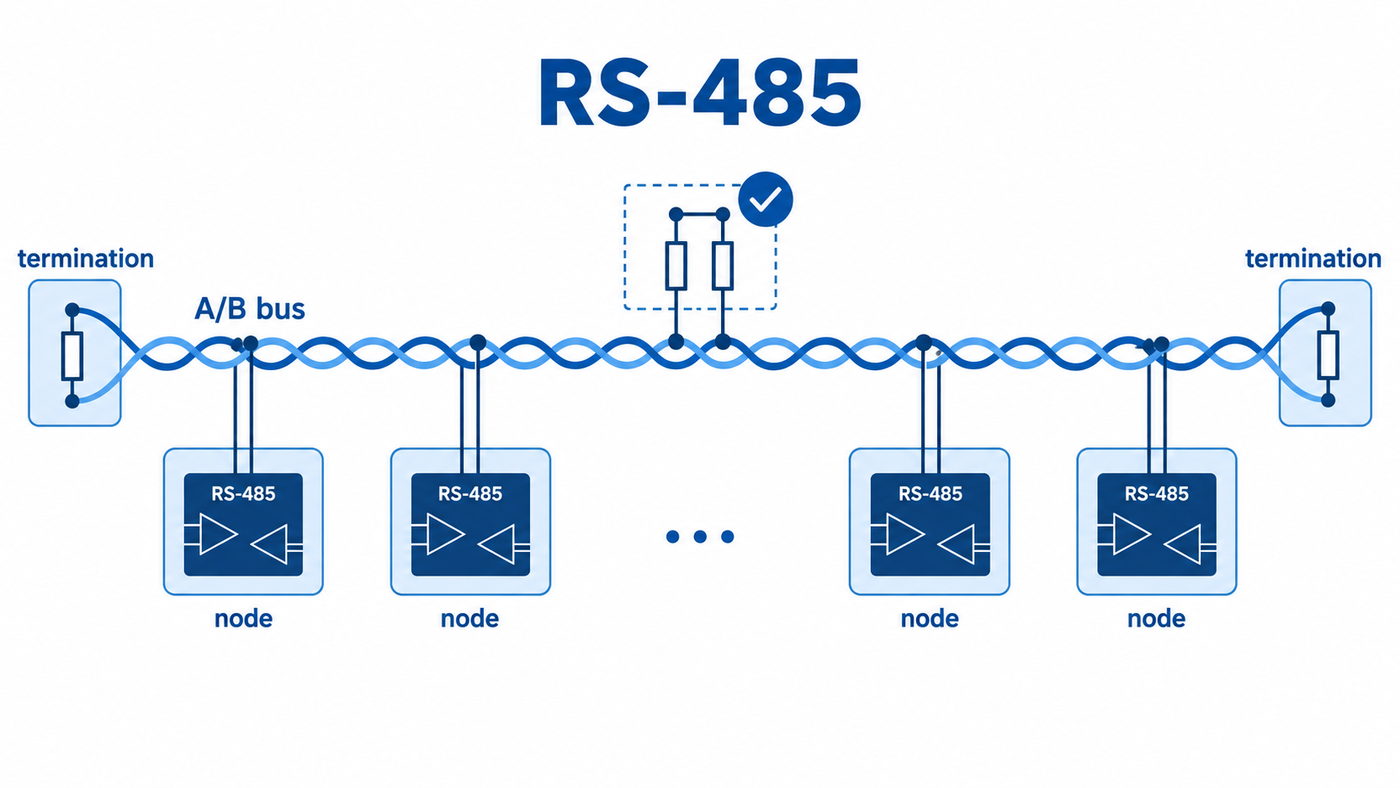
RS-485 is usually chosen when the system needs a robust shared bus across industrial nodes. Many designs use a two-wire half-duplex A/B pair where a node must enable its driver only when transmitting. That makes direction control, bus loading, termination, biasing, and protection important checks.
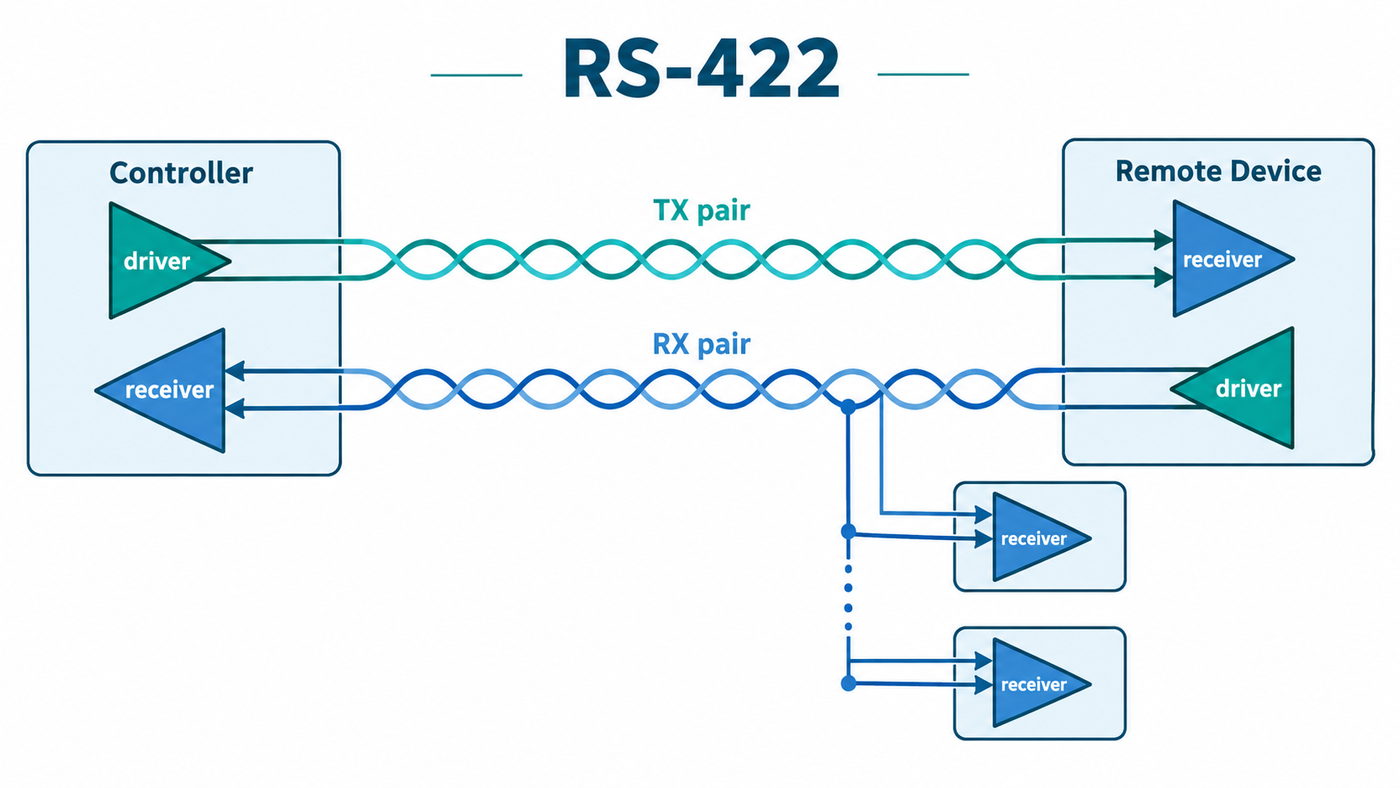
RS-422 is usually chosen when the design has a clearer driver-to-receiver direction, often with separate transmit and receive pairs. It can be the cleaner fit for equipment links where full-duplex communication or one driver feeding receivers is part of the original architecture.
When to Choose an RS-485 Transceiver IC
Choose an RS-485 transceiver IC when the product needs a shared differential bus, field wiring, multiple industrial nodes, or half-duplex communication over one pair. Typical examples include meters, PLC-connected modules, building automation nodes, industrial sensors, power equipment, and embedded gateways.
The transceiver choice should match the local logic rail, package, temperature range, driver-enable behavior, and system protection plan. If the equipment is exposed to electrical noise, long cable runs, ground potential differences, or outdoor wiring, isolation and surge protection may need to be reviewed as board-level requirements.
When to Choose RS-422 Driver and Receiver ICs
Choose RS-422 when the system architecture uses dedicated differential signal paths rather than a shared multi-transmitter bus. A common design pattern uses separate TX and RX pairs, so the BOM may include a driver, receiver, or full transceiver depending on the board role.
The procurement review should identify whether the line is transmit-only, receive-only, or full-duplex. A base description such as "RS-422 IC" is often not enough for sourcing because driver count, receiver count, channel direction, voltage family, package, and protection features can vary by device.
Transceiver IC Selection Checklist
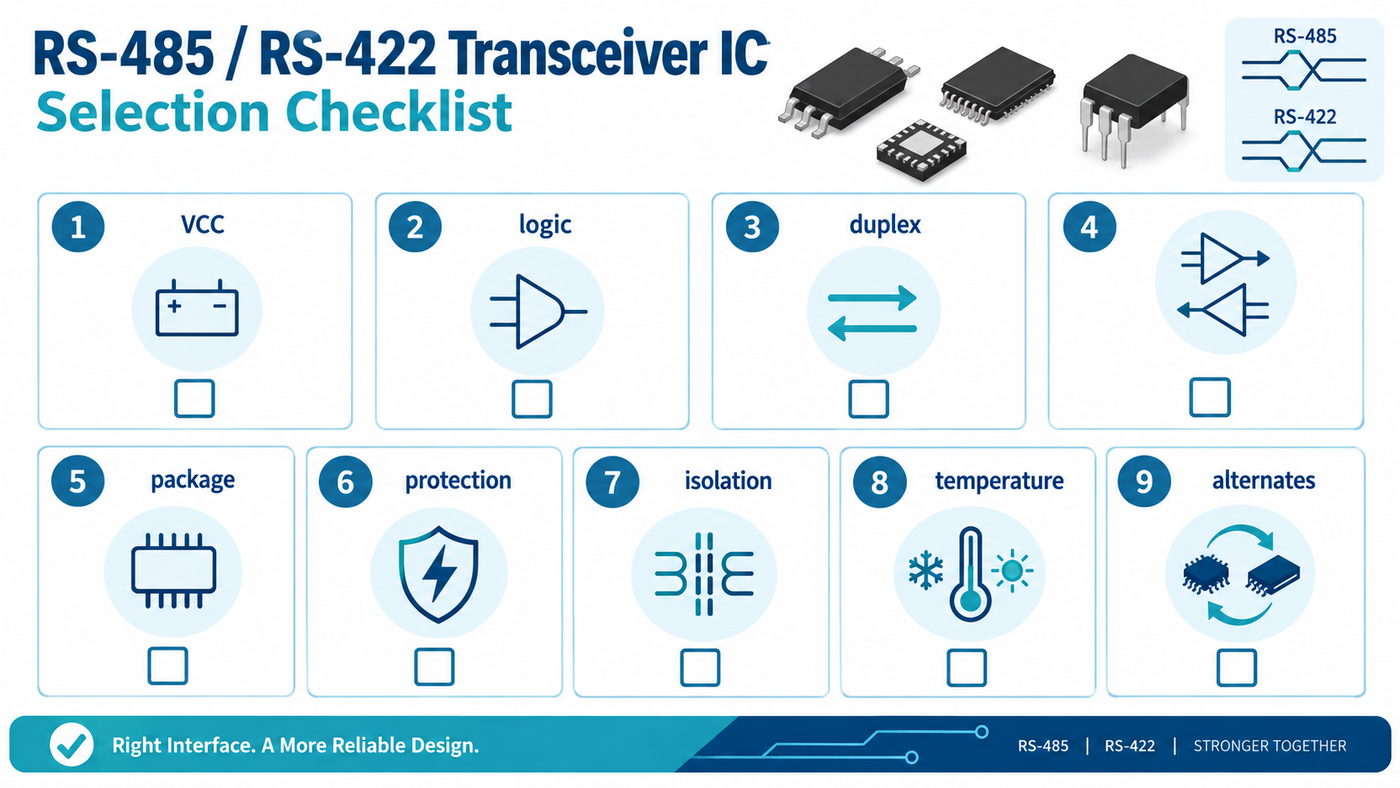
Start with the communication standard, then confirm topology and duplex mode. After that, check VCC, controller logic level, package, temperature grade, protection needs, isolation needs, and the exact manufacturer part number. Do not treat RS-485 and RS-422 labels as complete sourcing specifications.
Replacement review needs the schematic or original BOM. A part can match the interface family but still be wrong because it has a different channel direction, different enable behavior, different package, or a missing protection feature. For alternates, use "functional alternative" until pinout, electrical limits, and validation status are confirmed.
Common Sourcing Mistakes
- Ordering from a short description such as "RS-485 IC" or "RS-422 IC" without topology, voltage, package, or role details.
- Replacing a half-duplex RS-485 part with a device whose driver-enable behavior or package does not match the board.
- Buying an RS-422 device before confirming whether the board needs a driver, receiver, or full transceiver.
- Assuming isolation, surge protection, or industrial temperature grade is included without checking the exact MPN.
RFQ Details to Send
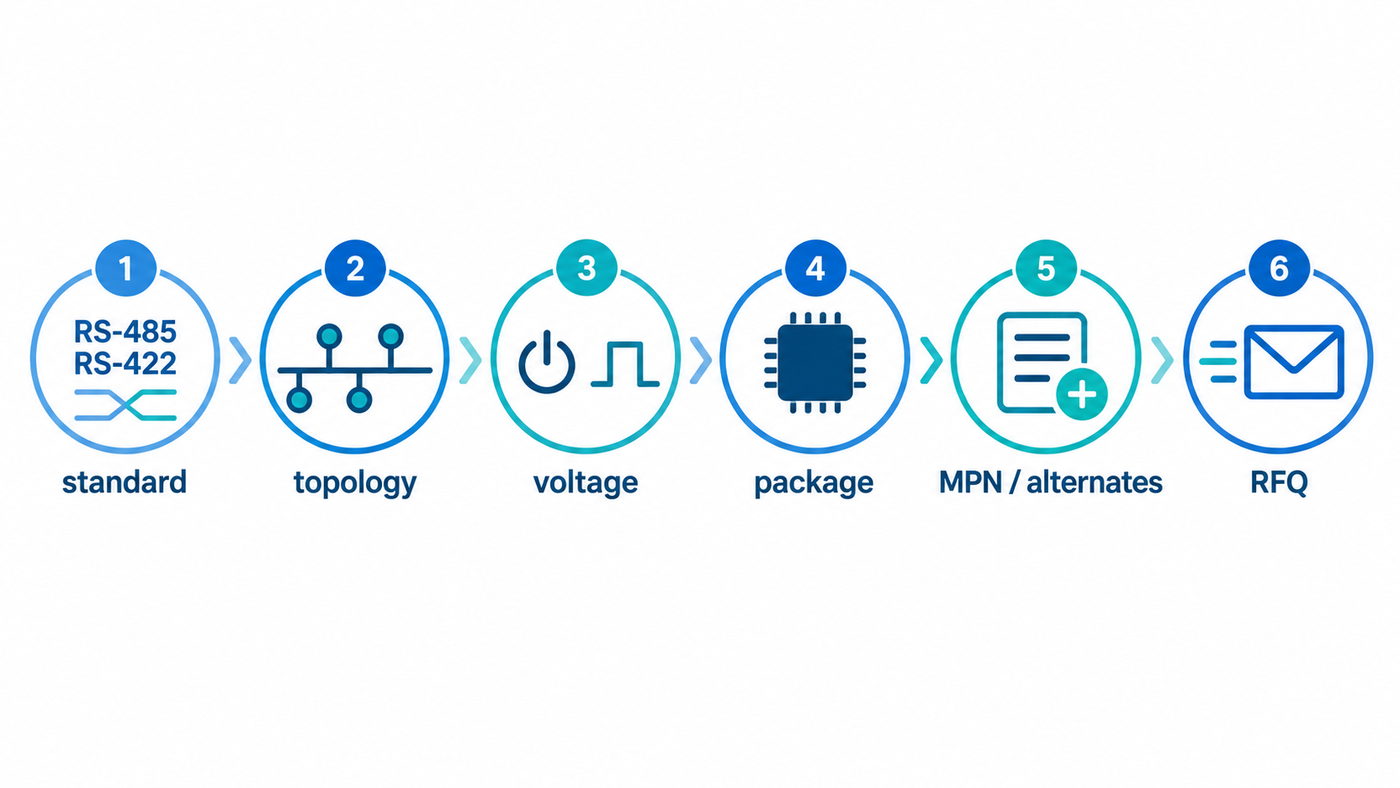
For an RS-485 or RS-422 RFQ, send the exact MPN if available, the interface standard, topology, duplex mode, VCC, logic level, package, quantity, manufacturer preference, and whether alternates are allowed. If the project needs isolation, surge protection, or a specific temperature grade, list those requirements directly.
ApexComponent can review RS-485 and RS-422 transceiver BOM lines and help organize approved alternates, but price, inventory, lead time, lifecycle, and substitution approval must be checked against the actual MPN and sourcing date.
FAQ
Is RS-485 the same as RS-422?
No. Both use differential signaling, but they are usually applied with different topology and driver/receiver assumptions. RS-485 is commonly associated with shared multi-node buses, while RS-422 is commonly associated with dedicated differential links.
Can an RS-485 transceiver replace an RS-422 transceiver?
Not automatically. Some devices support both interface families, but replacement depends on channel direction, duplex mode, voltage, package, pinout, protection level, and the original circuit.
Is RS-485 half-duplex or full-duplex?
Many RS-485 systems are two-wire half-duplex, but four-wire and full-duplex RS-485 designs also exist. Check the actual transceiver and wiring topology before selecting a part.
What should I include in an RS-422 or RS-485 RFQ?
Include exact MPN, interface standard, topology, duplex mode, voltage, logic level, package, quantity, approved alternates, and any isolation or protection requirements.