
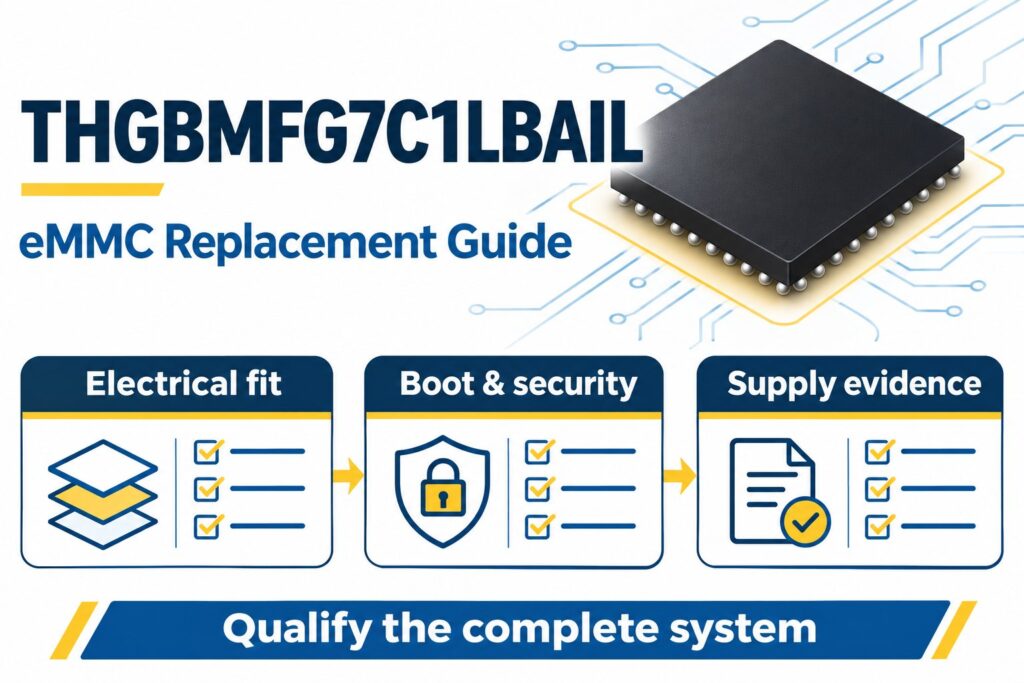
A THGBMFG7C1LBAIL replacement needs electrical, boot and sourcing approval. Start with the board's VCCQ interface supply, then compare the candidate's package, boot configuration and security provisioning. The historical manufacturer options below are a shortlist for evaluation; each needs current documentation and board validation.
This guide helps engineering and purchasing teams turn a replacement search into a controlled decision. It separates the original part's published specifications, the historical lifecycle record and the evidence needed before ordering an alternate.
What is THGBMFG7C1LBAIL?
THGBMFG7C1LBAIL combines NAND flash and a controller in an embedded MultiMediaCard (eMMC) package. Toshiba's October 2014 announcement identifies this exact part as the 16GB Premium option, with an 11.5 × 13.0 × 0.8mm package. The announcement's family specifications provide the following starting point. Original Toshiba announcement, now hosted by Kioxia.
| Item | Published baseline | Check before replacement |
|---|---|---|
| Full part number | THGBMFG7C1LBAIL | Match every character to the approved BOM. |
| Nominal density | 16GB | Compare usable sectors and the programmed partition layout. |
| Interface | eMMC 5.0 family | Confirm the host's required modes and initialization. |
| Package | 153-ball FBGA family; exact part: 11.5 × 13.0 × 0.8mm | Obtain the exact ball map and mechanical drawing. |
| Memory-core supply | 2.7–3.6V, family launch data | Verify the current part specification and board rail. |
| Interface supply | 1.7–1.95V or 2.7–3.6V, family launch data | Identify the actual VCCQ rail and host I/O domain. |
| Operating temperature | −25°C to +85°C, family launch data | Match the application environment and required grade. |
These are screening facts from a launch announcement. They do not replace the controlled datasheet for limits, timing, solder-ball assignment or assembly requirements. Use the datasheet-reading workflow to capture each requirement with its revision and conditions.
What does the EOL record actually say?
Toshiba's January 2019 notice MBU-19-0018 lists THGBMFG7C1LBAIL as discontinued, with last-time buy at the end of June 2019 and last-time shipment at the end of September 2019. This is a historical schedule. Toshiba PCN/EOL notice, page 1, DigiKey-hosted copy.
Its 16GB consumer-temperature replacement group contains THGBMJG7C1LBAIL and THGAMRG7T13BAIL; page 2 calls for customer validation. Request current lifecycle information for the candidate you intend to buy.
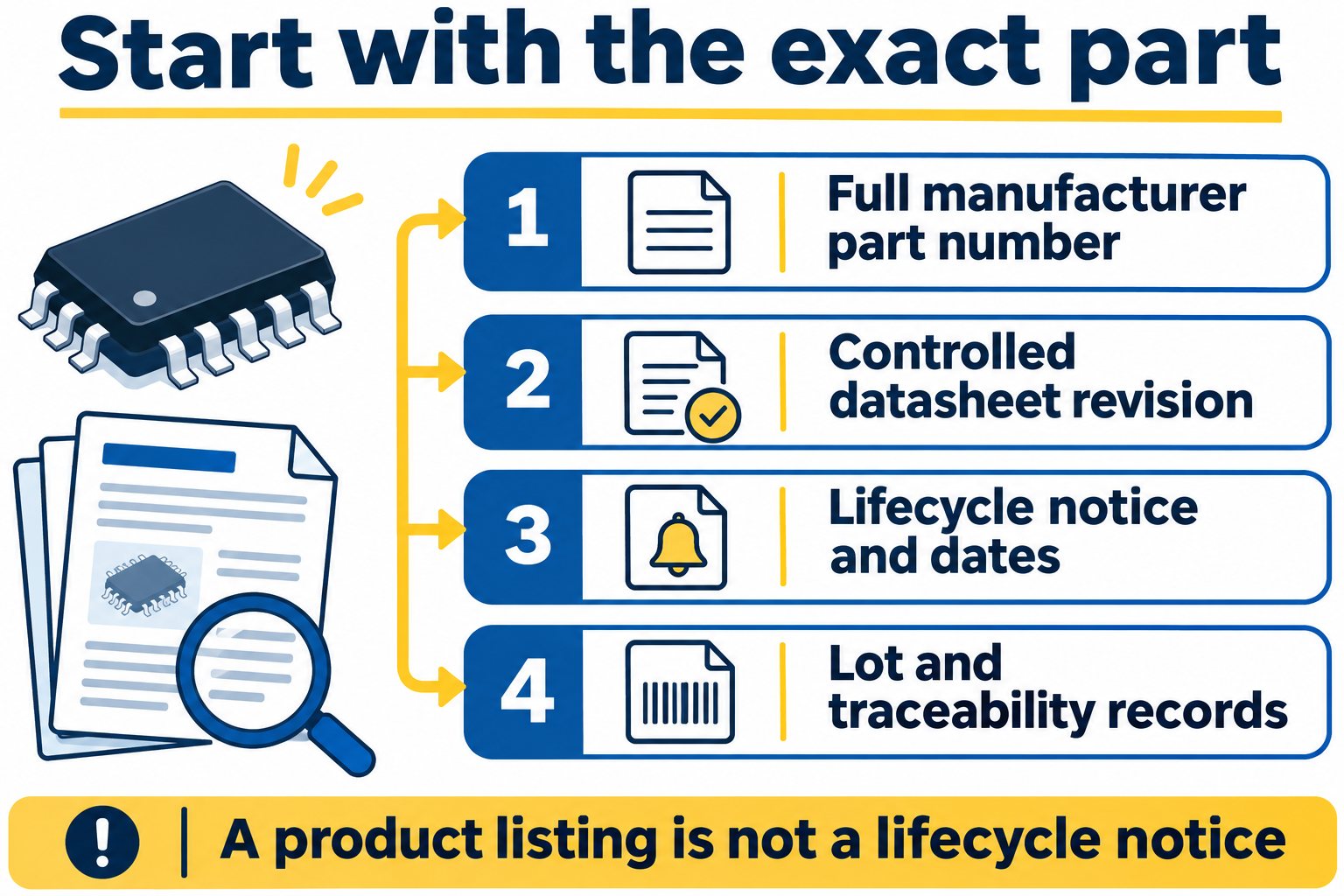
A practical sourcing decision has two separate records: engineering approves an exact configuration, and purchasing verifies an offered lot against the agreed requirements. A valid result in one record does not close the other.
Which Kioxia or Toshiba codes deserve a closer look?
Use complete part numbers when building the shortlist. Similar-looking codes can represent a different generation, controller or qualification history.
| Part number | Why it appears in the review | What remains to be established |
|---|---|---|
| THGBMHG7C1LBAIL | Also discontinued in the 2019 notice. | Similar spelling does not resolve the lifecycle decision. |
| THGBMJG7C1LBAIL | Historical 16GB 15nm Premium option. | Current lifecycle, exact electrical specification and board approval. |
| THGAMRG7T13BAIL | Historical 16GB BiCS FLASH option; its 2019 launch identifies eMMC 5.1 and an 11.5 × 13.0 × 0.8mm package. | Interface voltage, complete ball map, software behavior and current supply status. |
The code roles come from MBU-19-0018; the BiCS part's published specifications come from Toshiba Memory's February 2019 launch. Neither source establishes that these candidates are still in production in 2026.
For a long-lived design, ask the manufacturer to nominate a currently supported part for the required capacity, temperature and host. Keep that answer separate from the historical cross-reference. Moving to a larger capacity also needs a partition and provisioning review.
Why should VCCQ be the first electrical check?
Matching core voltage does not establish matching interface voltage. The original family's 2014 launch lists two interface-supply ranges: 1.7–1.95V and 2.7–3.6V. The 2019 BiCS family containing THGAMRG7T13BAIL lists only 1.7–1.95V for the interface, while retaining a 2.7–3.6V memory-core supply. 2014 specifications, 2019 specifications.
The engineering consequence is specific: a board using 3.3V VCCQ cannot be approved for that BiCS candidate from these documents alone. A shared 16GB density and package outline do not resolve this mismatch. Obtain the exact current datasheet before powering the sample.
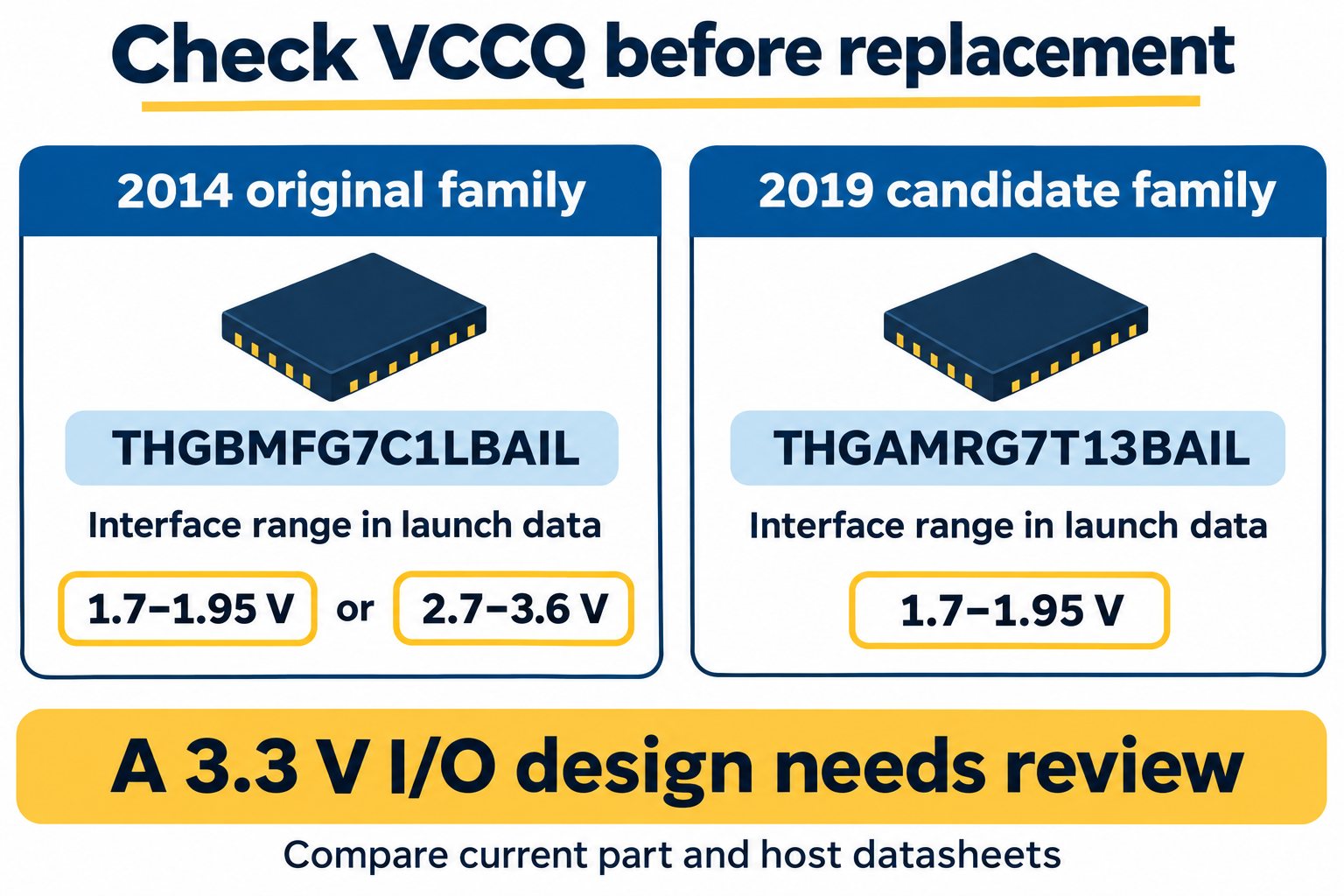
For an existing board, record:
- The memory's VCC and VCCQ rail connections and measured startup behavior.
- The host bank's I/O supply, supported signaling levels and pull-up supply.
- The operating mode used by the boot ROM, bootloader and operating system.
- Any proposed power or layout changes, with their design-review owner.
If the board already uses 1.8V signaling, the voltage screen may remain open for evaluation. It is only one check: power sequencing, signal timing and the package drawing still need review. Do not treat an unpopulated voltage option in a schematic as proof that the assembled product can switch domains safely.
What must migrate besides the user data?
A readable filesystem is only part of an eMMC migration. On Linux, the two hardware boot partitions are exposed separately as /dev/mmcblkXboot0 and /dev/mmcblkXboot1; they can contain platform-critical boot information. A copy of the main user-area block device does not include those separate devices. Linux kernel: SD and MMC device partitions.
Before removing the old device, have the platform owner identify the required boot contents, boot selection, bus settings and provisioning sequence. Read the extended card-specific data register (EXT_CSD) with an appropriate tool and preserve the interpretation alongside the raw record. Linux's mmc-utils documentation lists EXT_CSD parsing and boot-configuration functions. Linux kernel: MMC tools.
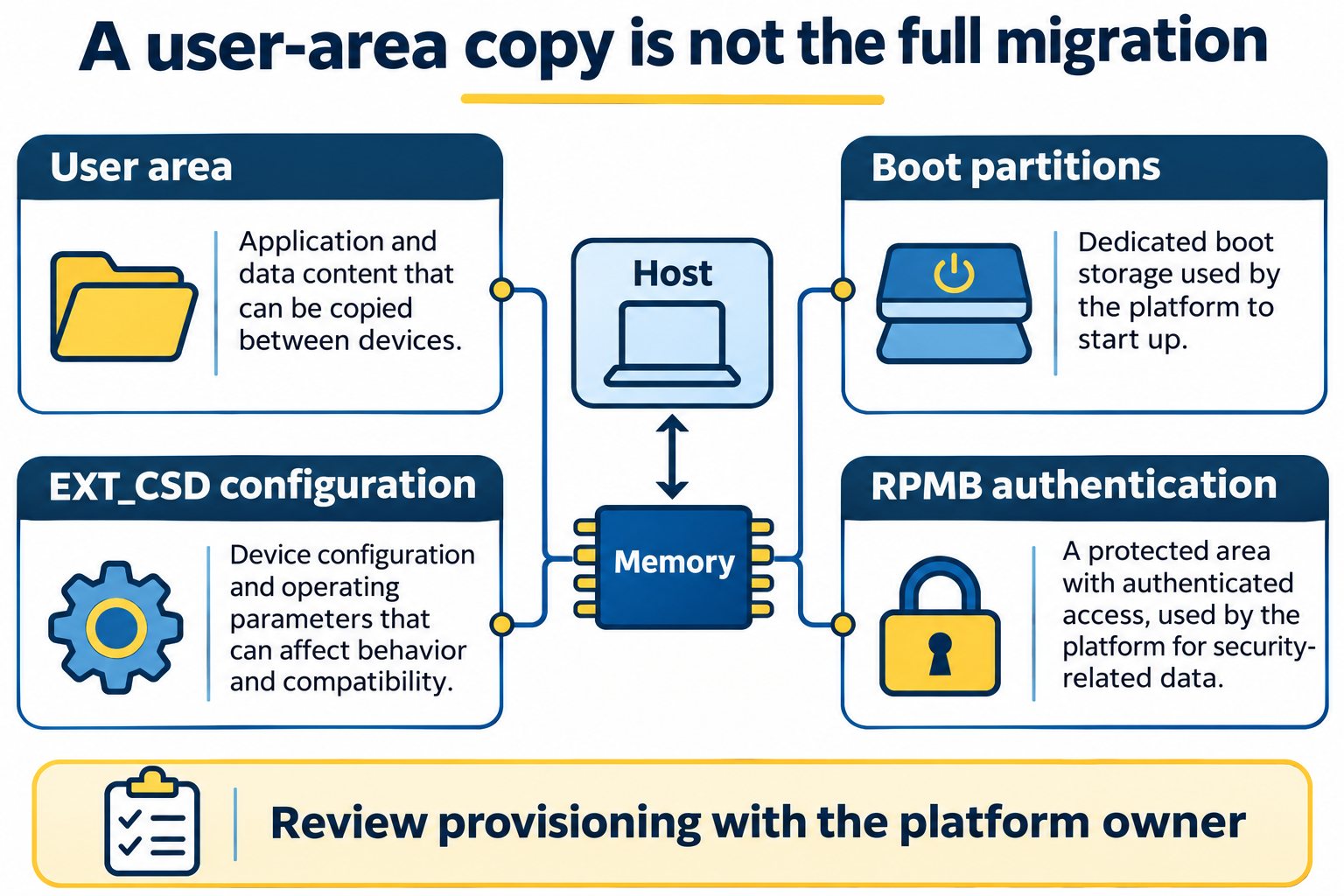
The Replay Protected Memory Block (RPMB) requires a separate security review. Kioxia describes authenticated access using a key shared by the host and storage device and a counter that helps prevent replay. This is not an ordinary filesystem-copy operation. Confirm the platform's approved provisioning and recovery procedure; do not assume a replacement chip will inherit authentication state. Kioxia RPMB technical brief, November 2022, revision 1.1, pages 1–3.
Record the following before a sample build:
| Area | Question for the platform owner | Acceptance evidence |
|---|---|---|
| User storage | Does the image fit the actual usable sector count? | Image size, layout and read-back verification. |
| Boot partitions | Which contents and boot selection does the ROM expect? | Approved programming recipe and cold-boot log. |
| Configuration | Which settings must be reproduced, and which are device-specific? | Reviewed EXT_CSD comparison and configuration record. |
| Security | Does the product use RPMB or other device-bound provisioning? | Authorized provisioning and recovery test results. |
| Field update | Can the approved firmware update and recover on the candidate? | Update, interruption and recovery logs. |
Use controlled sample devices for programming work. Review commands that change persistent configuration before running them; this guide deliberately provides no universal write recipe for an unspecified platform.
How do you qualify the candidate on the real board?
Define the acceptance criteria before testing. “It boots once” is useful feedback, but it does not cover production programming, full workload or recovery from an interrupted operation.
Kioxia's managed-flash validation guidance recommends signal-integrity verification on the embedded design before mass production. It also calls for checking the relevant device and host documentation when preparing measurements. Kioxia signal-integrity technical brief, May 2025, version 1.0.
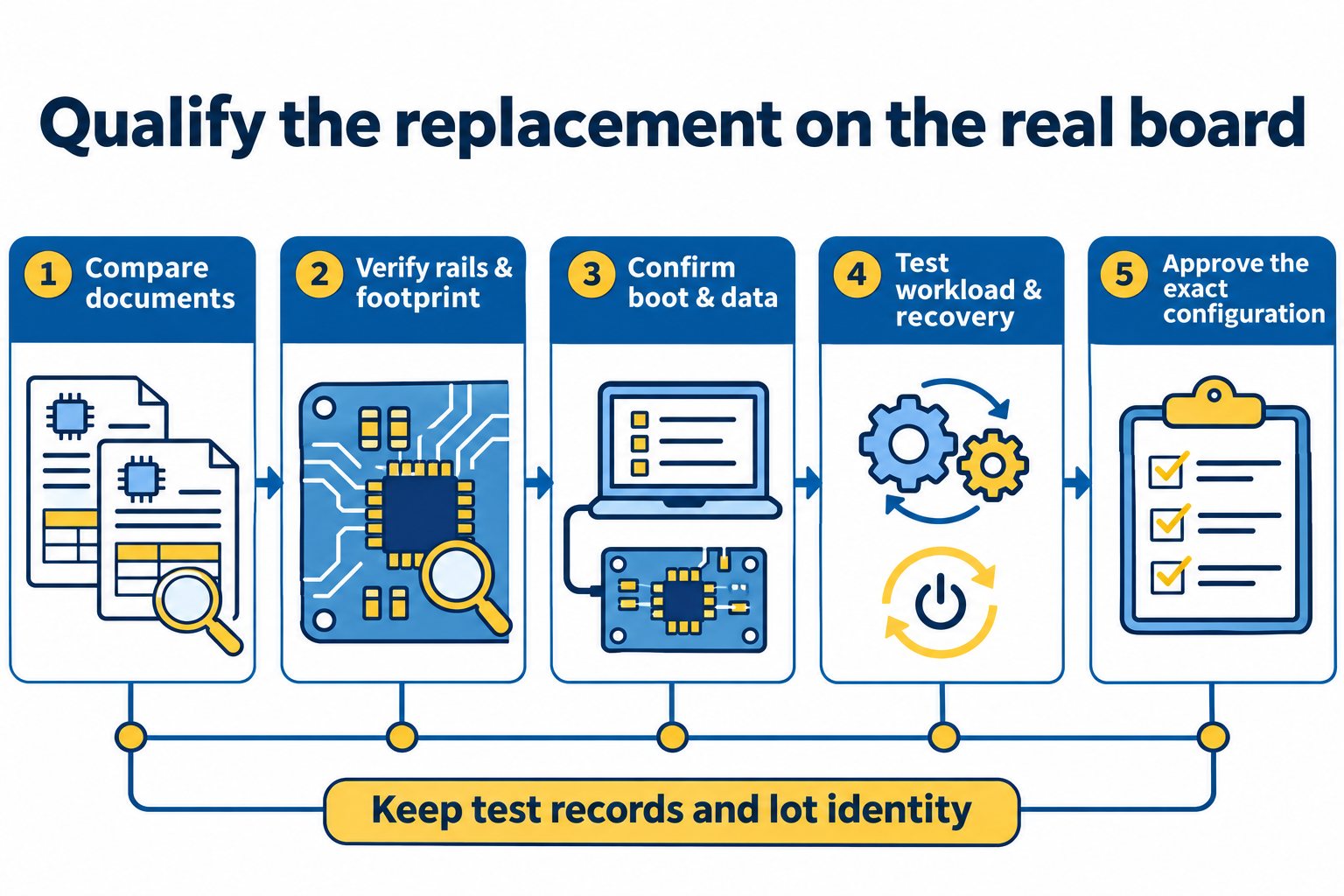
The following is a proposed review plan, not a claim that these tests have been run:
| Stage | Work to perform | Evidence to retain |
|---|---|---|
| Document comparison | Compare ball functions, package tolerances, rails, temperature, modes and required features. | Revision-controlled comparison with unresolved items assigned. |
| Assembly and power | Review land pattern and assembly process; measure startup, reset and rail behavior. | Inspection results and measurements tied to board revision. |
| Boot and programming | Exercise the production programmer, boot ROM, bootloader and operating-system image. | Programming logs, configuration records and boot results. |
| Application behavior | Run representative reads, writes, updates and idle periods across the project's operating conditions. | Workload definition, errors and performance against project limits. |
| Fault and recovery | Exercise controlled resets and power interruption under an agreed data-integrity policy. | Recovery outcome, data checks and recorded failure cases. |
| Release | Close deviations and approve the exact device, firmware, board and programming recipe. | Signed engineering change and approved supplier/lot criteria. |
Choose sample size, duration and environmental coverage from the product's reliability requirements. There is no universal test count that makes every eMMC replacement valid. Retain a known-good baseline so a failure can be traced to a device change, programming difference, assembly issue or software regression.
If the replacement requires a different rail or boot procedure, estimate that work before comparing purchase prices. Component price alone cannot represent the total migration effort.
What should a controlled sourcing RFQ contain?
First choose the purchasing route: maintain an already-approved legacy build with an acceptable original-part lot, or evaluate a new candidate through engineering change control. Mixing the two in one line item invites an unapproved substitution.
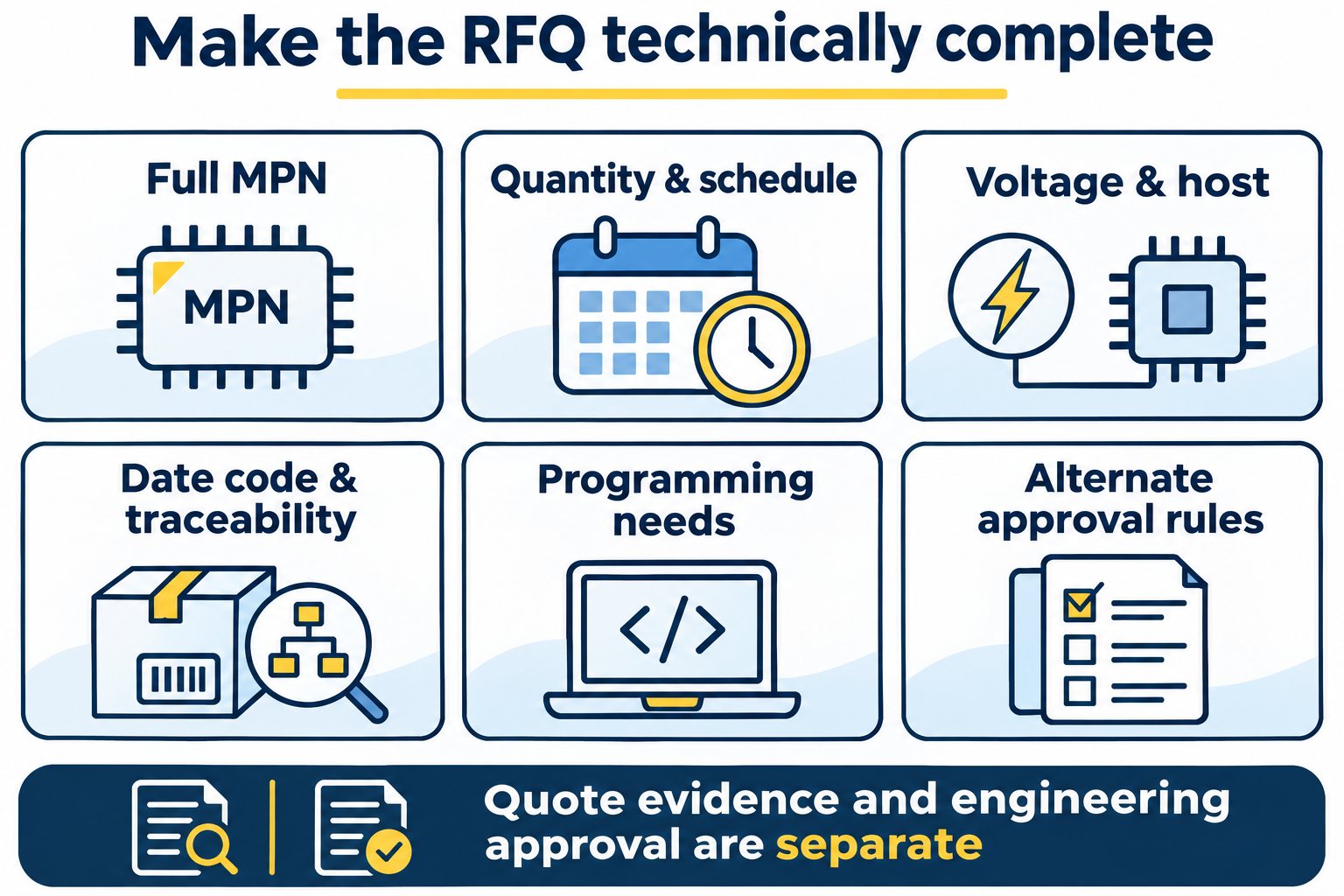
| RFQ field | Information to provide or request |
|---|---|
| Part identity | Full MPN; distinguish an original-part request from a candidate-alternate request. |
| Demand and timing | Quantity, delivery destination and required production dates. |
| Technical context | Board revision, host, VCCQ, temperature needs and programming requirements. |
| Material acceptance | Agreed date-code policy, packaging, condition, lot traceability and available evidence. |
| Verification scope | Inspection or testing required, acceptance criteria and the records the seller will provide. |
| Alternate control | State whether substitutions require written engineering approval before shipment. |
For old or previously programmed material, ask specifically about handling history and prior use. Neither a package photograph nor a capacity readout proves the remaining endurance, authenticity or fitness of a lot. Define what evidence is acceptable before placing the order.
Send the full MPN, quantity and requirements through ApexComponent's BOM enquiry. Include the board's VCCQ and whether engineering has approved an alternate. Availability, price, delivery and documentation must be confirmed for the actual offer; this article makes no stock or supply commitment.
Frequently asked questions
Is THGBMFG7C1LBAIL discontinued?
Yes, it appears in Toshiba's January 2019 discontinued-products table. Verify any present-day offered lot separately.
Is THGBMHG7C1LBAIL automatically the replacement?
No. It is also listed as discontinued. Similar spelling does not establish current support or board compatibility.
Can THGAMRG7T13BAIL replace it without a board change?
That cannot be concluded from the public documents. The published VCCQ ranges are an early concern for a 3.3V I/O design. The exact device specification, host, package drawing, boot behavior and qualification results must support the decision.
Can I use a 32GB part instead of 16GB?
Larger nominal capacity does not approve the substitution. Verify electrical and mechanical fit, then review image sizing, usable sectors, partitions, provisioning and the platform's software assumptions.
Is an ordinary NAND flash chip an equivalent?
An eMMC design expects a managed device and its interface. A raw NAND part would require a different integration review. The NAND-versus-NOR guide gives additional memory-selection context.
Documents to keep with the approval record
Keep the original and candidate datasheet revisions, lifecycle correspondence, schematic and footprint comparison, programming recipe, qualification results and accepted-lot requirements in the same engineering-change record. The public documents used here are linked at the relevant decisions above. Historical notices explain the migration path; the current controlled documents and your board results determine release.