
Table of Contents
LDO Regulator Basics: When Should You Use an LDO?
1.Introduction
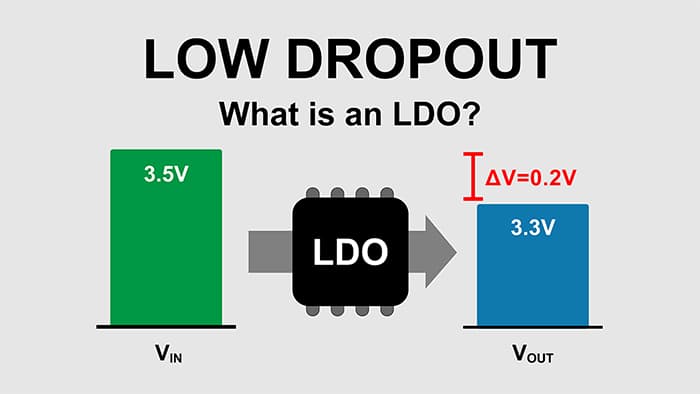
A Low-Dropout Regulator, often called an **LDO**, is a common power management IC used in many electronic products. It provides a stable output voltage from a higher input voltage. Compared with a switching regulator, an LDO is usually simpler, quieter, and easier to use.
In 2026, LDOs are still important in power design. Many products need clean and stable power for sensors, RF modules, microcontrollers, data converters, medical devices, smart meters, and battery-powered systems. TI also highlights low-noise, high-PSRR LDOs for smart metering, traction inverter, medical imaging, wearable electronics, and HEV/EV systems.
For engineers and procurement teams, choosing an LDO is not only a technical decision. It also affects BOM cost, package size, heat, battery life, quality control, and long-term supply.
2.What Is an LDO Regulator?
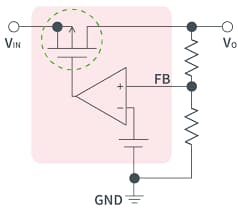
An LDO regulator is a type of linear voltage regulator. It can keep the output voltage stable even when the input voltage is only slightly higher than the output voltage.
The word dropout means the minimum voltage difference needed between input and output. For example, if an LDO outputs 3.3 V and needs only 100 mV dropout, it may still work when the input voltage is about 3.4 V.
An LDO does not use an inductor like a buck converter. It usually needs only a few external capacitors. ST describes LDO regulators as simple voltage regulators with few external parts, and says they work well when the output current is below a few amps and the input voltage is close to the output voltage.
3.Key LDO Specifications Buyers Should Know
I.Dropout Voltage
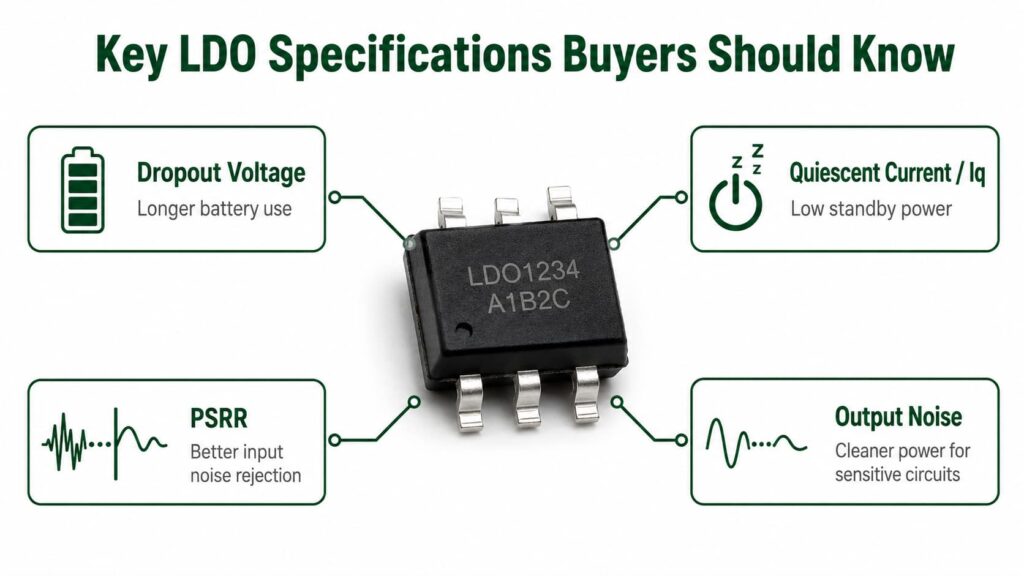
Dropout voltage is important for battery-powered devices. A lower dropout voltage helps the system use more of the battery energy before the battery voltage becomes too low.
For example, a wearable device, wireless sensor, or handheld meter may use a single lithium battery. If the LDO has high dropout voltage, the product may shut down earlier. If the LDO has low dropout voltage, the product can run longer.
II.Quiescent Current
Quiescent current, or Iq, is the current used by the LDO itself. This matters when the product spends a lot of time in standby mode.
Low-Iq LDOs are useful for smart meters, medical sensors, wireless IoT devices, and coin-cell powered products. ST states that low quiescent current helps extend battery life in portable and standby applications. Some ST low-Iq LDO products reach very low current levels, such as 300 nA in the STLQ020 series.
III.PSRR
PSRR means Power Supply Rejection Ratio. It shows how well the LDO can reduce noise from the input power source.
High PSRR is important when the load is sensitive to power noise. Examples include RF circuits, precision ADCs, VCOs, analog sensors, audio circuits, and medical measurement devices. ST also lists high PSRR and low noise as key LDO benefits, especially for signal quality.
IV.Output Noise
Output noise is the noise created by the LDO itself. Even if the input power is clean, a noisy LDO can still affect sensitive components.
For RF modules, high-speed data converters, and precision instruments, buyers should compare both PSRR and output noise. A high-PSRR LDO is not always the same as a low-noise LDO, so both parameters must be checked.
4.LDO vs Buck Converter: Which One Is Better?
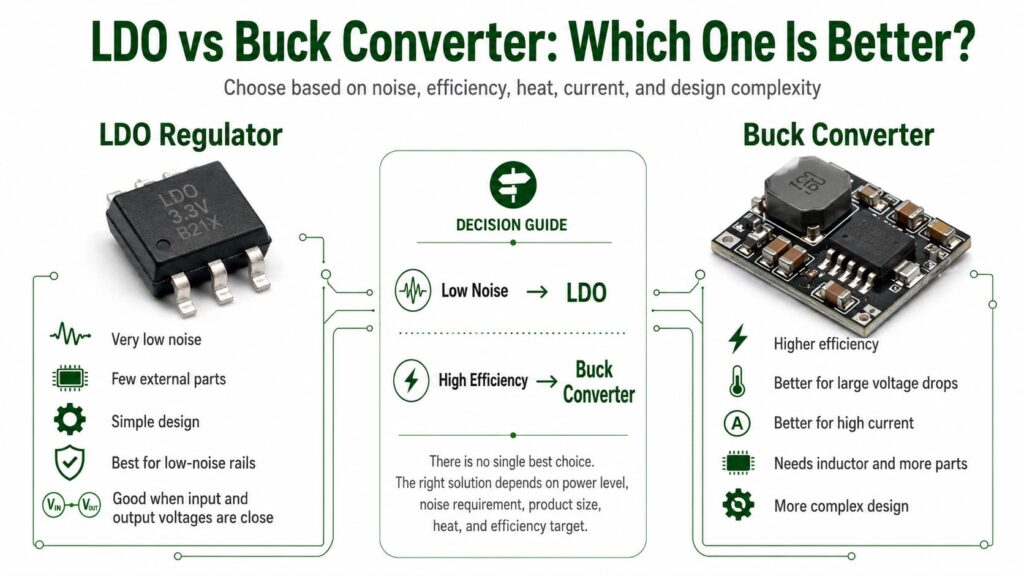
There is no single answer. The right choice depends on power level, noise requirement, product size, and efficiency target.
| Item | LDO Regulator | Buck Converter |
|---|---|---|
| Noise | Very low | Higher because of switching |
| Efficiency | Good when input and output voltages are close | Usually higher for large voltage drops |
| External parts | Few parts | Needs inductor and more parts |
| Design difficulty | Simple | More complex |
| Heat | Can be high at large voltage drops | Usually better at high current |
| Best use | Low-noise and low-current rails | High-current and high-efficiency rails |
A buck converter is usually better when the voltage drop is large or the load current is high. For example, converting 12 V to 3.3 V at high current with an LDO will create too much heat.
An LDO is usually better when the voltage drop is small, the current is not too high, and low noise is more important than maximum efficiency.
5.When Should You Use an LDO?
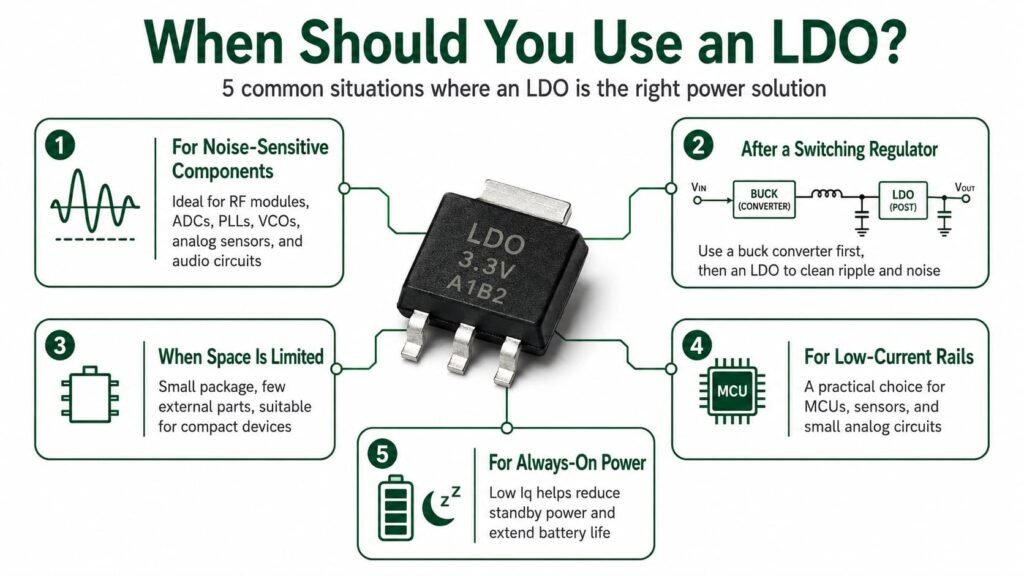
I. Use an LDO for Noise-Sensitive Components
LDOs are widely used to power RF modules, analog sensors, ADCs, VCOs, PLLs, and audio circuits. These components need clean power. Noise can reduce signal quality, cause measurement errors, or create unstable performance.
Analog Devices notes that ultralow-noise linear regulators are useful for PLLs, VCOs, mixers, LNAs, power amplifiers, and precision instruments.
II. Use an LDO After a Switching Regulator
A common design method is to use a buck converter first, then add an LDO after it.
The buck converter reduces voltage efficiently. The LDO then cleans the remaining ripple and noise. This method gives a balance between efficiency and clean power.
This is common in RF systems, industrial sensors, communication modules, and precision measurement products.
III. Use an LDO When Space Is Limited
Many LDOs come in small packages and need only a few external parts. This is useful for wearables, IoT modules, medical sensors, and compact industrial devices.
ST lists very small package options for LDOs, including flip-chip and DFN packages. For buyers, package size, pin compatibility, and reel availability should be checked early.
IV. Use an LDO for Low-Current Rails
If a microcontroller, sensor, or small analog circuit only needs a small current, an LDO may be more practical than a buck converter.
For example, if the system steps down from 3.7 V to 3.3 V at a light load, the power loss may be small. In this case, the simple design and low noise of an LDO may be more valuable than the higher efficiency of a switching converter.
V. Use an LDO for Always-On Power
Many electronic products have always-on sections. These sections may monitor buttons, sensors, memory, or wake-up signals while the main system is asleep.
For these loads, low Iq is very important. A low-Iq LDO can reduce standby power and help extend battery life.
6.Thermal Design: The Main Limitation of LDOs
An LDO reduces voltage by turning extra energy into heat. The basic power loss formula is:
Power loss = (Input voltage − Output voltage) × Load current
For example, if the input is 5 V, the output is 3.3 V, and the load current is 500 mA:
Power loss = (5 − 3.3) × 0.5 = 0.85 W
That heat must be managed. If the package cannot release the heat, the LDO may enter thermal shutdown or fail over time.
Before selecting an LDO, engineers and buyers should check:
Input voltage range
Output voltage
Maximum load current
Dropout voltage
Thermal resistance
Operating temperature range
Package type
Protection features
7.New Trend: Digital LDOs and Smarter Power Monitoring
One recent development is the digital LDO. Analog Devices describes the LT3074 as a digital LDO with a PMBus interface. It can support functions such as setting output voltage, setting current limit, and reading operating information such as input voltage, output voltage, load current, and temperature.
This does not mean all products need a digital LDO. For simple low-cost products, a standard LDO is enough. But for RF systems, medical equipment, high-end instruments, FPGA power rails, and industrial systems, monitoring and fault reporting can improve reliability.
8.LDO Sourcing Tips for B2B Buyers
When sourcing LDO regulators, do not only compare output voltage and current. A similar part number may still have a different package, output voltage, tolerance, temperature grade, or packing method.
Buyers should check:
Full manufacturer part number
Brand and original source
Package and pinout
Fixed or adjustable output
Dropout voltage
PSRR and output noise
Quiescent current
Temperature range
Automotive grade or industrial grade
Lifecycle status
Stock and lead time
Date code and traceability
For automotive and industrial applications, reliability is especially important. ST’s LDO40L, for example, is described as a 400 mA LDO for harsh automotive and industrial environments, with AEC-Q100 Level 1 qualification.
9.Conclusion
An LDO regulator is a simple but important power management IC. It is not always the most efficient choice, but it is often the right choice when the product needs low noise, simple design, compact size, or stable power for sensitive components.
Use an LDO when the input and output voltages are close, the load current is moderate, and clean power matters. Use a buck converter when efficiency and high current are more important.
For sourcing teams, the key is to check both electrical performance and supply risk. Dropout voltage, PSRR, Iq, package, lifecycle, traceability, and quality inspection all matter.
For LDO regulator sourcing, BOM review, original component supply, alternative part recommendations, and inventory support, our team can help review your requirements and provide suitable component options.
10.FAQ
1. What does LDO mean?
LDO means Low-Dropout Regulator. It is a linear voltage regulator that can provide stable output voltage with a small difference between input and output voltage.
2. Is an LDO better than a buck converter?
Not always. An LDO is better for low noise and simple design. A buck converter is usually better for high efficiency, high current, or large voltage drops.
3. Why is PSRR important in an LDO?
PSRR shows how well the LDO rejects input power noise. High PSRR is important for RF, analog, sensor, and precision measurement circuits.
4. What is quiescent current?
Quiescent current is the current used by the LDO itself. Low quiescent current helps battery-powered products run longer.
5. What should buyers check before purchasing LDO regulators?
Buyers should check the full part number, output voltage, current rating, dropout voltage, PSRR, noise, package, temperature grade, lifecycle status, stock source, and quality documents.