
Table of Contents
NAND vs NOR Flash: Key Differences, Applications, and 2026 Sourcing Tips
Introduction
NAND Flash and NOR Flash are two common types of non-volatile memory. Non-volatile memory means the chip can keep data even when power is turned off.
Although their names are similar, they are used in different ways. NOR Flash is mainly used for firmware and boot code. NAND Flash is mainly used for large data storage, such as files, logs, operating systems, eMMC, UFS, and SSDs.
For engineers and B2B buyers, choosing the right memory chip is not only a technical decision. It also affects cost, delivery time, software design, lifecycle planning, and long-term supply.
In 2026, memory sourcing needs more attention. AI servers, enterprise SSDs, data centers, industrial electronics, and embedded systems are increasing demand for memory components. TrendForce reports that AI and enterprise demand are creating tight NAND supply in some market segments.
1.What Is NOR Flash?
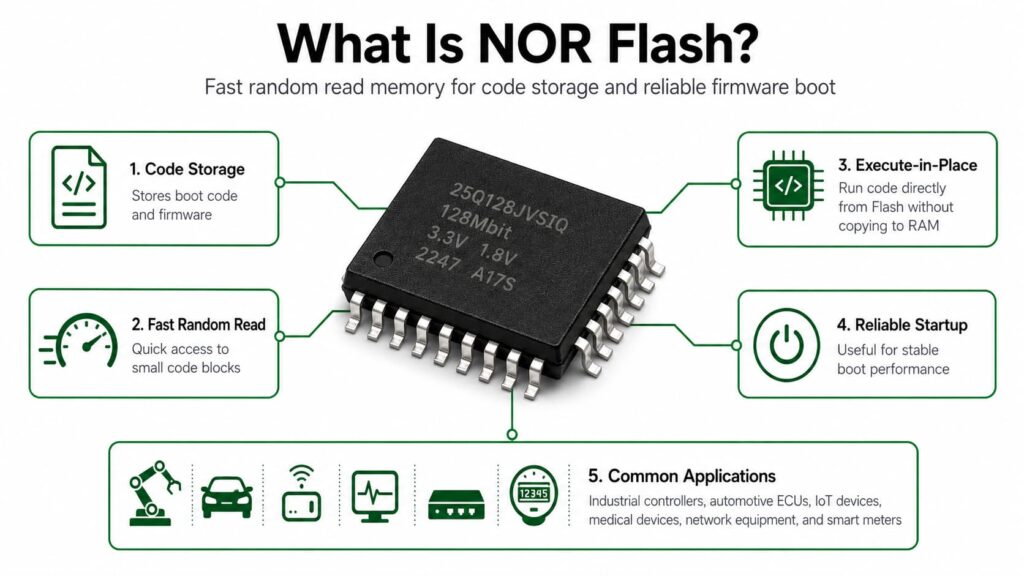
– NOR Flash is a memory chip mainly used for code storage.
Its main advantage is fast random read access. This means the processor can quickly read small pieces of code from different memory addresses. Because of this, NOR Flash is often used in systems that need fast startup and reliable firmware storage.
Common NOR Flash applications include:
– Boot code
– Firmware storage
– Industrial controllers
– Automotive ECUs
– IoT devices
– Medical devices
– Network equipment
– Smart meters
One important feature of NOR Flash is **Execute-in-Place**, also called **XiP**. XiP means the processor can run code directly from the Flash chip without first copying the code into RAM.
This can help reduce RAM usage and make the system start faster. It is useful for small embedded devices, industrial control systems, and products that need stable boot performance.
2.What Is NAND Flash?
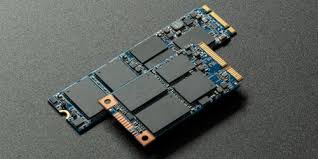
NAND Flash is mainly used for high-capacity data storage.
It is suitable when a product needs to store a large amount of data. NAND Flash is used in:
– SSDs
– eMMC
– UFS storage
– USB drives
– Memory cards
– Industrial storage modules
– Embedded Linux systems
– Data logging devices
NAND Flash usually has a lower cost per bit than NOR Flash. This means it is more cost-effective when large storage capacity is needed.
However, NAND Flash is more complex to use. It often needs error correction, bad block management, and wear leveling.
ECC, or Error Correction Code, helps find and correct some memory errors.
Bad block management means the system avoids using damaged memory areas.
Wear leveling spreads write and erase activity across the memory to help extend service life.
In simple words:
NOR Flash is better for code.
NAND Flash is better for data.
3.NAND vs NOR Flash: Main Differences
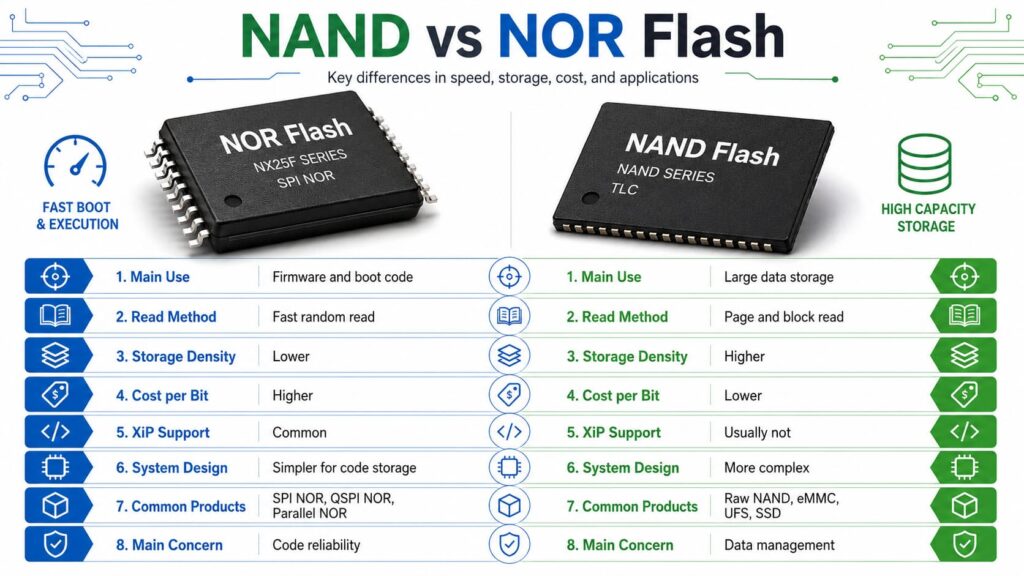
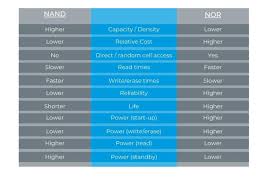
| Item | NOR Flash | NAND Flash |
|---|---|---|
| Main use | Firmware and boot code | Large data storage |
| Read method | Fast random read | Page and block read |
| Storage density | Lower | Higher |
| Cost per bit | Higher | Lower |
| XiP support | Common | Usually not |
| System design | Simpler for code storage | More complex |
| Common products | SPI NOR, QSPI NOR, Parallel NOR | Raw NAND, eMMC, UFS, SSD |
| Main concern | Code reliability | Data management |
4.Code Storage vs Data Storage
The biggest difference between NAND and NOR Flash is their main use.
NOR Flash is a good choice when the system needs to store and run firmware. Firmware is the basic software that controls hardware. Many embedded products need stable firmware storage because the device must start correctly every time.
For example, an industrial controller may use NOR Flash to store boot code. When the device powers on, the processor reads the code from NOR Flash and starts the system.
NAND Flash is better when the system needs large data storage. For example, an industrial gateway may store logs, images, system files, or user data. In this case, NAND Flash, eMMC, or UFS may be more suitable.
Some products may use both. NOR Flash can store boot code, while NAND Flash can store files and system data.
5.Capacity, Cost, and Design Complexity
NAND Flash has a strong advantage in storage density. If a product needs gigabytes of storage, NAND Flash is usually the better choice.
This is why NAND Flash is used in SSDs, eMMC, UFS, and memory cards.
NOR Flash is usually used at lower capacities. It is not normally used for large data storage because the cost per bit is higher.
However, for firmware storage, NOR Flash can still be practical. Even if the chip price is higher, the total system design may be simpler. This can reduce software work, testing time, and design risk.
For buyers, the lowest chip price is not always the lowest total cost. The full cost should include design effort, testing, qualification, replacement risk, and long-term supply.
6.How to Choose Between NAND and NOR Flash
Choose NOR Flash If:
The product needs firmware storage
Fast boot time is important
The system needs XiP
Storage capacity is not very large
Code reliability is important
The design needs a simple memory interface
The product has a long lifecycle
NOR Flash is suitable for bootloaders, firmware, MCU code storage, and embedded control systems.
Choose NAND Flash If:
The product needs large data storage
Cost per bit is important
The system stores files, logs, images, or OS data
The design can support ECC and bad block management
eMMC, UFS, or SSD storage is acceptable
Higher storage capacity is required
NAND Flash is better for data-heavy applications.
7.Conclusion
NAND Flash and NOR Flash are both important memory components, but they are used for different jobs.
NOR Flash is usually better for firmware, boot code, and Execute-in-Place applications. NAND Flash is usually better for large data storage and lower cost per bit.
In 2026, memory sourcing requires more planning. AI, enterprise SSDs, industrial demand, and long product lifecycles can affect supply and price. Buyers should check not only price and capacity, but also lifecycle status, lead time, original source, and replacement options.
For stable supply, work with a component sourcing partner that can support BOM review, original part sourcing, alternative recommendations, inventory checking, and quality inspection.
Need help sourcing NAND of NOR regulators? Send your BOM to Apex Components for fast quotation.