
Table of Contents
What is a logic chip?
Introduction
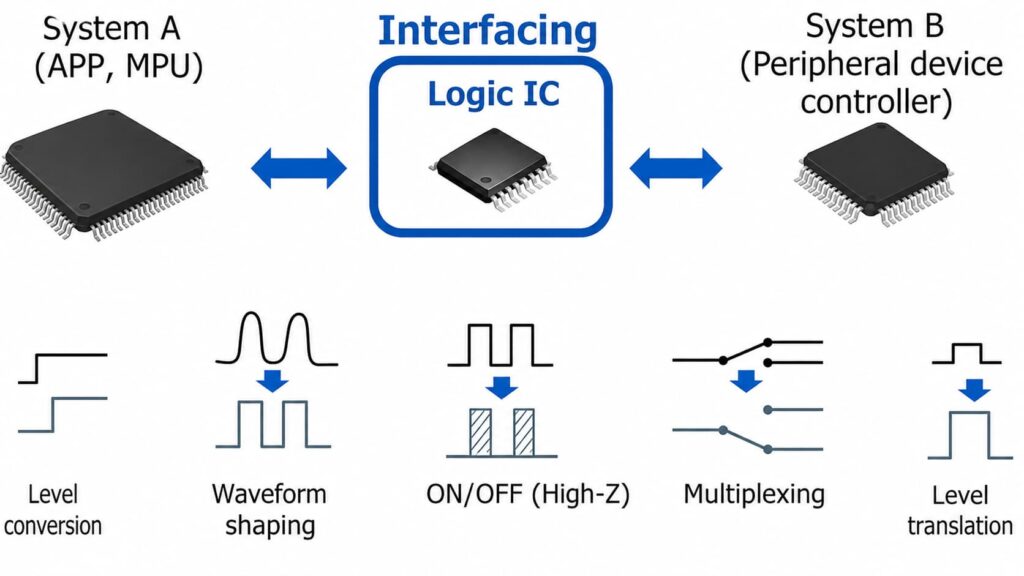
In the digital world, every complex operation—from a simple LED blink to high-speed data processing—is built upon the foundation of 0s and 1s. Logic chips are the fundamental integrated circuits (ICs) that process these high and low electrical signals. While modern microcontrollers (MCUs) have integrated many logic functions, discrete logic ICs remain essential for signal conditioning, level shifting, and high-speed glue logic in industrial and communication systems.
This guide explains what logic chips are, the most common families available today, and how to select the right ones for your BOM (Bill of Materials).
1.What Are Logic Chips?
Logic chips are digital ICs designed to perform logical operations based on Boolean algebra. They take one or more digital inputs (High/Low) and produce a digital output according to a specific truth table.
Digital Signal Control: They act as the “decision-makers” in a circuit.
Logic High and Low: Typically represented by the supply voltage (VCCVCC) and Ground (GND). In a 5V system, “High” is near 5V and “Low” is near 0V.
2.Common Types of Logic Chips
I. Logic Gates
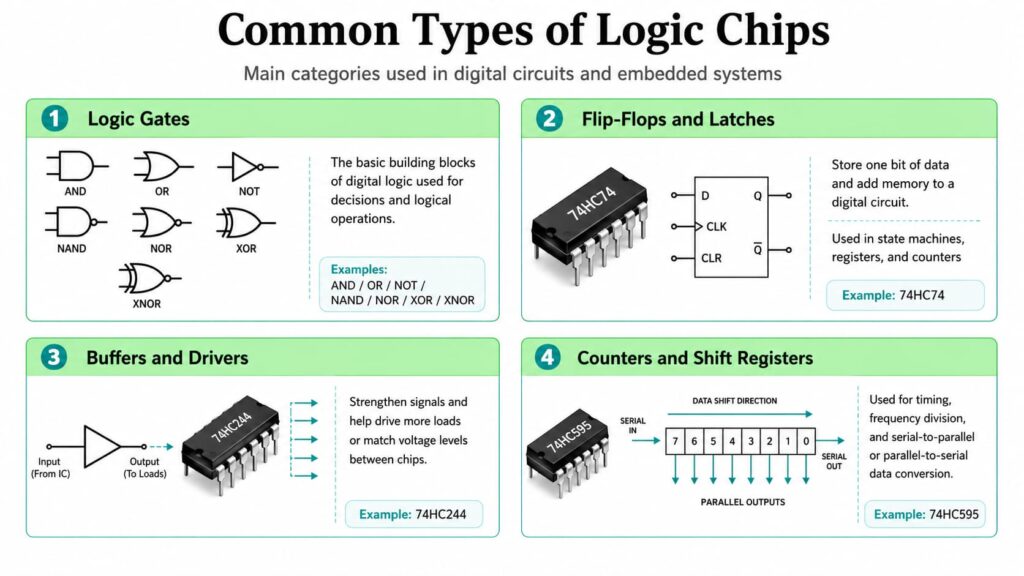
The building blocks of all digital logic. Common gates include:
AND / OR / NOT: Basic decision gates.
NAND / NOR: Universal gates (can build any other gate).
XOR / XNOR: Used for parity checks and arithmetic.
II. Flip-Flops and Latches
Unlike simple gates, these have “memory.” They are used to store a single bit of data and are essential for state machines and counters (e.g., 74HC74).
III. Buffers and Drivers
Used to strengthen a signal so it can drive more components or to match different voltage levels between chips (e.g., 74HC244).
IV. Counters and Shift Registers
Used for timing, frequency division, and converting serial data to parallel data (or vice versa), which is vital for reducing the number of pins used on an MCU (e.g., 74HC595).
3.Important Logic IC Families
Choosing the right “family” is the most critical step in sourcing logic ICs.
74LS Series (Low-power Schottky): An older bipolar technology. Fast, but consumes more power and operates strictly at 5V.
74HC Series (High-speed CMOS): The modern standard. Very low power consumption and operates over a wide voltage range (2V to 6V).
74HCT Series: A special version of the HC family that is compatible with TTL (LS) input levels. Perfect for mixing old and new systems.
4000 Series: An older CMOS family that can handle high voltages (up to 15V or 18V), though it is much slower than the 74 series.
Low-Voltage Families (LVC/ALVC): Designed for modern 1.8V and 3.3V systems used in mobile and high-speed computing.
4.Key Specifications
When reviewing a logic chip datasheet, focus on these parameters:
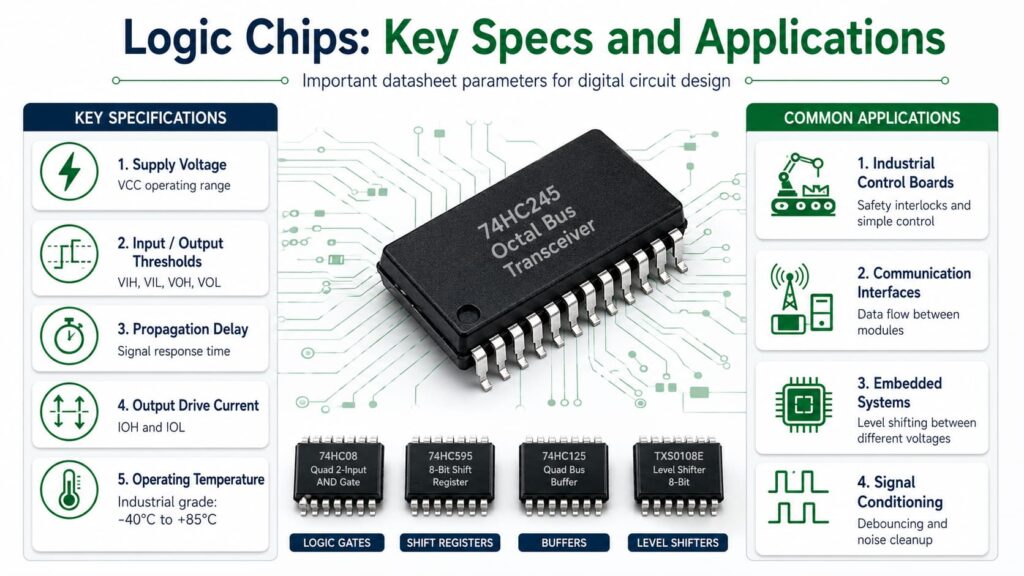
Supply Voltage (VCC): The required operating voltage range of the chip.
Input / Output Thresholds (VIH, VIL, VOH, VOL): The voltage levels used to recognize logic “High” and “Low” signals.
Propagation Delay (tpd): The time it takes for an input signal change to appear at the output, usually measured in nanoseconds.
Output Drive Current (IOH, IOL): The amount of current the chip can source or sink at the output.
Operating Temperature: The temperature range the chip can work in. Industrial-grade logic chips commonly support -40°C to +85°C.
5.Common Applications
Industrial Control Boards: Logic gates are used for safety interlocks and simple state control.
Communication Interfaces: Shift registers and buffers manage data flow between modules.
Embedded Systems: Level shifters allow a 1.8V processor to talk to a 5V sensor.
Signal Conditioning: Debouncing mechanical switches or cleaning up noisy signals.
6.How to Choose Logic Chips
Match Logic Family: Ensure all chips in a signal path are compatible (e.g., don’t drive an LS input with an HC output without checking thresholds).
Confirm Voltage Compatibility: Check if your system is 3.3V, 5V, or mixed.
Check Speed Requirements: Ensure the propagation delay won’t interfere with your timing.
Review Package and Stock: In 2026, SMD packages (SOIC, TSSOP) are much easier to source than traditional DIP versions.
7.Alternative and Replacement Notes
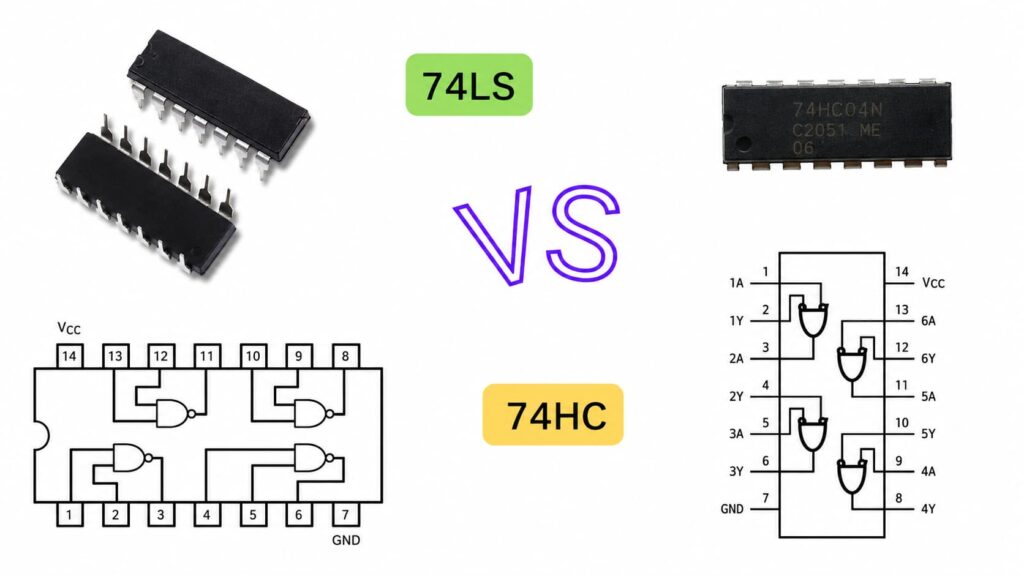
Caution: A 74LS04 and a 74HC04 are both Hex Inverters, but they are NOT always direct replacements.
Voltage: LS is 5V only; HC is 2-6V.
Input Thresholds: HC CMOS inputs require higher voltages for a “High” than LS TTL inputs. Using an LS chip to drive an HC chip may lead to unreliable operation. In such cases, use the 74HCT version.
8.Comparison Tables
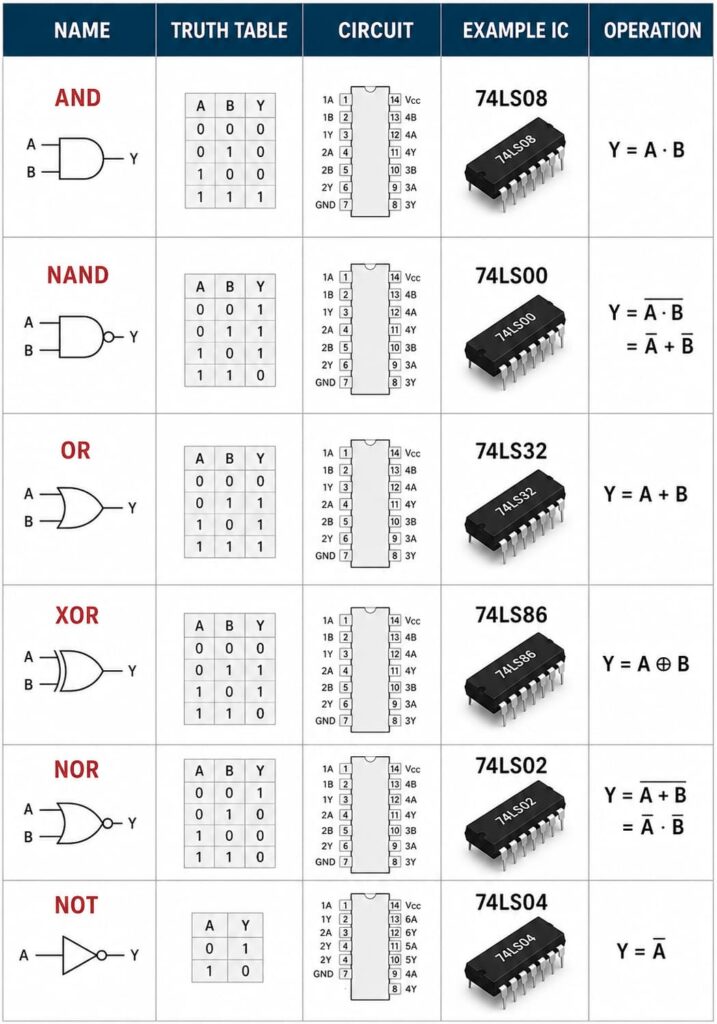
Table 1: Common Logic Gate Truth Table
| Gate Type | Logic Function | Typical Part (74HC) |
|---|---|---|
| AND | Output High only if ALL inputs are High | 74HC08 |
| OR | Output High if ANY input is High | 74HC32 |
| NAND | Output Low only if ALL inputs are High | 74HC00 |
| NOT | Inverts the input signal | 74HC04 |
| XOR | High if inputs are different | 74HC86 |
Table 2: Logic Family Comparison
| Family | Technology | Voltage Range | Speed | Power |
|---|---|---|---|---|
| 74LS | Bipolar (TTL) | 4.75V – 5.25V | Fast | High |
| 74HC | CMOS | 2.0V – 6.0V | Fast | Very Low |
| 74HCT | CMOS (TTL In) | 4.5V – 5.5V | Fast | Low |
| 4000 | CMOS | 3.0V – 18.0V | Slow | Very Low |
9.Conclusion
Logic chips are the quiet workhorses of the digital world. While they seem simple, correct selection depends on a precise balance of voltage, speed, and family compatibility. By choosing the right series—whether it’s the versatile 74HC or the high-voltage 4000 series—you ensure your digital control circuits remain stable and reliable.
Managing a complex BOM with mixed logic families or facing a shortage of specific 74-series parts? Our technical team specializes in logic IC matching and identifying high-quality pin-compatible alternatives. Send us your part numbers today for a professional BOM review and sourcing support.