
Table of Contents
Buck vs Boost Converter: What Is the Difference?
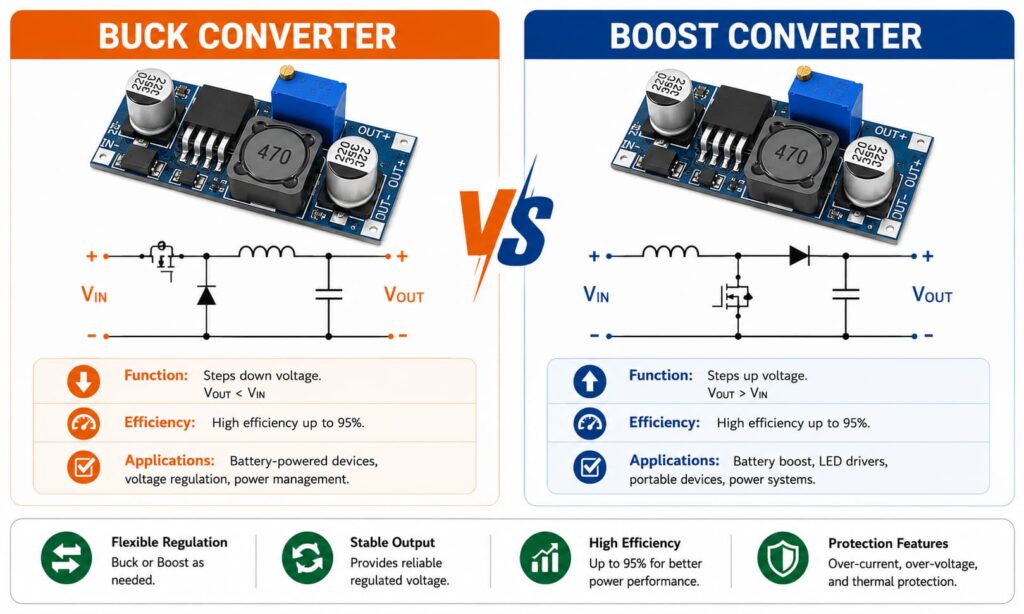
Introduction
In the complex landscape of modern electronics, the ability to manage power efficiently is the difference between a high-performance product and a design failure. At the heart of this management are DC-DC converters. As we navigate the technological landscape of 2026, these components have evolved far beyond simple voltage regulators.
Whether you are designing a high-speed industrial gateway using a 600MHz STM32H7RS or a high-density AI server, you likely need multiple voltage rails from a single power source. A 12V input may need to be stepped down to power a 5V sensor or a 1.2V core, while a single Lithium-ion cell may need to be boosted to drive a high-voltage LED string. This is where Buck and Boost converters—and their versatile cousin, the Buck-Boost—come into play.
1.What Is a Buck Converter?
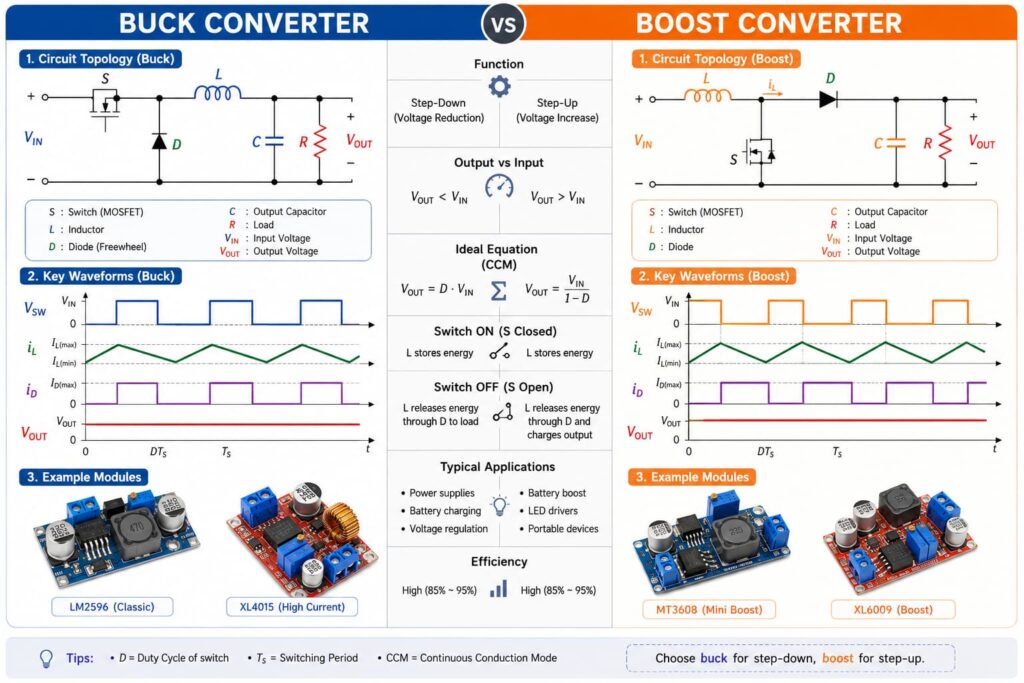
A Buck Converter is a step-down switching regulator. Its primary function is to convert a higher input voltage into a lower, regulated output voltage with maximum efficiency.
2.How a Buck Converter Works
A buck converter is a step-down switching regulator. Unlike a linear regulator, which wastes excess voltage as heat, a buck converter uses a switching element, usually a MOSFET, to rapidly switch the input voltage on and off. This switching action helps convert a higher input voltage into a lower, stable output voltage with better efficiency.
Core Components
| Component | Function |
|---|---|
| Switching MOSFET | Rapidly opens and closes to control the energy flow from the input source. |
| Inductor | Stores energy in a magnetic field when the switch is on and releases energy when the switch is off. |
| Diode or Synchronous MOSFET | Provides a current path for the inductor when the main switch is off. |
| Output Capacitor | Smooths the pulsed switching signal into a stable DC output voltage. |
Basic Formula
| Item | Formula |
|---|---|
| Output Voltage | Vout = Vin × D |
| Vin | Input voltage |
| Vout | Output voltage |
| D | Duty cycle |
Example
If the input voltage is 12V and the duty cycle is 25%, then:
Vout = 12V × 0.25 = 3V
So, the buck converter steps 12V down to 3V.
2026 Industry Context
In 2026, the focus has shifted toward Synchronous Buck Converters. Manufacturers like STMicroelectronics now offer extensive lines of AEC-Q100 qualified synchronous regulators designed specifically for automotive body electronics and low-noise industrial applications. These devices replace the traditional diode with a second MOSFET, significantly reducing power loss and improving thermal performance in compact designs.
3.What Is a Boost Converter?
A Boost Converter is a step-up switching regulator. It is used when the available power source provides a lower voltage than what the load requires.
How a Boost Converter Works
A boost converter steps low voltage up to higher voltage.
- Switch ON: inductor stores energy
- Switch OFF: inductor releases energy and raises output voltage
Formula:
Vout = Vin / (1 − D)
Critical Sourcing Note: Switch Current
For procurement teams, the most common mistake in sourcing boost converters is looking only at the output current. In a boost topology, the Peak Switch Current is significantly higher than the output current. If the IC’s internal MOSFET cannot handle this peak, the sensor or driver will fail under load.
Common Applications
LED Drivers: Powering backlight strings from low-voltage batteries.
Portable Instruments: Boosting a 3.7V Li-ion cell to a stable 5V or 12V rail.
Sensor Modules: Providing higher voltage for specialized precision analog circuits.
4.Buck vs Boost Converter: Key Differences
| Metric | Buck Converter | Boost Converter |
|---|---|---|
| Main Function | Steps voltage down (Step-down) | Steps voltage up (Step-up) |
| Output Voltage | Buck Converter: Vout < Vin | Boost Converter: Vout > Vin |
| Efficiency | Generally higher (Lower ripple) | Moderate (Higher current stress) |
| Thermal Focus | Power dissipation in MOSFET | Inductor and Switch Peak Current |
| Typical 2026 Use | 48V to 12V / 12V to 1.2V | Battery to 5V / 12V to 24V |
What Is a Buck-Boost Converter?
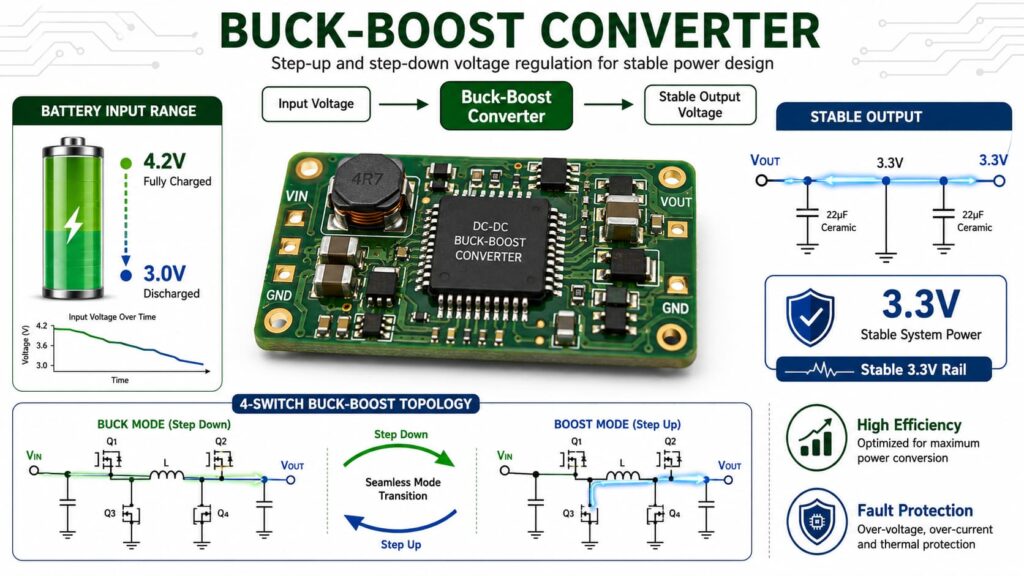
The Buck-Boost Converter is the “universal” solution. It can step voltage either up or down, making it essential for battery-powered devices where the battery voltage fluctuates above and below the required output.
The Li-ion Use Case
A standard Lithium-ion battery ranges from 4.2V (fully charged) to 3.0V (discharged). If your system requires a stable 3.3V rail, a buck converter will fail as the battery drops below 3.3V, and a boost converter will be inefficient when the battery is at 4.2V.
4-Switch Topology and 2026 Innovation
Modern designs favor the 4-switch buck-boost topology. Leading vendors like Analog Devices (ADI) have released parts like the MAX77845, which supports a 2.5V to 16V input and achieves up to 94% peak efficiency. These devices provide seamless transitions between modes and include advanced fault protection against input/output shorts.
5.How to Choose the Right Converter IC
Input/Output Range: Ensure the part handles the absolute maximum input voltage, including surges.
Peak vs. Continuous Current: Especially for boost and buck-boost, verify the internal switch current limits.
Efficiency Curve: Look for high efficiency at your typical load, not just the peak load.
Automotive Qualification: For IIoT and EV projects, AEC-Q100 and wide temperature ranges (-40°C to +125°C) are non-negotiable.
Lifecycle Status: Avoid NRND (Not Recommended for New Designs) parts. In the active 2026 market, parts facing EOL (End of Life) can cause immediate production halts.
6.Conclusion
Selecting between a buck, boost, or buck-boost converter is a strategic decision that affects the reliability and thermal footprint of your entire product. In 2026, the adoption of GaN technology and 48V systems is pushing the boundaries of what is possible in power density.
Are you optimizing your power system for 2026? Whether you need a high-efficiency GaN buck converter for an AI server or a robust AEC-Q100 boost IC for an automotive sensor, our team is here to help. Contact us today for a professional BOM review, alternative part recommendations, or a volume quote for your DC-DC converter requirements.