
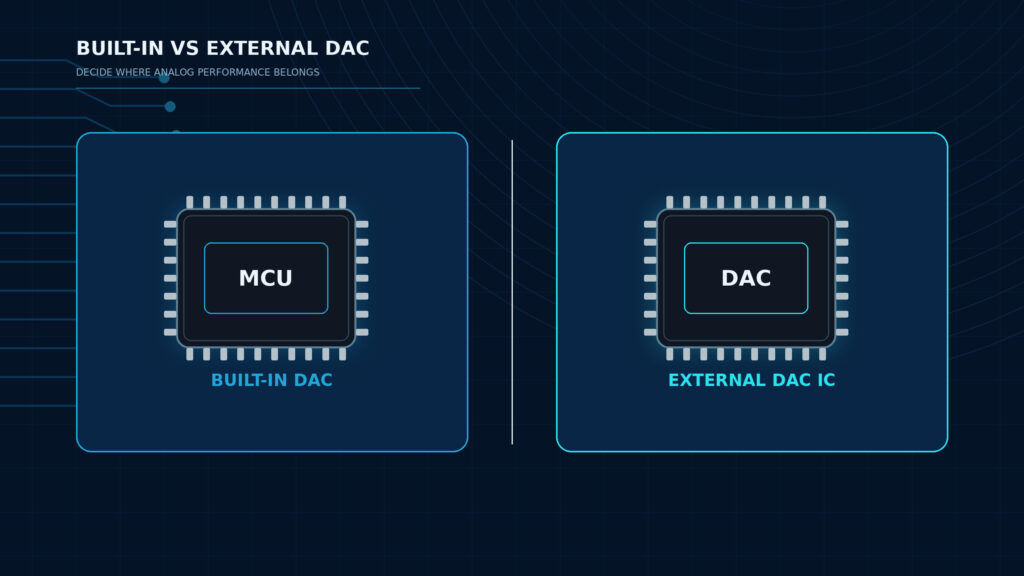
Not all devices have a built-in DAC, and even when an MCU, SoC, or mixed-signal controller includes one, that internal block is not always the right analog-output solution for a production design. A built-in DAC can be enough for simple biasing, low-speed control, waveform generation, trimming, or proof-of-concept work. An external DAC IC becomes the better choice when the design needs higher resolution, better accuracy, lower noise, more output channels, a stable reference strategy, isolation from digital noise, or a package and lifecycle that procurement can manage separately.
If your BOM needs a dedicated digital-to-analog converter, ApexComponent's digital-to-analog converter ICs category is the right starting point for comparing external DAC options. This article focuses on embedded and industrial electronics, not USB DAC adapters, headphones, DAP players, speakers, or consumer audio buying advice. The practical question is whether your circuit can rely on the DAC block already inside the processor, or whether it should specify a standalone DAC IC through I2C, SPI, or a parallel interface.
Do all devices have a built-in DAC?
No. Many devices include some form of digital-to-analog conversion, but that does not mean every device has a general-purpose built-in DAC that a hardware designer can use directly.
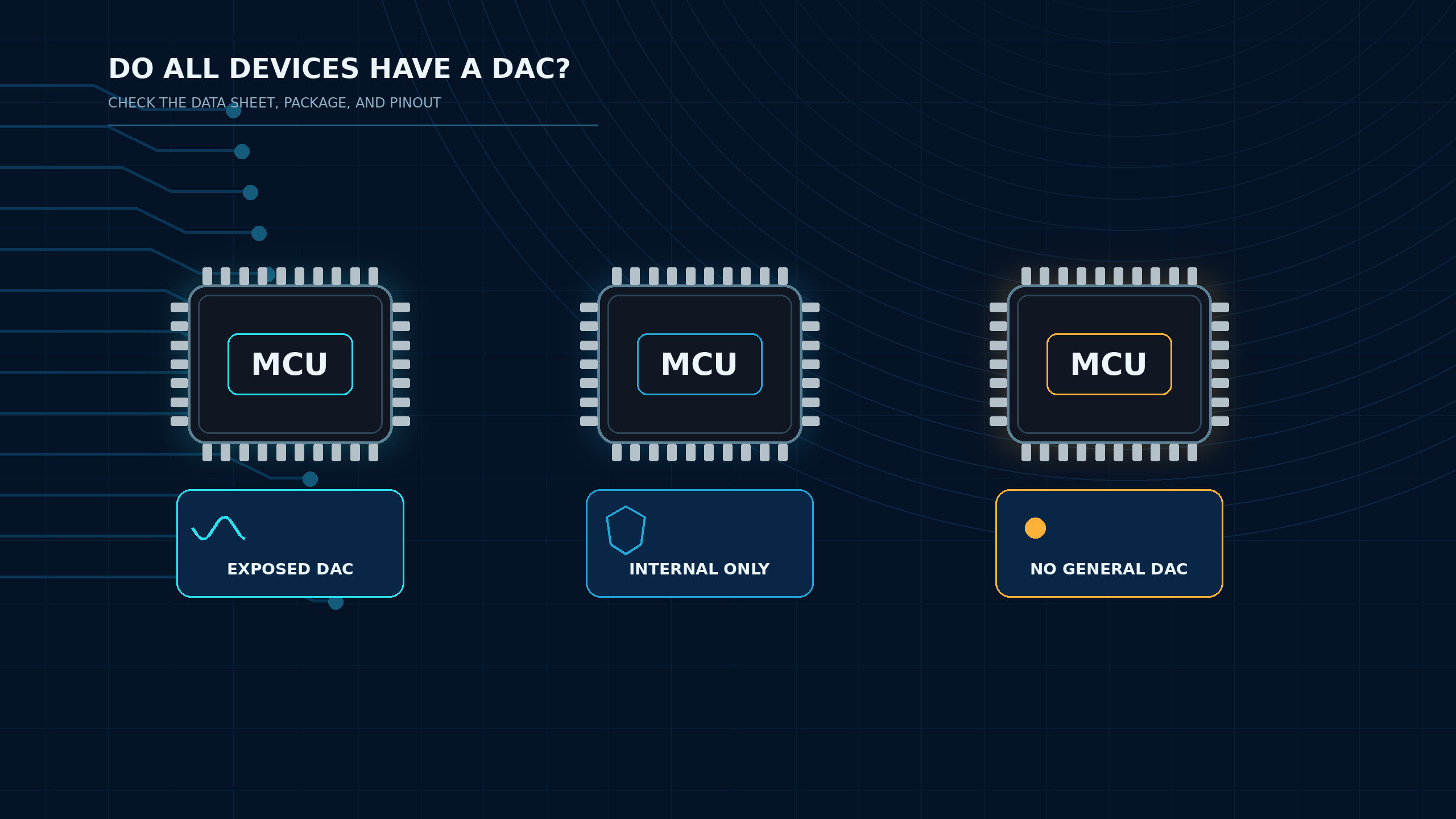
Some microcontrollers include one or more DAC output channels. Other MCUs offer only ADCs, PWM timers, comparators, op amps, or digital interfaces. Many application processors and SoCs contain audio, display, power-management, or RF signal paths with internal conversion blocks, but those functions may not be exposed as precision analog outputs.
For design work, treat "built-in DAC" as a specific datasheet feature, not a generic assumption. Check the MCU or SoC datasheet for DAC channel count, resolution, output buffer capability, reference options, output range, settling time, linearity, load drive, temperature limits, and pin availability. For a broader decision framework, see Do You Really Need a DAC IC?.
What built-in DAC blocks can and cannot do
Built-in DAC blocks are useful when the analog-output requirement is modest and tightly connected to the host controller. Typical use cases include simple threshold generation, low-speed control voltage, waveform demonstration, sensor offset trimming, bias setting, motor-control support, or audio and waveform experiments on development boards.
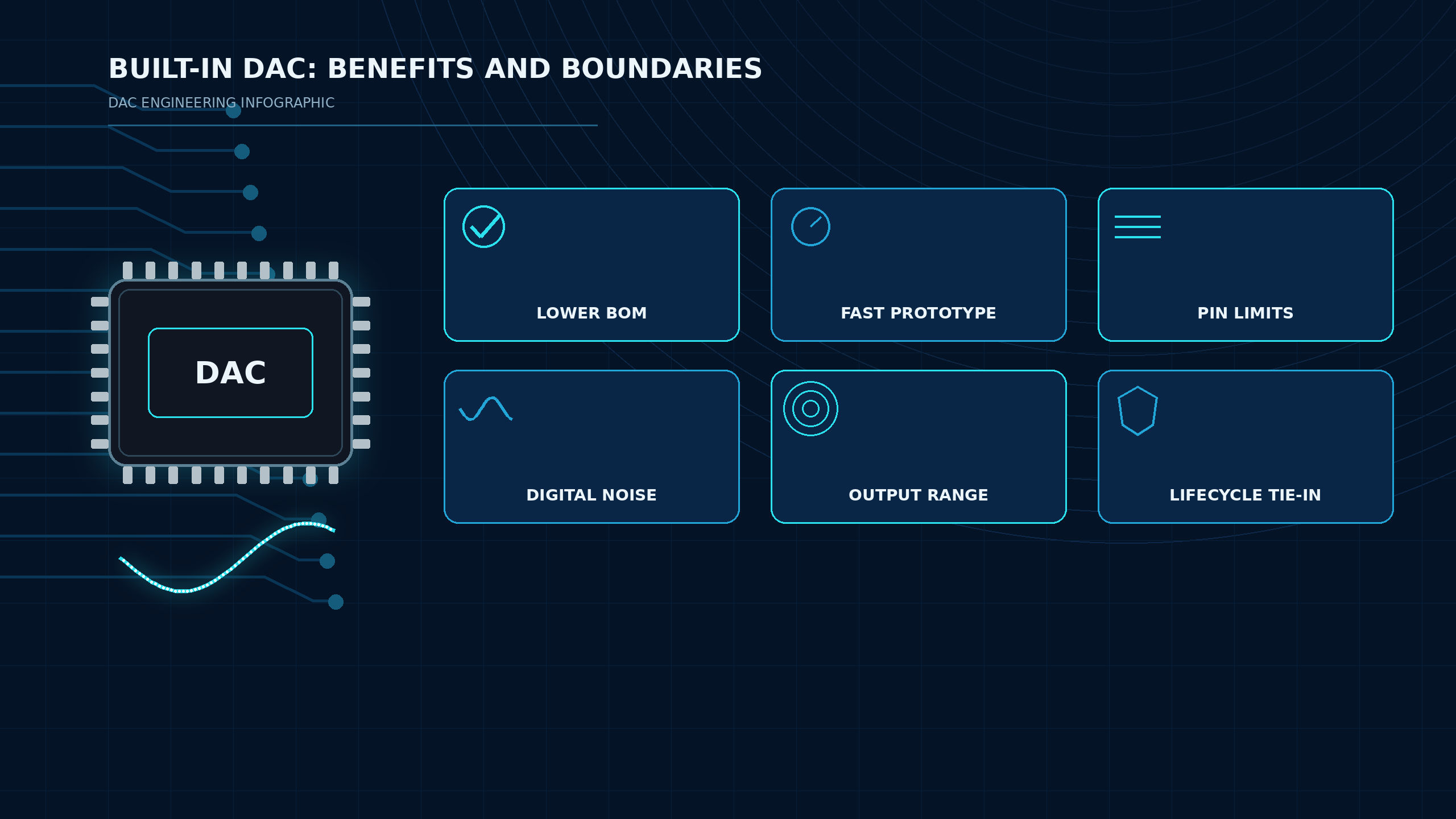
An MCU DAC can reduce part count because it avoids a separate IC, routing, interface pullups, and additional purchasing work. It can also simplify firmware because the peripheral is configured inside the same development environment as timers, DMA, GPIO, and ADCs.
However, internal DAC blocks have clear boundaries. They may have limited resolution, limited channel count, constrained output swing, modest drive capability, or stronger coupling to digital supply noise. Pin multiplexing can also turn the DAC into a layout constraint: the channel may exist in the silicon but be unavailable in the chosen package, or the same pin may be needed for another function.
| Built-in DAC advantage | Engineering limit to verify |
|---|---|
| No extra DAC IC in the BOM | Tied to MCU package, pinout, and processor lifecycle |
| Simple firmware integration | May have limited resolution, speed, or output-drive capability |
| Good for trimming, thresholds, and simple control | Analog performance can be affected by digital supply and layout noise |
| Lower board area for simple designs | Reference voltage and output range may not match system requirements |
| Fast for prototypes | Procurement cannot swap it independently from the MCU |
For more application examples, see What Is a DAC Used For?.
Why use an external DAC IC?
Use an external DAC IC when the analog output is important enough to define its own specifications, qualification path, and sourcing strategy. That usually happens when a design needs more predictable resolution, monotonic behavior, linearity, settling time, noise performance, reference control, channel count, output type, or interface behavior than the host controller can provide.
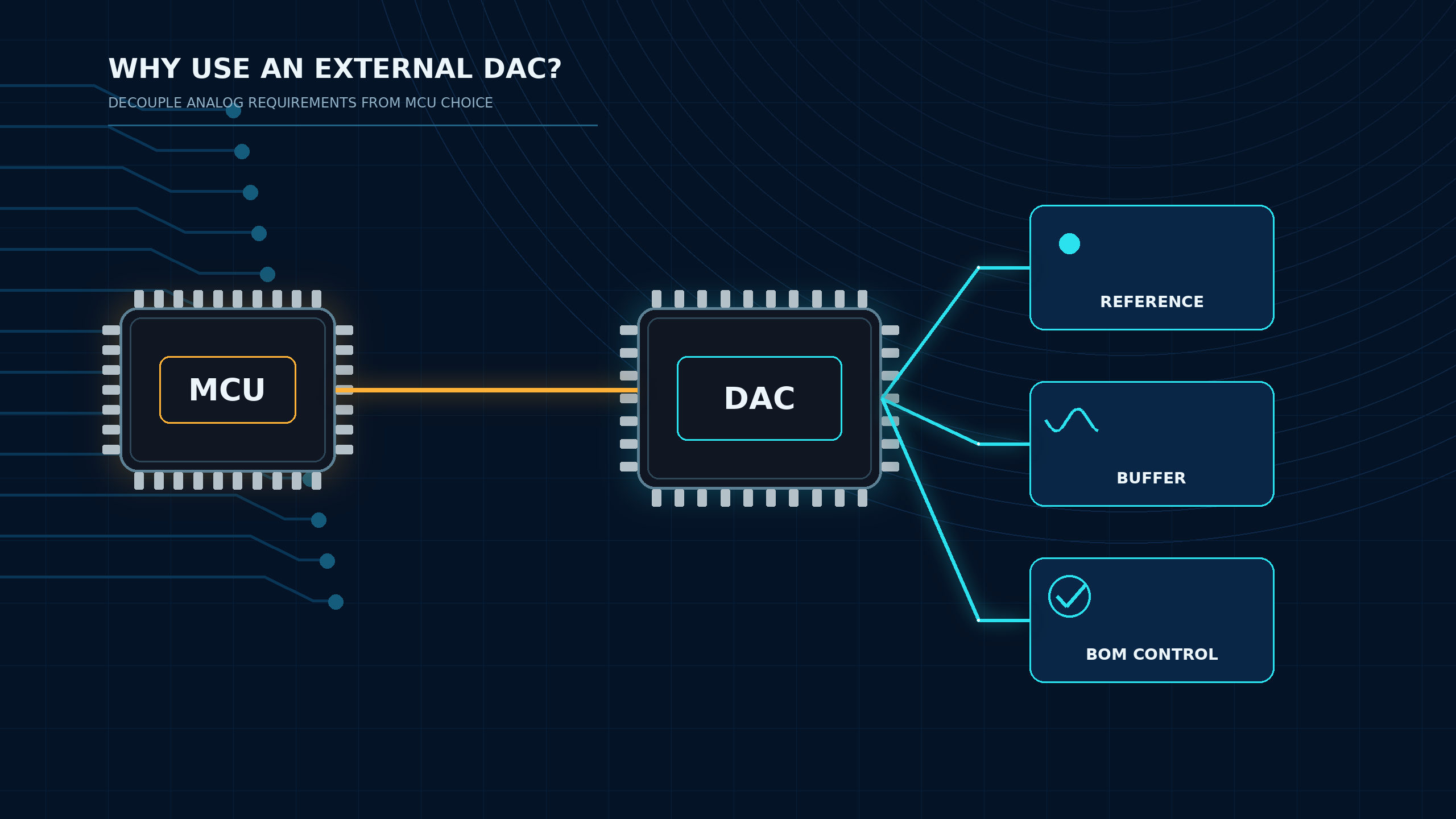
An external DAC IC can separate analog performance from processor selection. If the firmware team needs one MCU family but the analog-output requirement changes from 8-bit control to 12-bit, 16-bit, or multi-channel output, a dedicated DAC can absorb that change without forcing a processor redesign. It also gives procurement more flexibility: the DAC can be quoted, stocked, and risk-managed separately from the MCU.
The main tradeoff is added design responsibility. A standalone DAC needs an interface, reference planning, decoupling, layout attention, output filtering or buffering when required, and firmware support. It also adds a purchasable component, so the buyer must verify manufacturer, package, lifecycle, compliance, price, lead time, authorized sourcing, date-code limits, and approved alternatives before quoting or release.
If the design needs a deeper spec-by-spec decision process, use How to Choose a Good DAC IC with the checklist below.
I2C DAC, SPI DAC, and parallel DAC options
External DAC ICs are often selected by interface because the host already has available buses, pin constraints, and update-rate requirements.
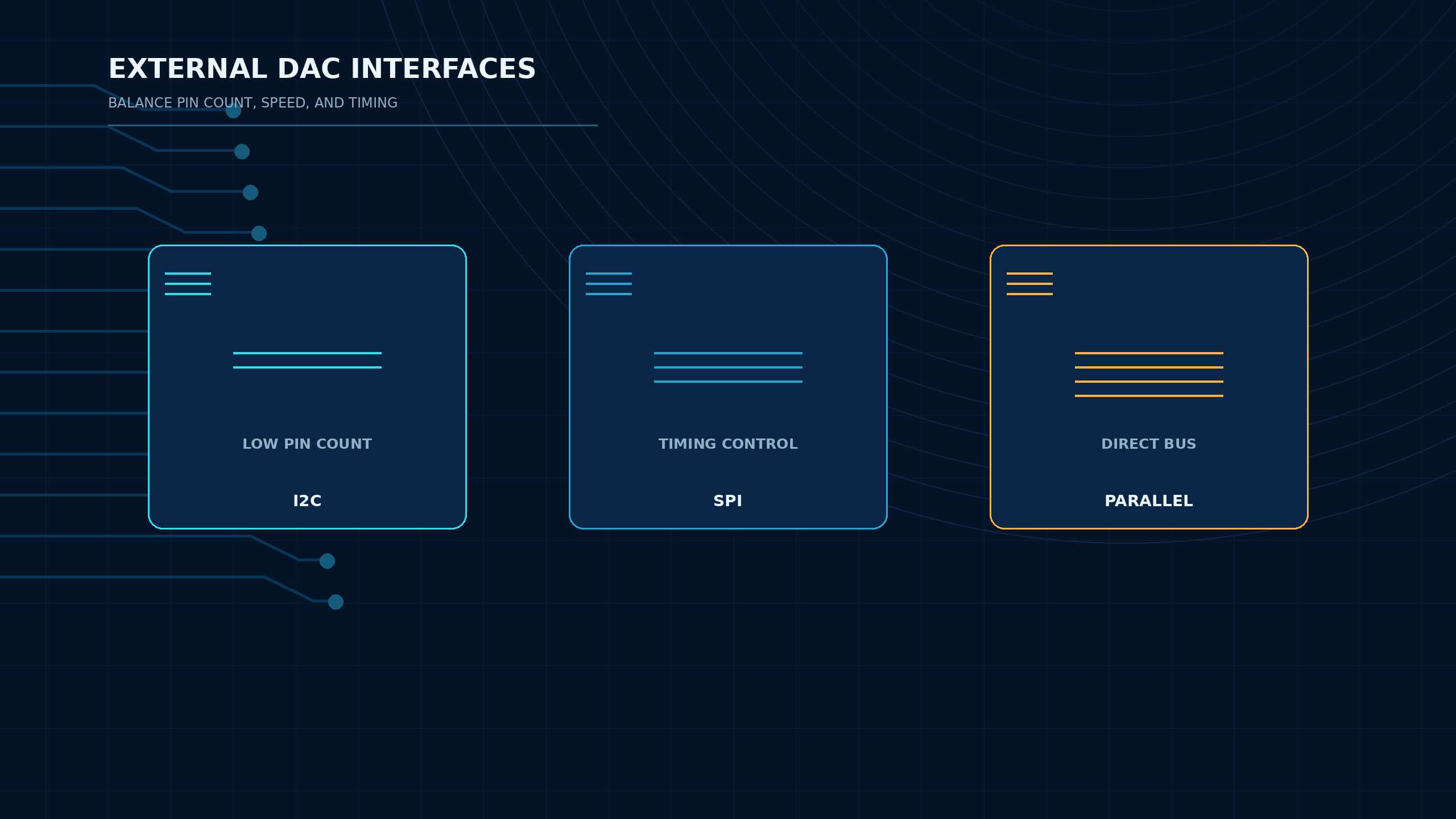
An I2C DAC is attractive when the design needs low pin count and moderate update speed. It can share a bus with sensors, EEPROMs, GPIO expanders, or other control ICs. The tradeoff is bus addressing, pullup design, bus capacitance, and lower throughput compared with many SPI or parallel options.
An SPI DAC is often used when update speed, deterministic timing, or multi-channel control matters. SPI normally uses more host pins than I2C, but it can provide higher data rates and simpler point-to-point control. A parallel DAC can be useful in legacy systems, high-speed conversion, or timing-sensitive designs where bus serialization is not desirable.
| Interface | Typical reason to choose it | Main tradeoff |
|---|---|---|
| I2C DAC | Low pin count, shared control bus, simple board-management outputs | Lower throughput and bus-loading constraints |
| SPI DAC | Faster updates, deterministic timing, broad DAC IC availability | More pins than I2C and chip-select planning for multiple devices |
| Parallel DAC | Fast or legacy digital updates, direct bus-style control | High pin count and larger routing burden |
Interface choice does not replace analog specification. A convenient I2C DAC is still wrong if resolution, output range, reference accuracy, or temperature drift do not match the design. For related performance boundaries, see Will a DAC Improve Signal Quality?.
MCP4725 as an I2C DAC example
The MCP4725 is a useful example of a small external I2C DAC because it shows why a separate DAC IC can be practical even when the host microcontroller is capable. Microchip describes MCP4725 as a single-channel, 12-bit, nonvolatile DAC with an I2C-compatible serial interface and EEPROM memory for storing DAC register data.
In an MCU design, an MCP4725-style DAC can free the processor selection from the analog-output requirement. The host only needs an I2C bus and firmware support. The DAC output is handled by a component whose resolution, interface, package, and behavior can be reviewed from its own datasheet.
Do not turn this example into an unsupported sourcing claim. Whether MCP4725 is the best option for a production design depends on resolution, output range, reference behavior, speed, package, temperature range, availability, price, lead time, and compliance requirements. For MCP4725 or any suggested alternative, inventory, pricing, lead time, certification, and drop-in replacement compatibility depend on the exact orderable suffix, package, quantity, date code, delivery date, supplier channel, and compliance requirement, so they must be confirmed through current sourcing data.
Built-in DAC vs external DAC IC selection checklist
Use the following checklist before deciding whether the built-in DAC is enough or the BOM should include an external DAC IC.
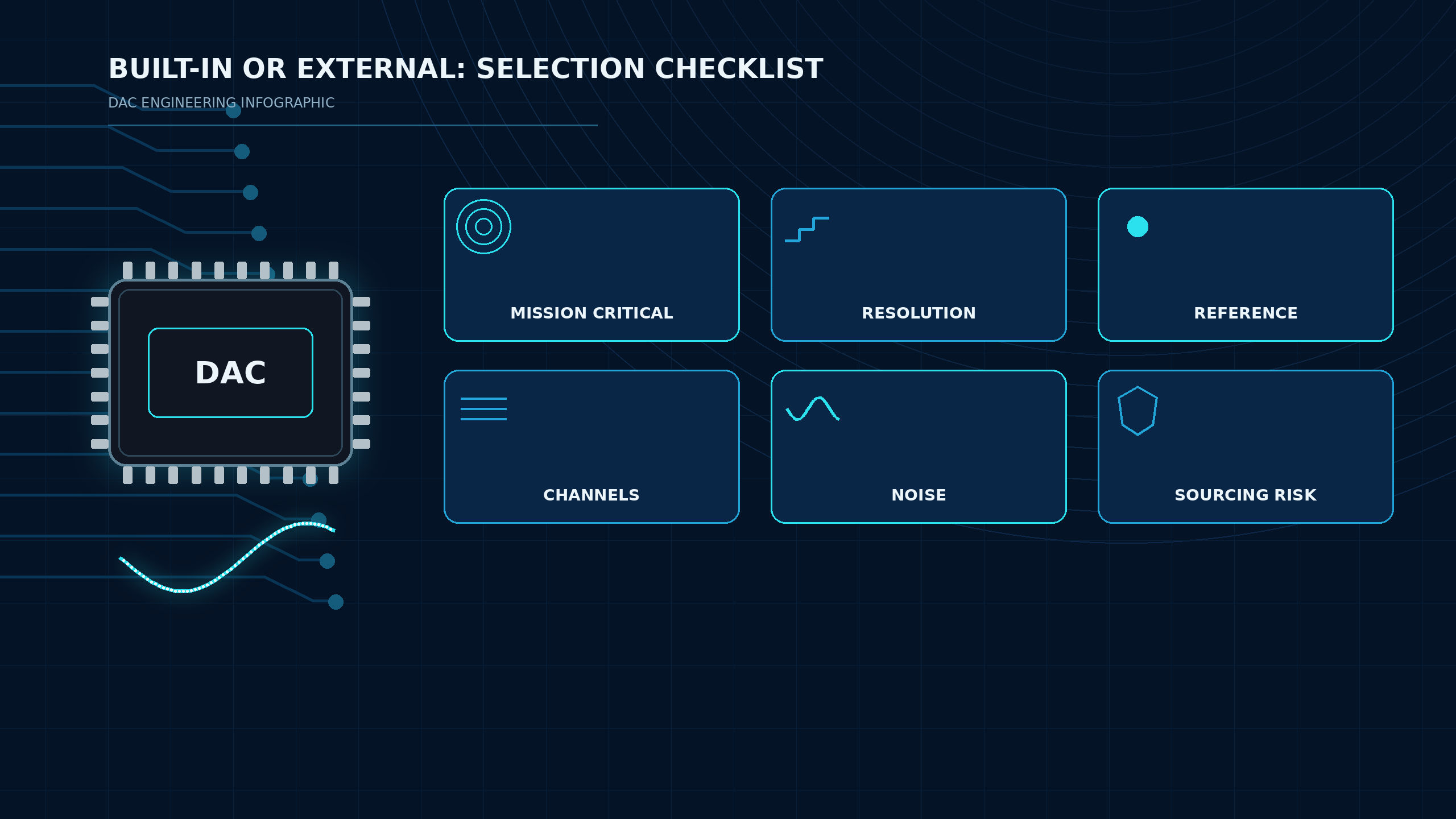
| Question | Built-in DAC may be enough when... | External DAC IC is safer when... |
|---|---|---|
| Is the DAC output mission-critical? | It only sets a coarse threshold, trim, or noncritical bias | It controls calibration, instrumentation, power, waveform, or industrial output |
| What resolution is required? | The internal resolution meets real system accuracy after noise and tolerance | The design needs higher resolution, monotonicity, or tighter linearity |
| What reference does the output use? | The MCU supply or internal reference is acceptable | A dedicated reference or stable analog rail is required |
| How many outputs are needed? | One or two MCU DAC channels are available in the selected package | Multi-channel output or independent analog placement is needed |
| Can procurement manage the risk? | The DAC requirement is inseparable from the selected MCU | The DAC should be quoted, stocked, or replaced independently |
- Required resolution and output range.
- Interface preference: I2C, SPI, or parallel.
- Number of channels and update-rate requirement.
- Reference voltage or reference accuracy requirement.
- Output load, buffer, and filtering assumptions.
- Package, board-space, temperature, lifecycle, stock, price, lead time, and replacement review status.
Treat sourcing data as live order data, not static article content. Inventory, price, lead time, certification files, package availability, and replacement approval must be tied to the exact orderable suffix, quote date, quantity, supplier channel, delivery date, and compliance requirement.
FAQ
Do all microcontrollers have a built-in DAC?
No. Some microcontrollers include DAC channels, while others only include ADCs, PWM, timers, or digital interfaces. Always verify DAC channel count, resolution, pin availability, reference options, and output limits in the selected MCU datasheet.
Is a built-in DAC better than an external DAC IC?
Not automatically. A built-in DAC is convenient and can reduce component count, but an external DAC IC may provide better specification control, more channels, cleaner analog layout, or independent sourcing.
When should I use an external DAC IC with a microcontroller?
Use an external DAC IC when the built-in DAC is missing, unavailable on the package, too noisy, too low in resolution, too limited in output range, or tied to an MCU lifecycle risk that procurement wants to separate.
Is MCP4725 a good I2C DAC example?
Yes, MCP4725 is a common example of a single-channel 12-bit I2C DAC with nonvolatile memory, but suitability for a production design depends on the datasheet, application limits, package, compliance, price, lead time, and availability.
Can PWM replace a DAC?
PWM plus filtering can replace a DAC in some low-cost or low-speed control tasks, but it is not the same as a precision DAC output. Ripple, response time, filter design, load behavior, and noise must be checked before using PWM as a substitute.
Compare external DAC IC options / Upload BOM
If the built-in DAC is not enough for your MCU or SoC design, use Upload BOM so the DAC requirement can be reviewed together with the controller, voltage reference, op amp or buffer, filters, power rails, package constraints, lifecycle risk, and approved alternates.