
Table of Contents
What Is a Gyroscope Sensor?
1.Introduction
A gyroscope sensor, also called a gyro sensor, is an important motion sensor in modern electronic products. It helps a device know how fast it is rotating or turning.
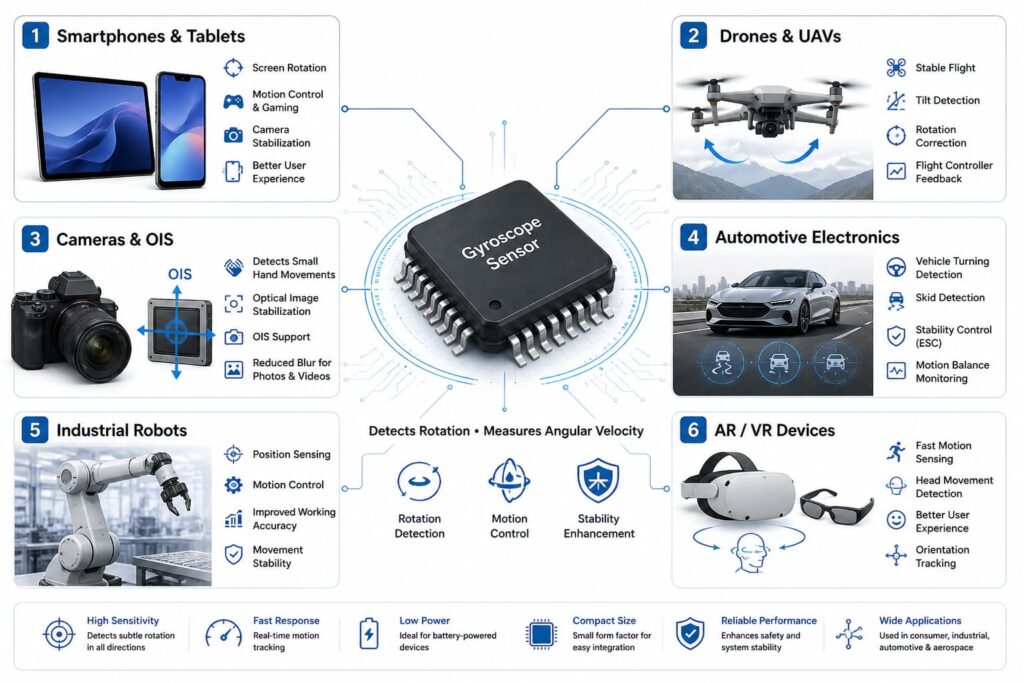
Gyroscope sensors are used in many products, such as smartphones, drones, cameras, robots, vehicles, and AR/VR devices. They help improve motion control, image stabilization, navigation, and safety functions.
For engineers and B2B buyers, choosing the right gyroscope sensor is not only about price. It also affects product accuracy, power use, reliability, and long-term supply.
This article explains what a gyroscope sensor is, how it works, where it is used, and what buyers should check before sourcing.
2.What Is a Gyroscope Sensor?
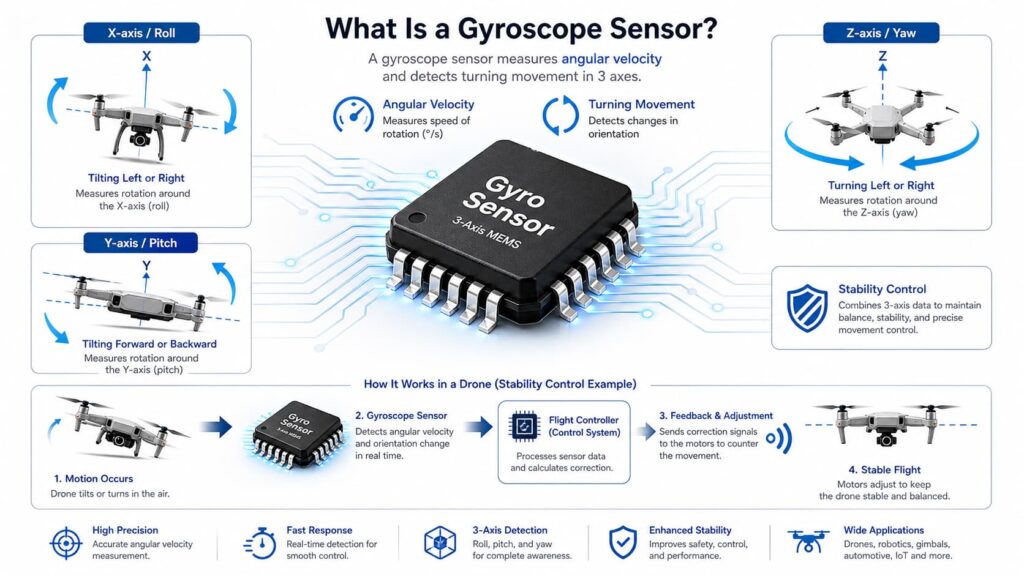
A gyroscope sensor is an electronic component that measures angular velocity.
Angular velocity means how fast an object is rotating around an axis.
In simple words:
A gyroscope sensor detects turning movement.
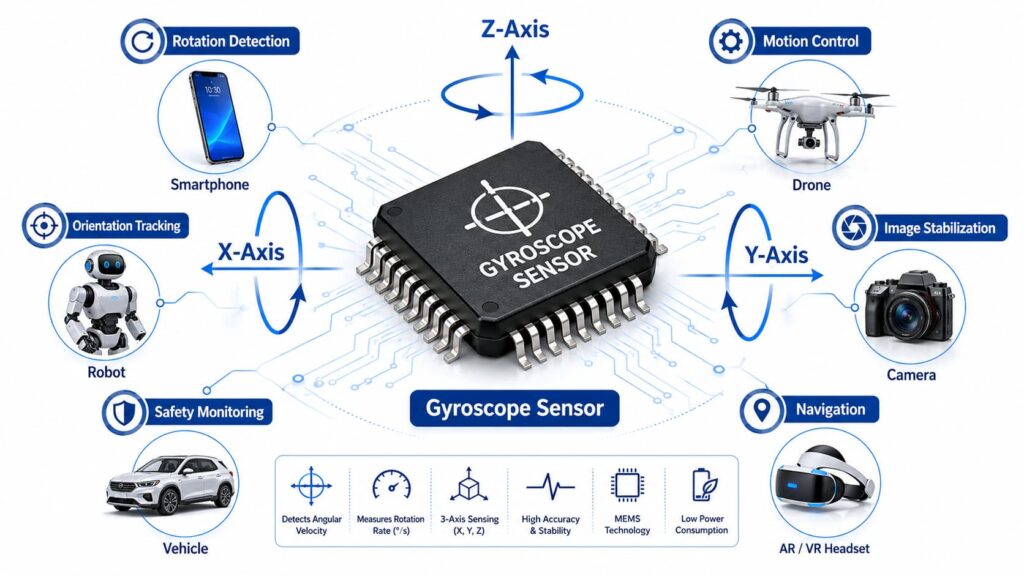
Most gyroscope sensors can measure movement on three axes:
X-axis / Roll: tilting left or right
Y-axis / Pitch: tilting forward or backward
Z-axis / Yaw: turning left or right
For example, when a drone tilts in the air, the gyroscope sensor detects this change. Then the control system can adjust the motors to keep the drone stable.
3.How Does a Gyroscope Sensor Work?
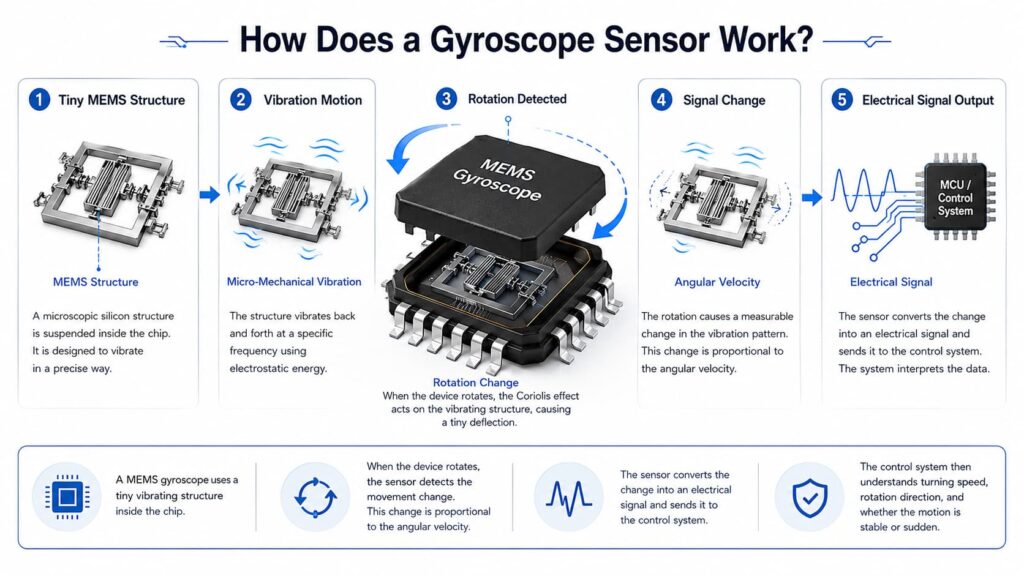
Modern electronic products usually use MEMS gyroscopes.
MEMS means Micro-Electro-Mechanical Systems. It means very small mechanical structures are built inside a chip.
A MEMS gyroscope has a tiny moving structure inside the sensor. This structure vibrates when the device is working. When the product rotates, the movement changes slightly. The sensor detects this change and converts it into an electrical signal.
The system can then understand:
– How fast the product is turning
– Which direction it is rotating
– Whether the movement is stable or sudden
This is why MEMS gyroscopes are widely used in small electronic devices
4.Gyroscope vs Accelerometer
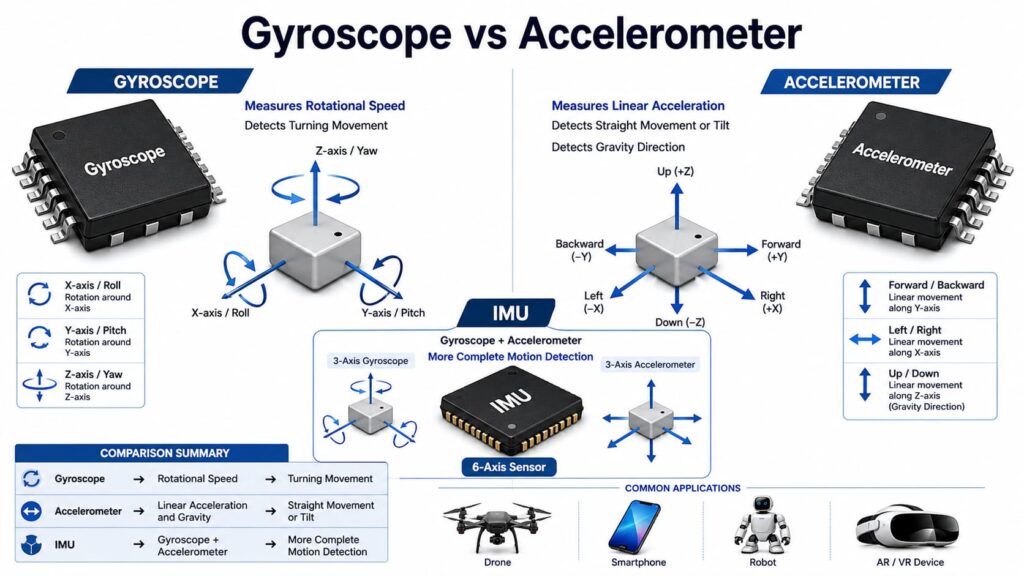
Many people confuse gyroscopes with accelerometers. They are both motion sensors, but they measure different things.
| Sensor Type | What It Measures | Simple Meaning |
|---|---|---|
| Gyroscope | Rotational speed | Detects turning movement |
| Accelerometer | Linear acceleration and gravity | Detects straight movement or tilt |
| IMU | Gyroscope + accelerometer | Detects more complete motion |
An accelerometer can tell if a device is moving forward, backward, up, or down. It can also help detect the direction of gravity.
A gyroscope can tell how fast the device is rotating.
In many electronic products, both sensors are used together. When a gyroscope and accelerometer are combined in one package, it is often called an IMU, or Inertial Measurement Unit.
A common IMU may be called a 6-axis sensor because it includes:
– 3-axis gyroscope
– 3-axis accelerometer
5.Main Types of Gyroscope Sensors
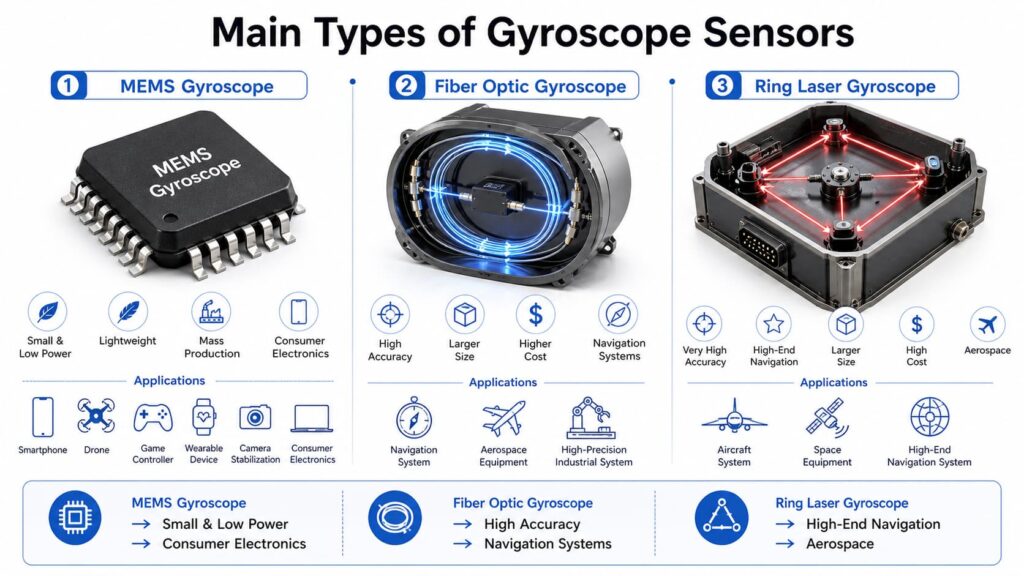
I.MEMS Gyroscopes
MEMS gyroscopes are the most common type in electronic products.
They are small, light, and suitable for mass production. They also use low power, which makes them good for portable devices.
Common applications include:
Smartphones
Drones
Game controllers
Wearable devices
Camera stabilization
Consumer electronics
II.Fiber Optic Gyroscopes
Fiber optic gyroscopes use light inside optical fiber to detect rotation.
They are more accurate than common MEMS gyroscopes, but they are also larger and more expensive.
Common applications include:
– Navigation systems
– Aerospace equipment
– High-precision industrial systems
III.Ring Laser Gyroscopes
Ring laser gyroscopes use laser light to measure rotation.
They are highly accurate, but they are not common in normal consumer electronics because of their size and cost.
Common applications include:
– Aircraft systems
– Space equipment
– High-end navigation systems
6.Common Applications of Gyroscope Sensors
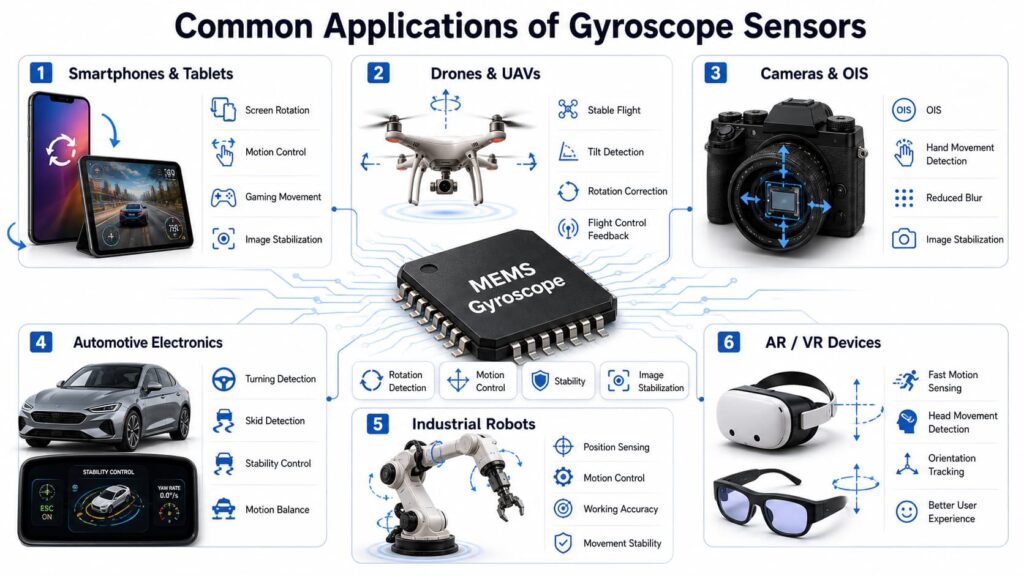
Smartphones and Tablets
Gyroscope sensors help phones detect screen rotation, motion control, gaming movement, and camera stabilization.
Drones and UAVs
Drones need gyroscopes to keep stable flight. The sensor helps detect unwanted tilt or rotation, so the flight controller can correct the movement.
Cameras and Optical Image Stabilization
In cameras and smartphones, gyroscopes help detect small hand movements. This supports optical image stabilization, also called OIS.
OIS helps reduce image blur when taking photos or videos.
Automotive Electronics
In vehicles, gyroscope sensors can support stability control systems. They help detect if a vehicle is turning, skidding, or losing balance.
Industrial Robots
Robots use gyroscopes to understand position and movement. This helps improve motion control and working accuracy.
AR/VR Devices
AR and VR devices need fast motion sensing. Gyroscopes help detect head movement and improve the user experience.
7.Key Specifications to Check Before Sourcing
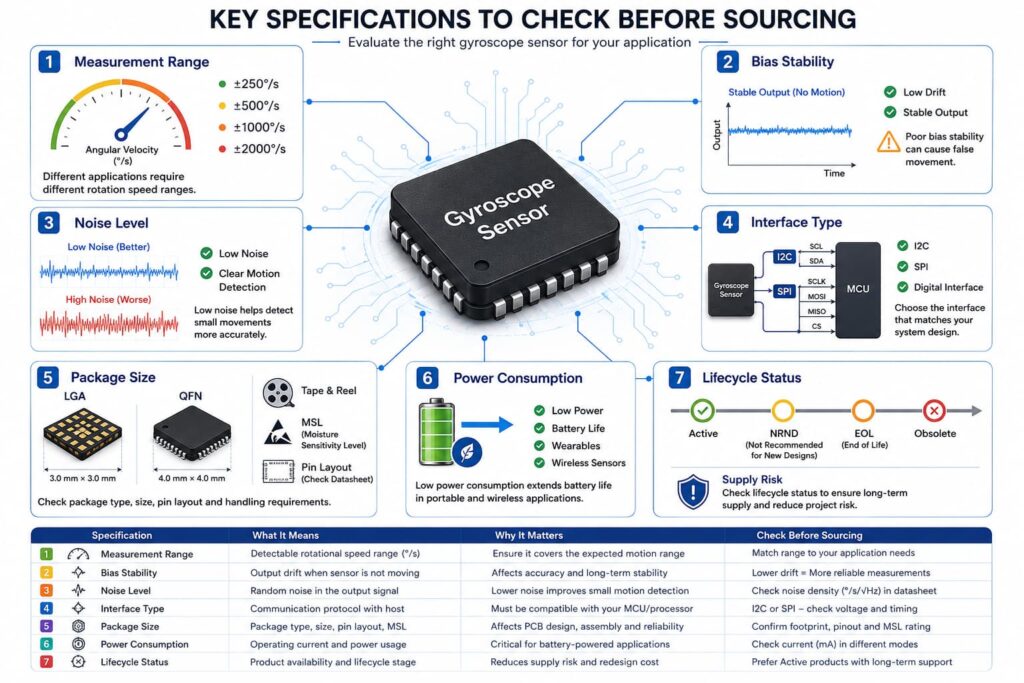
I.Measurement Range
The measurement range shows how much rotation speed the sensor can measure.
It is usually shown in **degrees per second**, written as **°/s**.
For example:
– ±250°/s
– ±500°/s
– ±1000°/s
– ±2000°/s
A drone may need a higher range than a simple handheld device.
II.Bias Stability
Bias stability means how much the sensor output changes when the sensor is not moving.
If bias stability is poor, the sensor may show small false movement. This is often called drift.
Low drift is important for navigation, robotics, and high-precision products.
III.Noise Level
Sensor noise can affect accuracy.
If the noise is too high, the system may not detect small movements clearly. For robotics, medical devices, and industrial equipment, low noise is usually important.
IV.Interface Type
Gyroscope sensors often use digital interfaces such as:
I2C
SPI
These interfaces allow the sensor to communicate with a microcontroller or processor.
Before sourcing, buyers should check whether the sensor interface matches the system design.
V.Package Size
Gyroscope sensors are available in small packages, such as LGA or QFN-style packages.
Buyers should check:
– Package type
– Package size
– Pin layout
– Tape and reel quantity
– Moisture sensitivity level
A wrong package may cause design or production problems.
VI.Power Consumption
For battery-powered products, low power consumption is important.
Wearables, handheld devices, and wireless sensors need components that can work with limited battery capacity.
VII.Lifecycle Status
Before using a gyroscope sensor in a long-term project, check whether the part is:
– Active
– Not recommended for new designs
– Near end-of-life
– Obsolete
This helps reduce future supply risk.
8.Gyroscope Sensor Sourcing Tips for B2B Buyers
When buying gyroscope sensors, do not only compare the basic part number. Similar part numbers may have different packages, temperature grades, interfaces, or performance levels.
Before purchasing, buyers should confirm:
– Full manufacturer part number
– Brand and original source
– Package type
– Interface type
– Measurement range
– Operating voltage
– Temperature range
– Date code and lot number
– Lifecycle status
– Stock availability
– RoHS / REACH compliance
– Original packaging condition
– Traceability documents
For industrial and automotive projects, quality control is more important. Buyers may need visual inspection, packaging inspection, X-ray inspection, or electrical testing.
If the original part is hard to buy, an alternative part may be possible. But the replacement must be checked carefully. The sensor range, interface, package, software support, and performance must match the system requirements.
9.Conclusion
A gyroscope sensor is a key motion sensor used to detect rotational movement. It helps electronic products understand turning, tilting, and movement direction.
MEMS gyroscopes are widely used because they are small, low-power, and suitable for many modern devices. They are common in smartphones, drones, cameras, robots, vehicles, and AR/VR equipment.
For engineers and procurement teams, selecting the right gyroscope sensor requires careful review of specifications, package, interface, quality, lifecycle status, and supply stability.
For gyroscope sensors, IMUs, motion sensors, or full BOM sourcing support, buyers should use traceable supply channels and check component details before purchase.
If you need original gyroscope sensors or IMU components for your project, our team can help check part numbers, stock status, package details, and replacement options. We support electronic component sourcing, BOM review, quality inspection, and long-term supply planning. Contact us to get sourcing support for your sensor components.
10.FAQ
1. What does a gyroscope sensor do?
A gyroscope sensor measures rotational movement. It tells the system how fast a device is turning around an axis.
2. What is the difference between a gyroscope and an accelerometer?
A gyroscope measures rotation. An accelerometer measures straight movement, tilt, and gravity. Many products use both sensors together.
3. What is a MEMS gyroscope?
A MEMS gyroscope is a very small gyroscope sensor built inside a chip. It is widely used in smartphones, drones, cameras, and wearable devices.
4. What should buyers check before sourcing gyroscope sensors?
Buyers should check the full part number, package, interface, measurement range, operating voltage, temperature range, lifecycle status, and traceability.
5. Can one gyroscope sensor replace another?
Not always. A replacement must match the package, interface, measurement range, power requirements, software support, and accuracy needs.