
Table of Contents
STM32 Package Types Explained: LQFP, QFN, BGA, and WLCSP
Introduction
When selecting an STM32 microcontroller, engineers often focus first on the core, Flash memory, SRAM, clock speed, and peripherals. These are important, but the package is just as critical. The same STM32 series may be offered in several package types, such as LQFP, QFN, BGA, and WLCSP. Each package affects size, pin count, routing difficulty, inspection method, replacement options, and sourcing risk.
For hardware engineers, package choice affects the STM32 footprint, pin access, thermal behavior, and layout flexibility. For buyers and BOM managers, package choice affects availability, lead time, approved alternatives, and long-term supply planning.
This guide explains the main STM32 package types in simple terms and shows how to choose the right package before sourcing or replacing STM32 microcontrollers.
1.What Are STM32 Package Types?
An MCU package is the physical body of the chip. It protects the silicon die and provides electrical connections between the internal chip and the product design. For STM32 microcontrollers, the package can define the number of pins, body size, pitch, mounting style, and inspection method.
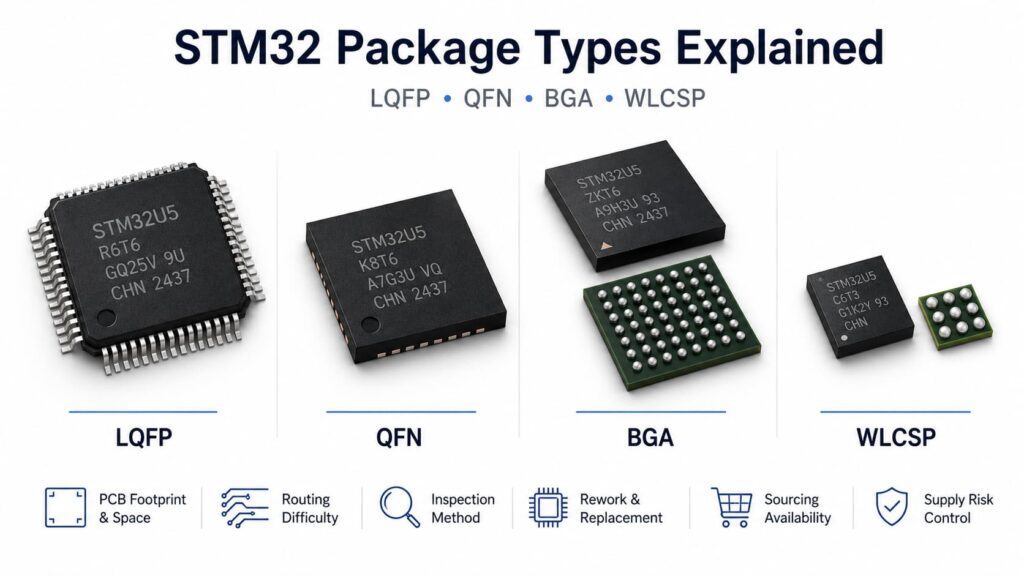
Common STM32 package types include:
LQFP
QFN or ST naming such as UFQFPN / VFQFPN
BGA, including UFBGA or LFBGA
WLCSP
The package is not only a mechanical detail. It can change which pins are available, which peripherals can be used, and whether one STM32 part can replace another. Two STM32 parts may have the same core and memory size but different packages, and they may not be drop-in replacements.
2.STM32 LQFP Package
What Is LQFP?
LQFP means Low-profile Quad Flat Package. It has visible metal leads on all four sides of the chip body. Many common STM32 microcontrollers use LQFP packages, especially in 32-pin, 48-pin, 64-pin, 100-pin, 144-pin, and 176-pin options.
Examples often seen in sourcing include STM32 parts in LQFP48, LQFP64, LQFP100, and LQFP144 packages.
Advantages of STM32 LQFP
LQFP is one of the easiest STM32 package types to understand and inspect. The pins are visible, so engineers and quality teams can check pin condition, solder joints, package marking, and orientation more easily.
LQFP is usually preferred when the product has enough space and the design does not require the smallest possible MCU footprint. It is also useful for prototypes, industrial products, control modules, and designs where serviceability and visual inspection are important.
Main advantages include:
Visible leads
Easier inspection
Common package availability
Easier handling than very small packages
Good option for many general-purpose STM32 designs
Limitations of STM32 LQFP
The main disadvantage of LQFP is size. Compared with QFN, BGA, or WLCSP, LQFP uses more board area. It also has lead pins around the package, so high-pin-count versions can become physically large.
For compact IoT devices, wearables, or high-density products, LQFP may not be the best choice.
3.STM32 QFN Package
What Is QFN?
QFN means Quad Flat No-lead. ST often uses package names such as UFQFPN or VFQFPN for QFN-style STM32 packages. These packages do not have long visible leads like LQFP. Instead, the terminals are located around the bottom edge of the package.
QFN packages are smaller than LQFP and are common in compact embedded products.
Advantages of STM32 QFN
The main benefit of QFN is space saving. It provides a smaller footprint and lower package height than many LQFP options. QFN can also provide good electrical performance because the connection path is short.
This makes STM32 QFN packages suitable for:
Compact IoT devices
Sensor modules
Handheld electronics
Smart home devices
Low-profile embedded products
QFN packages can also be a good middle point between easy-to-use LQFP and very compact WLCSP.
Limitations of STM32 QFN
QFN pins are not as visible as LQFP leads. This makes inspection more difficult. The exposed pad, pad size, solder paste design, and thermal pad connection may also need closer review.
For sourcing teams, QFN parts should be checked carefully because a similar STM32 part number may have a different package code, footprint, or pin count. A QFN version cannot directly replace an LQFP version unless the product design supports that package.
4.STM32 BGA Package
What Is BGA?
BGA means Ball Grid Array. Instead of side leads, a BGA package uses solder balls under the chip body. STM32 BGA package names may include UFBGA or LFBGA, depending on the family and package structure.
BGA packages are often used for higher-pin-count STM32 devices, especially when the design needs many I/O pins, memory interfaces, display interfaces, or advanced peripherals.
Advantages of STM32 BGA
BGA packages can support more connections in a smaller area compared with large LQFP packages. This is useful for high-performance STM32 series and feature-rich designs.
BGA can help when the application needs:
– Higher pin count
– External memory interface
– Display interface
– More communication ports
– Compact size with many signals
– Better signal routing options for advanced designs
For advanced STM32H7, STM32F7, STM32F4, and other high-pin-count MCUs, BGA may be a practical option when LQFP becomes too large.
Limitations of STM32 BGA
BGA packages are harder to inspect visually because the solder balls are under the chip. Quality control may require X-ray inspection for high-risk or high-value orders. Repair and rework are also more difficult than LQFP.
For buyers, BGA package selection should be confirmed early. If a project is designed around a BGA footprint, switching to an LQFP or QFN alternative later usually requires a major redesign.
5.STM32 WLCSP Package
What Is WLCSP?
WLCSP means Wafer Level Chip Scale Package. It is one of the smallest package types used for microcontrollers. In a WLCSP package, the package size is very close to the size of the silicon die itself.
STM32 WLCSP packages are used when the design must be extremely compact, such as in wearable devices, small wireless devices, and space-limited sensors.
Advantages of STM32 WLCSP
The main advantage of WLCSP is very small size. It is useful when product size is more important than easy inspection or replacement flexibility.
WLCSP can help in:
– Wearables
– Miniature IoT devices
– Portable medical devices
– Small sensor products
– Space-limited consumer electronics
Because WLCSP is very small, it can support compact product designs where LQFP or even QFN would be too large.
Limitations of STM32 WLCSP
WLCSP is usually the most demanding package type among the four discussed here. The balls or bumps are very small, and the pitch is tight. Inspection, handling, and replacement are more difficult.
For component sourcing, WLCSP should be used only when the design truly needs the smallest size. It may also have fewer direct replacement options compared with more common packages such as LQFP or QFN.
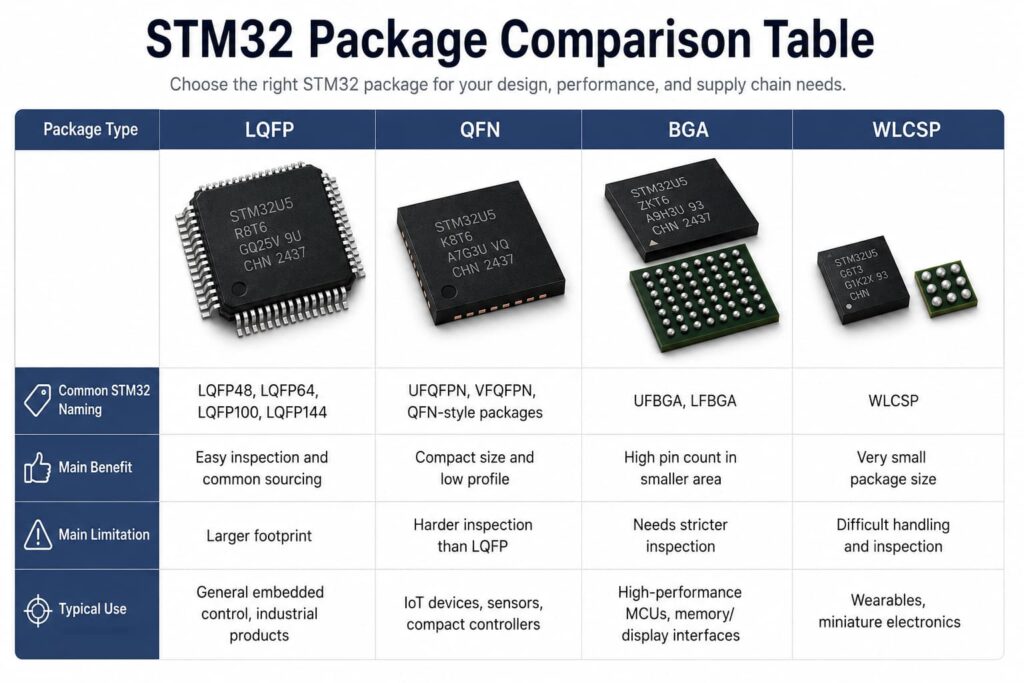
6.STM32 Package Comparison Table
| Package Type | Common STM32 Naming | Main Benefit | Main Limitation | Typical Use |
|---|---|---|---|---|
| LQFP | LQFP48, LQFP64, LQFP100, LQFP144 | Easy inspection and common sourcing | Larger footprint | General embedded control, industrial products |
| QFN | UFQFPN, VFQFPN, QFN-style packages | Compact size and low profile | Harder inspection than LQFP | IoT devices, sensors, compact controllers |
| BGA | UFBGA, LFBGA | High pin count in smaller area | Needs stricter inspection | High-performance MCUs, memory/display interfaces |
| WLCSP | WLCSP | Very small package size | Difficult handling and inspection | Wearables, miniature electronics |
7.How STM32 Package Type Affects Part Number Selection
STM32 ordering codes include information such as product family, device line, pin count, memory size, package, temperature grade, and packing option. However, the exact meaning of each character can vary between STM32 families, so buyers should not guess from the part number alone.
For example, an STM32 part number ending in a familiar package code may look similar to another device, but the actual package size, pin count, and footprint may be different. Always check the official datasheet and ordering information.
A sourcing checklist should include:
– Full manufacturer part number
– STM32 family and sub-series
– Package type
– Pin count
– Body size
– Pitch
– Temperature grade
– Packing method, such as tray, tube, or tape and reel
– Lifecycle status
– Approved replacement list
This is especially important when replacing an STM32 part during shortages. A part with the same core and memory may still fail as a replacement if the package or pinout is different.
8.Package Selection Tips for Engineers
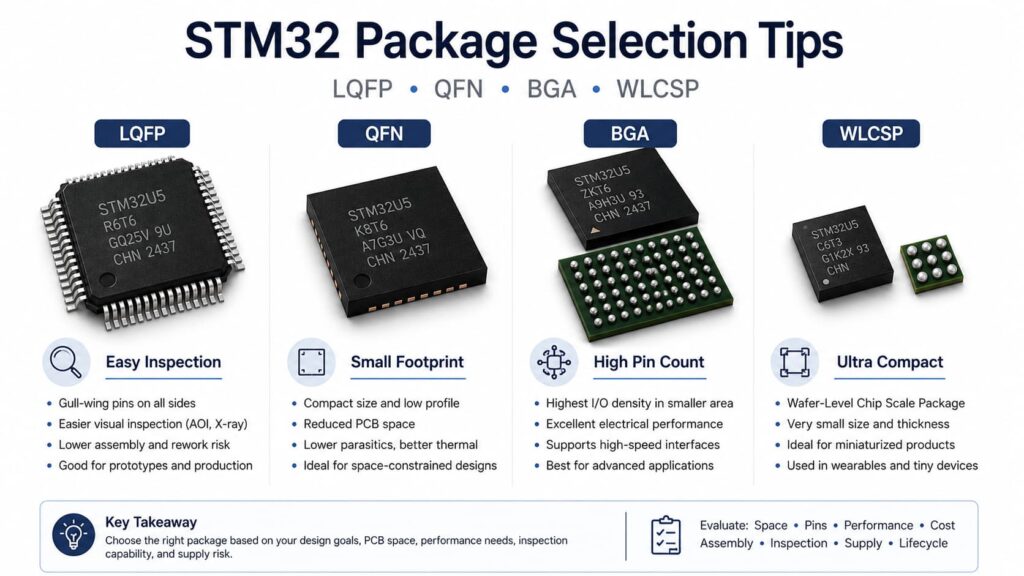
Choose LQFP for Easier Inspection and Lower Risk
LQFP is often a safe option when space is available. It is easier to inspect and easier to manage for many standard embedded products. It is also commonly available across many STM32 families.
Choose QFN When Space Matters
QFN-style packages are useful when the design needs a smaller footprint but does not require the extreme size reduction of WLCSP. Engineers should still review pad design, exposed pad connection, and inspection needs.
Choose BGA for High Pin Count
BGA is useful when the MCU needs many I/O pins or advanced interfaces. It is common in more complex STM32 designs. However, BGA requires stricter quality control and is not ideal if simple visual inspection is required.
Choose WLCSP Only for Very Compact Products
WLCSP should be selected when compact size is a major requirement. It is not the easiest option for sourcing, inspection, or replacement. Engineers and buyers should confirm long-term availability before using WLCSP in production.
9.Quality Control Points for STM32 Packages
When sourcing STM32 microcontrollers, package-related quality control should not be skipped. Check the package marking, pin or ball condition, moisture-sensitive packaging, date code, lot code, and label information.
For LQFP parts, inspect the leads for bending, oxidation, and coplanarity issues. For QFN packages, check package edges, bottom pad condition, and moisture control. For BGA and WLCSP packages, check ball condition and consider X-ray inspection for high-risk orders.
Buyers should also be careful with engineering sample markings. Parts marked as engineering samples should not be treated as normal production-grade components unless the engineering team has approved them for testing.
10.Conclusion
Understanding STM32 package types is important for both engineering and sourcing decisions. LQFP is easier to inspect and widely used. QFN saves space and is suitable for compact designs. BGA supports higher pin counts and advanced interfaces. WLCSP provides the smallest size but increases inspection and replacement difficulty.
For engineers, the package affects footprint, pinout, layout, and product size. For buyers and BOM managers, it affects availability, inspection, replacement options, and long-term supply risk.
Before selecting or replacing an STM32 microcontroller, always check the full part number, package drawing, recommended footprint, pinout, packing method, and lifecycle status. A correct package decision can reduce redesign risk, sourcing delays, and quality problems during production.