
LDO Voltage Regulators
Find fixed and adjustable low dropout regulator ICs by output voltage, current, dropout voltage, noise, quiescent current and package.
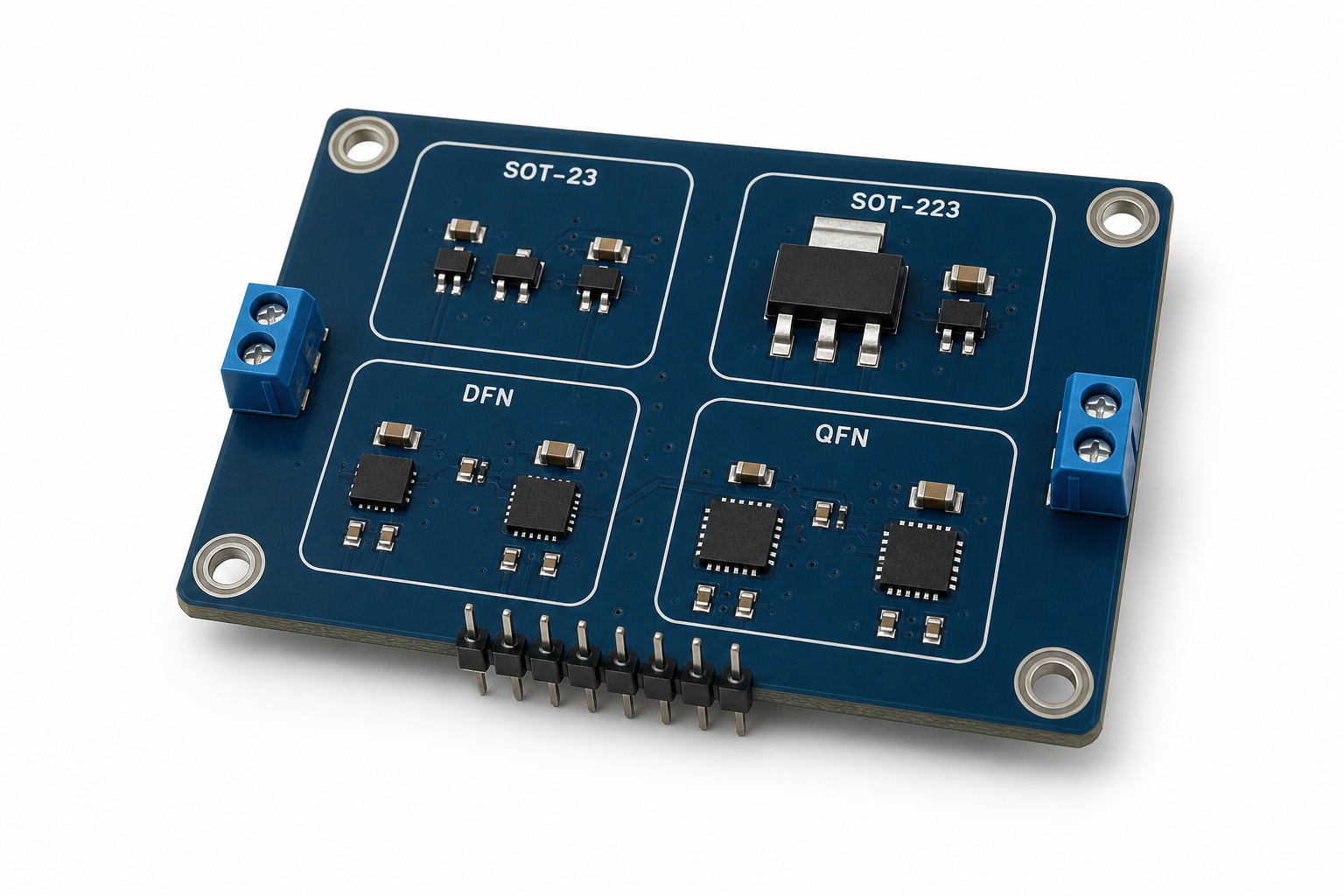
Ready to ship inventory
Inspection and traceability
Global sourcing support
Datasheet matching and alternatives
Find the Right LDO Regulator for Your Design
Share your voltage rail, current, package, noise or standby-power requirements. Our team can help match suitable LDO regulator ICs and prepare a sourcing quote.
Send an LDO BOM
Upload a part list for pricing, availability checks and package matching.
Submit BOMRequest LDO Pricing
Tell us the target part number, quantity and delivery requirement for a sourcing quote.
Request quoteFind an Alternative
Ask for replacement options when a regulator is obsolete, constrained or over budget.
Ask for alternativesShare LDO Requirements
Send your output voltage, current, package, dropout voltage, noise or standby-current requirements for matching support.
Send requirementsFeatured LDO Regulator Products
Browse selected LDO regulator products from the ApexComponent catalog, then send your target part number, quantity or BOM for sourcing support.
| Product | Brand | Package | Action |
|---|---|---|---|
| LDLN025 | STMicroelectronics | SOT-23-5 | View Product |
| LDL212 | STMicroelectronics | SOIC-8 | View Product |
| STLQ50 | STMicroelectronics | SOT-23-5 | View Product |
| LD49100 | STMicroelectronics | DFN-6 | View Product |
| ST1L05 | STMicroelectronics | DFN-8 | View Product |
| LK112S | STMicroelectronics | SOT-23-5 | View Product |
| L4940 | STMicroelectronics | TO-220 | View Product |
| LDK715 | STMicroelectronics | SOT-23-5 | View Product |
| ADP150 | Analog Devices | 5-lead TSOT-23 | View Product |
| ADP151 | Analog Devices | 5-lead TSOT-23 | View Product |
| ADP160 | Analog Devices | 5-lead TSOT-23 | View Product |
| ADP1740 | Analog Devices | 16-LFCSP | View Product |
| ADP1761 | Analog Devices | 16-LFCSP | View Product |
| ADP7102 | Analog Devices | 8-LFCSP | View Product |
| ADP7118 | Analog Devices | 8-LFCSP | View Product |
| ADP7150 | Analog Devices | 8-LFCSP | View Product |
| TPS7A02 | Texas Instruments | SOT-23-5 | View Product |
| TPS7A20 | Texas Instruments | SOT-23-5 | View Product |
| TPS7A52 | Texas Instruments | WQFN-12 | View Product |
| TPS7A66 | Texas Instruments | HTSSOP-14 | View Product |
LDO Sourcing Support Options
Send us your target LDO regulator part number, voltage rail, package, quantity or BOM list. ApexComponent can help check availability, match alternatives and prepare sourcing support.
Part Number Sourcing
For customers who already have a target LDO regulator model or approved vendor list.
- Check stock and lead time
- Confirm brand and package
- Support urgent sourcing needs
BOM Matching
Upload your BOM list for LDO regulator pricing, availability checking and package matching.
- Multi-line BOM review
- Quantity-based quotation
- Alternative part suggestions
Alternative Selection
When an LDO regulator is obsolete, constrained or over budget, our team can help review possible substitutes.
- Voltage and current review
- Package comparison
- Pinout and datasheet checking
Package Review
Share package requirements when board space, thermal margin or footprint compatibility matters.
- SOT-23, DFN, QFN and more
- Footprint-sensitive sourcing
- Thermal requirement notes
Voltage Rail Requirement
Tell us your output voltage, input voltage and load current requirements for suitable LDO regulator matching.
- Fixed or adjustable output
- Dropout voltage concerns
- Low IQ or low-noise needs
Industrial Supply Support
For production, repair, replacement and long-term sourcing requirements involving LDO regulator ICs.
- Production quantity support
- Supply risk review
- Cross-brand sourcing help
How to Select an LDO Regulator
Turn technical reading into concrete filter inputs and procurement actions.
Input and Output Voltage
Confirm the minimum input voltage is higher than output voltage plus dropout voltage.
Output Current
Check normal load, peak load, startup current and thermal derating.
Dropout Voltage
Use lower dropout parts when the input rail has limited margin.
IQ, Noise and PSRR
Battery devices need low IQ. RF, ADC, DAC and audio rails need noise and PSRR review.
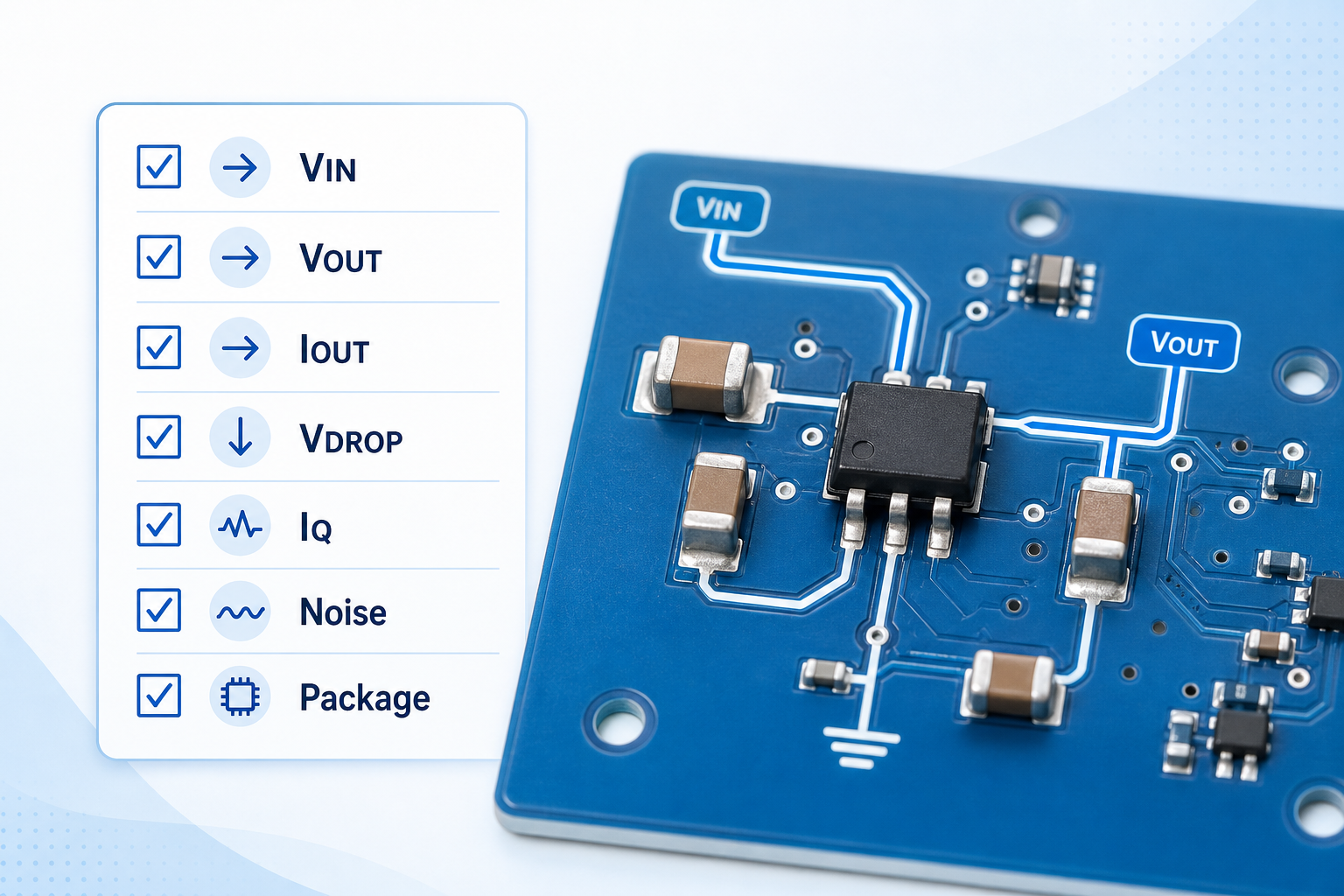
Selection Checks
VIN(min) > VOUT + VDROP
Power Dissipation = (VIN - VOUT) x IOUT
Use datasheet conditions, package thermal resistance, PCB copper area and operating temperature before approving a replacement part.
LDO vs Other Regulators
Compare LDOs with switching and standard linear regulators before choosing a part for noise, efficiency, thermal margin and sourcing requirements.
| Type | Main Advantages | Design Tradeoffs | Best Fit | Procurement Notes |
|---|---|---|---|---|
| LDO | Low output noise, strong ripple rejection, fast transient response and a simple circuit with few external components. | Efficiency falls when VIN is much higher than VOUT, so dropout voltage, load current and package heat must be checked. | RF modules, sensors, ADCs, DACs, audio rails, MCU rails and post-regulation after a switching converter. | Confirm output voltage, current rating, dropout, IQ, noise, PSRR, package, temperature grade and manufacturer availability. |
| Buck Converter | High efficiency for large voltage step-down, high current rails and battery systems where heat loss must be minimized. | Requires inductor, switching layout care and EMI review. Output ripple and switching noise may need filtering or an LDO post-regulator. | High current digital rails, wide VIN systems, 12V to 5V or 5V to 1.xV conversion and power-sensitive designs. | Check switching frequency, inductor availability, compensation, layout reference and whether a downstream low-noise LDO is needed. |
| Standard Linear | Simple, familiar and cost-effective for non-critical rails with enough input headroom. | Usually higher dropout than modern LDOs and can create more heat when the input-output voltage gap is large. | Legacy boards, general regulation, low-cost repairs and applications where dropout is not tight. | Verify pinout, package, dropout and thermal limits before replacing with an LDO or another linear regulator. |
| Negative Regulator | Provides negative supply rails for op amps, analog front ends, sensors and mixed-signal systems. | Product range is smaller, and pinout, package and stability requirements can be more restrictive. | Operational amplifier rails, instrumentation, audio, analog measurement and dual-supply circuits. | Confirm polarity, output voltage, input range, capacitor requirements and whether the customer needs a negative LDO specifically. |
Why Choose an LDO?
An LDO is often preferred when clean power, low ripple, low component count and predictable analog performance matter more than maximum efficiency.
When to Avoid an LDO
If the voltage drop is large or the load current is high, heat dissipation can become the limiting factor. In that case, compare a buck converter or buck plus LDO architecture.
Sourcing Check
For replacement or BOM review, do not match only by output voltage. Confirm package, pinout, dropout, current, IQ, noise, PSRR and thermal rating.
LDO Quality and Procurement Support
Send your LDO part number, target specification or BOM. ApexComponent can help review sourcing fit, package details, alternatives and quotation requirements before purchase.
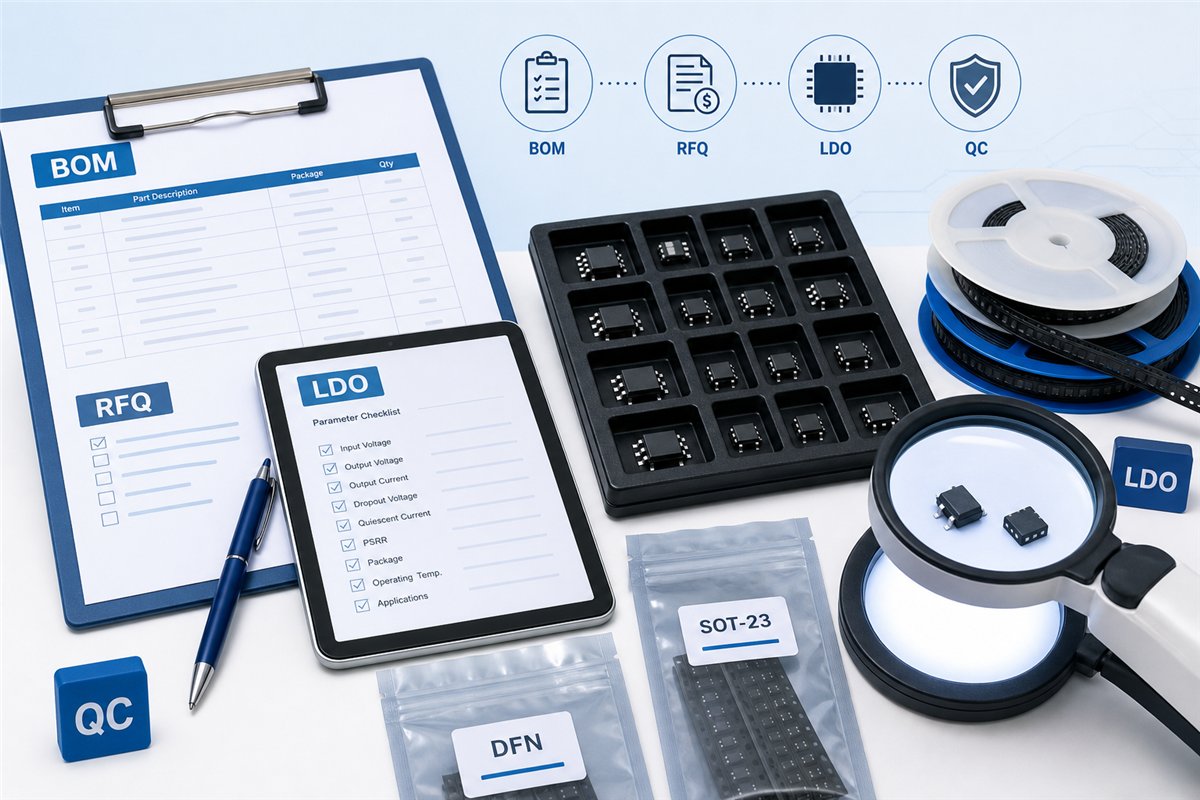
Share Part Number or BOM
Send the exact LDO model, approved manufacturer list, package, quantity, target delivery date or full BOM file.
Check Electrical Fit
Review output voltage, load current, dropout voltage, IQ, noise, PSRR, package and operating temperature requirements.
Confirm Package and Traceability
Compare package type, marking, reel or tray format, label information and sourcing documents before quotation.
Review Alternatives if Needed
When the requested LDO is obsolete, constrained or over budget, match alternatives by specification, package and application risk.
Prepare RFQ and Delivery Support
Provide pricing, availability, lead-time options and procurement notes for production, repair or replacement requirements.
Datasheet Matching
Match voltage, current, dropout, IQ, noise, PSRR, package and temperature range before recommending a sourcing path.
Quality Review
Support package inspection, label checks, reel or tray review and traceability document confirmation where available.
Alternative Search
Find replacement options when an LDO is obsolete, constrained, over budget or not suitable for the target application.
Related LDO Resources
Use these internal links to connect informational articles with the LDO commercial page.
LDO Linear Regulator: Selection, Applications and Buying Guide
An LDO linear regulator is a voltage regulator IC that...
Read MoreWhat Is a Low Dropout Regulator? LDO Basics and Selection Guide
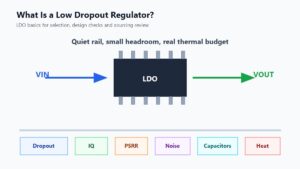
A low dropout regulator, or LDO, is a linear voltage...
Read MoreTLV1117-33: 3.3V LDO Dropout, Capacitor, and Revision Guide
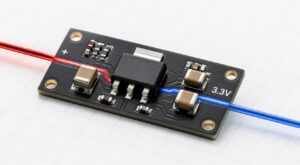
Quick Take TLV1117-33 is TI’s fixed 3.3 V member of...
Read MoreAMS1117 3.3V Circuit: Pinout, Wiring and Design Checks
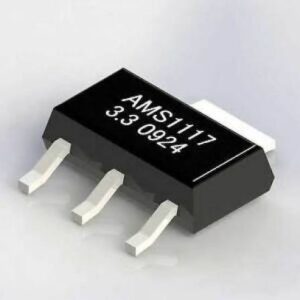
An AMS1117 3.3V circuit is a simple linear regulator circuit...
Read MoreFrequently Asked Questions
LDO Regulator FAQ
What should I check first when selecting an LDO regulator?
Start with the required output voltage, maximum load current, input voltage range and available package size. Then check dropout voltage, IQ, noise, PSRR and thermal dissipation before approving the part.
How much dropout voltage margin do I need?
Make sure the minimum input voltage is higher than the output voltage plus the LDO dropout voltage at your target load current. If the margin is too small, the output may fall out of regulation.
When is a low-IQ LDO important?
Low IQ matters in battery-powered devices, standby rails, IoT nodes, meters and portable equipment where the regulator must consume very little current during sleep or light-load operation.
When should I choose a low-noise LDO?
Choose a low-noise LDO for RF modules, ADCs, DACs, audio circuits, sensors and precision analog rails where supply noise or ripple can affect signal quality.
Can I replace one LDO with another similar part?
Only after checking output voltage, current rating, dropout voltage, pinout, package, capacitor requirements, enable pin behavior, thermal limits and manufacturer availability.
What package should I choose for an LDO?
Small packages such as SOT-23, DFN and QFN save board space, but thermal margin may be limited. For higher load current or wider voltage drop, compare the package power rating and PCB copper area.
Do LDO regulators need specific capacitors?
Yes. Many LDOs require specific input and output capacitor values, ESR range and placement for stability. Always check the datasheet before replacing one LDO with another.
Why does an LDO get hot in use?
The voltage difference between input and output becomes heat inside the regulator. Estimate power dissipation with (VIN – VOUT) x IOUT, then compare it with package and board thermal limits.
What information should I send for an LDO quote?
Send the part number, manufacturer preference, package, quantity, target price, delivery requirement and BOM file if available. For alternatives, include voltage, current, dropout, IQ, noise and package requirements.
Is an LDO the same as a standard linear regulator?
An LDO is a type of linear regulator designed to keep regulating with a smaller input-to-output voltage difference. It is often used when the input rail is close to the required output voltage.
When should I use a buck converter instead of an LDO?
Use a buck converter when the input voltage is much higher than the output voltage, the load current is high or heat loss is a concern. Use an LDO when low ripple, low noise and simple circuitry are more important.
Why is PSRR important for LDO selection?
PSRR shows how well the LDO rejects ripple or noise from the input supply. It is especially important after switching converters, in RF circuits, precision analog rails and sensor power supplies.
Does LDO noise matter for digital circuits?
For many basic digital rails, noise is less critical than voltage, current and thermal margin. For clocks, RF, ADC, DAC, audio and sensitive sensor circuits, choose a low-noise LDO and review the noise frequency range.
What is load transient response?
Load transient response describes how quickly and cleanly the output voltage recovers when the load current changes. It matters for MCUs, wireless modules and processors that move between sleep, standby and active modes.
What does the enable pin do on an LDO?
The enable pin turns the regulator on or off from a controller or logic signal. For battery products, check shutdown current, startup time, enable threshold and whether the pin can be left floating.
Can I use an LDO after a switching regulator?
Yes. A buck converter followed by an LDO is common when the design needs higher efficiency first and a cleaner final rail. Check dropout margin, PSRR at the switching frequency, thermal dissipation and output capacitor requirements.
Should I choose a fixed-output or adjustable LDO?
Fixed-output LDOs simplify BOM and reduce resistor-related tolerance issues. Adjustable LDOs are useful when the exact output voltage is uncommon or when one regulator family must support several rail options.
Why do some LDO replacements fail even with the same voltage?
Replacement issues often come from different pinout, package height, capacitor ESR, enable logic, current limit behavior, thermal rating, noise performance or manufacturer lifecycle status. Match the full datasheet conditions, not only VOUT.
Need Help Sourcing LDO Voltage Regulators?
Send a part number list or BOM. ApexComponent can help with datasheet matching, alternative search, quality review and quotation support.