
Table of Contents
MCU Sourcing Guide for OEM and EMS Buyers

Abstract
MCU sourcing is no longer just a matter of finding a unit price and placing a purchase order. For OEM and EMS buyers, microcontrollers sit at the center of product function, firmware compatibility, production continuity, and long-term supply risk.
When an MCU is delayed, obsolete, allocated, or replaced without proper validation, the impact can move far beyond procurement. Engineering may need to recheck firmware, NPI teams may need to repeat testing, quality teams may need new documentation, and production schedules can slip.
This guide explains how OEM, EMS, and industrial buyers should approach MCU sourcing more systematically. It covers what to check before sending an RFQ, how to manage shortage risk, how to evaluate alternatives, and what quality and traceability details matter before shipment.
For buyers managing production BOMs, Apex Component supports MCU and IC sourcing, BOM quotation, inventory matching, alternative part support, and RFQ review for microcontrollers and related electronic components.
1. What Makes MCU Sourcing Different from General IC Sourcing?
Microcontrollers are integrated circuits, but they are not always interchangeable in the way some simple logic, passive, or protection components may be. An MCU typically combines a processor core, memory, peripherals, clocks, communication interfaces, timers, analog functions, and firmware dependencies in one device.
That makes MCU sourcing more sensitive to both technical and supply chain risk.
Firmware dependency
Many MCUs are tied to firmware, development tools, libraries, bootloaders, and existing code. Even a similar device from the same manufacturer may require engineering review before approval.
Package and pinout dependency
MCUs are often selected around PCB layout. Package type, pin count, pitch, thermal pad, and pin mapping must be checked before any replacement is considered.
Peripheral requirements
An alternative MCU may have the same general performance level but lack a required interface, ADC channel, timer, communication bus, or low-power mode.
Common interface requirements include:
UART
SPI
I2C
CAN
USB
Ethernet
ADC
PWM
GPIO count
Lifecycle and qualification risk
Industrial, automotive, medical, and communication equipment often need long lifecycle support. A buyer should not evaluate an MCU only by current stock. Lifecycle status, manufacturer roadmap, temperature grade, and application requirements can matter just as much.
Quality and traceability expectations
MCUs can be high-value and shortage-sensitive. Buyers often need date code, lot code, label details, packaging condition, and available compliance documents before approving shipment.
2. What to Prepare Before Sending an MCU RFQ

A complete MCU RFQ helps a supplier respond faster and reduces the chance of incorrect quotation. If the request only includes a partial part number or vague description, the supplier may need multiple rounds of clarification.
Before sending an MCU sourcing request, prepare the following details.
Manufacturer part number
Always provide the full manufacturer part number, including package, memory size, temperature grade, packing option, and any suffix. For MCUs, suffixes often matter.
For example, a suffix may indicate:
Flash and RAM size
Package type
Temperature range
Tape and reel or tray packaging
RoHS status
Automotive or industrial grade
Brand or acceptable brands
If the BOM requires a specific manufacturer, state it clearly. If alternatives are acceptable, list approved brands or series.
Common MCU brands include:
STMicroelectronics
NXP
Microchip
Texas Instruments
Renesas
Infineon
Analog Devices
Espressif
Apex Component can support sourcing, quotation, and inventory matching for major electronic component brands. Unless specific authorization applies, sourcing language should stay focused on availability, quotation, and supply support rather than authorized distributor claims.
Target quantity
Clarify whether the request is for samples, pilot production, one-time repair, or mass production.
Useful quantity details include:
Sample quantity
First production quantity
Monthly or quarterly usage
Annual estimated usage
Acceptable split shipment, if any
Required date code
Some buyers require recent date codes. Others can accept older stock if storage condition, packaging, and traceability are acceptable.
Be specific. For example:
Date code 2024+
Date code 2023+
No strict date code requirement
Need date code confirmation before order
Package and packing method
MCUs may ship in tray, tube, tape and reel, or other packaging formats depending on part number and source.
For automated assembly, packing method may affect production readiness. EMS buyers should state whether they need tape and reel, tray, tube, dry pack, or moisture barrier packaging.
Target delivery date
If the order is tied to production, include the latest acceptable delivery date. This helps the supplier compare stock options, shipment methods, and lead time.
Compliance and document requirements
If your quality team needs documents, mention them before quotation.
Common requests include:
RoHS
REACH
CoC, when available
Date code
Lot code
Label photos
Packaging photos
Batch information, when available
Document availability depends on the specific part number, source, manufacturer, and order details.
Alternative acceptance
If alternatives are possible, explain the approval boundary. For example:
Same manufacturer only
Same series only
Same package required
Pin-to-pin compatibility required
Firmware-compatible option preferred
Engineering approval required before purchase
This helps the supplier separate direct stock options from potential replacement options.
For multi-line requirements, buyers can upload a BOM for quotation so the sourcing team can review MCU requirements together with related passives, connectors, power components, sensors, and protection parts.
3. MCU Shortage Sourcing Checklist

MCU shortage sourcing requires more caution than routine purchasing. When the original MCU is unavailable or affected by long lead time, buyers should check both supply availability and quality risk.
Use this checklist before approving a shortage MCU order.
1. Confirm the exact part number
Do not rely on partial matches. Verify every suffix and package detail against the approved BOM and datasheet.
Check:
Manufacturer
Series
Flash and RAM size
Package
Pin count
Temperature grade
Packing option
RoHS or compliance suffix
2. Check whether the quoted part is active, EOL, or NRND
Lifecycle matters. A part that is available today may not be suitable for long-term production if it is obsolete or not recommended for new designs.
If the part is EOL, the purchasing decision should include engineering, quality, and supply chain review.
3. Ask for date code and lot code
Date code and lot code help buyers understand production timing and traceability. They are especially important for industrial, automotive, medical, and long-lifecycle products.
The buyer should decide whether the quoted date code is acceptable before order confirmation.
4. Review label and packaging condition
Packaging can reveal useful information about handling, storage, and shipment readiness.
For MCUs, buyers may request:
Label photos
Reel or tray photos
Moisture barrier bag condition
ESD packaging condition
Quantity and package verification
5. Confirm storage and MSL handling expectations
Many ICs and MCUs are moisture-sensitive. If moisture sensitivity level handling is important for your process, state the requirement before quotation.
For production orders, quality and manufacturing teams may need to check whether baking, dry packing, or floor life management applies.
6. Compare stock options beyond price
The lowest quote is not always the safest option.
Compare:
Availability
Lead time
Quantity
Date code
Packaging
Traceability
Documentation
Supplier communication quality
Inspection options
For shortage-sensitive production, a slightly higher unit cost may be acceptable if it reduces schedule risk and quality uncertainty.
7. Keep engineering involved when substitutions appear
If the exact MCU is unavailable, procurement should not approve a substitution alone. MCU alternatives can affect firmware, PCB layout, peripherals, timing, power, and certification.
Alternative options should be reviewed by engineering and quality teams before purchase.
4. How to Evaluate an MCU Alternative
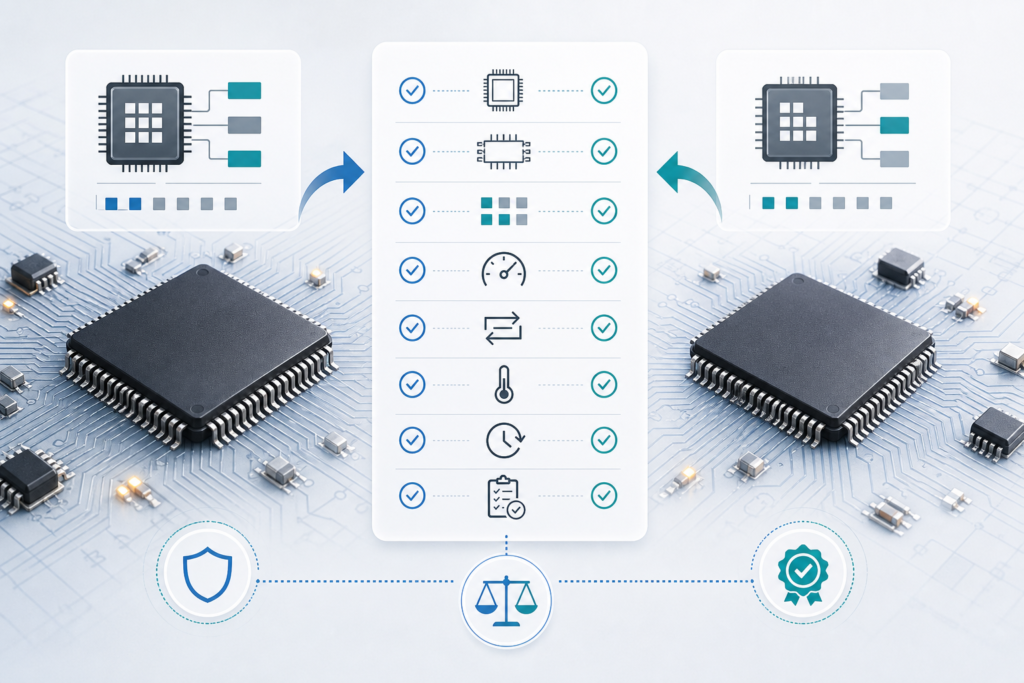
MCU alternatives can help reduce shortage risk, but they must be handled carefully. A similar microcontroller is not automatically a drop-in replacement.
When evaluating an MCU alternative, review these areas.
Package and pinout
Start with the physical and PCB-level match.
Check:
Package type
Pin count
Pin pitch
Footprint compatibility
Thermal pad
Pin mapping
Assembly process
Even when two MCUs share the same package size, the pinout may differ.
Core and performance
Compare the processor core, clock speed, instruction set, and performance requirements. If the firmware is timing-sensitive, performance differences may affect behavior.
Memory
Review flash, RAM, EEPROM, and external memory support. A part with lower memory may not support the current firmware or future updates.
Operating voltage and power
Check supply voltage, I/O voltage, low-power modes, current consumption, and power sequencing requirements.
This is especially important for battery-powered devices, industrial controllers, and IoT products.
Interfaces and peripherals
Confirm the required peripheral set.
Common checks include:
UART count
SPI count
I2C count
CAN support
USB support
Ethernet support
ADC resolution and channel count
PWM channels
Timer availability
GPIO count
Temperature grade
Industrial, automotive, medical, and outdoor applications may require wider temperature ranges. Do not replace an industrial-grade MCU with a commercial-grade part unless the customer has approved the risk.
Development tools and firmware impact
Even if the hardware looks similar, the software environment may change.
Check:
Compiler support
SDK or HAL support
Bootloader requirements
Debug interface
Firmware migration effort
Library compatibility
Programming process
Lifecycle and availability
An alternative should solve the supply problem rather than create a new one. Check whether the replacement is active, broadly available, and suitable for future production.
Testing and approval
MCU alternatives should go through engineering validation. For many products, that may include firmware testing, functional testing, environmental testing, EMC review, production programming checks, and quality approval.
Apex Component can help identify possible MCU alternatives based on package, parameters, voltage, interface, temperature grade, lifecycle, and availability. Final approval should always be completed by the customer’s engineering and quality teams.
5. Quality and Traceability Checks Before MCU Shipment
Quality review should happen before shipment, not only after parts arrive at the factory. For MCUs, pre-shipment checks can reduce the risk of wrong part, wrong package, incorrect quantity, packaging damage, or documentation mismatch.
Before shipping MCU orders, useful checks may include:
Model number
Brand
Package
Quantity
Date code
Lot code
Label
Exterior condition
Packaging condition
Datasheet consistency
For MCU orders, Apex Component can also support sampling inspection or programming test requirements based on customer needs.
Label verification
Label details should match the quoted part number and ordered quantity. If the label indicates a different package, date code, or packing method, the buyer should review before shipment.
Packaging review
MCUs should be protected against electrostatic discharge, moisture, and mechanical damage during handling and transportation.
Packaging may include:
ESD anti-static packaging
Moisture barrier bags
Trays
Tape and reel
Tube packaging
Protective outer packaging
Compliance documents
For some industries, documents such as RoHS, REACH, or CoC may be required. These should be requested before order confirmation, not after delivery.
Availability depends on the part number, source, manufacturer, and order details.
6. How MCU Sourcing Fits into a Complete BOM Strategy
MCUs rarely stand alone in a production BOM. A microcontroller often connects to power management ICs, crystals, oscillators, sensors, connectors, RF modules, memory, protection components, and passives.
That is why many EMS and OEM buyers prefer BOM-level sourcing instead of single-line purchasing.
BOM-level sourcing helps buyers see supply risk earlier
If the MCU is available but a crystal, connector, power IC, or sensor is delayed, production can still stop. A BOM-level review helps identify risk across all critical lines.
BOM-level sourcing supports better alternatives
When sourcing teams review the complete BOM, they can better understand whether an alternative affects only one line item or the entire design.
BOM-level sourcing improves quotation efficiency
Instead of sending separate RFQs for every part, buyers can submit a single BOM with part numbers, quantities, approved manufacturers, and delivery requirements.
This helps the supplier check:
Available inventory
Lead time
Price options
Shortage lines
Alternative possibilities
Documentation requests
Packaging requirements
For OEM and EMS buyers, BOM quotation is often the most efficient way to handle MCU sourcing together with related electronic components.
7. Common MCU Sourcing Mistakes to Avoid
Mistake 1: Quoting only a partial part number
Partial MCU part numbers can lead to incorrect quotation. Always include the full manufacturer part number.
Mistake 2: Comparing quotes only by unit price
Price matters, but it should not be the only factor. Availability, date code, packaging, traceability, lead time, and documentation can affect production risk.
Mistake 3: Accepting an alternative without engineering review
MCU substitutions can affect firmware, pinout, interfaces, power, memory, and test requirements. Engineering approval is essential.
Mistake 4: Requesting documents too late
If RoHS, REACH, CoC, date code, lot code, or label photos are required, state that before quotation.
Mistake 5: Treating shortage sourcing as a one-time transaction
For long-term products, shortage sourcing should feed into future planning. If one MCU becomes difficult to source, the team should review lifecycle status, approved alternatives, and safety stock strategy.
8. MCU RFQ Checklist
Use this checklist when preparing an MCU sourcing request:
Full manufacturer part number
Manufacturer or acceptable brands
Target quantity
Sample and production quantity, if different
Required date code
Package and packing method
Target delivery date
Destination country
Compliance document requirements
Label or packaging photo requirements
Alternative acceptance rules
Application or industry, if relevant
Programming or test requirement, if needed
The more complete the RFQ, the faster a sourcing team can check inventory, lead time, pricing, and document availability.
9. Work with Apex Component for MCU Sourcing
MCU sourcing requires coordination between procurement, engineering, quality, and supply chain teams. The right supplier should do more than quote a price. A useful sourcing partner should help confirm availability, review shortage risk, support alternative options, and provide traceability details where available.
Apex Component supports MCU sourcing, BOM quotation, hard-to-find component sourcing, alternative part support, inventory matching, quality checks, and global shipment support through its sourcing network and Hong Kong warehouse capability.
If you are sourcing MCUs for production, shortage recovery, NPI, or a multi-line electronic components BOM, contact Apex Component or upload your BOM for quotation.