
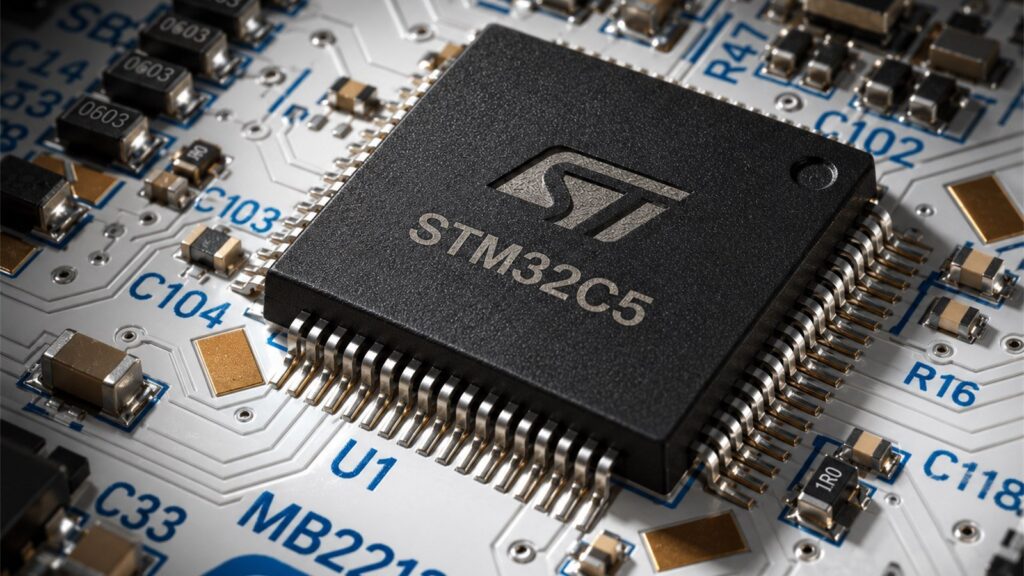
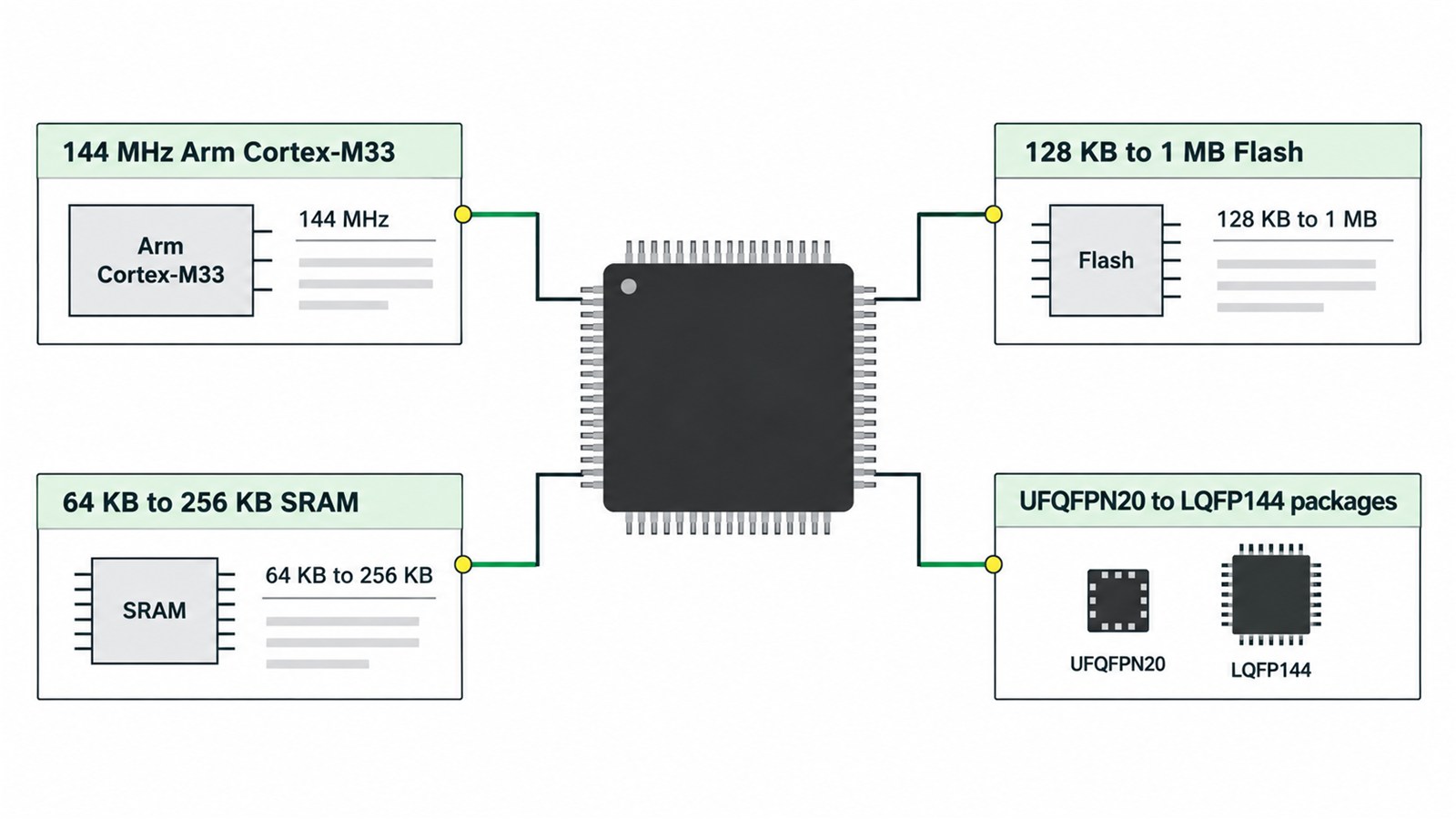
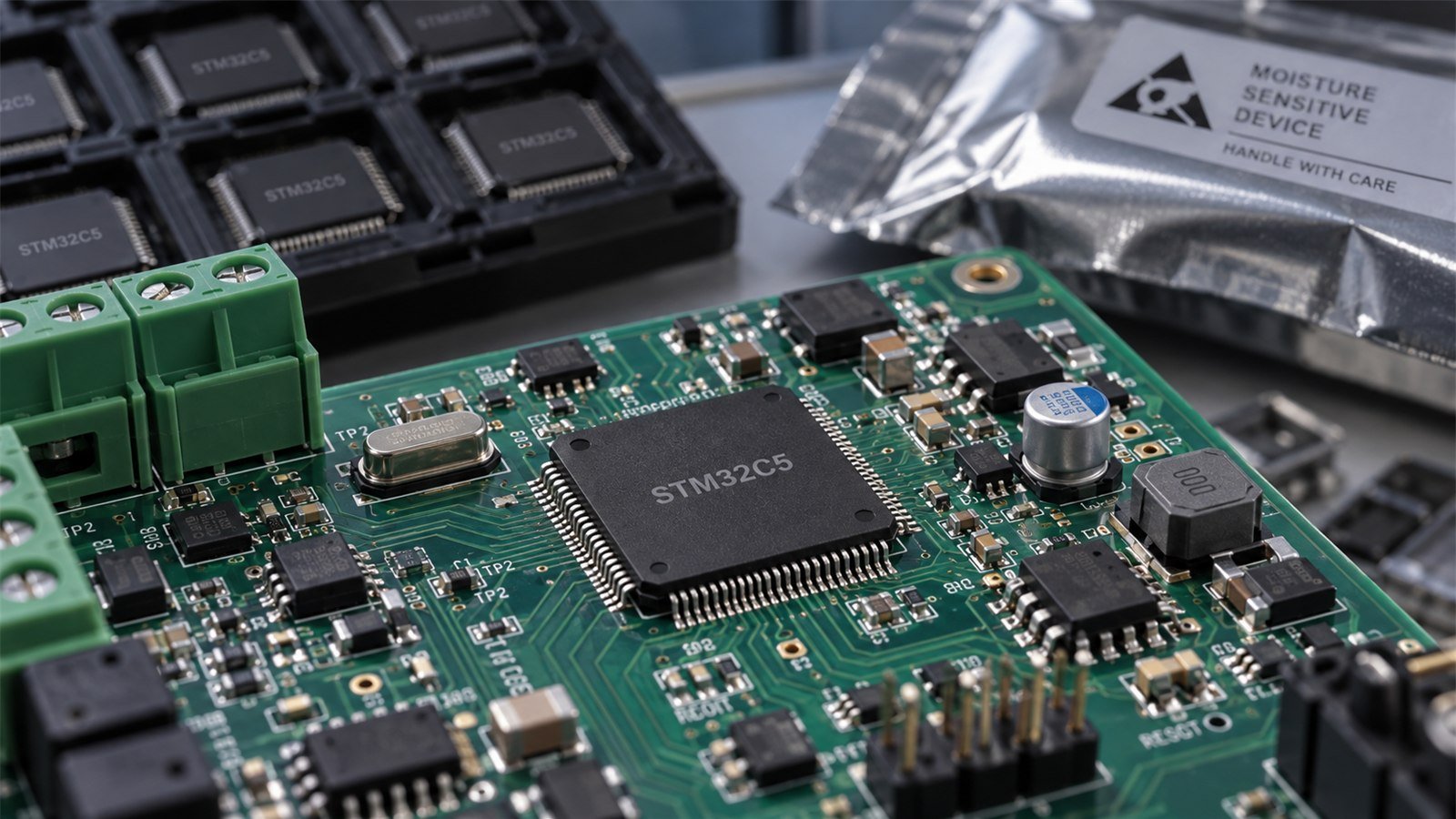
The STM32C5 is STMicroelectronics’ new entry-level Arm Cortex-M33 microcontroller family. It combines a 144 MHz CPU, 128 KB to 1 MB of Flash, 64 KB to 256 KB of RAM, and industrial-oriented analog, communication, security, and temperature options. The right choice depends on the exact subfamily and ordering code, not the STM32C5 name alone.
For engineering and procurement teams, the practical question is whether a specific device matches the application’s memory, interfaces, package, temperature range, security target, software plan, and supply requirements. Define those checks before requesting samples or a volume quote.
Last reviewed: September 15, 2026. Technical ranges are based on STMicroelectronics materials available on that date. Availability, price, lifecycle, and certification status must be verified for the exact ordering code.
| Quick take | What it means for a design or BOM |
|---|---|
| 144 MHz Arm Cortex-M33 with FPU and DSP instructions | More compute headroom than a typical Cortex-M0+ entry MCU, especially for filtering, control, and arithmetic workloads. |
| 128 KB to 1 MB Flash; 64 KB to 256 KB RAM | Select memory from the firmware budget, update strategy, middleware, and diagnostic requirements. |
| Packages from UFQFPN20 to LQFP144 | Package, pin count, PCB assembly capability, and I/O demand must be locked before quoting. |
| Analog and communication options vary by subfamily | ADC count, FDCAN, Ethernet, USB, I3C, OctoSPI, timers, DAC, and comparator needs should be checked line by line. |
What Is the STM32C5 Microcontroller?
STM32C5 is a scalable 32-bit MCU series built around the Arm Cortex-M33 core and ST’s 40 nm process. ST positions it between basic entry-level controllers and more feature-rich mainstream devices: it raises CPU and memory capability while retaining small-package and cost-sensitive design options.
The family runs at up to 144 MHz and is listed at 593 CoreMark, or 4.12 CoreMark/MHz, in ST’s launch materials. The Cortex-M33 implementation includes an FPU, DSP instructions, a memory protection unit, and flexible interrupt handling. Those features matter when a controller must perform sensor filtering, motor-control calculations, protocol processing, or complex state management.
Why the STM32C5 is relevant now
The reference article from Embedded emphasizes the performance jump at the entry level. For a production team, the larger change is architectural headroom: up to 1 MB of Flash, up to 256 KB of RAM, dual-bank Flash configurations, ECC-protected memory, and a broad range of analog and industrial interfaces can reduce pressure to redesign around a higher-tier MCU later.
STM32C5 is a family, not a purchasable part number. Memory, analog, communication, package, and security capabilities vary by line, so a generic “STM32C5” BOM entry is incomplete.
How the STM32C5 Subfamilies Scale
ST lists nine principal lines: STM32C531, C532, C542, C551, C552, C562, C591, C593, and C5A3. A useful first pass is to group them by memory and integration, then confirm the exact part in the current datasheet.
| Selection tier | Representative lines | Flash range | RAM | Practical starting point |
|---|---|---|---|---|
| Compact / baseline | STM32C531, C532, C542 | 128 KB to 256 KB | 64 KB | Cost-sensitive control, sensing, compact I/O, and controlled firmware footprints. |
| Mid-memory control | STM32C551, C552, C562 | 256 KB to 512 KB | 128 KB | More code space, buffers, analog channels, timers, or protocol capability. |
| High-integration | STM32C591, C593, C5A3 | 512 KB to 1 MB | 256 KB | Larger firmware, selected external-memory and connectivity options, and stronger security features. |
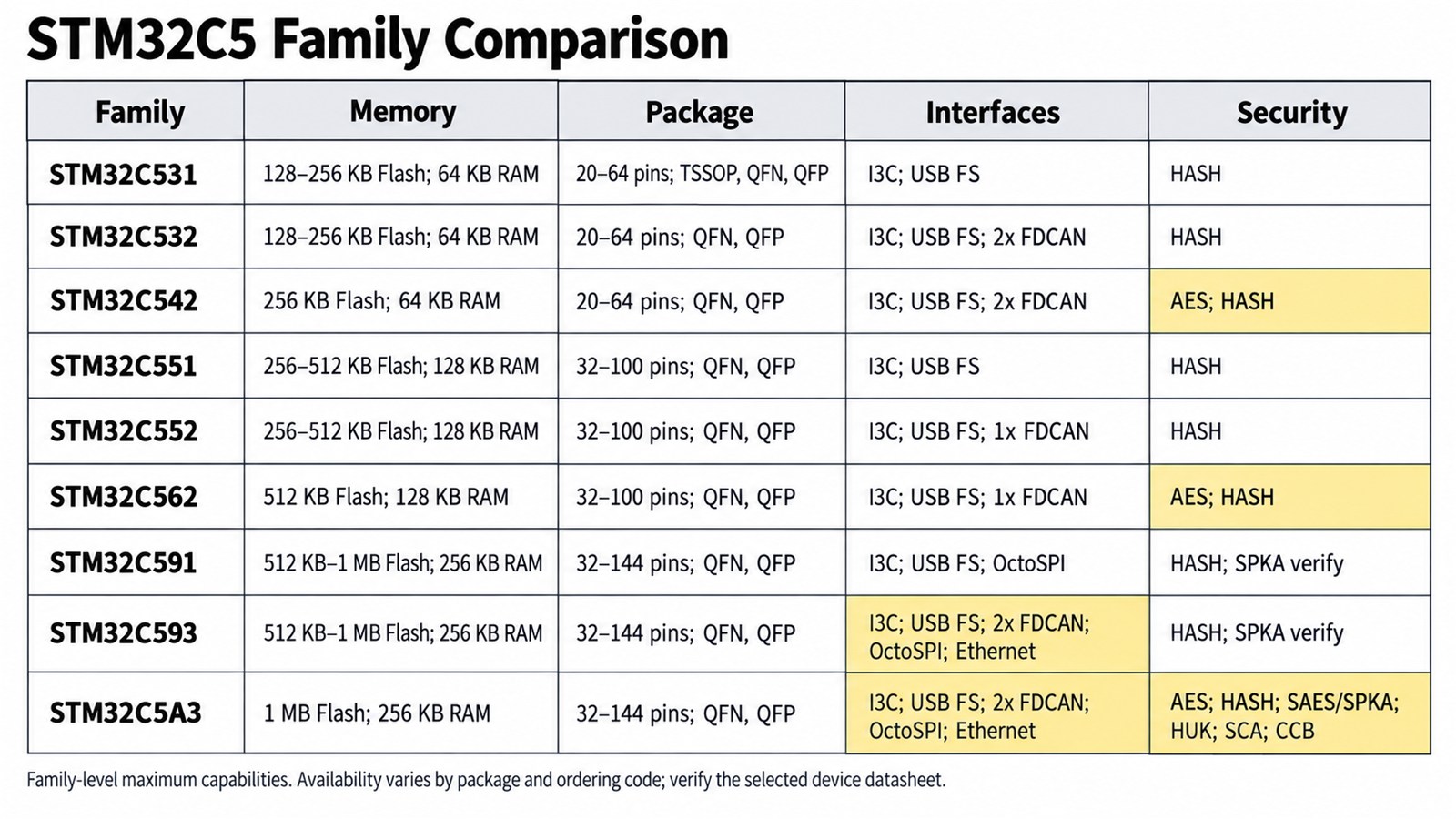
The table is a screening aid, not a substitute for a part-number comparison. Selected devices add FDCAN, Ethernet, OctoSPI, cryptographic accelerators, additional ADC instances, or larger packages. Put every hard requirement in the RFQ rather than assuming it follows the memory tier.
STM32C5 Selection Checklist for Engineers
A disciplined STM32C5 selection starts with the application constraints and ends with an exact ordering code.
- Build a real memory budget. Include the bootloader, application, middleware, diagnostics, calibration data, security libraries, update image, and growth margin.
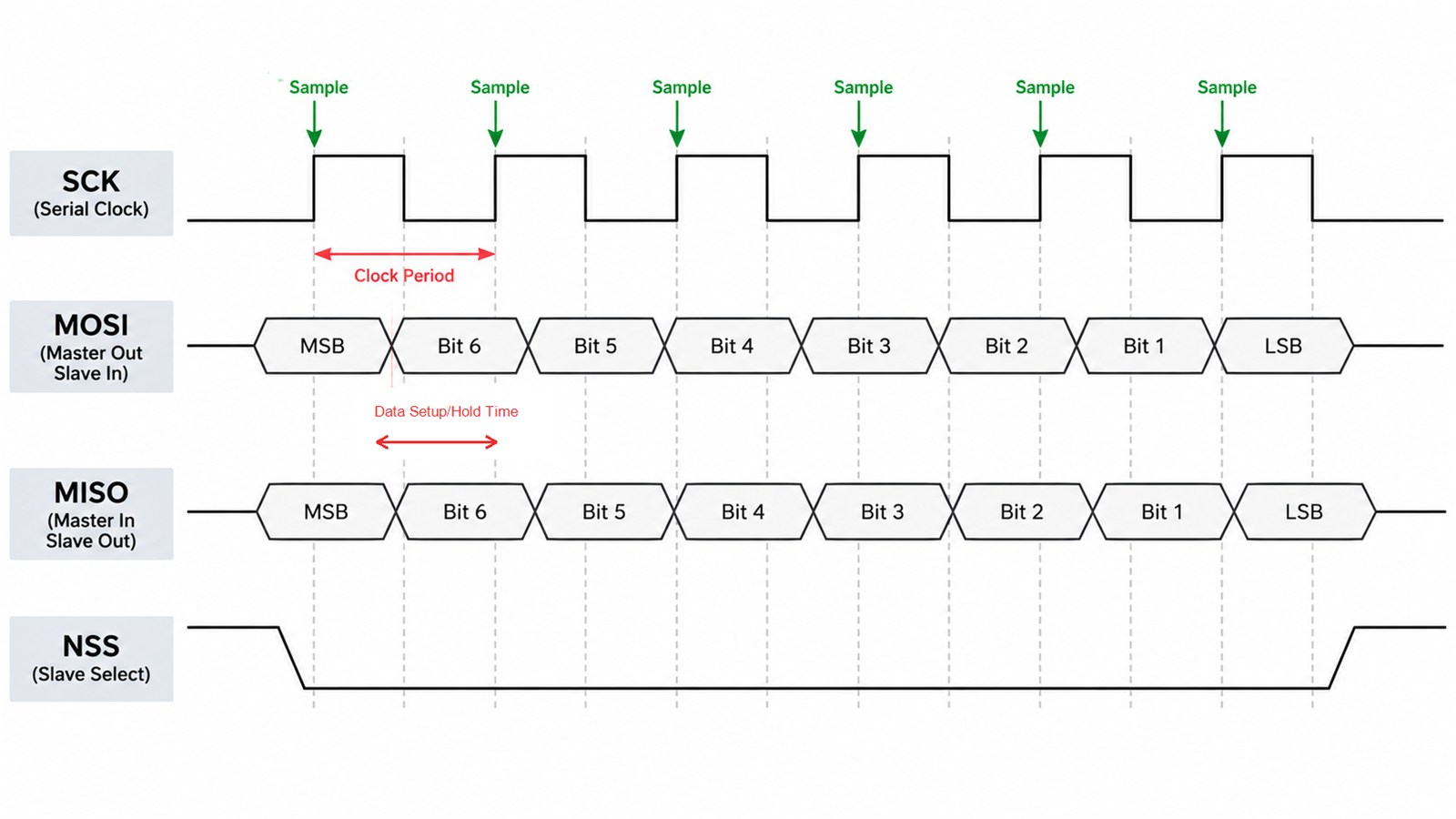
- List mandatory interfaces. Record the quantity and speed of UART/USART, SPI, I2C/I3C, USB, FDCAN, and Ethernet interfaces.
- Define analog performance. Check ADC count, channels, sampling needs, DAC or comparator requirements, input range, reference strategy, and required accuracy.
- Lock the package and I/O count. Confirm dimensions, pitch, assembly process, pin assignment, and available GPIO after peripheral mapping.
- Confirm the temperature grade. Match the exact suffix and datasheet limits to the product environment.
- Map security and safety requirements. Specify secure boot, updates, key storage, crypto, tamper protection, and required evidence.
- Validate the software path. Review HAL2, STM32CubeMX2, middleware, compiler support, migration effort, errata, and evaluation hardware.
Interfaces and Applications: Match the Device to the System
STM32C5 is suited to applications that need more real-time compute and integration than a basic entry MCU while remaining sensitive to PCB area and system cost. ST identifies smart thermostats, electronic door locks, industrial sensors, robotic actuators, wearables, computer peripherals, HVAC controls, and EV charging equipment among the target areas.
| Application need | Feature to verify | Why it matters |
|---|---|---|
| Sensor conditioning | FPU/DSP, ADC, DMA, timers | Reduces CPU overhead and supports faster control or filtering loops. |
| Motor or actuator control | Motor-control timers, ADC timing, comparators, FDCAN | Peripheral timing and channel count can matter more than peak CPU frequency. |
| Connected industrial node | Ethernet, FDCAN, USB, I3C, crypto | Interface and security requirements quickly narrow the eligible lines. |
| Field-updateable product | Flash capacity, dual-bank organization, secure update support | The update architecture must be designed before memory is committed. |
Security and Industrial Reliability: Verify the Exact Claim
The family includes memory protection, tamper-protection mechanisms, cryptographic engines, and process-isolation features. ST’s launch materials also describe target security certifications and functional-safety support. Capability is line-dependent, and certification wording may refer to a target, a library, an evidence package, or a specific device scope.
ST presents applicable devices for ambient operation up to 125 degrees C and junction temperature up to 140 degrees C. Request the exact datasheet revision, errata, product status, environmental declaration, security evidence, functional-safety package, and traceability required by the project.
STM32C5 vs STM32C0 or an Older STM32
Choose STM32C5 when the design needs Cortex-M33 performance, FPU/DSP capability, larger memory, richer industrial interfaces, higher-temperature options, or stronger security building blocks. A simpler STM32C0 can remain the better fit when firmware is small, interfaces are basic, and minimum component cost is dominant.
| Decision question | STM32C5 is favored when… | Another STM32 may be favored when… |
|---|---|---|
| Compute | Filtering, control, math, or protocol workloads need more headroom. | The workload is simple GPIO, timing, or basic control. |
| Memory | Firmware, middleware, updates, or diagnostics exceed a small MCU budget. | Code and RAM use are tightly bounded and stable. |
| Connectivity | Selected FDCAN, Ethernet, I3C, USB, or external-memory options are required. | Only basic UART, SPI, or I2C is needed. |
| Migration | The team can validate HAL2, STM32CubeMX2, pin mapping, and new-silicon errata. | A mature design cannot absorb firmware or PCB requalification. |
Do not describe STM32C5 as a drop-in replacement for STM32C0, STM32F1, STM32G0, or another family without a device-level comparison of pinout, power, clocking, boot behavior, analog limits, peripherals, firmware, and qualification evidence.
For a broader family view, see the STM32 series comparison and the STM32 part-number decoder.
Sourcing an STM32C5: What to Put in the RFQ
A usable RFQ identifies one or more exact ordering codes and separates mandatory requirements from acceptable alternatives. This prevents a memory-compatible but package-, temperature-, or interface-incompatible device from being quoted as an equivalent.
- Full manufacturer part number and acceptable alternates, if any
- Package, pin count, temperature grade, and packing format
- Flash/RAM minimum and mandatory peripherals
- Security or functional-safety document requirements
- Prototype quantity, production quantity, schedule, and forecast horizon
- Date-code limits, traceability, inspection, and test documentation
- Whether engineering approval is required before substitution
Availability, price, lead time, date code, and lifecycle can change. Verify them at quote time. For multi-line projects, use Quotes and BOM; for category-level sourcing, browse Microcontroller MCU ICs.
Common STM32C5 Selection Mistakes
Treating the family name as a purchasable part
“STM32C5” does not define Flash, RAM, package, temperature grade, interfaces, security level, or packing format. The RFQ must use a complete ordering code.
Selecting on MHz alone
A 144 MHz CPU does not guarantee the right design. Memory, DMA, timer topology, ADC timing, interfaces, power modes, and software architecture often decide system performance.
Assuming family-wide peripherals or certifications
Family tables summarize options while individual lines differ. Confirm each mandatory interface and compliance requirement in current device-specific documentation.
Calling an older STM32 device a drop-in alternative
Shared vendor and similar packaging do not establish compatibility. Compare pinout, dimensions, power, clock, boot mode, peripherals, firmware, thermal limits, and qualification evidence.
Frequently Asked Questions
What is STM32C5?
STM32C5 is an STMicroelectronics 32-bit microcontroller family based on the Arm Cortex-M33 core. It runs at up to 144 MHz and spans 128 KB to 1 MB Flash and 64 KB to 256 KB RAM, with options that vary by subfamily.
How fast is the STM32C5 microcontroller?
ST rates the core at up to 144 MHz and reports 593 CoreMark, or 4.12 CoreMark/MHz. Real performance depends on memory access, compiler settings, DMA use, peripheral workload, and firmware.
Which STM32C5 subfamily should I choose?
Start with memory: C53x/C542 lines use 64 KB RAM, C55x/C562 lines use 128 KB, and C59x/C5A3 lines use 256 KB. Then filter by Flash, package, ADC, FDCAN, Ethernet, OctoSPI, security, temperature grade, and tool support.
Is STM32C5 pin-compatible with STM32C0 or STM32F1?
Do not assume pin compatibility. Use exact datasheets and a pin-by-pin migration review because power pins, boot configuration, peripherals, and firmware support can differ.
Is every STM32C5 suitable for industrial or security-certified products?
No family-level statement is enough. Verify the exact device, temperature grade, certificate scope, library version, and required evidence.
How should buyers request a quote for STM32C5 devices?
Provide the complete ordering code, package, temperature grade, packing format, quantity, schedule, date-code limits, documentation needs, and rules for alternatives.
Sources and Related Reading
- STMicroelectronics: STM32C5 launch announcement, March 5, 2026
- STMicroelectronics: STM32C5 series presentation
- STMicroelectronics: STM32C5 documentation and device datasheets
- STMicroelectronics: STM32C5 and the updated STM32Cube ecosystem
- Reference: Embedded STM32C5 article
- ApexComponent: What Is an STM32 Microcontroller?