
Table of Contents
How to Read an STM32 Part Number: The Ultimate Decoder Guide for Engineers
Introduction
Choosing the right microcontroller is a critical step in hardware design. The STMicroelectronics STM32 family is an industry standard. Based on the ARM Cortex-M microcontroller architecture, these chips power everything from simple sensors to complex industrial machines.
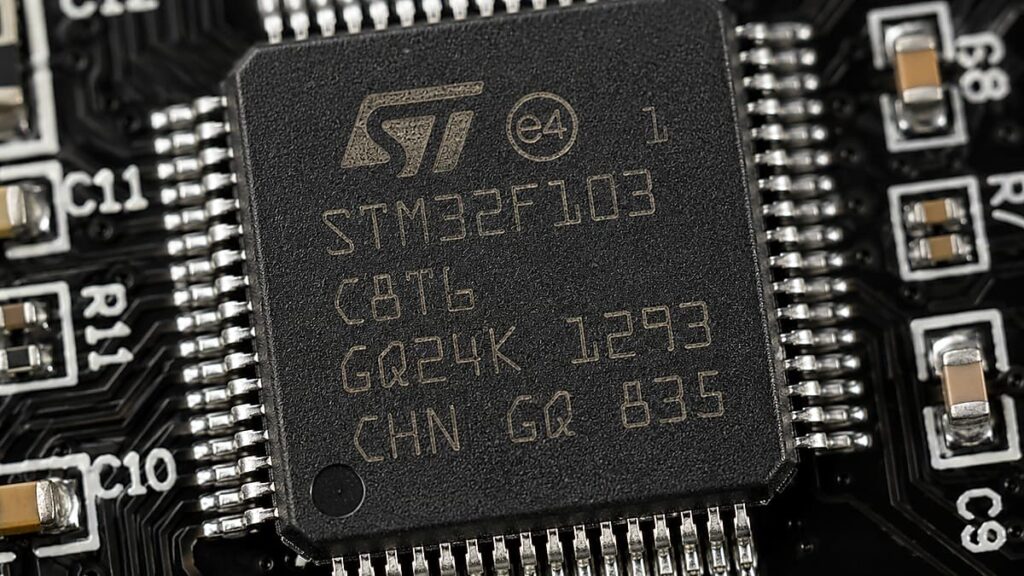
At first glance, an STM32 model number like STM32F103C8T6 looks like a random string of characters. However, each letter and number has a specific meaning.
Understanding the STM32 part number meaning helps you verify Bills of Materials (BOM), find alternative components during shortages, and design flexible PCBs. This guide breaks down the STM32 ordering code step-by-step.
1.The Anatomy of an STM32 Part Number
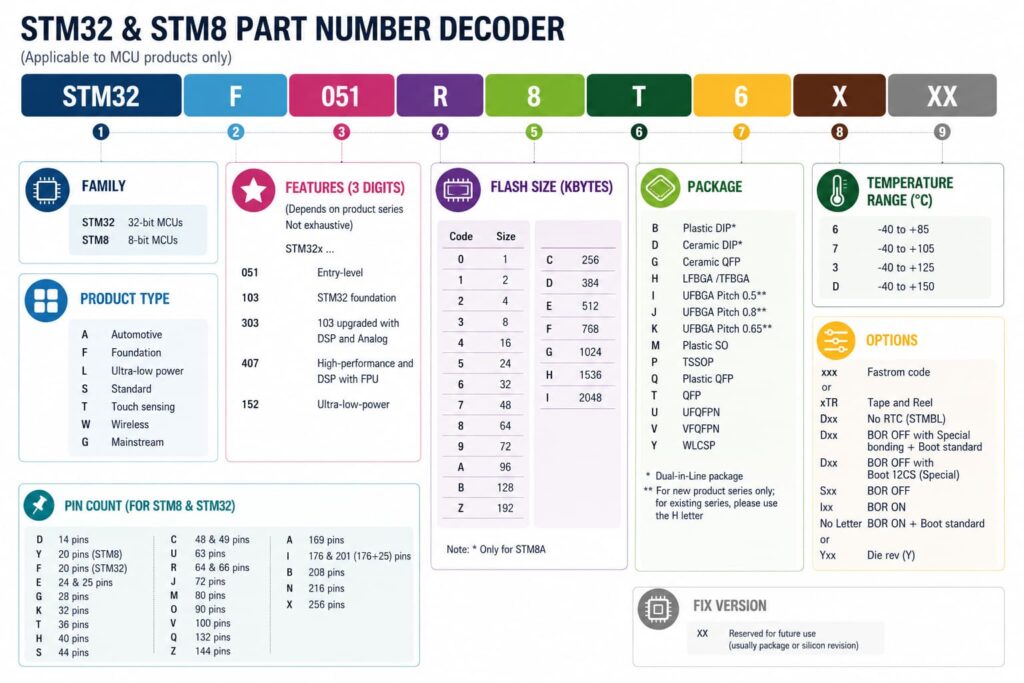
Every STM32 part number follows a structured naming convention. Here is the standard layout:
| Prefix | Family | Sub-family | Pin Count | Flash Memory | Package | Temperature | Suffix |
|---|---|---|---|---|---|---|---|
| STM32 | F | 103 | C | 8 | T | 6 | (TR) |
2.Core, Product Type, and Sub-family Codes
The Prefix
All part numbers begin with STM32. This identifies the device as a 32-bit ARM Cortex-M MCU from STMicroelectronics.
Product Type (Family)
The letter after “STM32” defines the core performance and power profile:
F: Classic foundation and high-performance MCUs (e.g., F0, F4, F7).
G: Modern, cost-effective mainstream MCUs (e.g., G0, G4) for mixed-signal designs.
L / U: Ultra-low-power series (e.g., L0, L4, U5) optimized for battery-powered devices.
H: High-performance MCUs (e.g., H7) with dual-core options and graphics support.
WB / WL: Wireless MCUs with integrated RF for Bluetooth, Zigbee, or LoRa.
Device Sub-family
The three-digit number that follows (e.g., 103, 407) indicates the specific feature set. This includes peripheral options, clock speeds, and hardware accelerators. For example, in the F1 series, 101 is the basic line, while 103 adds USB and CAN support.
3.Decoding STM32 Microcontroller Packages and Pin Counts
The next letter indicates the physical pin count of the STM32 microcontroller package:
F = 20 pins
G = 28 pins
K = 32 pins
T = 36 pins
S = 44 pins
C = 48 pins
R = 64 pins
M = 80 pins
V = 100 pins
Z = 144 pins
I = 176 pins
4.STM32 Package Codes
The letter after the flash memory code defines the physical package type. This choice affects your PCB layout and thermal performance:
T (LQFP): The STM32 LQFP package (Low-profile Quad Flat Package) has visible leads. It is easy to solder and debug manually.
U (QFN): The STM32 QFN package (Quad Flat No-lead) is compact. It offers excellent thermal dissipation for space-constrained boards.
I / H (BGA): The STM32 BGA package (Ball Grid Array) routes connections underneath the chip. It is used for high pin-count devices.
Y (WLCSP): Wafer Level Chip Scale Package. This is the smallest option, matching the size of the silicon die.
5.Determining STM32 Flash Memory Capacity
The character after the pin count represents the STM32 flash memory size. This determines how much space is available for your firmware.
| Code | Flash Memory Capacity |
|---|---|
| 4 | 16 KB |
| 6 | 32 KB |
| 8 | 64 KB |
| B | 128 KB |
| C | 256 KB |
| E | 512 KB |
| G | 1 MB (1024 KB) |
| I | 2 MB |
Design Tip: You can often swap to a chip with a larger flash capacity (e.g., from 8 to B) without changing your PCB layout, provided the package code remains the same.
6.Selecting the Right STM32 Temperature Grade
The final number indicates the STM32 temperature grade. This rating defines the safe operating environment for the chip:
6: -40°C to 85°C (Industrial and Consumer grade)
7: -40°C to 105°C (Extended Industrial grade)
3: -40°C to 125°C (Automotive and High-temperature grade)
Always match the temperature grade to your application. Consumer devices work well with grade 6. Industrial machinery and outdoor sensors require grade 7 or 3 to prevent thermal failure.
7.Step-by-Step Example: Decoding STM32F103C8T6
Let us decode the popular STM32F103C8T6:
STM32: STMicroelectronics 32-bit MCU.
F: Foundation / General Purpose family.
103: Performance line sub-family.
C: 48 pins.
8: 64 KB flash memory.
T: LQFP package.
6: Industrial temperature range (-40°C to 85°C).
8.MCU Selection Guide: Sourcing and Alternatives
Use this naming system as an MCU selection guide to find alternative parts during supply chain disruptions:
Keep the Package and Pin Count Constant: Ensure the pin count letter (e.g., R) and the STM32 package code (e.g., T) match. This avoids PCB redesigns.
Upgrade Flash Memory Safely: You can replace a lower-capacity chip with a higher-capacity one (e.g., replacing STM32F103C8T6 with STM32F103CBT6). The pinout remains identical.
Check Temperature Grades: You can replace a lower temperature grade with a higher one (e.g., replacing 6with 7). Never downgrade a chip meant for harsh environments.
Ready to source? Search our live inventory of STM32 microcontrollers to check real-time stock, pricing, and datasheet specifications for your exact part numbers.
FAQ
What is the difference between the ordering code and the physical STM32 MCU marking?
The STM32 ordering code is the full part number used for purchasing (e.g., STM32F103C8T6TR). The physical STM32 MCU marking on the chip is often shortened due to space limits. It may omit shipping suffixes but will always show the core model identifier.
What does the “TR” suffix mean?
“TR” stands for Tape and Reel. This suffix indicates the packaging method used for automated pick-and-place assembly. If the suffix is missing, the parts are usually shipped in trays or tubes.
Can I replace an LQFP package with a QFN package if they have the same pin count?
No. An STM32 LQFP package (code T) and an STM32 QFN package (code U) have different physical footprints. They are not drop-in replacements for the same PCB layout.