
Table of Contents
STM32 Series Comparison: F0, F1, F4, H7, G0 and U5 Guide
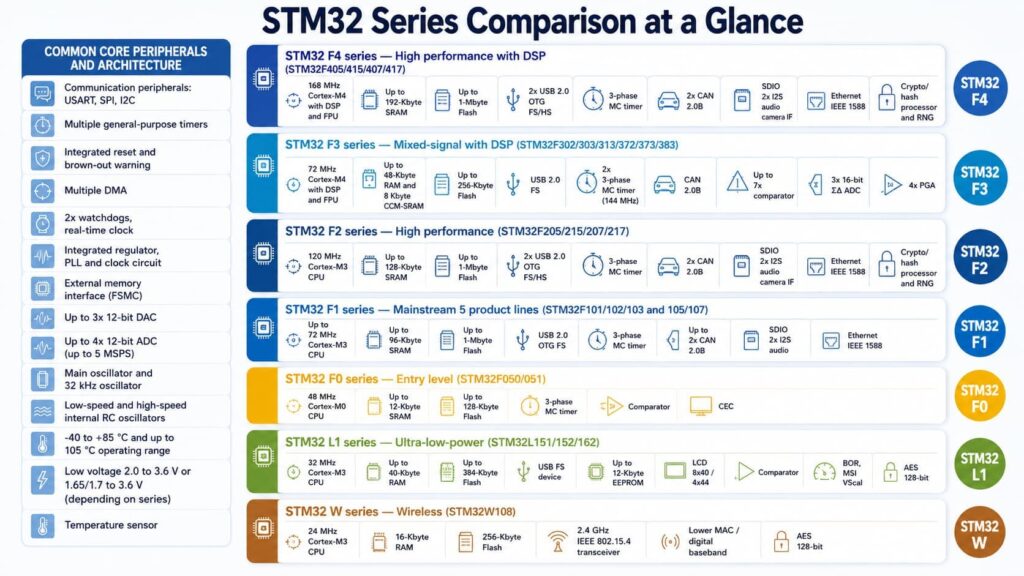
Introduction
Choosing the right STM32 series affects firmware development, PCB design, product cost, power consumption, and long-term sourcing risk. For engineers, the right MCU must meet performance and peripheral requirements. For procurement and BOM teams, the selected part also needs stable supply, clear lifecycle status, and possible alternative options.
This STM32 series comparison covers six commonly used families: STM32 F0, F1, F4, H7, G0, and U5.
1.What Is an STM32 Series Comparison?
An STM32 series comparison helps engineers and buyers choose a suitable microcontroller based on real project needs. Key factors include CPU core, clock speed, Flash, RAM, I/O count, package, power consumption, peripherals, lifecycle status, and supply availability.
It is not enough to compare only clock speed or price. The exact manufacturer part number, package suffix, temperature grade, and peripheral set must also be checked before mass production.
STM32 F0 Series
The STM32 F0 series is an entry-level MCU family based on the Arm Cortex-M0 core. It is designed for simple and cost-sensitive applications.
Typical features include:
Cortex-M0 core
Up to 48 MHz clock speed
Flash from 16 KB to 256 KB
SRAM up to 32 KB
UART, SPI, I2C, timers, ADC, and USB on selected parts
STM32 F0 is suitable for simple sensors, LED controllers, low-cost appliances, and basic industrial modules. For new designs, it should also be compared with STM32 G0, which offers newer peripheral options.
STM32 F1 Series
The STM32 F1 series uses the Arm Cortex-M3 core and is one of the most widely used STM32 families, especially in legacy products.
Typical features include:
Cortex-M3 core
Up to 72 MHz clock speed
Flash up to 1 MB
SRAM up to 96 KB
CAN 2.0 and USB full-speed on selected parts
Timers for motor-control and PWM applications
STM32 F1 is suitable for industrial controls, motor-control boards, appliances, and legacy product updates. Popular parts such as STM32F103 series devices are still widely requested, so procurement teams should pay attention to traceability and counterfeit risk.
STM32 F4 Series
The STM32 F4 series is a high-performance MCU family based on the Arm Cortex-M4 core with DSP instructions and FPU support.
Typical features include:
Cortex-M4 core with FPU
Up to 180 MHz clock speed
Flash up to 2 MB on selected parts
USB OTG, Ethernet, CAN 2.0, DCMI, and display-related features on selected variants
STM32 F4 is suitable for mid-range industrial control, robotics, audio processing, data acquisition, and basic HMI applications. It is often a practical choice when F1 or G0 is not powerful enough, but H7 is not necessary.
STM32 H7 Series
The STM32 H7 series is designed for high-performance embedded applications. It uses Cortex-M7 cores, and some variants include dual-core Cortex-M7 and Cortex-M4 architecture.
Typical features include:
Cortex-M7 core
High clock speed depending on product line
Large Flash and RAM options depending on the exact part
Ethernet, high-speed USB, FDCAN, external memory interfaces, and graphics-related features on selected variants
STM32 H7 is suitable for industrial gateways, advanced HMI, robotics controllers, edge processing, and high-speed communication equipment. It offers strong performance but may increase PCB complexity, firmware effort, power design requirements, and cost.
STM32 G0 Series
The STM32 G0 series is a modern entry-level MCU family based on the Arm Cortex-M0+ core. It is often a better starting point than F0 for new low-cost designs.
Typical features include:
Cortex-M0+ core
Up to 64 MHz clock speed
Flash up to 512 KB
SRAM up to 144 KB on selected parts
ADC, timers, UART, SPI, I2C, CAN FD, AES, RNG, or DAC on selected variants
STM32 G0 is suitable for smart home devices, sensor modules, low-cost industrial controllers, LED lighting, and utility devices. For BOM managers, G0 can offer better scalability because some parts provide different memory sizes in similar packages.
STM32 U5 Series
The STM32 U5 series is an ultra-low-power MCU family based on the Arm Cortex-M33 core with TrustZone support.
Typical features include:
Cortex-M33 core
Up to 160 MHz clock speed
Low-power operating modes
Large Flash and SRAM options depending on part number
TrustZone and security features on selected devices
Low-power peripherals for battery-powered applications
STM32 U5 is suitable for wearable devices, battery-powered IoT sensors, smart meters, portable medical devices, and secure connected products. Engineers should check the exact low-power mode, wake-up source, and SRAM retention behavior in the datasheet.
2.STM32 Series Comparison Table
| Series | Core | Main Strength | Typical Applications |
|---|---|---|---|
| STM32 F0 | Cortex-M0 | Low cost, simple control | Sensors, LED controllers, small appliances |
| STM32 F1 | Cortex-M3 | Mature ecosystem, legacy support | Industrial control, motor control, appliances |
| STM32 F4 | Cortex-M4 | Higher performance with FPU | Robotics, audio, HMI, data acquisition |
| STM32 H7 | Cortex-M7 | High processing power | Industrial gateways, advanced HMI, edge devices |
| STM32 G0 | Cortex-M0+ | Modern low-cost design | Smart home, sensors, utility devices |
| STM32 U5 | Cortex-M33 | Low power and security | Wearables, IoT sensors, medical devices |
3.How to Choose the Right STM32 Series
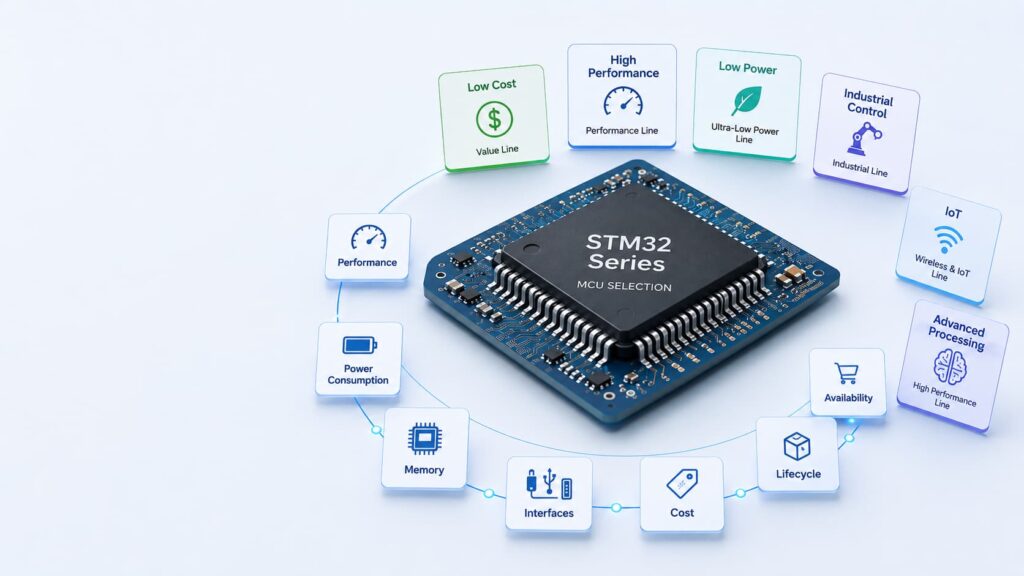
If cost is the main priority, start with STM32 F0 or STM32 G0. F0 is useful for simple or legacy designs, while G0 is often better for new low-cost products.
If performance is the main priority, start with STM32 F4. Move to STM32 H7 only when the application needs higher processing power, advanced graphics, or faster data handling.
If low power is the main priority, consider STM32 U5. It is suitable for battery-powered and secure connected devices.
If you are updating a legacy product, staying with STM32 F1 or F0 may reduce firmware and PCB changes. However, newer STM32 families may offer better long-term value if small design changes are acceptable.
4.Key Specifications to Check Before Ordering
Before locking an STM32 part into your BOM, check:
Full manufacturer part number
Flash and RAM size
Package type and pinout
Temperature grade
Required peripherals
Operating voltage
Lifecycle status
Authorized-channel availability
Lead time and MOQ
Possible pin-compatible or functionally similar alternatives
Do not assume two STM32 parts are interchangeable just because they belong to the same series. Always verify the datasheet, pinout, package, and peripheral mapping.
5.Common STM32 Selection Mistakes
Common mistakes include overbuying performance, ignoring package suffixes, checking availability too late, and assuming MCU alternatives are drop-in replacements.
For example, an H7 may be unnecessary for a simple control project. A G0 or F4 may provide enough performance at lower cost and with simpler PCB requirements. Similarly, replacing one STM32 part with another still requires checking pinout, firmware compatibility, and peripheral differences.
6.FAQ
What is the difference between STM32 F0 and STM32 G0?
STM32 F0 uses a Cortex-M0 core, while STM32 G0 uses a Cortex-M0+ core. G0 is usually better for new low-cost designs because it offers newer peripherals and better scalability.
Which STM32 series is best for industrial control?
STM32 F4 is widely used for mid-range industrial control. For high-performance gateways or advanced HMI, STM32 H7 may be more suitable.
Which STM32 series is best for low-power devices?
STM32 U5 is a strong option for low-power connected devices, especially when security and long battery life are required.
Can I replace one STM32 part with another?
Sometimes, but not automatically. You must check pinout, package, Flash, RAM, voltage range, peripheral set, and firmware compatibility.
7.Conclusion
This STM32 series comparison gives engineers, procurement teams, and BOM managers a clear starting point for MCU selection. F0 and G0 are suitable for low-cost designs, F1 is common in legacy products, F4 fits mid-range performance needs, H7 targets high-performance applications, and U5 is built for low-power secure devices.
Before placing an order, confirm the exact STM32 part number, package, memory size, lifecycle status, inventory, and possible alternatives. If you need STM32 availability checking, cross-reference support, or BOM sourcing assistance, send your part number list or BOM file for review.