
Table of Contents
STM32U5 Low Power MCU: Features, Applications, and Buying Guide
Introduction
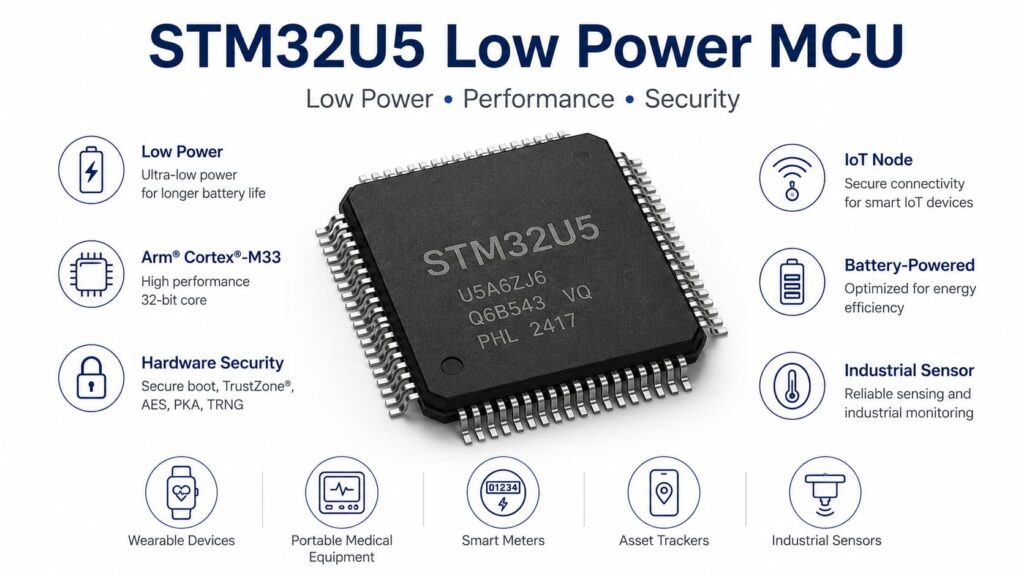
The STM32U5 low power MCU is designed for embedded products that need a strong balance between low energy use, processing performance, and hardware security. It is part of the STM32 ultra-low-power microcontroller portfolio from STMicroelectronics and is commonly considered for battery-powered devices, secure IoT nodes, portable medical equipment, smart meters, wearable products, and industrial sensors.
For engineers, STM32U5 offers a modern Arm Cortex-M33 core, low-power operating modes, strong memory options, and useful peripherals for connected devices. For buyers and BOM managers, the main concern is different: choosing the correct part number, checking package and memory options, confirming lifecycle status, and securing stable supply before mass production.
This guide explains the main STM32U5 features, where it is typically used, and what sourcing teams should check before buying this type of low power MCU.
1.What Is the STM32U5 Low Power MCU?
The STM32U5 is an ultra low power microcontroller series based on the Arm Cortex-M33 core. It is designed for applications that must stay active for long periods while using limited battery power. Compared with older low-power MCU families, STM32U5 provides higher performance, larger memory options, and stronger security functions.
In simple terms, a microcontroller is a small computer inside an electronic product. It usually includes a CPU core, Flash memory, SRAM, timers, analog interfaces, communication ports, and power management functions. A low power MCU is optimized to reduce energy use during run, sleep, standby, and shutdown states.
The STM32U5 microcontroller is especially useful when the product must collect sensor data, process signals, communicate with other devices, and protect firmware or user data without draining the battery too quickly.
2.Key Features of STM32U5 Microcontrollers
Arm Cortex-M33 Core
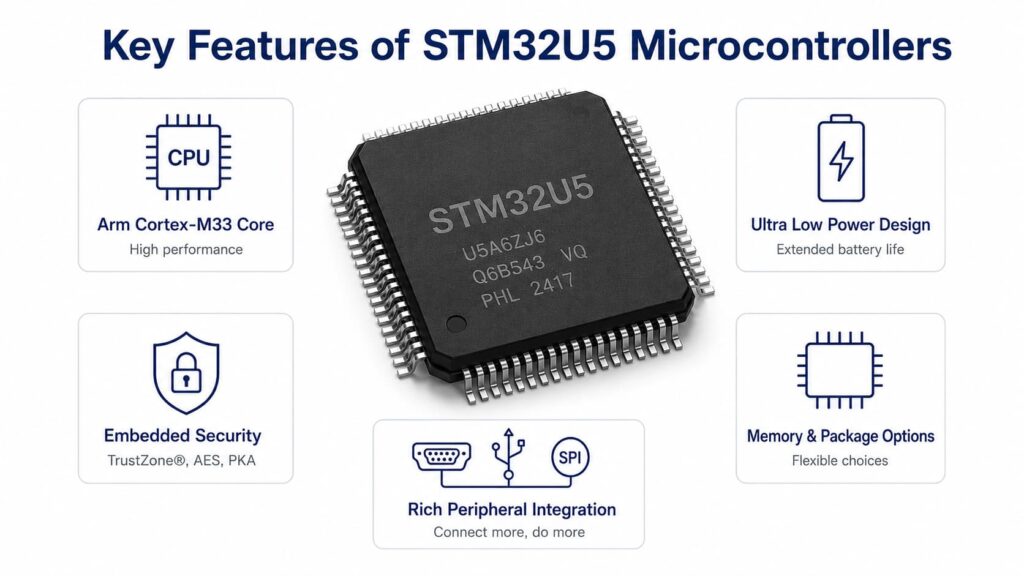
STM32U5 devices use the Arm Cortex-M33 core. This core supports modern embedded processing features such as DSP instructions, a floating-point unit, and memory protection. DSP means digital signal processing, which helps the MCU handle tasks such as sensor filtering, audio processing, and control algorithms more efficiently.
For many embedded engineers, the Cortex-M33 core provides enough performance for IoT edge devices, portable instruments, metering products, and industrial control nodes without moving to a higher-power processor.
Ultra Low Power Design
The main value of the STM32U5 series is its low-power architecture. The MCU can switch between different power modes depending on the workload. For example, the system may run at higher speed when processing data, then enter a low-power mode when waiting for a sensor interrupt or communication event.
Some STM32U5 devices support LPBAM, or Low-Power Background Autonomous Mode. This allows certain peripherals and DMA functions to continue working while the CPU remains in a low-power state. In practical designs, this can reduce unnecessary CPU wake-ups and help extend battery life.
This is important for products such as wireless sensors, medical wearables, remote meters, smart locks, and portable data loggers.
Embedded Security Functions
Security is another major feature of the STM32U5 series. Many connected products need to protect firmware, encryption keys, user data, and communication channels. STM32U5 devices can support features such as Arm TrustZone, secure boot, secure firmware update, readout protection, cryptographic acceleration, random number generation, and tamper detection.
Arm TrustZone helps separate secure and non-secure software areas. This means sensitive code, keys, or boot functions can be isolated from the normal application code. For IoT devices, payment terminals, smart building equipment, and industrial monitoring products, this hardware-based separation can reduce security risk.
For procurement teams, it is important to check whether the selected STM32U5 part includes the required crypto and security functions. Not every part number has the same feature set.
Memory and Package Options
The STM32U5 family includes different Flash memory, SRAM, and package options. Lower-memory devices may be suitable for simple sensor nodes or control products. Higher-memory versions are better for applications that need larger firmware, advanced user interfaces, graphics, wireless stacks, or secure firmware update space.
When selecting an STM32U5 microcontroller, engineers should check:
– Flash memory size
– SRAM size
– Package type
– Pin count
– Operating temperature grade
– Peripheral set
– Security feature availability
– Display or graphics support
– Power supply range
Buyers should not treat all STM32U5 part numbers as interchangeable. Even small differences in the part number may indicate a different package, memory density, temperature range, or feature set.
Rich Peripheral Integration
STM32U5 devices can include common embedded peripherals such as ADCs, DACs, timers, I2C, SPI, USART, USB, Octo-SPI, comparators, operational amplifiers, RTC, and low-power timers. Some higher-end devices also support display or graphics-related functions.
This integration can reduce the need for extra external ICs. For example, built-in analog functions may reduce the number of separate signal-conditioning components. Built-in communication interfaces can simplify connections to sensors, wireless modules, memories, displays, and other devices.
For BOM managers, this can reduce component count, but it also makes correct MCU selection more important. If one peripheral is missing from the selected device, the design may require a larger MCU or an external component.
3.Common Applications of STM32U5 MCUs
Battery-Powered IoT Devices
The STM32U5 is a strong option for battery powered MCU designs. It can be used in wireless sensor nodes, smart trackers, remote monitoring devices, smart locks, and connected meters. These products often need long standby time, secure firmware, and reliable sensor data handling.
Wearable and Portable Devices
Wearables need compact packages, low power consumption, sensor interfaces, and reliable sleep modes. STM32U5 can support applications such as health monitoring devices, personal electronics, portable instruments, and small control units.
Industrial Sensors and Monitoring Equipment
Industrial sensors often need accurate data collection, stable operation, and long lifecycle support. STM32U5 can be used in condition monitoring, temperature sensing, flow measurement, vibration sensing, and low-power control nodes.
Medical and Healthcare Devices
Portable medical devices often require low power consumption, secure data handling, and reliable operation. STM32U5 may be considered for patient monitors, handheld diagnostic tools, wearable health devices, and connected medical sensors. Engineers should still review all regulatory, safety, and reliability requirements before final selection.
Smart Home and Building Automation
The STM32U5 microcontroller can be used in smart thermostats, access control devices, smart lighting controllers, environmental sensors, and home automation products. In these applications, low standby power and secure connectivity are often important.
4.STM32U5 Selection Guide for Engineers
Match Performance to the Real Workload
Do not select an MCU only by clock speed. Review the actual tasks: sensor sampling, communication, encryption, display refresh, motor control, audio processing, or data logging. If the device spends most of its time sleeping, low-power mode behavior may matter more than peak frequency.
Check Memory Headroom
Firmware size usually grows during development. Security libraries, wireless stacks, bootloaders, graphics assets, and over-the-air update functions can quickly increase memory demand. Choose a Flash and SRAM size with enough margin for future firmware updates.
Confirm Low-Power Mode Requirements
Different designs need different sleep behavior. Some applications only need standby mode. Others need RTC, SRAM retention, sensor monitoring, or autonomous peripheral operation during low-power states. Engineers should compare the datasheet power mode table with the real use case.
Review Security Requirements Early
Security should not be added at the end of the project. If the product needs secure boot, encrypted firmware update, key storage, TrustZone separation, or anti-tamper functions, confirm these requirements during MCU selection. This can avoid redesigns later.
Verify Pinout and Package Compatibility
Package choice affects PCB layout, thermal behavior, assembly process, and second-source planning. Common package types may be easier to source than rare package variants. Before locking the BOM, confirm whether the package has stable availability across distributors and long-term supply channels.
5.Buying Guide for STM32U5 Low Power MCUs
1. Use the Full Manufacturer Part Number
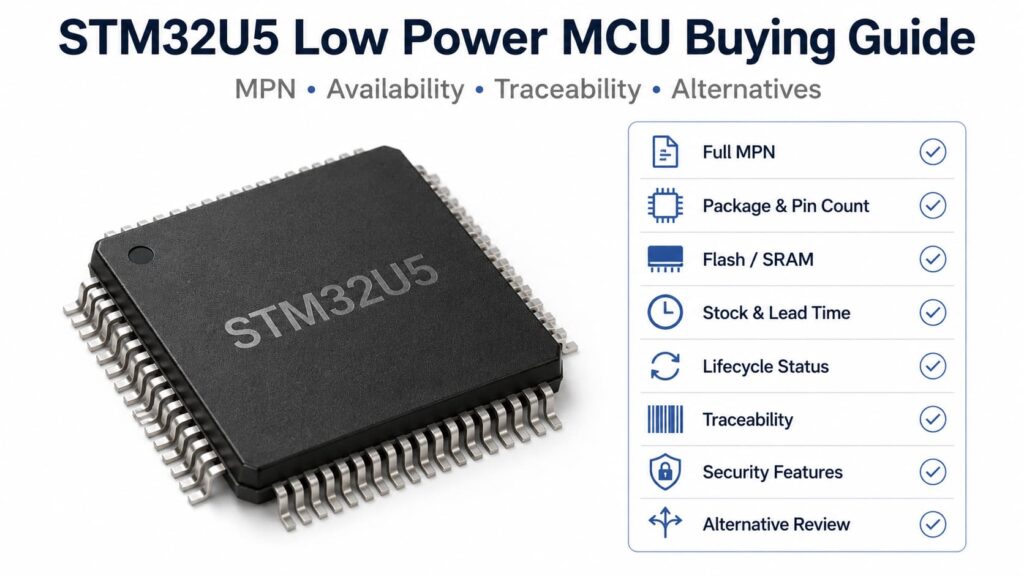
Always source STM32U5 parts by full MPN, not by short family name. For example, “STM32U5” is only the series name. The full part number defines memory size, package, pin count, temperature grade, and sometimes security or feature options.
A BOM should clearly include:
– Full MPN
– Manufacturer name
– Package
– Quantity
– Accepted alternatives, if any
– Datasheet version or revision reference
– Required date code or traceability requirements
2. Check Availability Before Design Freeze
Some STM32U5 models may be more available than others. Before the design is frozen, procurement teams should check current stock, lead time, lifecycle status, and package availability. If the selected part has limited supply, engineers may need to review another memory size or package option.
3. Avoid Unverified Open-Market Stock
STM32 MCUs are popular components, so sourcing risk can increase during shortages or high demand. Buyers should avoid unclear supply channels, especially for urgent orders or discontinued package variants.
For quality control, request:
– Clear supplier information
– Manufacturer label photos
– Lot and date code details
– Packaging condition
– Traceability documents when available
– Visual inspection before shipment
– Electrical or functional testing if required
4. Plan for Firmware and Hardware Revisions
If the product may receive firmware updates, choose enough memory and confirm bootloader requirements. If the product may later need more security, more RAM, or better graphics support, select a device group that allows upgrade options without major redesign.
5. Build a Controlled Alternative List
STM32U5 alternatives should be reviewed carefully. Even within the same STM32U5 family, pinout, memory, peripherals, and software compatibility may differ. Cross-reference should be based on datasheets, not only on similar names.
A safe alternative review should compare:
– Core and clock speed
– Flash and SRAM
– Package and pinout
– Power modes
– Peripheral match
– Security functions
– Temperature grade
– Software impact
– Stock and lifecycle status
6.Quality Control Points for STM32U5 Sourcing
For semiconductor sourcing, quality control is not only about checking whether the part looks new. STM32U5 microcontrollers may be used in secure and battery-powered products, so incorrect or counterfeit parts can cause serious field failures.
A practical inspection process may include label verification, package marking review, pin condition inspection, moisture-sensitive packaging check, X-ray inspection for high-risk lots, and sample electrical testing. For production orders, buyers should also keep batch records and supplier traceability files.
If the parts are used in long-term industrial or medical projects, it is also useful to track approved vendor lists, approved alternates, lifecycle changes, and last-time-buy notices.
7.Conclusion
The STM32U5 low power MCU is a suitable choice for embedded products that need low energy use, strong processing capability, and hardware-based security. It is especially relevant for battery-powered IoT devices, portable instruments, smart home products, industrial sensors, and secure connected equipment.
For engineers, the key is to match the MCU’s power modes, memory, peripherals, and security functions to the real application. For buyers and sourcing teams, the key is to confirm the full part number, package, stock status, lifecycle information, and quality control process before purchase.
A correct STM32U5 selection can reduce power consumption, support secure firmware design, and improve long-term BOM stability. A poor selection can create sourcing delays, firmware limits, or redesign costs. For production projects, engineering and procurement teams should review the STM32U5 device choice together before final BOM release.