
Table of Contents
AI Power Management ICs: Why Data Center Power Is the Next Big Semiconductor Opportunity
Abstract
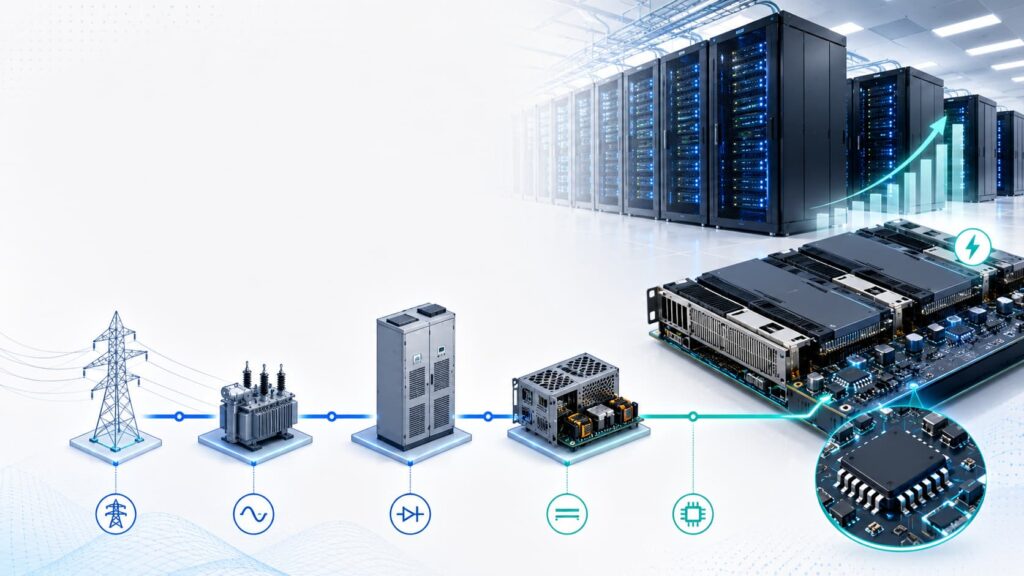
AI is not only increasing demand for compute chips. It is also changing the power architecture behind AI servers and data centers. As rack-level power continues to rise, power management ICs are becoming a critical part of the semiconductor supply chain. For component suppliers, this creates a clear opportunity in high-efficiency conversion, point-of-load regulation, protection, and system monitoring.
Introduction
The AI hardware market is often discussed in terms of GPUs, accelerators, and memory bandwidth. But behind every high-performance AI system is a power delivery network that must be efficient, stable, and reliable.
NVIDIA is actively promoting an 800VDC architecture for future AI factories, aiming to reduce conversion losses and improve power delivery efficiency. Texas Instruments also notes that AI data centers require new power-management solutions to support higher density, higher efficiency, and more complex distribution needs.
For distributors and buyers, this means one thing: power management ICs are no longer just supporting parts. They are now core design items.
1.Why AI Is Driving Power Management Demand
Compared with traditional servers, AI servers run at much higher power levels and face faster load transients. They also have tighter space and thermal constraints. That changes the way engineers design the power tree.
The main challenges are:
Higher power density
Faster voltage regulation requirements
More heat in a smaller area
Stronger protection needs during startup and fault conditions
This is why the market is paying more attention to power management ICs that can improve efficiency and reliability at both board level and system level.
2.Which Power Management ICs Matter Most?
2.1Multiphase Controllers
Multiphase controllers are widely used in core rails for GPUs and CPUs. In AI systems, they help deliver high current with better transient response and higher efficiency.
These parts matter because AI workloads change quickly. If the power rail cannot respond fast enough, performance and stability both suffer.
For a related internal product reference, LTM4644IY#PBF is a strong match because it is a quad 4A DC/DC µModule regulator suited to high-density power conversion.
2.2 POL Regulators and DC-DC Converters
Point-of-load regulation is especially important in dense server boards. Analog Devices highlights POL regulators as a key part of data center power design.
For AI servers, POL regulators help support:
Board-level voltage conversion
Stable local power delivery
Better voltage accuracy
Improved efficiency near the load
If you want a lighter auxiliary-rail example to link from this section, MP2315GJ is a compact buck DC-DC converter that fits the same power-management story.
2.3 Hot-Swap Controllers and eFuses
Protection is another major theme. Texas Instruments recently introduced 48V integrated hot-swap eFuse solutions designed for modern data centers.
These devices help manage:
Inrush current
Safe startup
Fault isolation
Overcurrent and overvoltage protection
For AI servers, that kind of protection is important because the system is under heavy load for long periods of time.
STBP120AVDK6F is a useful internal link here because it is an overvoltage protection device and fits the same protection-focused narrative.
2.4 PMICs, Power Monitors, and Sequencers
Power management is not only about conversion. It is also about control and visibility.
PMICs, power monitors, and sequencers help with:
Power-up sequencing
Rail supervision
Fault detection
System-level control
STPMIC1BPQR is a good internal match for this section because it is a PMIC for processor-based embedded systems and naturally extends the discussion of system-level power control.
Renesas also continues to emphasize higher-efficiency, high-density power conversion in its 800V AI data center architecture. That reinforces the trend toward smarter and more integrated power control.
2.5 GaN FETs and High-Efficiency MOSFETs
When power density goes up, conversion efficiency becomes even more important. GaN and advanced MOSFETs are attractive because they can support higher-frequency, higher-efficiency power conversion.
For AI infrastructure, this helps reduce:
Energy loss
Heat generation
Cooling burden
Footprint at the power stage
3. What Buyers Should Look For
For OEMs, EMS buyers, and sourcing teams, the most important selection points are not just electrical specs. They also include supply continuity and lifecycle risk.
When sourcing power management ICs for AI-related applications, confirm:
Exact part number and package
Voltage and current ratings
Efficiency and thermal performance
Protection features
Lifecycle status and availability
Lead time and supplier reliability
This is especially important for AI infrastructure, where design changes are expensive and supply interruptions can delay production.
4. Why This Matters for Component Suppliers
AI is turning power management from a support function into a performance-critical one. That creates a strong opportunity for suppliers that can offer the right parts for:
High-efficiency conversion
Point-of-load regulation
Startup and fault protection
System monitoring and sequencing
For companies like Apex Components, this is a natural content and product fit. It connects well with categories such as:
A practical way to position your portfolio is to focus on how the parts help customers solve real AI power challenges, not just list the parts themselves.
5.Conclusion
AI data centers are changing the demand profile for power management ICs. As power density rises and supply architectures move toward higher efficiency designs, components such as multiphase controllers, POL regulators, hot-swap controllers, PMICs, and GaN FETs are becoming more important than ever.
For engineers, these parts help improve stability, efficiency, and protection. For buyers, they are now strategic sourcing items with real supply chain impact.
If your business supplies power-related components, this is one of the clearest growth areas in the AI hardware market.