
Table of Contents
78xx Voltage Regulator Selection Guide: 7805, 7812, 7815, 7824 & LM317 Comparison
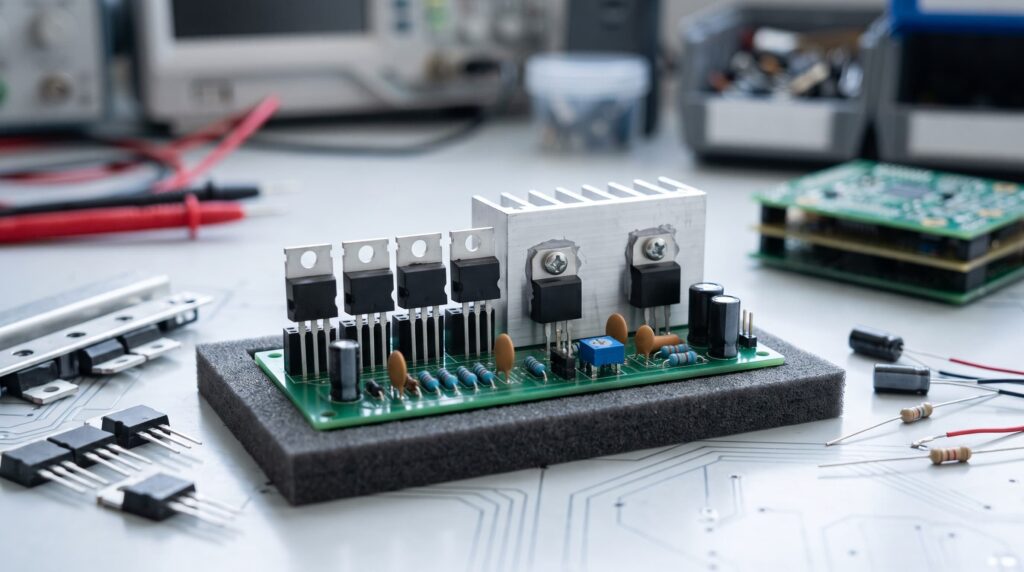
You need a 5V rail for a microcontroller. Your motor driver wants 12V. The op-amp circuit runs best at ±15V. Three different voltages, three different regulator part numbers — and you still haven’t figured out which package variant ships in under two weeks.
The 78xx family has been solving exactly this problem since the 1970s. One family, one pinout, one design pattern — just pick the last two digits for your voltage and you’re done. But “just pick the digits” only works when you already know the full picture: which voltages are standard, what the package options mean, where the LM317 fits in, and when the whole 78xx family is the wrong answer.
This guide maps out the complete 78xx lineup against your actual design constraints — voltage, current, thermal budget, BOM complexity, and supply chain — with a clear comparison to the LM317 adjustable regulator.
1. The 78xx Family at a Glance
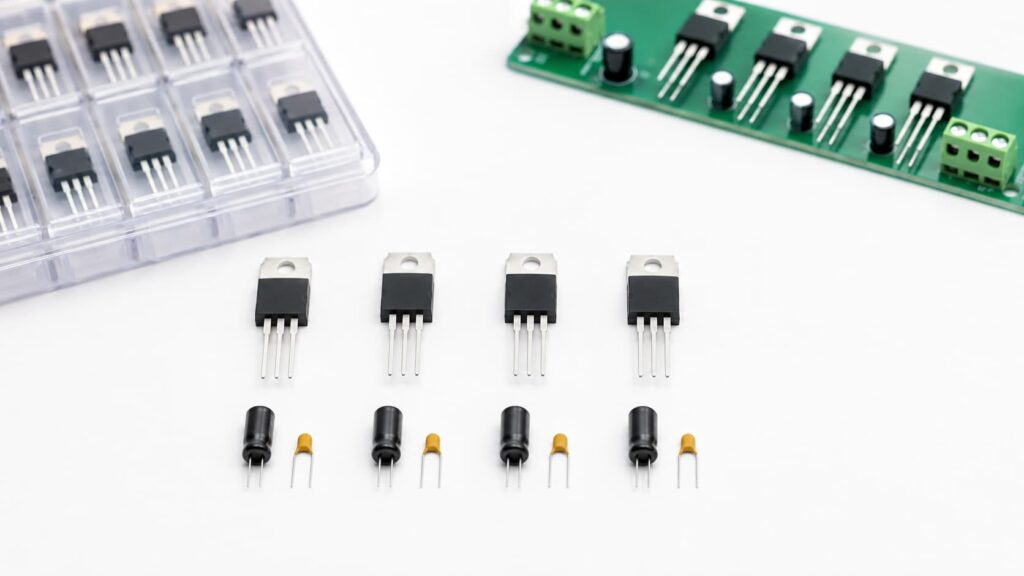
The 78xx series is a family of three-terminal fixed positive linear voltage regulators. The naming convention tells you everything: “78” means positive fixed regulator, and “xx” is the output voltage. A 7805 outputs 5V. A 7812 outputs 12V. A 7824 outputs 24V.
This simplicity — one part number per voltage, no external resistor dividers, no configuration — is the family’s defining strength. A designer can look at a schematic, see “7805,” and immediately know what’s happening on that rail. No datasheet cross-referencing required.
What the Naming Convention Actually Means
| Prefix/Suffix | Meaning | Example |
|---|---|---|
| LM78xx | National Semiconductor / TI branding | LM7805CT |
| L78xx | STMicroelectronics branding | L7805CV |
| MC78xx | ON Semiconductor branding | MC7805CTG |
| UA78xx | Texas Instruments legacy (Fairchild) | UA7805CKC |
| 78Lxx | Low-current variant (100mA) | 78L05 |
| 78Mxx | Medium-current variant (500mA) | 78M05 |
| 78Hxx | High-current variant (5A) | 78H05 |
| 79xx | Negative voltage regulator (complementary) | 7905 (−5V) |
The core part is always the “xx” digits — that’s your output voltage. Everything else is manufacturer prefix or current rating suffix. When sourcing, watch out: an L7805CV from ST and an MC7805CTG from ON Semi are functionally identical but carry different order codes.
The Parallel Universe: 79xx Negative Regulators
Every positive 78xx has a negative twin in the 79xx family. A 7905 outputs −5V, a 7912 outputs −12V. The pinout is different from the 78xx (input and ground swap positions on some packages), so don’t assume you can drop a 79xx into a 78xx footprint. They’re used together in dual-supply circuits — op-amp designs that need ±15V typically run a 7815 and a 7915 from a center-tapped transformer.
2. Complete 78xx Series Specifications
Here is the full standard 78xx lineup with the numbers that matter for selection.
Standard 78xx Family (1.5A, TO-220)
| Model | Vout | Vin (min) | Vin (max) | Iout (max) | Dropout Voltage | Typical Application |
|---|---|---|---|---|---|---|
| 7805 | 5.0V | 7.0V | 25V | 1.5A | 2.0V | Microcontrollers, TTL logic, Arduino, Raspberry Pi 5V rail |
| 7806 | 6.0V | 8.5V | 25V | 1.5A | 2.0V | Audio preamplifiers, sensor excitation |
| 7808 | 8.0V | 10.5V | 25V | 1.5A | 2.0V | Industrial sensors, panel meters, relay drivers |
| 7809 | 9.0V | 11.5V | 25V | 1.5A | 2.0V | Guitar pedals, audio effects, 9V battery replacements |
| 7810 | 10.0V | 12.5V | 28V | 1.5A | 2.0V | Analog circuits, op-amp supplies, test equipment |
| 7812 | 12.0V | 14.5V | 30V | 1.5A | 2.0V | Motor drivers, automotive (pre-regulation), relay logic, CCTV |
| 7815 | 15.0V | 17.5V | 30V | 1.5A | 2.0V | Industrial automation, PLC I/O, ±15V op-amp rails |
| 7818 | 18.0V | 20.0V | 35V | 1.5A | 2.0V | Audio power amplifiers (pre-driver stage), high-voltage relays |
| 7824 | 24.0V | 27.0V | 38V | 1.5A | 2.0V | Solenoid drivers, PLC power, 4–20mA loop power, industrial controls |
Key numbers to remember across the entire family:
- Dropout voltage: ~2V (all variants) — your input must be at least 2V above the output
- Line regulation: typically 3–100mV (input voltage variation)
- Load regulation: typically 15–100mV (0 to 1.5A load step)
- Ripple rejection: 62–78dB at 120Hz
- Junction temperature rating: 0°C to +125°C (commercial), −40°C to +125°C (industrial/automotive)
- Internal protection: thermal shutdown, SOA (safe operating area) limiting, short-circuit current limiting
De-Rated Current Reality
That “1.5A max” on the datasheet front page is a marketing number that assumes you’ve solved the thermal problem. In practice, a TO-220 7805 without a heatsink has a junction-to-ambient thermal resistance (θJA) of about 65°C/W. At 25°C ambient, permissible power dissipation is roughly:
Pmax = (125°C − 25°C) / 65°C/W ≈ 1.5W
If you’re dropping 12V to 5V (ΔV = 7V), you can only pull about 210mA before hitting thermal limits — far from the advertised 1.5A. Add a heatsink dropping θJA to ~15°C/W, and suddenly 6.6W is available, bringing you much closer to the rated current.
This is the single most common mistake we see in procurement: engineers order 7805s assuming they’ll get 1.5A out of them, then wonder why the thermal shutdown kicks in at 300mA.
Current Variant Quick Reference
| Variant | Max Current | Common Package | Typical Use |
|---|---|---|---|
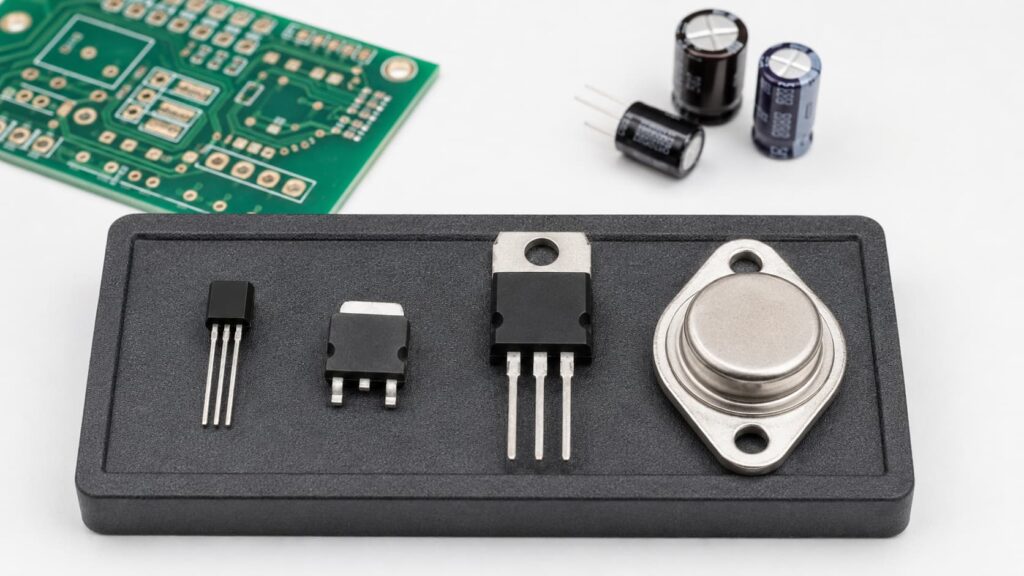
| 78Lxx (e.g., 78L05) | 100mA | TO-92, SOT-89 | Low-power logic, reference voltages, signal conditioning |
| 78Mxx (e.g., 78M05) | 500mA | TO-252 (DPAK), TO-220 | Medium-power analog, sensor arrays |
| 78xx (standard) | 1.5A | TO-220, D²PAK | General-purpose power supplies, motor drivers |
| 78Hxx (e.g., 78H05) | 5A | TO-3 | High-current industrial, legacy equipment |
Accuracy Grades
Most manufacturers offer two accuracy bins:
- Standard grade (e.g., L7805CV): ±4% output tolerance (4.8V–5.2V for a 7805)
- A-grade (e.g., L7805ACV): ±2% output tolerance (4.9V–5.1V for a 7805)
For digital logic, standard grade is almost always fine. For precision analog references or ADC supplies, the A-grade’s tighter tolerance is worth the marginal price difference — typically $0.05–0.15 more per unit in volume.
3. 78xx vs LM317: Fixed vs Adjustable — The Real Decision
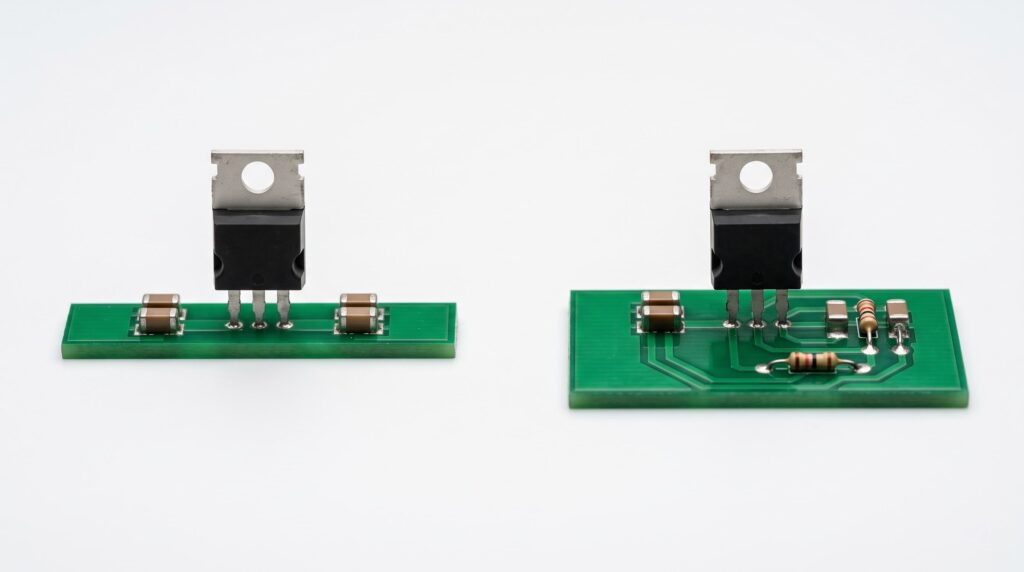
This is the comparison that determines most linear regulator selection decisions. The 78xx gives you one fixed voltage per part number. The LM317 gives you any voltage between 1.25V and 37V — but only after you add two external resistors and do the math.
Side-by-Side Comparison
| Factor | 78xx (Fixed) | LM317 (Adjustable) |
|---|---|---|
| Output voltage | Fixed: 5V, 6V, 8V, 9V, 10V, 12V, 15V, 18V, 24V | Adjustable: 1.25V–37V via R1/R2 divider |
| Voltage formula | None — it’s on the label | Vout = 1.25 × (1 + R2/R1) |
| External components | 2 capacitors (input + output) | 2 resistors + 2 capacitors minimum |
| BOM line items | 3 (IC + Cin + Cout) | 5 (IC + R1 + R2 + Cin + Cout) |
| Design complexity | Beginner — pick part, add caps, done | Intermediate — calculate R2, verify stability |
| Quiescent current (Iq) | 5–8mA (7805 typical) | 46–100µA (typical) |
| Dropout voltage | ~2.0V | ~1.7V (slightly better) |
| Max output current | 1.5A | 1.5A (LM317); 3A (LM350); 5A (LM338) |
| Line regulation | ~3mV typical | 0.01%/V |
| Load regulation | ~15mV typical | 0.1% |
| Ripple rejection | 62–78dB | 65–80dB |
| Unit cost (1ku) | $0.15–0.40 | $0.25–0.60 |
| Inventory strategy | Stock one part per voltage needed | Stock one part, adjust per design |
| Pinout | IN-GND-OUT (left to right, front view) | ADJ-OUTPUT-INPUT (different from 78xx) |
The Quiescent Current Difference That Changes Battery Life
The single most overlooked difference between the 7805 and LM317 is quiescent current. A standard 7805 draws 5–8mA even with zero load. An LM317 draws 40–100µA — roughly 100× less.
This doesn’t matter for a line-powered industrial controller that’s on 24/7 anyway. But for a battery-powered sensor node that sleeps 99% of the time, an LM317’s 100µA standby draw versus a 7805’s 8mA standby draw is the difference between a 6-month battery life and a 2-week battery life. If you’re designing for battery power, the LM317 wins on Iq alone — or better yet, consider a modern LDO with sub-1µA quiescent current.
When the 78xx Wins
- One fixed voltage, never changes. If your design will always need exactly 5V or exactly 12V, the 7805 or 7812 eliminates two resistors and the design calculation step. Simpler BOM, fewer assembly errors.
- Production consistency across many units. Fixed voltage means no tolerance stack-up from resistor dividers. A 7805 is always a 7805.
- Beginner-friendly designs, education, prototyping. When the goal is to get a circuit working, not to optimize every parameter, the 78xx is the shortest path from schematic to powered-on.
- Legacy replacement. If the original design used a 78xx, replacing it with the same part avoids requalification. LM317 substitution requires circuit modification and revalidation.
When the LM317 Wins
- You need a non-standard voltage. 3.3V, 7.5V, 13.8V (lead-acid float charge), or any voltage that doesn’t exist as a standard 78xx variant.
- One design, multiple output voltages across product variants. Stock one LM317 instead of five different 78xx part numbers. Procurement simplification is a real cost saver at scale.
- Battery-powered designs where standby current matters. The 100× Iq advantage of the LM317 is significant for duty-cycled loads.
- Prototyping and lab use. One LM317 on a breadboard covers every voltage you’ll need during development. No drawer full of 7805s, 7809s, 7812s.
- Precision voltage trimming. With 1% resistors, an LM317 can hit voltages with tighter tolerance than standard-grade 78xx regulators.
A Note on Pinout Traps
The LM317 pinout is NOT the same as the 78xx. The 78xx pinout (front view, left to right) is Input–Ground–Output. The LM317 pinout (front view, left to right) is Adjust–Output–Input.
If you drop an LM317 into a 7805 footprint, you will short the Adjust pin to the input voltage rail and likely destroy the regulator. This is a common prototyping mistake — always verify the pinout before substituting
4. How to Choose the Right 78xx Variant — A Decision Framework
Walk through these four questions in order. By the end, you’ll have a specific part number or a clear reason to look elsewhere.
Question 1: What Output Voltage Do You Need?
| Your Required Voltage | Pick This 78xx | Also Consider |
|---|---|---|
| 5V | 7805 | LM317 (if you might need other voltages later) |
| 6V | 7806 | LM317 (6V is a less common standard voltage) |
| 8V | 7808 | — |
| 9V | 7809 | LM317 (for adjustable guitar pedal supplies) |
| 10V | 7810 | — |
| 12V | 7812 | LM317 (for lead-acid battery charging at 13.8V) |
| 15V | 7815 | LM317 (for precision ±15V analog rails) |
| 18V | 7818 | — |
| 24V | 7824 | LM317HV (high-voltage version, 57V input max) |
| Anything else | LM317 | See Section 3 comparison |
If your voltage isn’t on this list, stop right here — the 78xx family doesn’t cover it. You need an LM317 or a different regulator topology entirely.
Question 2: How Much Current?
| Your Current | Pick This Variant | Package |
|---|---|---|
| ≤100mA | 78Lxx (e.g., 78L05) | TO-92, SOT-89 |
| 100mA–500mA | 78Mxx (e.g., 78M05) | TO-252, TO-220 |
| 500mA–1.5A | Standard 78xx | TO-220, D²PAK |
| >1.5A | Not a 78xx — consider LM350 (3A), LM338 (5A), or switching regulator | — |
Remember: the current rating assumes adequate heatsinking. At 500mA with a 7V drop (12V→5V), you’re dissipating 3.5W. A TO-220 without a heatsink will hit thermal shutdown in minutes. Always run the thermal calculation in Section 5 before locking your BOM.
Question 3: What’s Your Input Voltage?
This is where many designs fail silently. The 78xx needs headroom:
- Minimum input = Vout + dropout voltage (2V). A 7805 needs at least 7V. Feed it 6.5V, and the output sags below 5V — but doesn’t shut down. Your microcontroller browns out intermittently, and debugging begins.
- Maximum input varies by output voltage. A 7805 can take up to 25V. A 7824 can take up to 38V. Exceeding the maximum input voltage permanently damages the regulator.
- The headroom gap determines efficiency. 12V input → 5V output through a 7805: efficiency is 5/12 ≈ 42%. The other 58% becomes heat. At 1A load, that’s 7W of heat dissipated into your enclosure.
If your input–output differential exceeds ~10V at meaningful currents, a switching regulator (buck converter) is probably the better choice. More on this in Section 6.
Question 4: What’s the Thermal Environment?
For every watt dissipated, a TO-220 7805 junction temperature rises ~65°C above ambient without a heatsink. With a modest clip-on heatsink, that drops to ~15–25°C/W. With a forced-air-cooled extruded heatsink, you can get below 5°C/W.
Quick thermal checklist:
Calculate Pdiss = (Vin − Vout) × Iload
Calculate Tj = Tambient + (Pdiss × θJA)
Verify Tj < 125°C with margin (aim for <100°C in production)
If Tj exceeds 100°C, either add a heatsink, reduce input voltage, or switch to a switching regulator
5. Thermal Design Quick Reference
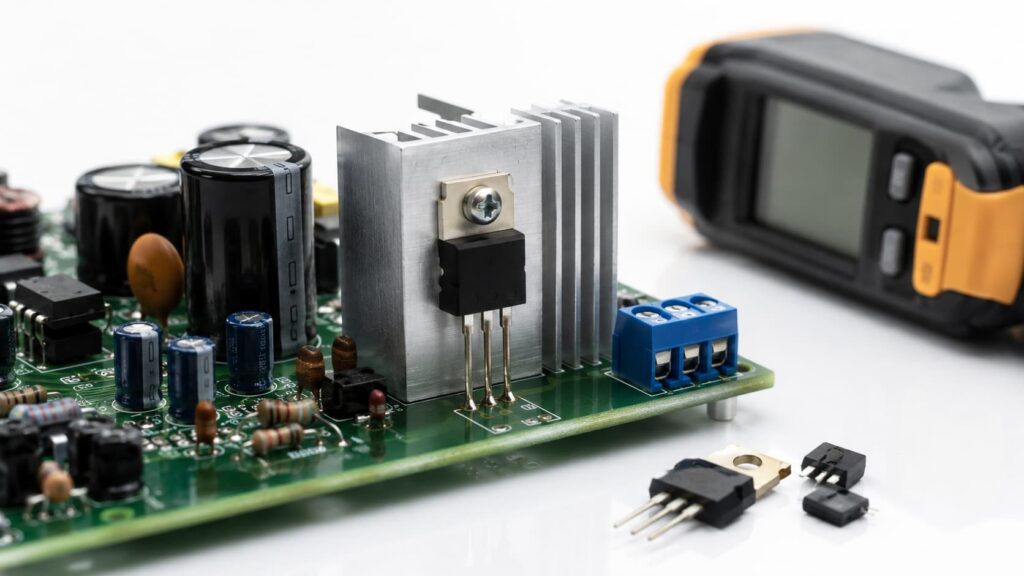
For 78xx regulators in TO-220 packages, here’s a practical thermal lookup table:
| Vin−Vout | 100mA | 250mA | 500mA | 750mA | 1.0A | 1.5A |
|---|---|---|---|---|---|---|
| 3V | 0.3W ✅ | 0.75W ✅ | 1.5W ⚠️ | 2.25W 🔴 | 3.0W 🔴 | 4.5W 🔴 |
| 5V | 0.5W ✅ | 1.25W ⚠️ | 2.5W 🔴 | 3.75W 🔴 | 5.0W 🔴 | 7.5W 🔴 |
| 7V | 0.7W ✅ | 1.75W ⚠️ | 3.5W 🔴 | 5.25W 🔴 | 7.0W 🔴 | 10.5W 🔴 |
| 10V | 1.0W ⚠️ | 2.5W 🔴 | 5.0W 🔴 | 7.5W 🔴 | 10.0W 🔴 | 15.0W 🔴 |
- ✅ No heatsink needed (Pdiss ≤ 1W, Tj rise ≤ 65°C)
- ⚠️ Small clip-on heatsink recommended (1W < Pdiss ≤ 2W)
- 🔴 Active heatsink or switching regulator required (Pdiss > 2W)
Heatsink recommendation for TO-220: Wakefield-Vette 274-1AB (θSA ≈ 28°C/W, $0.46 in volume) is a good starting point for moderate power. For higher dissipation, the 513 series or equivalent extruded aluminum heatsinks bring θSA below 10°C/W.
6. When NOT to Use a 78xx (or LM317)
Linear regulators are not always the right answer. Here are the scenarios where you should look elsewhere:
High Input–Output Differential
Dropping 24V to 5V at 1A through a 7805 wastes 19W as heat. A buck converter doing the same job at 90% efficiency wastes about 0.5W. The 38× difference in heat dissipation makes this a non-decision: use a switching regulator.
Battery-Powered Designs Requiring Long Runtime
Even at low currents, the 7805’s 5–8mA quiescent draw drains a battery continuously. A modern LDO (e.g., TPS7A series, HT7333) with sub-1µA Iq, or a switching regulator with pulse-skipping at light load, will dramatically extend battery life. The LM317 at ~50µA is an improvement over the 7805, but still not competitive with modern ultra-low-Iq LDOs for truly battery-constrained designs.
Tight PCB Space
A TO-220 7805 plus its heatsink plus two electrolytic capacitors takes significant board area. A SOT-23 switching regulator with a tiny chip inductor can deliver the same output current in a fraction of the space. For space-constrained designs (wearables, IoT sensors, compact modules), integrated switching regulators or PMICs (see our [PMIC guide →]) are the right call.
Noise-Sensitive Analog Front-Ends
Linear regulators are inherently low-noise — that’s one of their strengths. But if your application demands sub-100µV noise (precision ADC, RF front-end, audio preamplifier), even a 78xx’s ~40µV output noise might be too high. Dedicated low-noise LDOs (e.g., LT3045, TPS7A49) can achieve single-digit µV noise figures. The LM317, despite its adjustable nature, is not a low-noise device — its output noise is comparable to a 78xx.
You Need More Than 1.5A
The 78xx family tops out at 1.5A (5A for the rare 78Hxx). For higher currents, the LM350 (3A) and LM338 (5A) extend the adjustable-regulator approach. Beyond that, switching regulators or parallel LDO designs are standard practice.
7. 78xx vs Modern Switching Regulators — The Efficiency Trade-off
This comparison comes up in almost every power supply design review. Here’s the straight answer:
| Factor | 78xx Linear Regulator | Modern Buck Converter (e.g., LM2596, MP1584) |
|---|---|---|
| Efficiency | 40–55% (load-dependent, Vout/Vin) | 85–95% |
| Output noise | ~40µV RMS (clean, no switching ripple) | ~5–15mV ripple (requires output filtering) |
| Component count | 3 (IC + 2 capacitors) | 8–12 (IC + inductor + diode + capacitors + resistors) |
| PCB area | Small for low power; large with heatsink | Moderate (inductor dominates) |
| EMI | Essentially zero | Switching node radiates; needs layout care |
| Cost (1ku) | $0.15–0.40 | $0.80–3.00 (IC + inductor + diode) |
| Drop-in 7805 replacements | — | RECOM R-78E series, CUI V78 series, etc. |
The switching-regulator-as-7805-replacement trend: Several manufacturers now produce pin-compatible switching regulator modules in the TO-220 footprint (RECOM R-78E, CUI V78, Murata OKI-78SR). These drop directly into a 7805 PCB layout, require no external components, and deliver 90%+ efficiency. They cost $5–10 versus $0.30 for a 7805, but the elimination of heatsink hardware, wasted power, and thermal design effort often justifies the premium in production designs.
Our rule of thumb: for low-current (<200mA), low-differential designs, stick with the 78xx. For anything that needs a heatsink or runs from a battery, price out the switching alternatives before committing.
8.FAQ
What’s the difference between L7805 and LM7805?
Nothing functional. “L” is STMicroelectronics’ prefix, “LM” is National Semiconductor/TI’s prefix. Both are 5V fixed positive regulators with identical specs. The suffix letters (CV, CT, CKC) indicate package and temperature range. When cross-referencing, match the package, accuracy grade, and temperature range — the prefix is secondary.
Can I use a 7812 to get 5V by adding resistors?
No. The 78xx is a fixed regulator — its internal reference and feedback network are set at the factory. You cannot change a 7812’s output voltage with external resistors. To get 5V, use a 7805. For adjustable output, use an LM317.
Is the 7805 obsolete?
No. Despite being introduced in the 1970s, the 7805 remains in active production by multiple manufacturers and is one of the highest-volume linear regulator ICs in the world. It is not NRND (not recommended for new designs) or EOL at any major manufacturer. However, for new designs where efficiency or battery life matters, a switching regulator or modern LDO is often the better engineering choice — even though the 7805 will remain available.
Why does my 7805 get burning hot?
Almost always because (Vin − 5V) × Iload exceeds 1–2W without a heatsink. The 7805 has thermal shutdown protection, so it won’t destroy itself — but it will cycle on and off as it overheats and cools. Solution: add a heatsink, reduce input voltage (use a lower transformer tap or pre-regulate with a switching converter), or reduce load current.
Can I parallel two 7805s for more current?
Not directly. 78xx regulators don’t share current evenly — the one with the slightly higher output voltage will carry most of the load until it hits current limit. For paralleling, you need ballast resistors (0.1–0.2Ω in series with each output) to force current sharing, and you’ll lose some voltage accuracy. For >1.5A, use an LM350 (3A), LM338 (5A), or a switching regulator instead of paralleling 78xxs.
What’s the best 7805 replacement for higher efficiency?
Several companies make pin-compatible switching regulator modules in the TO-220 footprint: RECOM R-78E series, CUI V78 series, Murata OKI-78SR. These drop directly into a 7805 PCB layout, need no external components, and deliver 90%+ efficiency. At $5–10 each, they’re more expensive than a $0.30 7805, but the saved heatsink cost, assembly labor, and wasted energy often justify the BOM cost increase.
Does the 78xx need a diode for reverse protection?
It depends. If your design has a large output capacitor (>100µF) and the input can suddenly short to ground (e.g., a crowbar circuit or connector hot-plug), the stored energy in the output capacitor can discharge backward through the regulator and damage it. A 1N4002 diode connected from output to input (cathode to input) provides reverse protection. For most low-capacitance designs, this diode is unnecessary.
Where can I find the 78xx datasheet?
The ST L78 series datasheet and TI µA78xx datasheet are the two most commonly referenced documents. Both are freely available on the manufacturers’ websites. For obsolete or niche variants (78Hxx, specific temperature grades), check datasheet archive sites or contact the manufacturer directly.
Need Help Sourcing 78xx or LM317 Regulators?
Whether you’re ordering production volumes of 7805s and 7812s, need help cross-referencing an obsolete 78xx variant, or want to compare pricing and lead times across ST, TI, ON Semi, and alternative sources — we can help.