
Table of Contents
AI Server Components Sourcing: Power ICs, Memory, Retimers, and Optical Modules
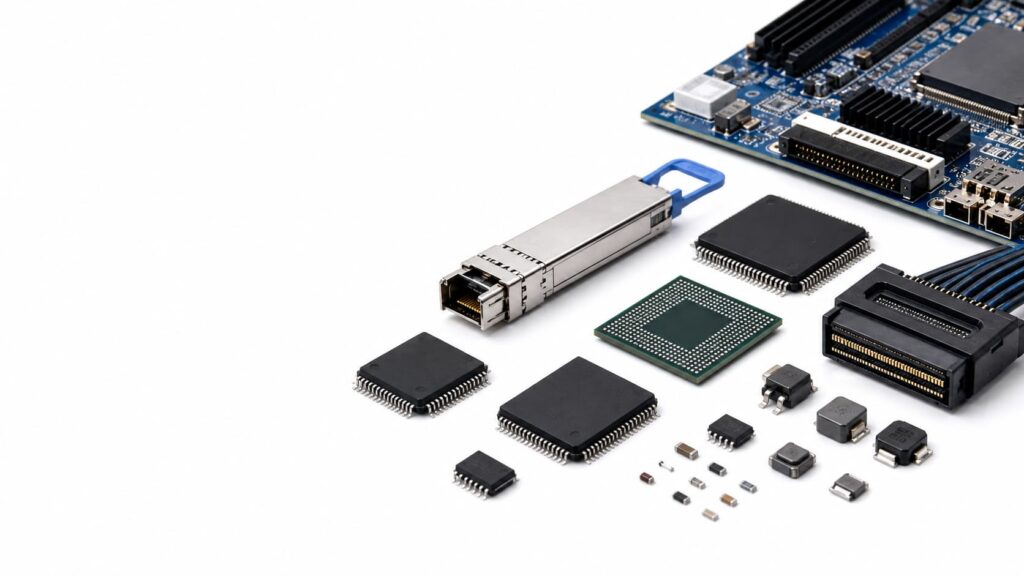
If you’re sourcing components for an AI server build right now, you already know the GPU situation is a headache. That story has been told a hundred times.
But here’s what actually keeps procurement managers up at night: it’s not the GPU that stops the line. It’s the power management IC that went to 26-week lead time when nobody was watching. Or the retimer that your engineer can’t swap because the firmware table is locked to one vendor. Or the memory batch that showed up with the wrong date code and now QA won’t sign off.
The headline components — GPUs, AI accelerators, HBM — get all the attention. Fine. But a production BOM doesn’t run on headlines. It runs on hundreds of supporting parts: multiphase controllers, hot-swap ICs, eFuses, current sensors, DDR5 DRAM, PCIe retimers, Ethernet PHYs, optical transceivers, high-speed connectors, ESD arrays. Any one of them can delay a build. Ask me how I know.
This guide walks through the AI server component categories that buyers should actually be worrying about — what makes each one tricky, what to check before you send an RFQ, and how to keep quality and traceability under control when lead times are ugly.
1. Why AI Server BOMs Are Getting Harder to Source — and Why It's Not Just About GPUs
Let’s start with some numbers, because the macro picture matters even if you’re just trying to buy 5,000 pieces of a specific buck regulator.
Deloitte’s 2026 semiconductor outlook puts global chip sales at around US$975 billion this year — a historic peak, with growth accelerating to 26%. That sounds great if you’re a chip company. If you’re a buyer, it means demand is pulling on every node, every package type, every wafer start. And when supply is that tight across the board, the parts that get squeezed first are rarely the $20,000 GPUs. They’re the $3 power management ICs that the foundry deprioritized because the margin-per-wafer math said so.
Gartner’s latest forecast points to worldwide semiconductor revenue exceeding $1.3 trillion in 2026, with memory revenue climbing sharply. They’re also calling for steep annual price increases on DRAM and NAND flash, with no meaningful relief until late 2027 at the earliest. If that timeline holds — and nobody has a crystal ball — buyers should be planning for a rough 18 months in the memory aisle.
What does this actually mean if you’re sitting on an AI server BOM right now?
One: memory pricing is not going to be your friend. DDR5, NAND, eMMC — none of it. Budget for volatility.
Two: power and signal-chain components around accelerators are vulnerable to lead-time blowouts. These are the parts nobody panic-buys until they’re already late.
Three: alternative sourcing and pre-shipment checks stop being “nice to have” and start being survival tools. When the original part number is gone, you need a plan B that doesn’t involve praying.
The point is: the buyer’s job isn’t “find the GPU.” It’s “keep the whole BOM alive.” And that means paying attention to categories that don’t make headlines.
2. Power Management ICs: The Parts Nobody Thinks About Until the Line Stops
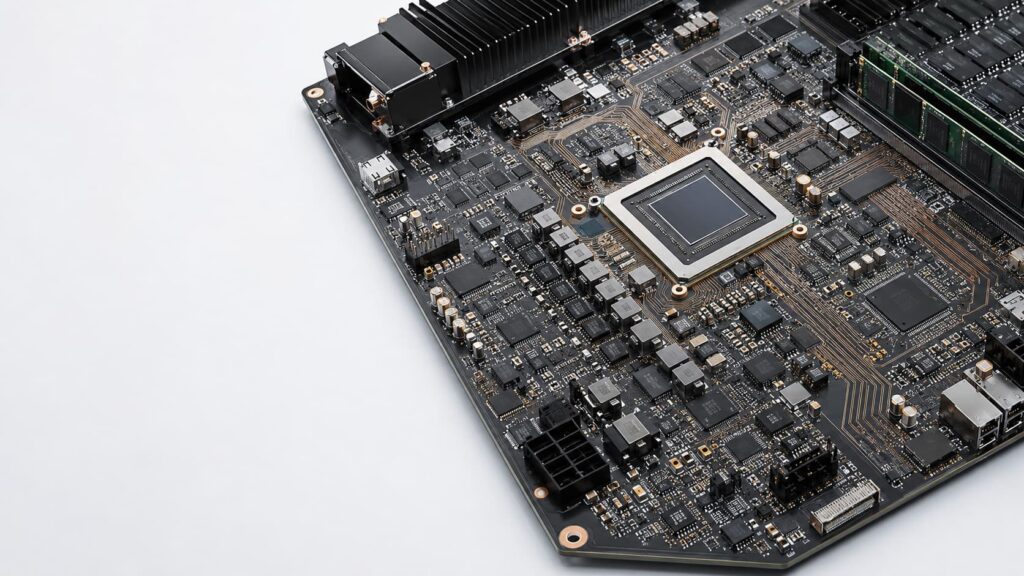
I’m going to say something that sounds dramatic but isn’t: power management ICs are the most underappreciated risk in an AI server BOM. An accelerator board might have 40, 50, even 60 voltage rails — CPUs, DDR, networking, storage controllers, BMCs, fans, sensors, PCIe retimers, you name it. Every single one of those rails depends on a regulator, a controller, a power stage, or a supervisor doing its job.
And here’s the thing: these are not easy one-to-one replacements. You can’t just grab a buck regulator with the same input voltage range and call it a day. You need to match switching frequency, current capacity, compensation network requirements, PMBus command set, sequencing behavior, thermal performance, package footprint, and a dozen other parameters that your engineer cares about deeply and your supplier’s datasheet may or may not make obvious.
What you’re likely dealing with
DC-DC converter ICs and buck regulators
Multiphase controllers (these are workhorses in AI power delivery)
Power stages (DrMOS, Smart Power Stages)
LDO regulators (yes, still relevant — especially for low-noise analog rails)
PMBus power controllers and telemetry ICs
eFuse ICs and hot-swap controllers
Ideal diode / ORing controllers
Voltage supervisors and power sequencers
Current sense amplifiers
MOSFET and gate driver ICs
TVS diodes and board-level circuit protection
What to put in the RFQ — don’t skip these
If you’re sending an RFQ for AI server power ICs, the supplier needs more than a part number. Way more. Here’s what actually helps:
Full manufacturer part number — including every suffix. That trailing “-T” or “-R” can mean a completely different packaging option.
Approved brand list — if your engineer will only accept TI, MPS, Infineon, Renesas, or a specific shortlist, say so upfront.
Package type — QFN, BGA, WLCSP, flip-chip. Don’t assume the supplier knows which one you need.
Target quantity and required date code
Application rail or system function — “Vcore for accelerator” or “DDR5 VDDQ rail” tells the supplier more than “power IC.”
Output voltage and current — if known. If not, at least the rail function.
PMBus / I2C / telemetry requirements — critical for AI server power architectures.
Whether cross-references or alternatives are acceptable — and if yes, whether your engineer needs to approve them.
One thing I’ve learned the hard way: if the original power IC is unavailable, “alternative review” doesn’t mean “find something with similar specs on Octopart and ship it.” It means matching electrical parameters, package compatibility, pinout, thermal rating, lifecycle status, and then getting engineering to sign off. Skip one step and you’re buying a line-down situation.
3. Memory ICs: Let's Be Honest About What's Happening Right Now
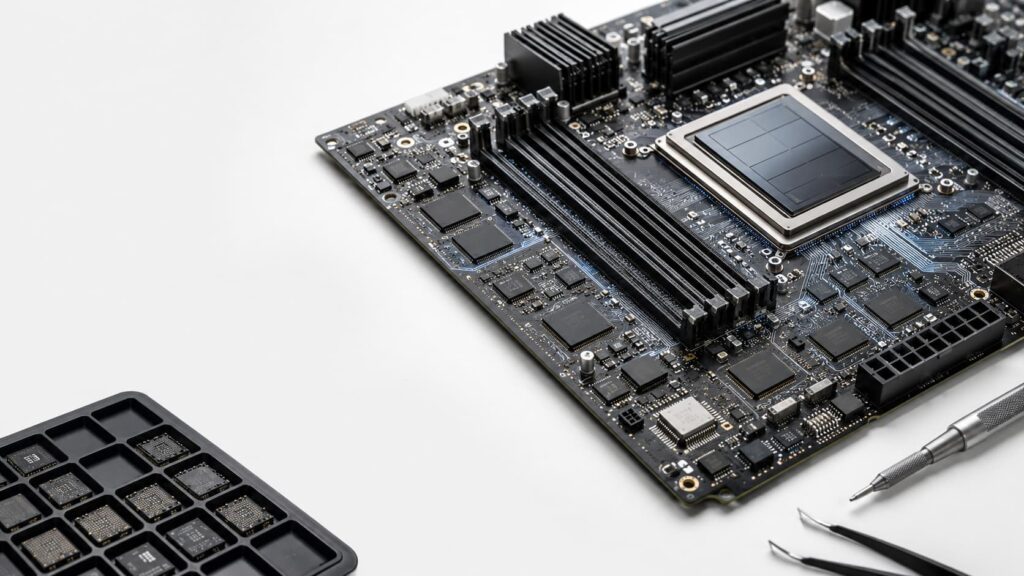
Memory is a mess. I’m not going to sugarcoat this.
The HBM story dominates industry coverage — TrendForce is tracking aggressive HBM capacity expansion through 2026 and 2027, with HBM wafer input from the big three suppliers expected to hit 22% of total DRAM wafer input by end of 2026 and 30% by end of 2027. HBM capacity per AI chip is jumping from 96GB/192GB to 216GB/288GB in 2026 alone, driven by AI ASIC upgrades and higher GPU shipment volumes.
Now, you might be thinking: “I’m not buying HBM. Why should I care?”
Because when Samsung, SK hynix, and Micron shift wafer capacity toward HBM, the stuff you are buying — DDR5, NAND flash, eMMC, UFS — gets squeezed. Not a little. A lot. TrendForce is calling it a “crowding-out effect on conventional DRAM capacity,” and that’s exactly what it sounds like. Fewer wafers for standard memory, same or higher demand, prices go up. It’s not complicated, but it is painful.
Memory components that show up in AI server BOMs
DDR5 DRAM — the workhorse. Speed grades and temperature ranges matter enormously.
Server DIMM-related components — SPD EEPROMs, temperature sensors, PMICs.
NAND flash — enterprise SSDs don’t build themselves.
eMMC and UFS — management controllers, boot devices.
NOR flash — firmware storage. Small but critical.
EEPROM — configuration data, board ID.
SSD controllers and their supporting power ICs.
Before you source memory — the checklist that actually matters
Memory sourcing is detail work. The difference between a good RFQ and a bad one is usually three rounds of back-and-forth that you don’t have time for. Get it right the first time:
Exact part number and speed grade — “DDR5 16GB” is not a part number. It’s a wish.
Density and organization — x4, x8, x16? It matters for the board layout.
Package type — FBGA, with ball count and pitch.
Voltage and interface specs
Temperature grade — commercial, industrial, automotive? AI servers run hot; don’t assume “commercial” is fine.
Date code requirement — for production orders, this is non-negotiable.
Lot code / batch preference — mixed batches can cause QA headaches downstream.
Packaging condition — tape and reel, tray, tube. Specify it.
Label photos and traceability documents — if your receiving inspection needs them, say so before you place the order.
And please — please — don’t send an RFQ that says “equivalent to DDR5 16GB.” Nobody can quote that with confidence. You’ll get three different interpretations and none of them will match what your engineer expected.
4. Retimers and Redrivers: Small Chips, Big Consequences
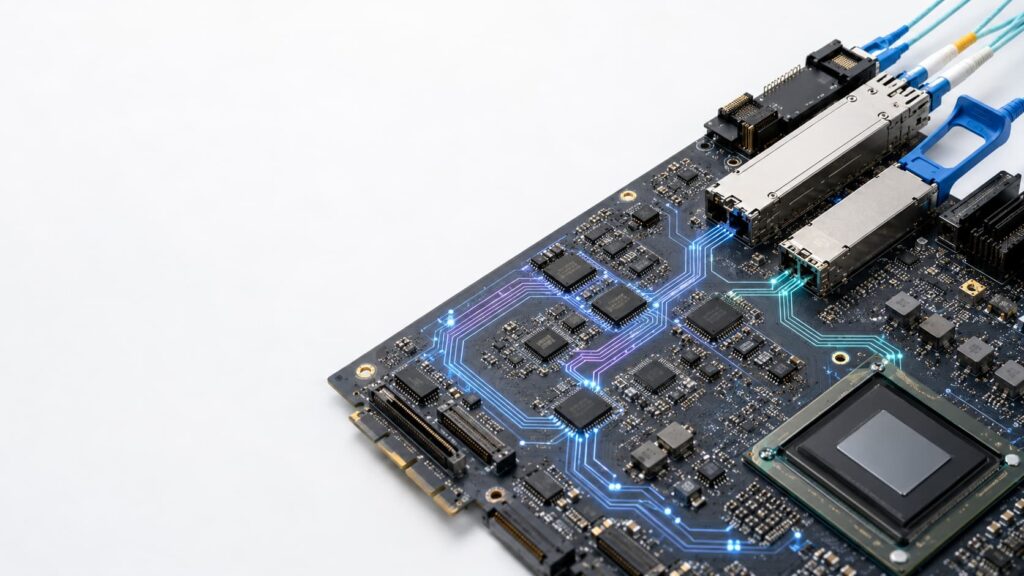
Here’s a category that almost never makes the sourcing panic list — until a PCIe link won’t train and suddenly everyone cares.
AI servers depend on high-speed interconnects between CPUs, accelerators, memory, storage, NICs, and switches. As PCIe moves to Gen 5 and Gen 6, CXL adoption grows, and Ethernet speeds climb, signal integrity across PCB traces, connectors, cables, and backplanes gets harder to maintain. This is basic physics: higher data rates, shorter eyes, less margin.
Retimers and redrivers sit in the signal path and clean things up. Retimers fully recover and retransmit the signal (clock and data). Redrivers boost what’s already there (equalization and amplification). Different jobs, different complexity, both critical.
PCI-SIG published the PCIe 6.0 specification doubling the bandwidth of PCIe 5.0 — 64 GT/s raw data rate — while maintaining backwards compatibility. That’s impressive engineering. It also means the margin for error in your signal chain keeps shrinking.
What you’re likely sourcing
PCIe retimer ICs (Astera Labs, Broadcom, Renesas, Microchip, TI)
PCIe redriver ICs
CXL retimers
USB and multi-protocol redrivers
Ethernet PHYs
Clock generators, clock buffers, jitter cleaners
Equalizers and high-speed muxes
Why these parts are sourcing-sensitive
A retimer is not a commodity. You can’t just find one with the same lane count and call it cross-compatible. Your engineer is going to want to review:
PCIe or CXL generation support (Gen 4, 5, 6?)
Lane count and bifurcation options
Package and footprint — these are often proprietary or semi-custom
Equalization features and tuning ranges
Reference clock requirements — spread spectrum? Independent SSC?
Power rail sequencing
Firmware or EEPROM configuration — some retimers need external firmware; if it’s missing, the chip is a brick
Vendor toolchain — evaluation boards, software utilities, signal integrity models
If your original retimer is on allocation and you’re looking for alternatives: get engineering involved early. Don’t assume. Don’t guess. A wrong retimer swap can mean a PCIe link that won’t train at speed — or won’t train at all. That’s not a sourcing problem anymore. That’s a respin.
5. Optical Modules and High-Speed Communication Parts
AI clusters don’t just need fast processors. They need fast pipes between racks, between switches, between buildings. This is driving serious demand for optical transceivers, fiber components, and everything that supports them.
Deloitte’s outlook calls out co-packaged optics as a trend to watch in data center switches — the idea being that as bandwidth per rack keeps climbing, moving the optics closer to the switch ASIC reduces power and footprint. Whether your design is using pluggable optics or co-packaged, the components involved are not sitting on a shelf waiting for you.
The sourcing landscape
Optical transceivers (QSFP-DD, OSFP, SFP, and their variants)
Fiber optic components — photodiodes, laser diodes, TOSA/ROSA
Optocouplers and digital isolators
High-speed connectors and cable assemblies
RF and microwave connectors
Clock and timing ICs (clean clocks for high-speed SERDES)
TVS and ESD protection (high-speed I/O is fragile)
Power modules for optical and switch systems
What to nail down in the RFQ
Data rate per lane and protocol — 100G PAM4 per lane? NRZ? It changes everything.
Form factor — QSFP56, QSFP-DD, OSFP, SFP28. These are not interchangeable.
Reach and fiber type — SR, DR, FR, LR. Single-mode vs multi-mode. Don’t guess.
Wavelength — CWDM, DWDM, or fixed-wavelength? Your link budget depends on it.
Temperature grade — commercial vs industrial. Data centers are temperature-controlled, but edge deployments aren’t.
Connector type — LC, MPO, MXC? If you order the wrong one, it won’t even plug in.
Compliance and interoperability — MSA compliance, CMIS, IEEE standards. Required or just nice-to-have?
For production or field replacement orders, don’t sleep on label photos, lot traceability, and ESD-safe packaging. Optical modules are sensitive to handling, and a DOA transceiver that was damaged in shipping is nobody’s idea of a good Tuesday.
6. Connectors, Passives, and Protection: The Parts That Look Easy Until They're Wrong
I’ve seen BOMs where every IC was sourced perfectly — right part numbers, right date codes, right quantities — and then production got held up for three days because someone ordered the wrong board-to-board connector height. Three days. Over a connector.
These parts look trivial. They’re not.
The supporting cast
Board-to-board and mezzanine connectors
Backplane connectors
High-speed cable assemblies (PCIe riser cables, internal I/O)
RF and coaxial connectors
Fuses and PTC resettable fuses
TVS diodes and ESD protection arrays
Current sense resistors (low-ohm, high-precision)
High-reliability capacitors (tantalum, MLCC, polymer)
Power inductors and chokes
Thermal sensors and fan controller ICs
Why they can ruin your week
The difference between “right” and “almost right” on a connector is often a millimeter or less. Pitch, stacking height, mating orientation, number of positions — get one wrong and it’s a respin or a rework order. Passive components have tolerance bands, temperature coefficients, voltage derating curves, and package sizes that directly affect board performance. A capacitor with the right value but the wrong dielectric can fail at temperature. A TVS diode with the wrong standoff voltage will either clamp too early or — worse — not clamp at all.
For every line item: full manufacturer part number. Not “high-speed connector.” Not “TVS diode, 5V.” The exact MPN, including package suffix. Small differences in pitch, capacitance, surge rating, or packaging orientation can make the difference between a working board and a pile of rework tickets.
7. Quality and Traceability: Don't Wait Until Receiving Inspection
AI server components are expensive, often short in supply, and time-sensitive. Finding out about a mismatch after the parts land at your EMS is the worst possible timing. Pre-shipment inspection — or at minimum, pre-shipment documentation review — isn’t paranoia. It’s math.
What we recommend checking before shipment
Model number verification — visually confirm the marking against the datasheet.
Brand / manufacturer logo check — counterfeit components are a real problem in tight markets.
Package type and quantity count
Date code and lot code review — and whether they’re consistent across the order.
Manufacturer label photo — this alone catches a surprising number of issues.
Packaging condition — crushed trays, torn moisture barrier bags, missing desiccant. All red flags.
ESD-safe packaging — if it shows up in a regular poly bag, reject it.
MSL / moisture barrier bag integrity — for moisture-sensitive devices, this matters.
Datasheet cross-check — does the marking format match what the manufacturer documents?
CoC, RoHS, REACH, or other compliance docs — availability varies by part and source, but ask early.
For memory ICs, retimers, and power management parts, pay special attention to the package suffix, temperature grade, and date code on the label versus what your PO says. I’ve seen an entire reel come in with the right base part number but the wrong temperature range. The label “looked close enough” — until someone read the fine print.
Document availability depends on manufacturer, channel, quantity, and part type. State what you need before you order. Surprising your supplier with a last-minute documentation request is a great way to delay your own shipment.
8. How to Write an RFQ That Doesn't Waste Everyone's Time
I’ve seen too many RFQs that look like this:
“Qty 500 — DDR5 16GB — target price please.”
That’s not an RFQ. That’s a conversation starter that will cost you three days of back-and-forth before anyone can give you a real number.
A good RFQ makes the supplier’s job easy. And when the supplier’s job is easy, you get faster, more accurate quotes. Here’s what belongs in every line item:
The basics — every single line
Full manufacturer part number — every suffix, every package code.
Approved brand or manufacturer list — if your engineer has a preference or restriction, disclose it.
Target quantity — and whether partial shipments are acceptable.
Date code requirement — if you need current production, say so.
Package / packing requirement — tape and reel? Tray? Cut tape is fine?
Target delivery date or window
Destination country — import duties, export controls, and logistics routing all depend on this.
Alternatives policy — are cross-references acceptable? Does engineering need to approve?
For multi-line AI server BOMs, add a priority tag
Mark every line with one of these:
| Tag | Meaning |
|---|---|
| No-sub | Must be this exact MPN. No substitutes. |
| AVL-only | Alternatives must come from the approved vendor list. |
| Alt-OK | Cross-references are welcome, subject to engineering review. |
| Sample | Engineering samples only — small qty, may accept older date code. |
| Production | Full production order — strict date code, lot, and doc requirements. |
| Docs-req | Requires CoC, RoHS, REACH, or other compliance docs. |
This takes five minutes to add but saves hours of confusion later. It tells the sourcing team which lines are “find stock now” versus “research alternatives.” It also makes clear which parts are non-negotiable — and those are usually the ones you want to flag before the shortage hits, not after.
9. One Sourcing Strategy Does Not Fit All
Different component types fail in different ways. Treating a power management IC the same way you treat a passive capacitor is how mistakes happen.
| Component Type | What Actually Goes Wrong | What to Focus On |
|---|---|---|
| Power management ICs | Lead times stretch, wrong package variant ships, alternative causes instability | Full MPN, package suffix, PMBus/telemetry, rail specs, engineer-reviewed alternatives |
| Memory ICs | Price swings, date code mismatches, tight allocation | Full MPN with speed/density/package, batch consistency, label verification |
| Retimers / redrivers | Engineering incompatibility — firmware, config, or signal integrity | PCIe/CXL gen, lane count, firmware requirement, package footprint |
| Optical modules | Wrong form factor, wrong reach, interoperability failure | Data rate, form factor, wavelength, reach, MSA compliance |
| Connectors | Mechanical mismatch — pitch, height, orientation | Exact MPN, pitch, mating height, orientation, number of positions |
| Protection (TVS, ESD) | Wrong clamping voltage, wrong surge rating | Standoff voltage, clamping voltage, surge current rating, package |
| Passives | Tolerance, temperature coefficient, or package mismatch | Value, tolerance, voltage rating, tempco, dielectric, case size |
For urgent builds: split the BOM into three buckets
This is probably the single most useful thing you can do before sending out an AI server BOM for quotation:
Bucket 1 — No-substitution parts. These are the MPNs your engineering team has qualified and cannot change without a full respin review. Mark them clearly.
Bucket 2 — Approved alternatives exist. These are parts where your AVL already lists one or more drop-in replacements that engineering has signed off on. Tell the supplier so they can check stock across all options.
Bucket 3 — Open to proposal. These are parts where you’re willing to review alternatives the supplier suggests. Engineering needs to approve, but you want options on the table.
This triage makes shortage recovery realistic. It also prevents the most common sourcing disaster: approving an “alternative” that wasn’t actually an alternative, shipping it to the line, and discovering it doesn’t work.
10. The Bottom Line — And I Mean This
AI server demand isn’t going anywhere but up. The components that keep those servers running — the power ICs, the memory devices, the retimers, the optics, the connectors, the protection — will stay tight, volatile, and unforgiving of sloppy procurement.
The buyers who do well in this environment aren’t the ones with the biggest budgets. They’re the ones with the cleanest RFQs, the clearest alternative policies, and the discipline to check documentation before parts hit the receiving dock.
A few things I’d leave you with:
Don’t treat every line item the same. A $2 TVS diode and a $40 retimer IC require fundamentally different sourcing approaches. The retimer needs engineering involvement. The TVS diode needs an exact MPN. Both will stop the line if they’re wrong.
Date codes, lot codes, and photos matter more than most buyers think. Especially for memory and power ICs. The label tells you things the part number doesn’t.
“We’ll figure out alternatives later” is not a strategy. It’s a prayer. Figure out your alternative policy before the shortage hits, when your engineer has time to review options, not when production is three days from line-down.
Quality checks before shipment are cheap insurance. Finding a mismatch at the supplier’s dock costs you a delay. Finding it at your EMS’s incoming inspection costs you a line stop. I know which one I’d rather pay for.
Apex Component supports AI server component sourcing across all the categories covered here — BOM quotation, inventory matching, hard-to-find part sourcing, alternative part review, pre-shipment quality checks, and traceability documentation where available.
Sourcing AI server components for a production build, shortage recovery, or a multi-line BOM? Send us your BOM and we’ll come back with options — stock, alternatives, and availability, not just a price list.