
Table of Contents
HBM Memory Shortage 2026: Why AI Is Reshaping the DRAM Market — and What It Means for Procurement
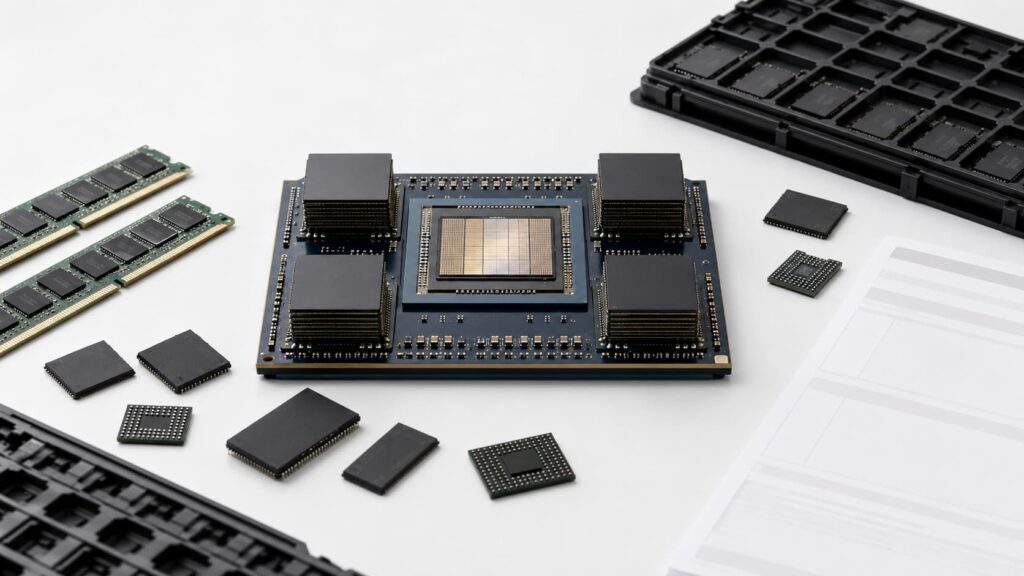
In early 2026, Micron confirmed that its entire HBM production capacity for the year was sold out. Not “tight.” Not “under allocation.” Sold out — with orders locked in more than twelve months ahead of delivery.

The HBM Bottleneck
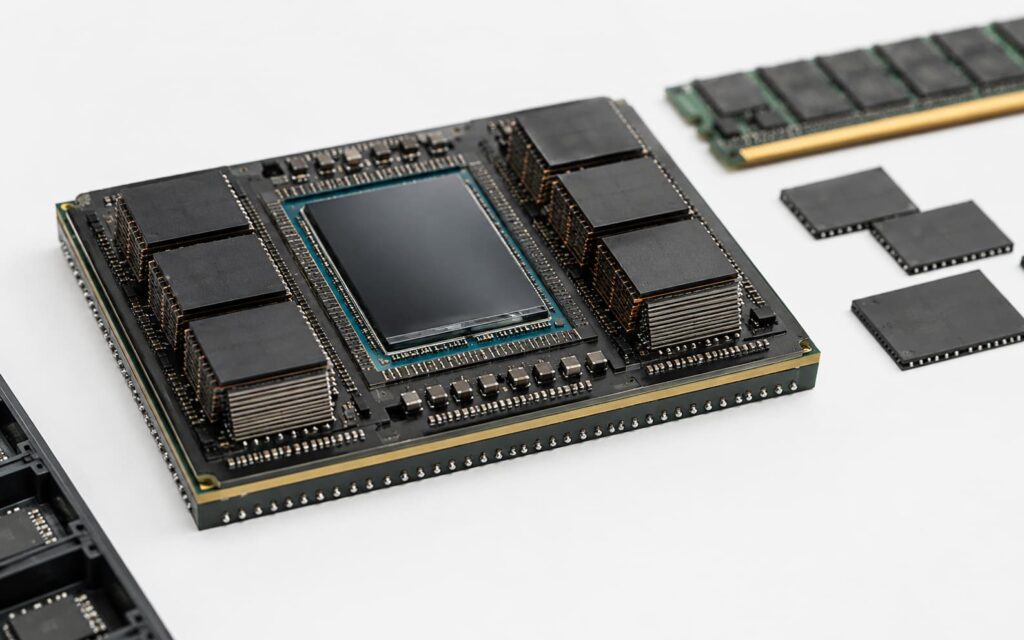
HBM — High Bandwidth Memory — has become the physical bottleneck in AI computing. Every NVIDIA H200, every AMD MI300X, every custom AI accelerator from Google and AWS relies on stacks of HBM sitting next to the processor die. No HBM means no AI server. It is not an exaggeration. It is the bill of materials.
The structural problem is in how HBM is made. It shares the same DRAM fabrication lines as conventional DDR5. When a foundry allocates wafer capacity to HBM — which yields fewer viable dice per wafer and uses roughly three times the silicon area per gigabyte compared to standard DDR — it does not expand total supply. It reallocates existing capacity. The AI boom is not adding a new lane to the highway. It is taking lanes away from everyone else.
HBM stacks multiple DRAM dies vertically using through-silicon vias, then places the stack on a silicon interposer beside the processor. The result is a 1024-bit data path per stack — sixteen times wider than a standard DDR5 channel at 64 bits — with substantially lower latency. For AI training and inference, where moving model weights between memory and compute is the primary bottleneck, this bandwidth advantage is not a nice-to-have. It is the reason every major AI chip uses HBM, period.
Micron is not alone in this. Samsung and SK Hynix — together with Micron, the three companies that control effectively all HBM supply — have both reported full capacity allocation through 2026. SK Hynix, which supplies HBM3E to NVIDIA for the H200 and B200 platforms, has been running its advanced packaging lines at maximum utilization since late 2025. Samsung’s HBM3E qualification took longer — that is a story in itself — but its latest-generation HBM is now shipping to multiple AI accelerator customers. Put those three together and you get an HBM market with zero slack. Not tight. Zero. And any new capacity announced today takes 12 to 18 months to turn into actual chips. The quarterly-earnings coverage tends to gloss over that timeline.
DRAM contract pricing over the first half of 2026 tells a story. The problem is, it tells two stories at once, and the headline one is misleading. Q1 saw a jump of roughly 90-95%. Q2 added another 58-63%. TrendForce’s July 3 update places Q3 growth at 13-18%. That deceleration looks like a cooling market. If you only read the headline, you would think the worst is over. It is not — at least not on the enterprise side. The slower growth rate is largely a base effect: 15% on a price that has already nearly doubled is still a meaningful increase in absolute dollars. Meanwhile, consumer DRAM demand from PCs and smartphones has weakened, pulling the blended average down and conveniently hiding the structural tightness underneath. Server DRAM and HBM remain under-supplied. The “softening” headline is a consumer story. The enterprise reality is a different animal entirely.
Micron sold out a year in advance — yet its stock dropped 20% in two days. Physical demand and financial sentiment are telling two different stories.
Stock prices react to quarterly earnings expectations, trade policy shifts, and algorithmic trading. Lead times and allocation decisions react to physical wafer capacity. Wall Street can afford to be wrong about lead times. A production line cannot. The gap between the two signals has widened in 2026, and the physical one — allocation letters, extended lead times, suppliers quietly refusing new orders — is what actually determines whether a BOM gets built.
The Shortage Is Spreading
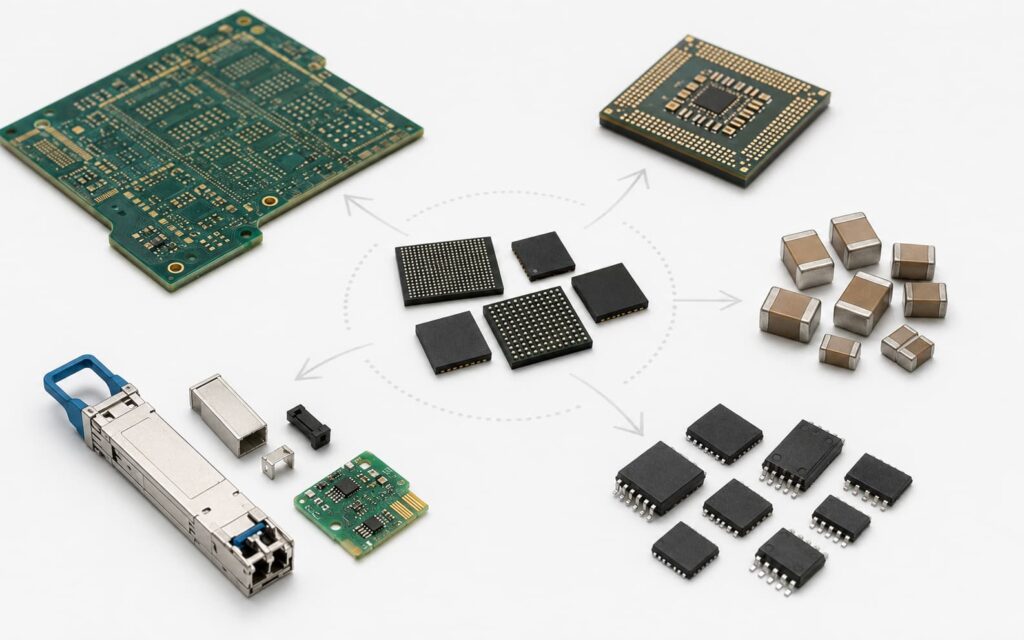
A Nomura research note from July 2 flagged a development that extends well beyond memory: the capacity squeeze that started in advanced logic chips is now spreading into PCB substrates, IC substrates, high-end MLCCs, PMICs, and optical components. The report noted that lead times for high-layer-count PCB substrates used in AI servers have extended by 30-40% since Q4 2025. High-end MLCCs — particularly large-case-size, high-capacitance parts used in server power delivery — are seeing allocation tighten as the same factories face competing demand from AI infrastructure and automotive electrification. Each wafer diverted to HBM and AI server silicon is a wafer not available for something else. The list of affected categories is growing by the quarter. And honestly, one of them should be getting more attention than it is.
Automotive-grade memory.
Automotive Memory: The Silent Victim
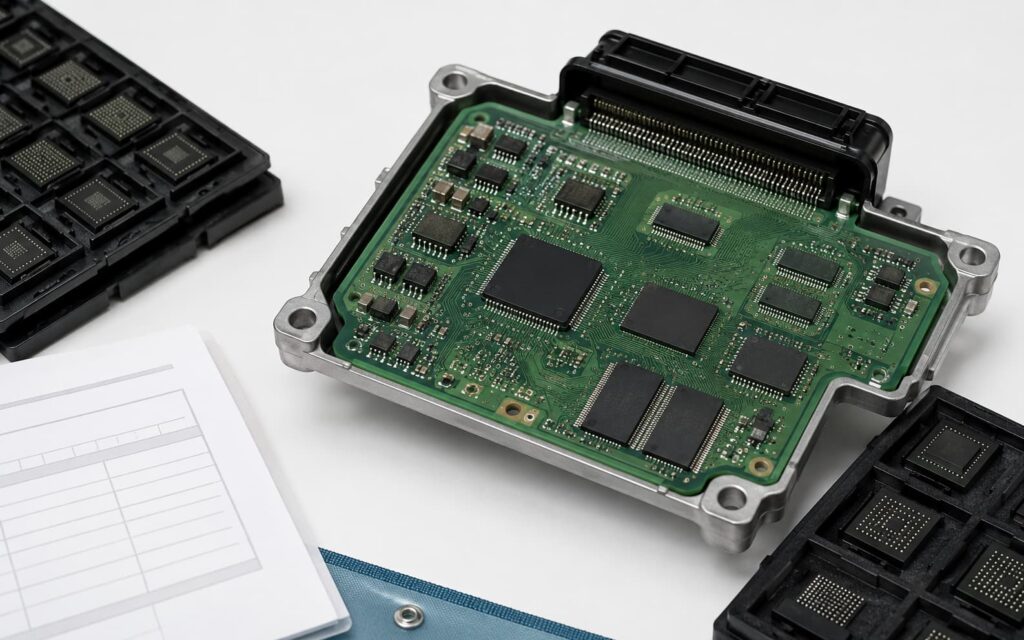
New orders for automotive-grade eMMC are being quoted with lead times stretching to 2028. Four years. Let that sit for a second. This is not a worst-case forecast from some analyst deck — it is what suppliers are currently telling customers. And when the base case is four years, the line between “worst case” and “current reality” starts to blur.
The mechanism is the same structural squeeze driving the HBM shortage, applied to a different product category. Automotive memory — eMMC for infotainment and telematics, DDR3L and DDR4 for ADAS processing, NAND flash for in-vehicle storage — competes for the same wafer capacity that feeds AI data centers. HBM and high-density server DDR5 carry substantially higher margins than automotive-grade parts. When a foundry allocates limited capacity, the economics pull toward the data center. It is not a conspiracy. It is just math
On the demand side, automotive memory consumption is rising. The global automotive MCU market is projected to grow from roughly $15.5 billion to $34.1 billion by 2034, a CAGR of about 8.2%. Every new ADAS feature, every digital cockpit upgrade, every shift to domain controller architectures adds memory content per vehicle. A mid-range car in 2026 might carry 8-16 GB of DRAM and 64-256 GB of NAND. By 2030, those figures could double. So you have two curves moving in opposite directions: demand climbing, supply squeezed. The gap between them is what produces a 2028 lead time. It is not complicated. It is just ugly.
The automotive qualification cycle makes it worse. An automotive-grade memory part must pass AEC-Q100 qualification, complete PPAP documentation, and receive production part approval tied to a specific fab line and process node. Here is the part that stings: switching an automotive eMMC line to HBM and then back again is not like flipping a switch. Requalification alone takes most of a year. Once capacity is committed to HBM and server DDR5, bringing it back to automotive-grade memory is a multi-quarter proposition — in practice, closer to a year or more. The fab does not care that your SOP date is slipping.
For Tier 1 and Tier 2 suppliers with production programs running into 2027 and 2028, the numbers point in one direction. Lead times are already extending past most companies’ standard planning horizons. The typical automotive program plans memory sourcing 12-18 months ahead of SOP. A 2028 lead time on a part needed for a 2027 SOP means the sourcing cycle has already been missed for some programs. Worse, industry analysts have noted that mid-tier Tier 1 suppliers — the ones without the negotiating muscle of the largest automotive groups — are facing allocation-based rationing. Not just extended lead times. Actual rationing. They are competing for a shrinking pool of available parts.
What Comes Next
The Q3 pricing data from TrendForce suggests DRAM contract growth is slowing, but the slowdown is uneven. Server DRAM and HBM remain structurally tight. Consumer DRAM is more readily available. How this split plays out through the end of 2026 depends on several moving pieces. None of them are fully under anyone’s control, which is exactly what makes this worth watching.
The antitrust lawsuit alleging that DRAM manufacturers artificially constrained DDR3 and DDR4 output is one variable. If the case advances — and that remains a big “if” — it could trigger a temporary release of held-back capacity into the spot market. Legal analysts note that DRAM price-fixing cases historically take years to resolve, but interim rulings or settlement pressure can shift market behavior faster than a final judgment. For now, the lawsuit is a scenario to monitor, not a forecast to plan around. Think of it as a wildcard, not a strategy.
The broader supply chain signal from Nomura is probably the more important takeaway. The same factory-floor economics that pushed automotive eMMC lead times to 2028 are now visible in PCBs, substrates, MLCCs, and PMICs. When capacity is finite and one high-margin application takes an outsized share, the lower-margin categories absorb the squeeze. Memory is the most visible example in mid-2026. It will not be the last.
For the automotive sector specifically, the 2028 lead times on eMMC are a hard data point with implications that ripple outward. Every system that depends on automotive-grade storage — infotainment head units, telematics modules, ADAS data loggers, digital instrument clusters — is indirectly affected. The supply planning assumptions that worked in 2023 and 2024 no longer hold. Whether the industry adapts through multi-sourcing, design changes that reduce memory dependence, or simply earlier and larger commitment volumes remains to be seen. But one thing is fairly clear from the current allocation picture: lead time visibility for automotive-grade memory is unlikely to improve before at least Q2 2027. The capacity that would need to come back is committed elsewhere through 2026, and the requalification timeline adds another two to three quarters on top of that. For programs with SOP dates in late 2027 or 2028, that leaves almost no margin.
Our sourcing desk tracks memory lead times and allocation updates across major HBM, DDR5, and automotive-grade memory suppliers. Reach out for current part-number-level data.