
Table of Contents
Resistor, Capacitor and Inductor Explained: Basic Electronic Components for Beginners
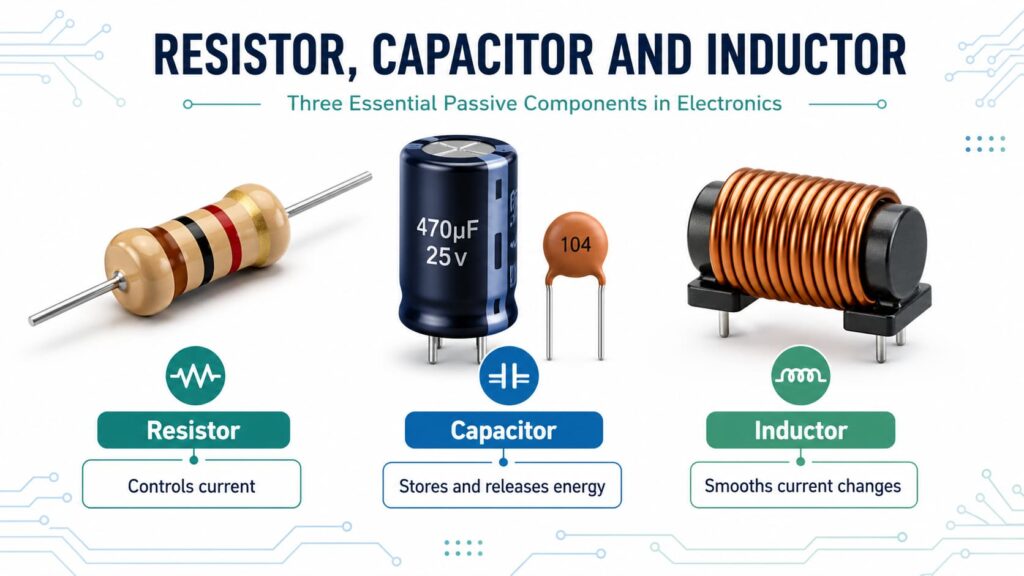
1.Introduction
Electronic circuits need stable voltage, controlled current, and reliable energy flow. If current is too high, components may be damaged. If voltage is unstable, ICs, sensors, power modules, and microcontrollers may not work correctly.
This is why many circuits use three basic passive components:
Resistors
Capacitors
Inductors
A simple way to understand them is to compare a circuit to a water pipe system.
| Component | Water Pipe Example | Main Function |
|---|---|---|
| Resistor | Valve or narrow pipe | Controls current |
| Capacitor | Water tank | Stores and releases energy |
| Inductor | Flywheel | Smooths current changes |
These components may look simple, but they are used in almost every electronic product. Understanding them helps buyers, engineers, and procurement teams make better component selection and sourcing decisions.Lorem ipsum dolor sit amet, consectetur adipiscing elit. Ut elit tellus, luctus nec ullamcorper mattis, pulvinar dapibus leo.
2.What Is a Capacitor?
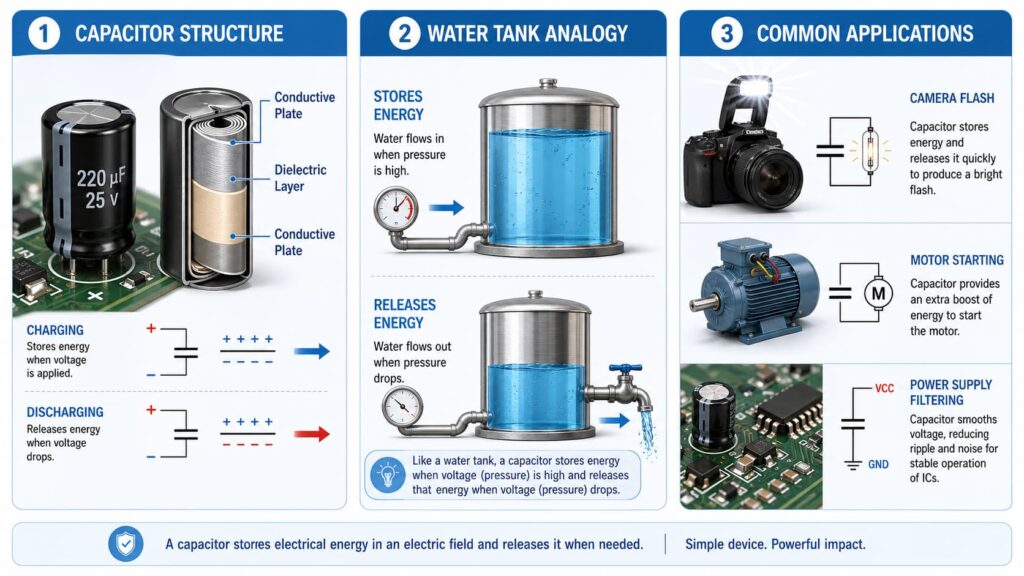
A capacitor is a passive electronic component that stores electrical energy.
It is usually made of two conductive plates separated by an insulating material. This insulating layer is called the dielectric. When voltage is applied, electric charge builds up on the plates. This process is called charging.
When the circuit needs energy, the capacitor releases the stored charge. This process is called discharging.
In simple terms:
A capacitor stores energy and releases it when needed.
3.Capacitor as a Water Tank
In a water pipe system, a capacitor is like a water tank.
When pressure is too high, the tank stores extra water. When pressure drops, the tank releases water to keep the flow stable.
In a circuit, a capacitor works in a similar way. When voltage rises suddenly, it absorbs energy. When voltage drops, it releases energy back into the circuit.
This helps reduce voltage fluctuation and improves circuit stability.
4.Common Uses of Capacitors
I. Energy Storage for Camera Flash
A camera flash needs a large amount of energy in a very short time. A battery may not provide this energy instantly, so a capacitor charges first and then releases energy quickly when the flash is triggered.
II. Motor Starting
Some motors need extra energy when they start. A capacitor can help provide this temporary energy, allowing the motor to start more smoothly.
III. Power Supply Filtering
Capacitors are commonly used near ICs, microcontrollers, sensors, and power modules. They help reduce voltage ripple, noise, and sudden voltage drops.
For component sourcing, capacitance value, voltage rating, tolerance, package size, dielectric type, temperature rating, and lifecycle status are important selection factors.
5.What Is a Resistor?
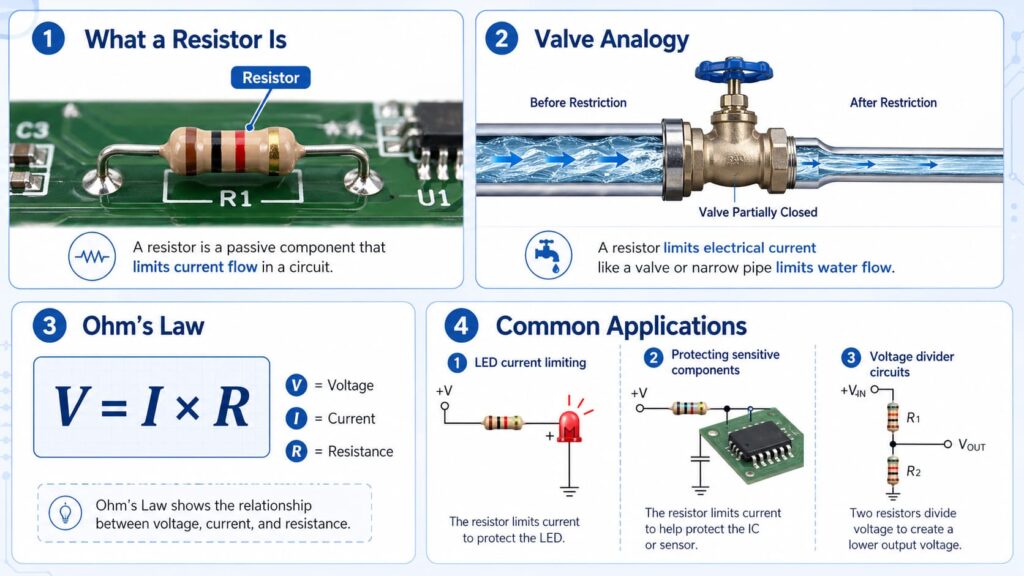
A resistor is a passive electronic component that limits current.
Current is the flow of electric charge. If too much current flows through a circuit, LEDs, ICs, sensors, or transistors may be damaged. A resistor helps control the current and keep it within a safe range.
In simple terms:
A resistor controls how much current can flow in a circuit.
6.Resistor as a Valve
In a water pipe system, a resistor is like a valve or narrow pipe.
If the valve is partly closed, less water can pass through. If the pipe is narrow, the flow becomes smaller.
A resistor works in a similar way. Higher resistance allows less current to pass. Lower resistance allows more current to pass.
7.Basic Formula: Ohm’s Law
The relationship between voltage, current, and resistance is called Ohm’s Law.
V = I × R
| Symbol | Meaning |
|---|---|
| V | Voltage |
| I | Current |
| R | Resistance |
This formula shows that when voltage stays the same, higher resistance results in lower current.
8.Common Uses of Resistors
I. LED Current Limiting
LEDs cannot handle excessive current. If an LED is connected directly to a power source without current control, it may burn out. A resistor is often connected in series with the LED to limit current.
II. Protecting Sensitive Components
Many ICs, sensors, and transistors require controlled current. Resistors help protect these components from current spikes or incorrect signal levels.
III. Voltage Divider Circuits
Resistors can divide voltage into a lower level. This is useful in battery detection, sensor interfaces, signal conditioning, and control circuits.
When sourcing resistors, buyers should check resistance value, tolerance, power rating, package size, temperature coefficient, and availability.
9.How to Read a Color Band Resistor
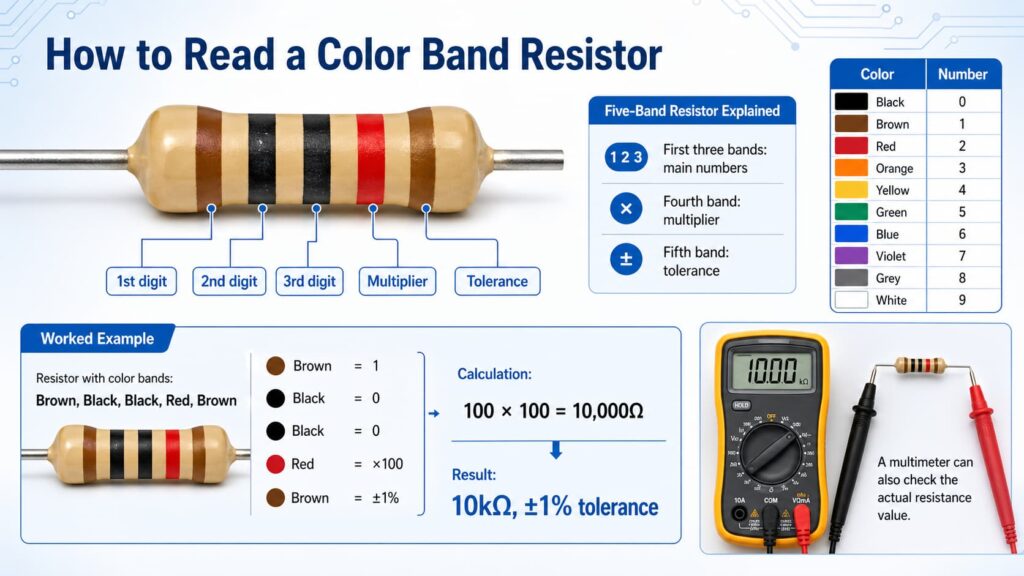
Some through-hole resistors use color bands to show resistance value.
For a five-band resistor:
– First three bands: main numbers
– Fourth band: multiplier
– Fifth band: tolerance
| Color | Number |
|---|---|
| Black | 0 |
| Brown | 1 |
| Red | 2 |
| Orange | 3 |
| Yellow | 4 |
| Green | 5 |
| Blue | 6 |
| Violet | 7 |
| Grey | 8 |
| White | 9 |
Example:
Brown Black Black Red Brown
This means:
– Brown = 1
– Black = 0
– Black = 0
– Red = ×100
– Brown = ±1%
So the resistance is:
100 × 100 = 10,000Ω
That means:
10kΩ, ±1% tolerance
A multimeter can also be used to check the actual resistance value.
10.What Is an Inductor?
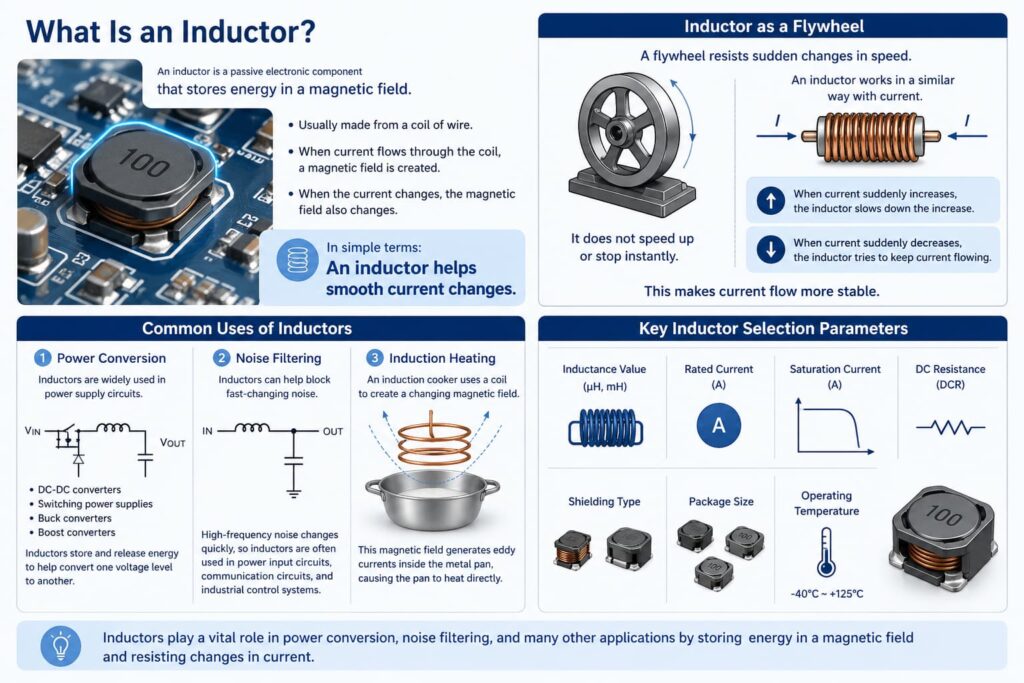
An lnductor is a passive electronic component that stores energy in a magnetic field.
It is usually made from a coil of wire. When current flows through the coil, a magnetic field is created. When the current changes, the magnetic field also changes. The inductor resists sudden changes in current.
In simple terms:
An inductor helps smooth current changes.
11.Inductor as a Flywheel
In a mechanical system, a flywheel resists sudden changes in speed. It does not speed up or stop instantly.
An inductor works in a similar way with current.
When current suddenly increases, the inductor slows down the increase. When current suddenly decreases, the inductor tries to keep current flowing.
This makes current flow more stable.
12.Common Uses of Inductors
I. Power Conversion
Inductors are widely used in power supply circuits, including:
– DC-DC converters
– Switching power supplies
– Buck converters
– Boost converters
In these circuits, inductors store and release energy to help convert one voltage level to another.
II. Noise Filtering
Inductors can help block fast-changing noise. Since high-frequency noise changes quickly, inductors are often used in power input circuits, communication circuits, and industrial control systems.
III. Induction Heating
An induction cooker uses a coil to create a changing magnetic field. This magnetic field generates eddy currents inside a metal pan, causing the pan to heat directly.
For component selection, important inductor parameters include inductance value, rated current, saturation current, DC resistance, shielding type, package size, and operating temperature.
13.Resistor vs Capacitor vs Inductor
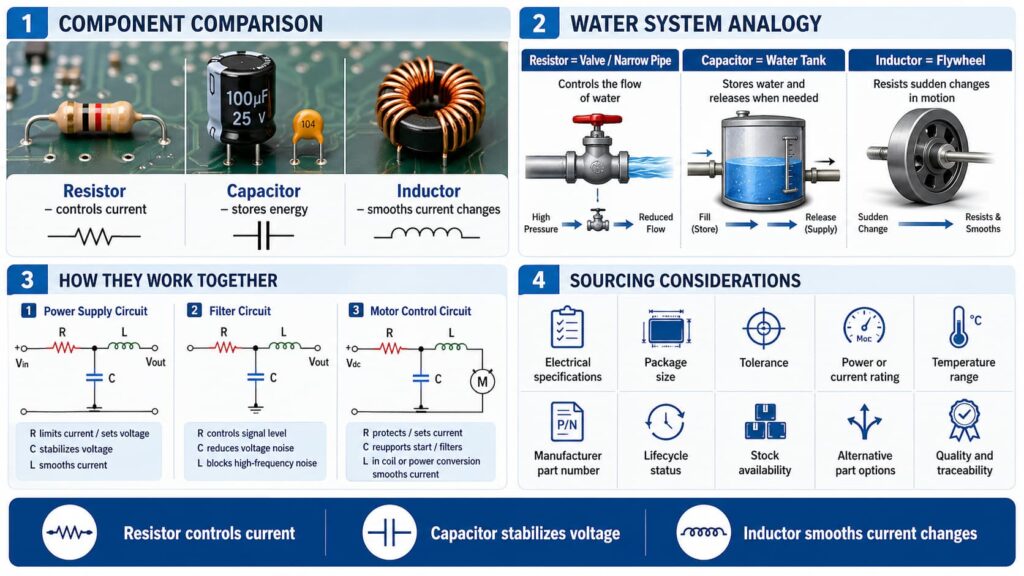
| Component | Simple Role | Water System Example | Main Job |
|---|---|---|---|
| Resistor | Controls current | Valve | Limits current flow |
| Capacitor | Stores energy | Water tank | Stabilizes voltage |
| Inductor | Smooths current | Flywheel | Reduces sudden current changes |
A simple way to remember them:
Resistor controls current
Capacitor stabilizes voltage
Inductor smooths current changes
14.How These Components Work Together
In real electronic designs, resistors, capacitors, and inductors often work together.
In a power supply circuit:
– A capacitor helps stabilize voltage
– An inductor helps smooth current
– A resistor may limit current or divide voltage
In a filter circuit:
– A capacitor helps reduce voltage noise
– An inductor helps block high-frequency interference
– A resistor helps control signal level
In a motor control circuit:
– A capacitor may support starting or filtering
– An inductor may appear in coils or power conversion sections
– A resistor may protect the circuit or control feedback signals
Together, these components help improve safety, stability, and efficiency.
15.Why These Components Matter in Sourcing
For buyers and procurement teams, passive components are not just small accessories. Wrong values, poor quality, unstable supply, or discontinued parts can affect the whole product.
When sourcing resistors, capacitors, and inductors, it is important to check:
– Electrical specifications
– Package size
– Tolerance
– Power or current rating
– Temperature range
– Manufacturer part number
– Lifecycle status
– Stock availability
– Alternative part options
– Quality and traceability
For long-term projects, stable supply and proper replacement planning are especially important.
16.Conclusion
Resistors, capacitors, and inductors are three of the most important passive components in electronic circuits.
A resistor controls current.
A capacitor stores and releases energy to stabilize voltage.
An inductor smooths current changes and supports power conversion.
Although they are small, they play an important role in protecting ICs, reducing noise, improving power stability, and supporting reliable electronic products.
For engineers and procurement teams, understanding these components helps with better part selection, BOM review, alternative sourcing, and long-term supply planning.
17.FAQ
1. What is the main difference between a resistor, capacitor, and inductor?
A resistor limits current, a capacitor stores energy in an electric field, and an inductor stores energy in a magnetic field while smoothing current changes.
2. Why are capacitors placed near ICs?
Capacitors are placed near ICs to reduce voltage noise and provide quick local energy when the IC needs it. This helps improve circuit stability.
3. Can one resistor value replace another?
Only if the circuit allows it. Resistance value, tolerance, power rating, and package size must be checked before using an alternative resistor.
4. What should buyers check when sourcing inductors?
Buyers should check inductance value, rated current, saturation current, DC resistance, package size, shielding type, and operating temperature.
5. Why are passive components important in BOM sourcing?
Passive components affect stability, safety, noise control, and power performance. Incorrect or low-quality passive parts can cause circuit failure or unstable product performance.
18.Call to Action
Looking for reliable passive components or BOM sourcing support?
We provide original electronic components, alternative part recommendations, inventory support, and quality inspection services for overseas B2B customers.
Contact us to get support for your resistor, capacitor, inductor, IC, sensor, connector, power device, or full BOM sourcing needs.