
Table of Contents
ADI vs. TI Dual-Phase Buck Controllers for AI Server Power: LTC3880, LTC3882, and TPS536xx Compared
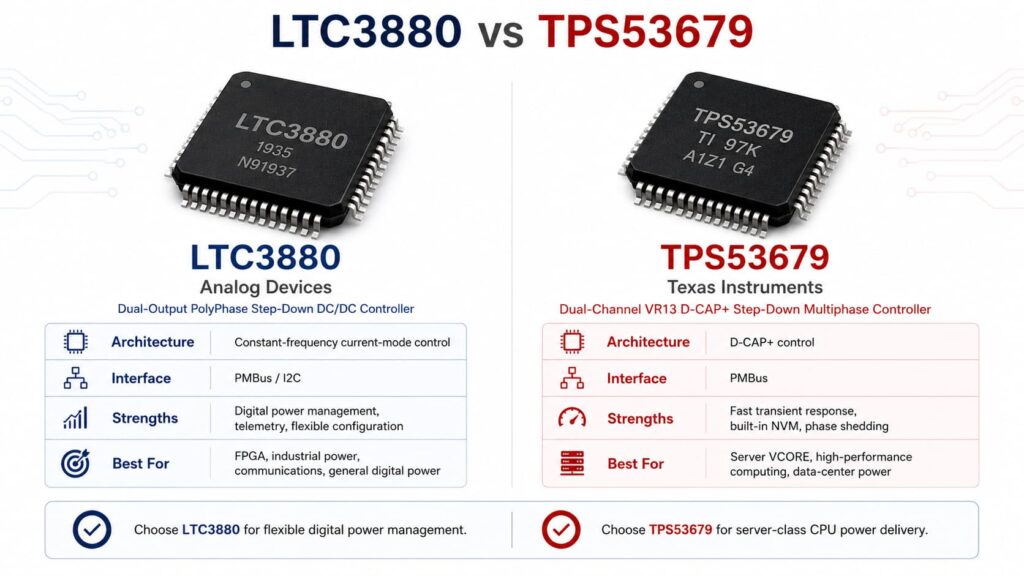
Summary — AI server racks are pushing past 200 kW toward the megawatt scale, and the power delivery architecture that feeds GPU and CPU core rails is under more pressure than ever. Dual-phase and multi-phase DC-DC buck controllers sit at the heart of this chain, stepping down intermediate bus voltages to the sub-1V, hundreds-of-amps rails that modern processors demand. This article compares four leading controllers from Analog Devices and Texas Instruments across key dimensions: input voltage range, phase configurability, digital telemetry, control architecture, and real-world availability in a market where lead times for power management ICs have spiked to 22–30 weeks and TI has enacted three rounds of price increases within a single year, with selected PMIC SKUs seeing hikes of up to 85%. We rank them, explain the trade-offs, and offer a practical viewpoint for engineers and procurement teams navigating a constrained supply chain.
1. Why These Candidates
The four controllers were chosen because they represent the most widely deployed dual-phase PMBus-enabled buck controllers in server, telecom, and industrial power delivery from the two dominant analog semiconductor suppliers. All four share a common architecture: dual outputs that can be stacked into a single high-current rail via PolyPhase (ADI) or multi-phase (TI) interleaving, with digital telemetry over PMBus for voltage, current, temperature, and fault monitoring.
| Candidate | Manufacturer | Architecture | Control Mode | PMBus | Package |
|---|---|---|---|---|---|
| LTC3880 | Analog Devices | Dual, PolyPhase (up to 6 phases) | Peak current mode | I²C/PMBus | QFN-40, 6×6 mm |
| LTC3882 | Analog Devices | Dual, PolyPhase | Voltage mode | PMBus | QFN-40, 6×6 mm |
| TPS53679 | Texas Instruments | Dual (6+1 or 5+2 phases) | D-CAP+ | PMBus + SVID | QFN-40 |
| TPS536C9 | Texas Instruments | Dual (N+M ≤ 12 phases) | D-CAP+ | PMBus + SVID (VR14) | QFN-40 |
2. Head-to-Head Comparison
| Parameter | LTC3880 | LTC3882 | TPS53679 | TPS536C9 |
|---|---|---|---|---|
| Input voltage range | 4.5 V – 24 V | 4.5 V – 24 V | 4.5 V – 17 V | 4.5 V – 17 V |
| Output voltage range | 0.5 V – 5.5 V (typ.) | 0.5 V – 5.25 V | 0.25 V – 1.52 V / 0.5 V – 2.8125 V* | 0.25 V – 5.5 V |
| Switching frequency | 250 kHz – 1.25 MHz | 250 kHz – 1.25 MHz | Fixed (per VR13 spec) | Configurable |
| Output voltage accuracy | ±0.5% over temp | ±0.5% over temp | Per VR13 SVID spec | Per VR14 SVID spec |
| Max phases (stacked) | 6 | 6+ | 7 (6+1 or 5+2) | 12 (N+M) |
| Telemetry ADC | 16-bit | 16-bit | PMBus voltage/current/temp | PMBus voltage/current/temp |
| NVM / EEPROM | External config | Internal EEPROM + ECC | Internal NVM | Internal NVM |
| Phase shedding | No | Yes | Yes (dynamic, programmable) | Yes |
| Power stage compatibility | Discrete MOSFETs | DrMOS / power blocks | TI NexFET optimized | TI NexFET / DrMOS |
| Interface standard | PMBus (I²C) | PMBus | PMBus + Intel SVID (VR13) | PMBus + Intel SVID (VR14) |
| Operating temperature | −40°C to +125°C | −40°C to +125°C | −40°C to +125°C | −40°C to +125°C |
| Key design target | General-purpose telecom / datacom / industrial | Higher-current POL, digital power | Intel VR13 server VCORE | Intel VR14 server VCORE, AI accelerators |
TPS53679 output range is DAC-selectable: 0.25–1.52 V at 5 mV/step or 0.5–2.8125 V at 10 mV/step.
3. Ranking
| Rank | Part | Score (100) | Best For |
|---|---|---|---|
| 1 | LTC3882 | 87 | AI server POL, high-current digital power, designs needing fault logging |
| 2 | TPS536C9 | 84 | Intel VR14 platforms, 12-phase GPU/ASIC core rails |
| 3 | LTC3880 | 78 | General-purpose industrial/telecom, 24 V input designs |
| 4 | TPS53679 | 75 | Legacy Intel VR13 server platforms, cost-sensitive builds |
4. Detailed Analysis
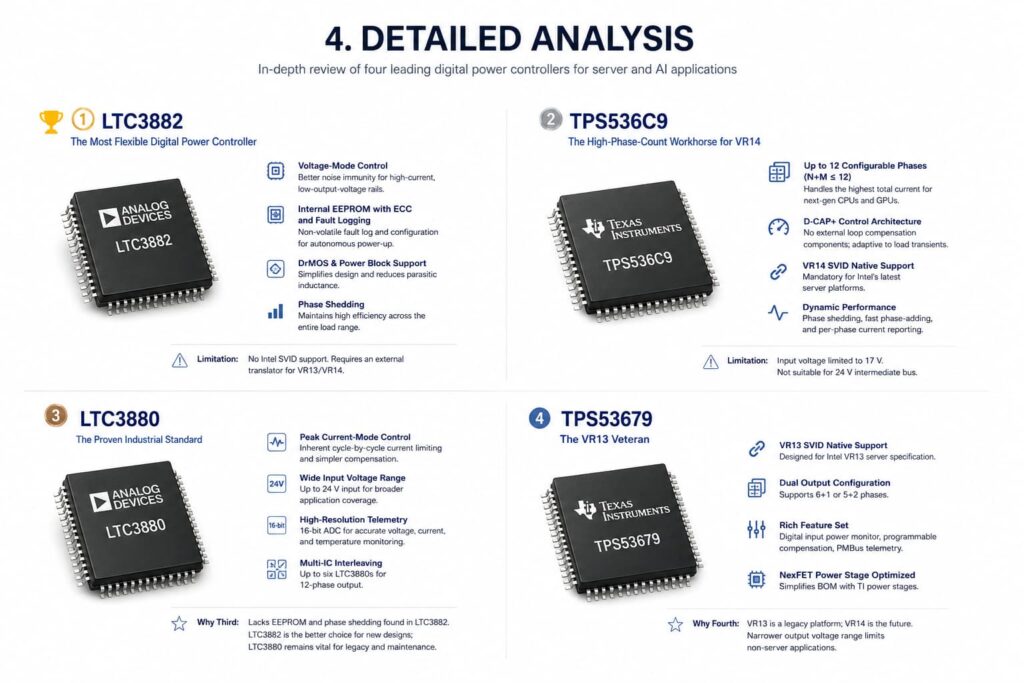
LTC3882 — The Most Flexible Digital Power Controller
The LTC3882 is ADI’s most advanced dual-phase digital controller. It uses voltage-mode control (unlike the current-mode LTC3880), which gives it inherently better noise immunity in high-current, low-output-voltage rails — exactly the operating point of GPU and AI accelerator core supplies.
Its standout feature is the internal EEPROM with ECC and fault logging. In a data center environment where every unexpected shutdown costs money, having a non-volatile fault log inside the controller itself is a genuine reliability advantage. The controller stores its configuration in EEPROM, meaning it can power up autonomously without waiting for a host to load register settings over PMBus.
The LTC3882 supports DrMOS and power block driver stages, which reduces layout complexity and parasitic inductance compared to discrete MOSFET designs. It also implements phase shedding — dropping unused phases at light load to maintain high efficiency across the entire load curve. This matters in AI servers, where idle-to-full-load transients can swing hundreds of amps in microseconds.
Limitations: Like all ADI controllers in this class, it does not include Intel SVID. If your design must speak VR13/VR14 SVID to an Intel CPU, you need an external translator or you look at the TI parts instead.
TPS536C9 — The High-Phase-Count Workhorse for VR14
The TPS536C9 is TI’s latest-generation server VCORE controller, targeting Intel’s VR14 specification and the next wave of AI accelerator core rails. With up to 12 configurable phases (N+M ≤ 12) , it can handle higher total current than any other controller in this comparison — a critical advantage as GPU power envelopes push past 1000 W per socket.
TI’s D-CAP+ control architecture is a key differentiator. It is a proprietary constant-on-time modulation scheme that eliminates external loop compensation components. The controller adapts its response to load transients without requiring the designer to tune a Type-III compensation network. For engineers who want to reduce design cycle time, this is a tangible advantage. The trade-off is less control over the loop response shape compared to the fully programmable compensation in ADI’s voltage-mode architecture.
The TPS536C9 also supports VR14 SVID natively — if you are designing for Intel’s latest server platforms, this is not optional, it is a hard requirement. The controller includes dynamic phase shedding, fast phase-adding for undershoot reduction, and per-phase current reporting with calibration.
Limitations: Input voltage tops out at 17 V. If your intermediate bus is 24 V (common in some telecom and industrial racks), the TPS536C9 cannot be used without a pre-regulator. The ADI parts accept up to 24 V directly.
LTC3880 — The Proven Industrial Standard
The LTC3880 is the predecessor to the LTC3882 and remains ADI’s most widely deployed digital power controller. It uses peak current-mode control, which provides inherent cycle-by-cycle current limiting and simplifies loop compensation compared to voltage-mode designs. For engineers who have used the LTC3880 for years, the design collateral, reference layouts, and field knowledge are deep.
Its 24 V input ceiling gives it a wider application range than the TI parts — it can operate directly from a 12 V or 24 V intermediate bus without a front-end regulator. The 16-bit ADC provides high-resolution telemetry on output voltage, current, and temperature, and up to six LTC3880s can be interleaved for a 12-phase output.
Why it ranks third: The LTC3882 has effectively superseded it for new designs. The LTC3880 lacks internal EEPROM and phase shedding, both of which are present in the LTC3882. For new projects, unless you are locked into an existing LTC3880 design or need to minimize requalification effort, the LTC3882 is the better choice. However, for maintenance, second-source, and legacy builds, the LTC3880 remains essential — and its deep installed base means replacement demand is steady.
TPS53679 — The VR13 Veteran
The TPS53679 is a mature, proven controller designed explicitly for Intel’s VR13 server specification. It supports dual outputs configurable as 6+1 or 5+2 phases and includes all the VR13-required features: SVID interface, digital input power monitor, programmable loop compensation, and PMBus telemetry.
It is fully optimized for TI’s NexFET power stages, which simplifies the BOM if you are already using TI MOSFETs. Dynamic phase shedding with programmable thresholds maintains efficiency from light load to full load, and fast phase-adding reduces undershoot during load steps.
Why it ranks fourth: VR13 is a legacy platform. Intel has moved to VR14, and the TPS536C9 is the designated successor. The TPS53679 remains relevant for existing designs and cost-sensitive builds where VR14 features are not needed, but it is not the controller you would spec for a new AI server motherboard in 2026. Its output voltage range is also narrower than the LTC3880/3882, limiting non-server applications.
5. Best Pick, Best Budget, Best Specialized
| Category | Pick | Why |
|---|---|---|
| Best overall | LTC3882 | Best balance of input voltage range, digital features (EEPROM + fault logging), phase configurability, and application breadth |
| Best for Intel VR14 | TPS536C9 | Only controller here with native VR14 SVID; 12-phase capability for the highest-current rails |
| Best for 24 V bus | LTC3880 | 24 V input ceiling; 16-bit ADC; deep field experience and design collateral |
| Best availability right now | LTC3880 | Longest production history, largest installed base, multiple package variants (LTC3880IUFD#PBF, #TRPBF, etc.) in distribution |
6. Author's Viewpoint
These four controllers are not direct drop-in competitors — they occupy overlapping but distinct niches. The real selection question is not “which one is better?” but “what is your intermediate bus voltage, and do you need SVID?”
If your design runs off a 12 V or 24 V intermediate bus and does not need to talk Intel SVID, the LTC3880 or LTC3882 is the natural choice. The 24 V headroom alone eliminates the TI parts for many telecom and industrial applications.
If you are designing for an Intel VR14 server platform, the TPS536C9 is almost mandatory — SVID is not optional for Intel CPU core voltage regulation. The 12-phase stacking ceiling also makes it the best fit for the highest-current GPU and AI accelerator rails.
If you are sourcing parts right now in June 2026, the supply landscape adds another layer. TI has raised prices three times in the past year, with a fourth wave expected July 1 — certain PMIC SKUs have seen increases up to 85%. ADI raised prices 10–15% across the board in February 2026, with military-grade parts up 30%. Both manufacturers are seeing lead time extensions, particularly on industrial-grade parts — TrendForce cut its 2026 server shipment growth forecast from 20% to 13% specifically because PMIC and BMC lead times are stretching to 35–40 weeks. The practical implication: lock your quotes early, validate part-number-specific lead times (category averages are misleading), and if you have an existing LTC3880 design, confirm that your approved vendor list still reflects current pricing before committing to customer delivery schedules.
Caveats: Pricing and lead time claims in this article are based on public market reports and should be verified against your distributor’s current quotes. As noted by EE Times, vendor quotes are now valid for as little as one week, and Gartner reports server costs have risen over 125% in H1 2026 due to memory and PMIC price escalation. Specific power-stage MOSFET selection and inductor design are beyond the scope of this controller-level comparison and significantly affect overall converter performance. For the broader context on how AI infrastructure is reshaping power semiconductor demand, see Yole Group’s Power SiC/GaN market analysis and Deloitte’s 2026 Semiconductor Industry Outlook.
7. References
TrendForce, “AI Server Demand to Drive Memory Contract Price Increases in 2Q26,” trendforce.com/presscenter/news/20260331-12995.html
PPSI, “Electronics Supply Chain Risk Report: Q2 2026,” ppsi.io/about/articles/electronics-supply-chain-q2-2026
Cerametronics, “Week 24, 2026 — Electronics Component Industry Highlights,” cmtelec.com/week-24-2026-electronics-component-industry-highlights/
Let’s Data Science / TrendForce, “AI Drives Shortages in Server Power Components,” letsdatascience.com/news/ai-drives-shortages-in-server-power-components-f9df105b