
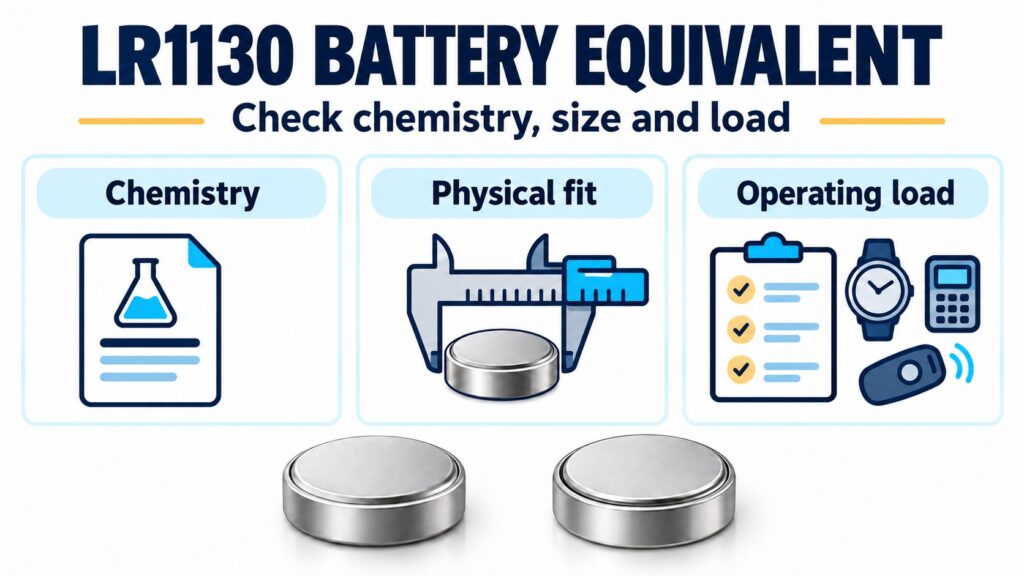
For a device that specifies a 1.5 V alkaline LR1130, start with the manufacturer's cross-references for AG10, LR54, 189, V10GA and L1131. Evaluate 389 and 390 silver-oxide cells separately: their chemistry, nominal voltage and discharge class must suit the equipment. The quickest useful comparison is the replacement category, followed by the exact manufacturer's specification.
Quick model guide
| Replacement category | Names to check | Practical decision |
|---|---|---|
| Alkaline cross-reference candidates | LR1130, AG10, LR54, 189, V10GA, L1131 | Match the branded cell's dimensions and electrical data to the device requirements. |
| Conditional silver-oxide candidates | Renata 389 / SR1130W and 390 / SR1130SW | Confirm approval for 1.55 V silver oxide and the required discharge class. |
| Different-height cells | LR44 / AG13 | Do not substitute on diameter alone; the documented LR44 example is taller. |
| Different-voltage cell | CR1130 | A documented 3 V lithium cell is not a direct replacement in an LR1130-specified 1.5 V application. |
Use the equipment manual and original cell marking to narrow the choice, then verify the candidate's drawing and discharge conditions. A cross-reference identifies candidates; device requirements decide which one to install or approve for a BOM.
Quick action matrix
| Replacement question | Engineering or sourcing action |
|---|---|
| Another alkaline code on the pack? | Identify the manufacturer, check its cross-reference and obtain the cell specification. |
| Considering 389 or 390? | Check equipment approval, voltage limits, low-battery thresholds and the specified drain class. |
| Same diameter but another model number? | Compare height, contact geometry and holder tolerances before insertion. |
| A much higher mAh rating? | Compare load, temperature, cutoff voltage and duty cycle first. |
| Fresh cell will not power the device? | Inspect orientation, contact engagement and the supply during the failing operation. |
What Counts as a True LR1130 Battery Equivalent?
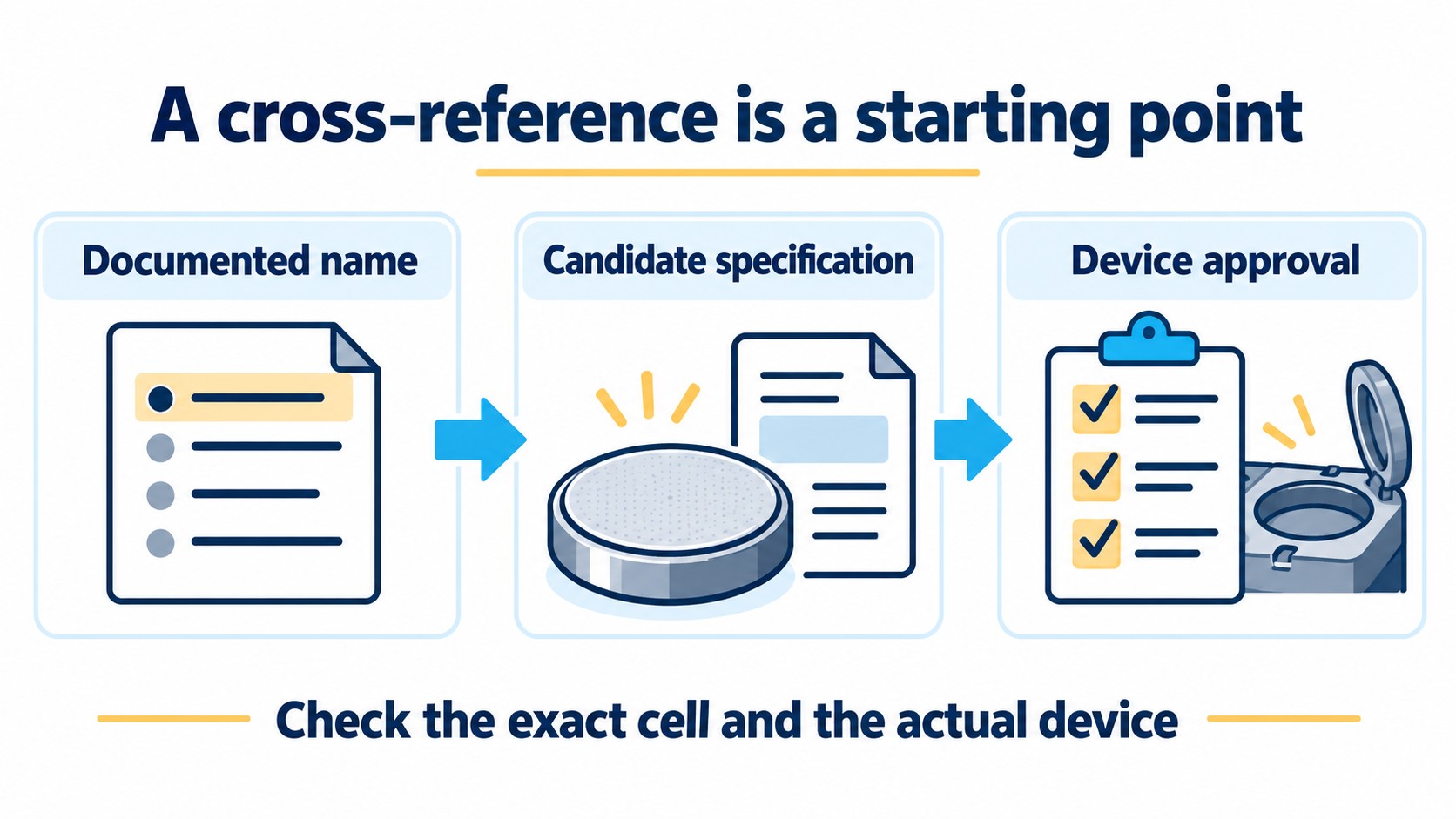
In component sourcing and service work, equivalent can describe three levels of evidence. Separating them makes the purchasing decision easier to audit:
- Documented cross-reference: a manufacturer's chart connects designation codes.
- Evaluated candidate: a named cell has physical and electrical specifications that can be checked against the application.
- Device-approved replacement: the cell meets the equipment maker's approved list or defined engineering acceptance criteria.
For a consumer replacement, follow the equipment manual. For a production BOM or service program, record the manufacturer, cell designation, document revision and acceptance limits. A pack marked AG10 / LR1130 Compatible does not provide that complete record.
Avoid choosing chemistry from an application label alone. A watch, thermometer or calculator can have requirements specific to its design. Where an approved battery list exists, use it rather than inferring compatibility from a general product category.
Documented Alkaline Cross-References (AG10, LR54, 189, L1131)
Maxell's October 2017 cross-reference places LR1130, 189, LR54, V10GA, Vinnic L1131 and AG10 on the same alkaline row. It provides a traceable basis for evaluating those names. Maxell manufacturer cross-reference
| Marking or specific example | What the manufacturer evidence establishes | What still requires checking |
|---|---|---|
| AG10, LR54, 189, V10GA, L1131, LR1130 | Documented alkaline cross-reference designations | Exact maker, full package marking, dimensional limits and load requirements |
| Maxell LR1130 | A published manufacturer specification for this cell | Holder fit and the application conditions attached to the ratings |
| Energizer 189 | Its datasheet identifies a 1.5 V alkaline cell and IEC-LR54 | The stated test conditions and the device's usable voltage range |
Energizer's 189 datasheet uses IEC-LR54 as its designation. Keep the datasheet with the proposed part so that purchasing and service teams can identify the same cell. A designation identifies a type; it is not a substitute for a test report or a claim of certification. Energizer 189 datasheet
Why L1131 Does Not Mean You Need a Taller Cell
Panasonic's L1131 replacement FAQ names LR1130P and lists 1.5 V, 11.6 mm diameter and 3.05 mm height. It also notes that normal operation is not guaranteed for every device or reverse substitution. Use that documented replacement relationship rather than decoding dimensions from similar-looking model names. Panasonic L1131 replacement FAQ
For another unfamiliar code, request the manufacturer's cross-reference and drawing. Keep suffixes in the purchasing record so that a supplier can identify the proposed cell precisely.
When Is Silver Oxide (389 / 390) a Compatible Alternative?
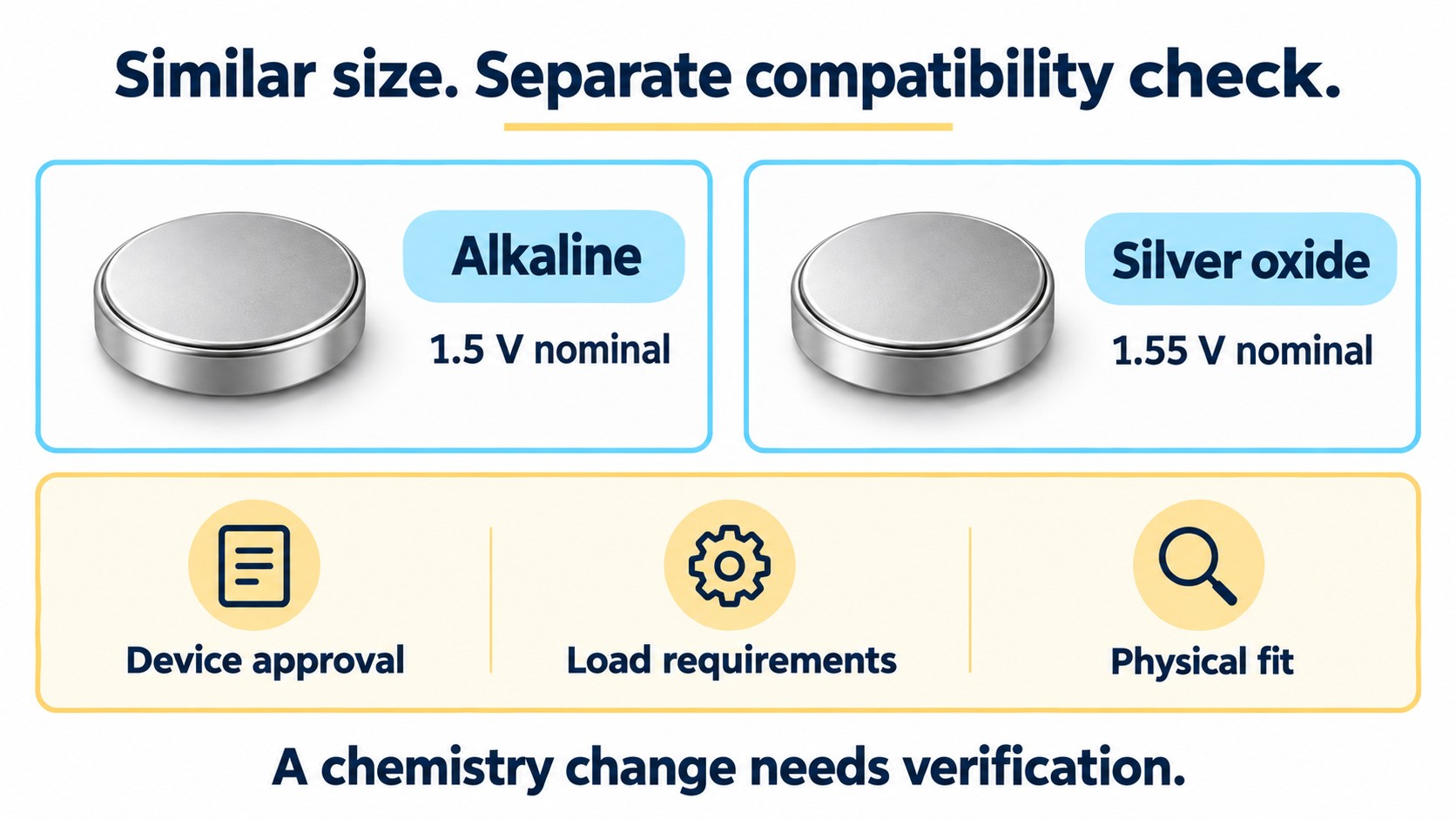
Silver oxide is a separate selection decision. Renata's individual sheets distinguish these two examples:
| Renata cell | Manufacturer designation | Discharge class | Nominal voltage | Dimensions in its technical PDF |
|---|---|---|---|---|
| 389 | SR1130W, SR54 | High drain | 1.55 V | 11.60 × 3.05 mm |
| 390 | SR1130SW | Low drain | 1.55 V | 11.60 × 3.05 mm |
The figures come from the Renata 389 technical sheet and Renata 390 technical sheet, both dated August 2019. Use the actual manufacturer's sheet when assessing a different brand or a combined-label product.
Can You Replace LR1130 with 389 or 390?
Yes, when the equipment permits the proposed silver-oxide chemistry, voltage and discharge characteristics, and the cell meets the mechanical requirements. Nominal voltage is only one part of that decision.
Check the device's supply limits and low-battery detection assumptions. A chemistry change can alter the relationship between terminal voltage and remaining useful service, so verify how the indicator and the equipment behave through discharge.
For a movement or instrument with a specified W or SW suffix, retain that requirement. Confirm any proposed change against its load profile and the equipment maker's guidance. If the original design requires silver oxide, an alkaline cross-reference alone does not approve a reverse substitution.
How to Handle Dual-Marked 389/390 Packaging
Obtain the datasheet for the specific combined-label product. Check its stated discharge capability against the required operating sequence, including any intermittent functions. Keep the manufacturer and complete marking in the record.
A useful comparison defines the device workload and the point at which the equipment stops meeting its requirements. Generic runtime multipliers or a claim of leak immunity cannot replace that comparison.
Verify the Holder, Polarity, and Dimensional Drawing
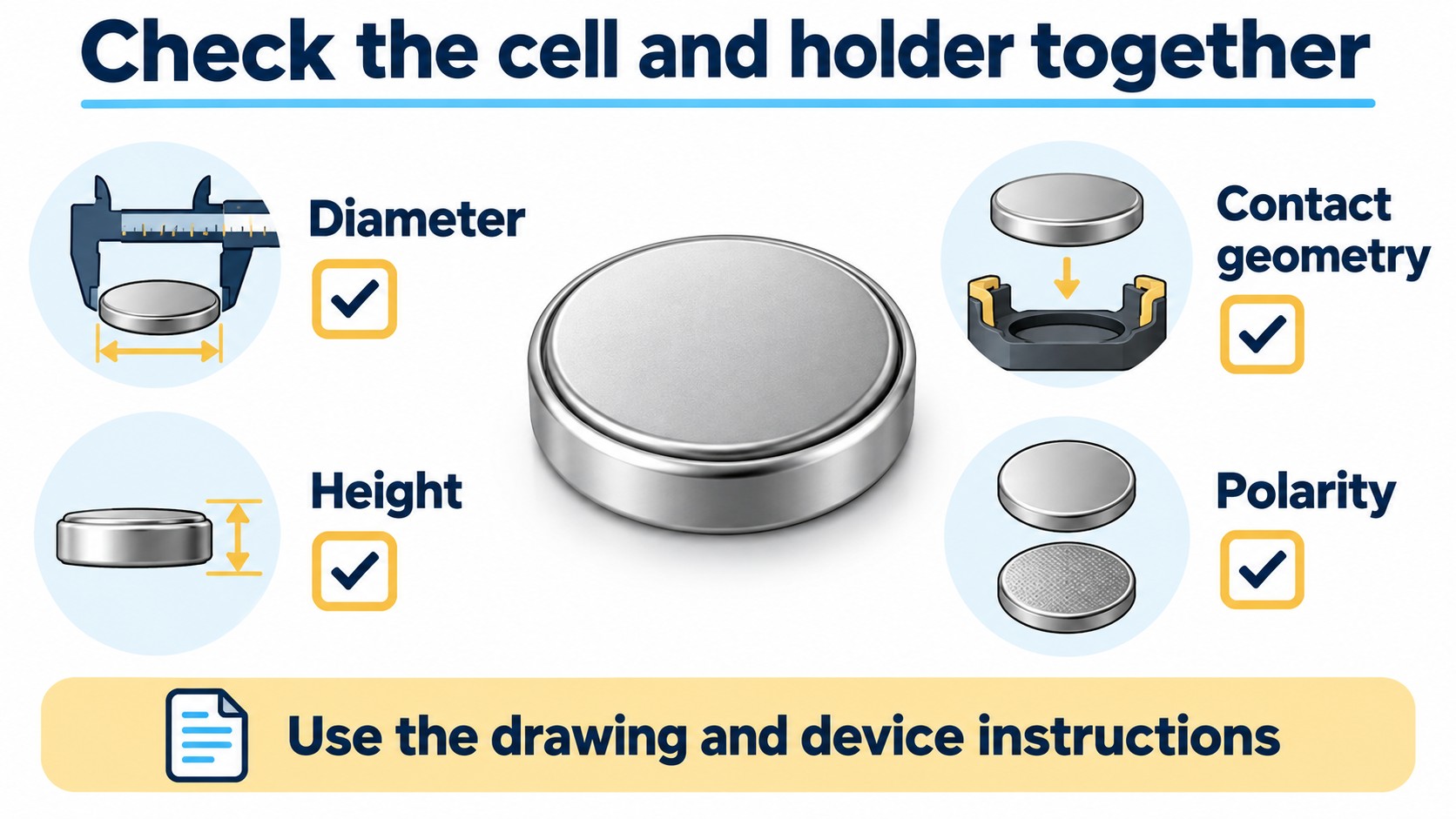
Maxell lists LR1130 at 11.6 mm diameter and 3.05 mm height, with 1.5 V nominal voltage. Its LR44 has the same listed diameter but a 5.4 mm height. These particular dimensions show why matching diameter is insufficient. Maxell alkaline button battery specifications
Check Dimensional Tolerances and Contact Geometry
Compare the candidate's minimum and maximum dimensions where provided with the holder or equipment drawing. A rounded catalog description such as approximately 3 mm does not define the full tolerance envelope.
Review the contact locations, insulated areas, seating position and retaining features. The cell should enter through the intended installation path and seat without excessive spring deflection or force on the compartment cover.
Do not use conductive foil shims, stack thinner cells or reshape the holder to accommodate an unapproved size. For manufacturing or organized service work, assess the cell and holder drawings together and record the result.
Verify Polarity Before Removal
Note the original orientation and check it against the device's polarity symbols and service instructions. Follow those instructions for the replacement. The marked face pointing upward is not a rule that applies to every holder.
If the new cell does not seat normally, stop and check the model and holder. Correct chemistry and voltage do not compensate for a poor mechanical connection.
Compare Capacity (mAh) Only Under Matched Test Conditions
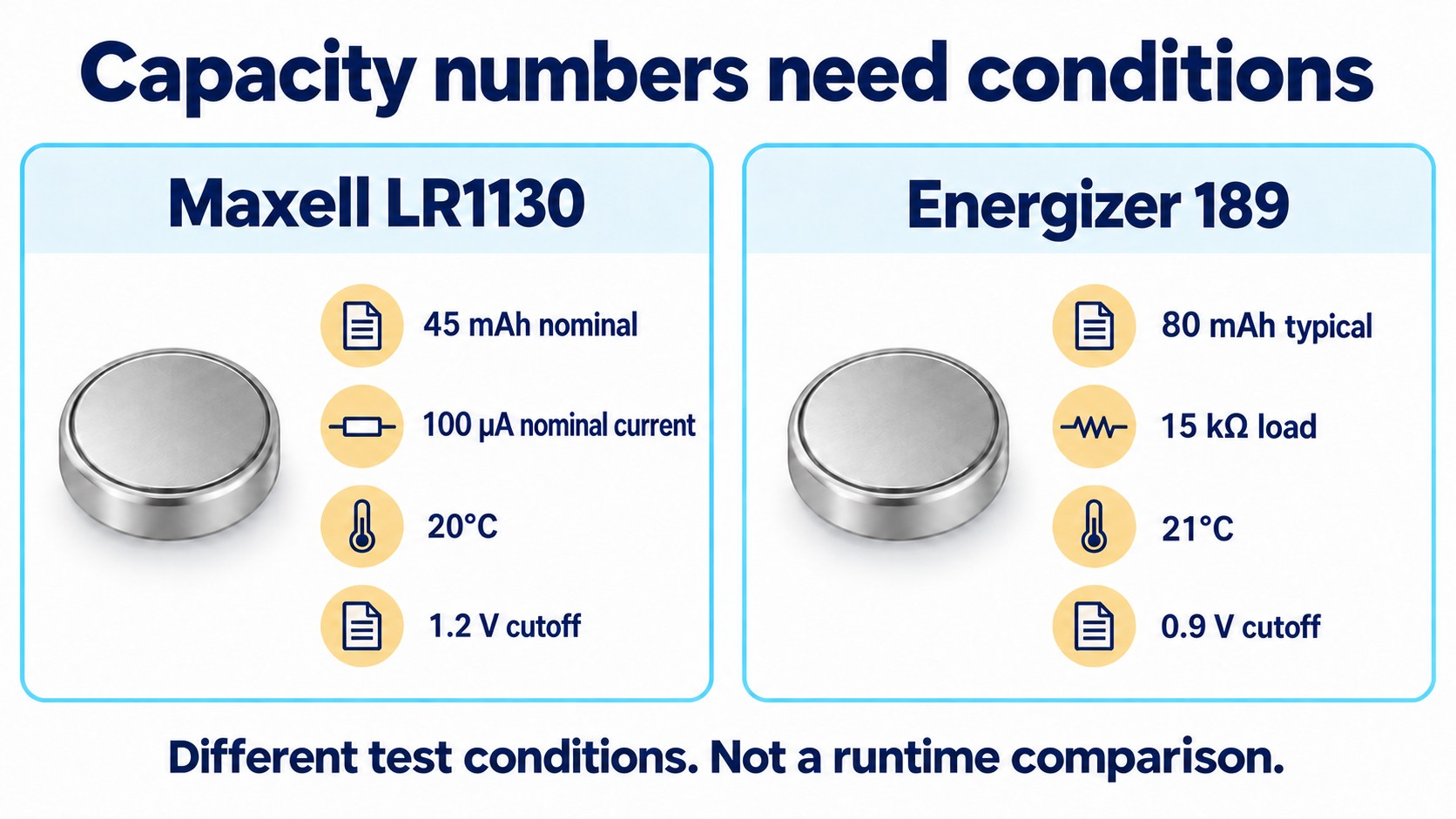
A published mAh value needs its test conditions. The following two manufacturer examples use different stated conditions:
| Published example | Stated capacity | Discharge load or current basis | Temperature | Discharge cutoff |
|---|---|---|---|---|
| Maxell LR1130 | 45 mAh nominal | 100 µA nominal discharge current | 20°C | 1.2 V |
| Energizer 189 | 80 mAh typical | 15 kΩ continuous load | 21°C | 0.9 V |
The Maxell specification table and Energizer 189 technical sheet report these figures. They are not a matched runtime comparison.
Why Cutoff Voltage Changes the Rating
The Maxell rating uses a 1.2 V endpoint; the Energizer example uses 0.9 V. A lower cutoff allows the rating to include another portion of the discharge curve. If the equipment stops working at a higher voltage, charge delivered below that threshold cannot extend its useful operation.
Also distinguish the load descriptions. Current through a resistance changes with cell voltage. A resistance value and a nominal discharge-current value do not establish identical test protocols.
For an application comparison:
- Record load, duty cycle, temperature and discharge cutoff.
- Define functional end of life, such as a reset, failed measurement or specified low-battery threshold.
- Test candidates with the actual continuous and intermittent operating sequence.
- Retain the results with the exact cell identity and acceptance criteria.
That record supports a replacement decision. A capacity number alone does not establish a number of months of service.
Troubleshooting a Device That Fails With a Fresh Cell
Start with observations that help separate a connection problem from a supply problem. Check the cell identity and the device requirements before changing chemistry.
| Observed symptom | Primary inspection point | Useful verification |
|---|---|---|
| No response after insertion | Model, orientation, protective tabs and contact engagement | Installed cell and polarity agree with the equipment manual |
| Powers on only when the lid is pressed | Holder retention, contact condition and cell height | Cell and holder meet the mechanical requirements without external pressure |
| Resets during an active function | Supply at the device during that operation | Loaded voltage remains within the circuit's required operating window |
| Inconsistent results from a new pack | Manufacturer, date or lot information and storage history | Traceable cells and repeatable application checks |
| Battery indicator changes after substitution | Chemistry approval and indicator assumptions | The proposed cell meets the device's documented behavior criteria |
Measure Loaded Voltage, Not Just Open-Circuit Voltage
An unloaded voltage reading does not reproduce the device's operating load or the installed contact path. For service diagnostics, use an appropriate instrument to check the supply at the device during the failing operation and compare it with the equipment limits.
Follow the instrument and equipment instructions. Do not short the cell or connect a meter's current input directly across its terminals. A short circuit can damage the cell or cause heating; follow the manufacturer's battery safety instructions.
For leakage, damaged contacts or substantial corrosion, follow the equipment maker's service procedure. Sealed, water-resistant and calibrated equipment may need appropriate tools and service checks. Do not assume that one household cleaning chemical is suitable for every holder, seal or optical assembly.
Safe Handling, Storage, and Disposal
Keep new and used button cells out of children's reach and secure the battery compartment. Used cells can still cause serious injury if swallowed. If ingestion is suspected, seek immediate emergency medical attention; do not wait for symptoms. Health Canada button battery safety
Do not recharge primary alkaline or silver-oxide cells. When the equipment uses a set of cells, follow its replacement procedure and avoid mixing old and new cells or different types or manufacturers. Keep the specified number and arrangement of cells.
Protect removed cells against terminal contact. The US EPA describes separate bags or non-conductive tape for button cells and specialist collection or takeback routes. Follow the handling and collection requirements for the chemistry and your location. US EPA used household battery guidance
How to Document a BOM or Service Replacement Decision
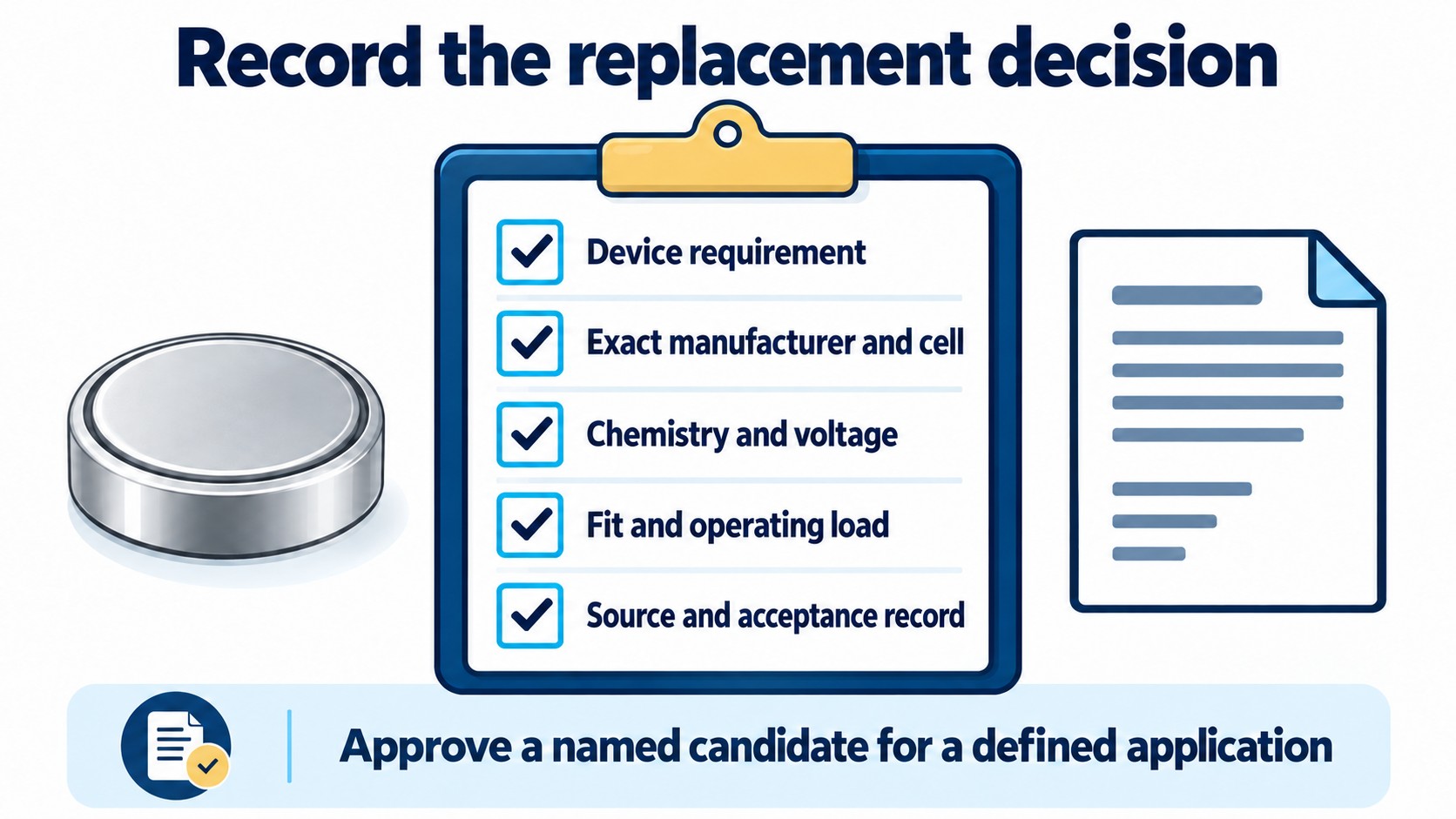
For a single device, retain the approved replacement designation and orientation information. A production BOM or service program should also keep:
- Equipment: model and the OEM-specified battery.
- Candidate: manufacturer, complete cell marking and packaging identification.
- Electrical requirements: chemistry, nominal voltage, operating loads and device cutoff.
- Mechanical requirements: drawing limits, contact arrangement and holder compatibility.
- Evidence: cross-reference, technical-sheet revision and application approval or test record.
- Incoming checks: agreed date or lot requirements and acceptance checks.
Approve a named cell for a defined application. That lets purchasing order the evaluated part and gives a service team a clear basis for identifying a later change.
Use the datasheet-reading workflow to connect each rating to its conditions. For a project inquiry, submit the full battery designation, equipment requirements and quantity through the Apex Components inquiry form. Availability, price, date-code options and lead time require separate confirmation.
Frequently Asked Questions (FAQ)
Is AG10 the Exact Same Battery as LR1130?
AG10 and LR1130 appear on the same alkaline row in Maxell's cross-reference. That makes AG10 a candidate to evaluate. Match the particular manufacturer's cell specification to the equipment requirements; the label alone does not guarantee identical capacity or service life.
Can I Use LR54 or 189 Instead of LR1130?
Both are documented alkaline cross-reference names. Energizer's 189 sheet identifies IEC-LR54 and a 1.5 V alkaline cell. Verify the exact manufacturer's dimensional drawing and electrical conditions against the approved replacement requirements.
What Is the Difference Between 389 and 390 Batteries?
In the individual Renata sheets, 389 is the high-drain SR1130W example and 390 is the low-drain SR1130SW example. Both are nominally 1.55 V silver oxide. Check a combined-label product against its own manufacturer's discharge specifications.
Can LR44 or AG13 Replace an LR1130 Battery?
Do not use them as a direct size substitution. Maxell's LR44 example is 5.4 mm high compared with 3.05 mm for LR1130; Panasonic's chart groups AG13 with LR44. Use the equipment-approved size instead of forcing the holder. Panasonic button-cell cross-reference
Can a CR1130 Replace an LR1130?
No, not directly in a device that specifies a 1.5 V LR1130. A documented CR1130 technical sheet specifies 3 V lithium/manganese dioxide. Similar-looking size codes do not establish electrical compatibility. CR1130 manufacturer technical sheet
Does a Higher mAh Rating Guarantee Longer Life?
No. Compare capacity together with its load, temperature, duty cycle and cutoff. The Maxell 45 mAh nominal and Energizer 80 mAh typical examples use different stated conditions and do not establish a runtime ranking.