
Table of Contents
MLCC Supply-Demand Gap and Domestic Substitution: A 2026 Industry Deep Dive
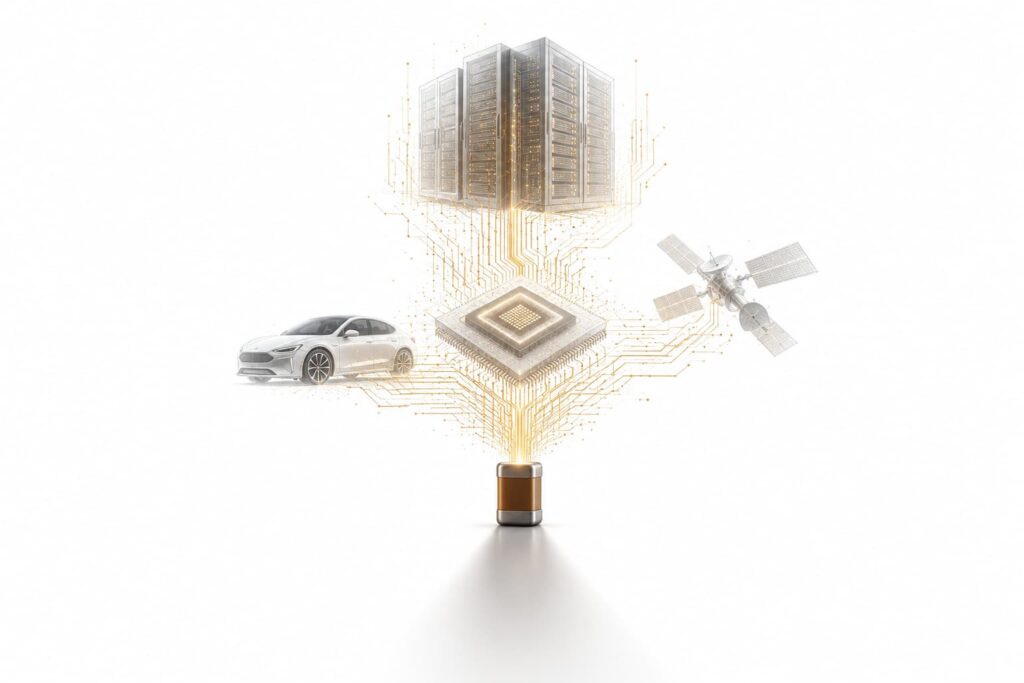
1. First, the Big Picture: What the Hell Is Happening in MLCC?
H1 2026 in the MLCC market. Two words: structural mania.
Not broad inflation. Not the kind of across-the-board price lift you get when demand recovers everywhere at once. This is the market getting chased uphill by AI servers and electric vehicles—pulling so hard on one end of the supply chain that the whole thing is starting to creak.
Here’s the timeline.
February 2026: Bloomberg breaks the story. Murata Manufacturing—the 800-pound gorilla at 31.8% global MLCC share—initiates internal discussions about raising prices on high-end multilayer ceramic capacitors. Murata president Norio Nakajima tells Bloomberg, flat out: demand for AI-related components is “extremely strong.” That’s Japanese-executive-speak for “we are drowning in orders.”
A few weeks later, Digitimes adds a number to the picture: AI-server MLCC orders are running at double Murata’s available capacity. Double. Not 20% over. Double.
March 17: TrendForce confirms Murata has formally notified customers. April 1, 2026. AI-server-grade and automotive-grade MLCCs: up 15%–35%. Three years since Murata’s last broad price hike.
That was round one. Round two is already forming. By late April, Murata announced an additional ¥80 billion (~$500 million) in MLCC capex on top of an already-elevated spending plan—and management told Japan’s Nikkan Kogyo Shimbun that capacity is “still very much insufficient.” When a famously conservative Japanese manufacturer uses the phrase “still very much insufficient” in public, that’s not a data point. That’s a signal. Multiple industry sources point to a July 1 second-round hike of 10%–40% on AI-server and automotive high-end models, with spot market data confirming the trajectory.
And nobody is sitting this one out. Digitimes reported Taiyo Yuden—Japan’s #2—issued price-increase notices in April, effective May: automotive and server-grade high-capacitance products up 10%–30%, consumer-grade up 6%–13%. The Korea Herald confirmed Samsung Electro-Mechanics is scrambling alongside them. SEMCO’s MLCC production capacity? Effectively sold out. For three years. Think about what that means: if you place an order today, you’re looking at a production slot in 2029.
The spot market is where it gets ugly—or beautiful, depending on which side you’re on. By end-May 2026, standard-grade MLCC spot prices were up 15%–20%. AI-server-grade high-capacitance products (10μF, 20μF)? Up 50%–60%. Some scarce models? Doubled.
2. Demand Side: This Is Not "A Few More Capacitors Per Board"
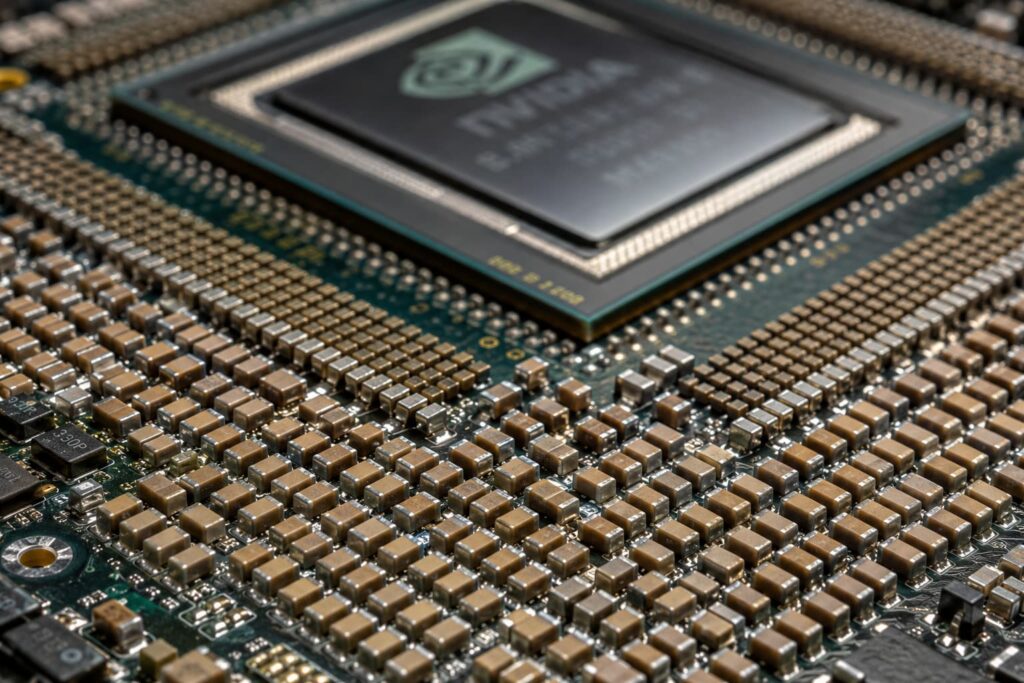
I’ll be honest—when I first saw TrendForce’s numbers laid out side by side, I had to blink and read them again.
| Platform | MLCC Count per Unit/Rack | Note |
|---|---|---|
| General-purpose server | ~2,000 | Baseline |
| NVIDIA GB200 (per board) | ~6,500 | TDP ~1,200W |
| NVIDIA Rubin (per board) | ~12,000 | TDP doubled |
| GB300 NVL72 rack | ~440,000 | Morgan Stanley estimate |
| VR200 NVL72 rack | ~600,000 | +30% over GB300 |
Source: TrendForce and Morgan Stanley .
A general-purpose server takes roughly two thousand MLCCs. One AI rack? Nearly six hundred thousand. That’s not a multiple—that’s two orders of magnitude. Pick a number: 8× to 12× the MLCC consumption of a traditional server. One AI rack uses more capacitors than 200 standard enterprise servers put together, as passive-components.eu calculated from TrendForce data.
But here’s the thing I find more revealing than the raw count. Morgan Stanley did a full BOM teardown of NVIDIA’s next-generation Vera Rubin rack—the VR200 NVL72, priced at roughly $7.8 million, nearly double the GB300. And what they found is quietly astonishing.
MLCC value content: from roughly $1,530 per rack in the GB300 to approximately $4,320 in the VR200. That’s a 182% jump—a figure confirmed by both Morgan Stanley and The Korea Herald .
PCBs went up 233%. Memory surged 435%. And the GPU—still the most expensive single line item—actually lost BOM share, shrinking from ~65% in the GB200 to ~51% in the VR200. The GPU’s absolute dollar value rose, sure, from about $2.52 million to $3.96 million. But the real action is in the stuff around the GPU, as Morgan Stanley’s $7.8 million rack breakdown makes clear.
Goldman Sachs put a name to this shift. Analyst Nelson Armbrust “Ambrust”—identified MLCCs as the third-largest cost item in AI server BOMs, behind only GPUs and memory chips. A separate Goldman note, from analyst Daiki Takayama , estimated the AI-server MLCC market will surge from roughly ¥215 billion (~$1.3 billion) in FY2025 to about ¥920 billion (~$5.8 billion) in FY2030. That’s a 34% CAGR. Goldman called MLCCs the new memory —which, look, is a bit of a marketing move. The logic chain for HBM and for MLCCs is completely different. But the label tells you something about where Wall Street’s attention is pointing.
The technical driver isn’t complicated. GPU power consumption has gone insane. H100: 700W. B200: 1,000W. GB200: 1,200W. Vera Rubin VR200, arriving H2 2026: 2,300W per GPU—as detailed in Morgan Stanley’s BOM analysis . Two thousand three hundred watts. That’s a space heater per chip. GPU boards need staggering numbers of capacitors for voltage regulation and high-frequency noise filtering across the full power delivery network.
3. Supply Side: An Oligopoly Running on Fumes
The supply structure is so concentrated it borders on absurd. Per the China Electronic Components Association (2024), as cited by The Korea Herald
| Rank | Manufacturer | Share |
|---|---|---|
| 1 | Murata | 31.8% |
| 2 | Samsung Electro-Mechanics | 22.9% |
| 3 | Taiyo Yuden | 11.2% |
| 4 | TDK | 5.9% |
| 5 | Kyocera | 5.5% |
Five companies. All Japanese or Korean. Combined: 77.3% .
Now zoom in on AI-server-grade high-end MLCCs. Only Murata, SEMCO, and Taiyo Yuden can deliver at production scale. Add Kyocera. Four firms. Combined share: roughly 97% .
Ninety-seven percent. That’s more concentrated than the GPU market.
Chinese mainland manufacturers? Less than 10% of the global total, still running a three-legged race: scale up, substitute imports, move upmarket.
And those four dominant players? They’re at the wall.
- Murata: automotive/server line utilization ~95%, overall ~88%. Lead times went from a standard 4 weeks to 20 weeks. Five months. Bloomberg and TrendForce both confirm.
- SEMCO: high-cap server lines above 90%, average ~85%. CEO Chang Duck-hyun told shareholders demand exceeds capacity by over 50%, per The Korea Herald .
- Taiyo Yuden: premium product utilization breaking 90%.
Japanese customs data for April 2026: average MLCC export prices up 16% year-on-year. The pricing power has shifted—and it’s showing up in the trade numbers, as The Korea Herald reported.
Now, expansion. How fast can new capacity come online? Mid-to-low-end lines: roughly six months if you already have the building. High-end lines? Core equipment delivery: 18+ months. Customer qualification: another 12–18 months. Add it up. Nothing material before 2027. Murata’s own capex announcement and management comments to the Nikkan Kogyo Shimbun underscore the timeline.
Goldman Sachs framed the mismatch bluntly: demand CAGR of 34%, supply CAGR of ~10%. That’s not a gap. That’s a chasm. Full Goldman analysis here .
4. The Rare-Earth Wildcard: The Story Nobody Was Watching Until It Hit
If AI demand is the headline everyone can see, China’s rare-earth export controls are the subplot that’s going to matter more than most people realize.
Let me walk through the logic, because it’s genuinely elegant—in a grim sort of way.
Japan controls over 75% of the high-end MLCC dielectric powder market. The core material is barium titanate. But pure BaTiO₃ has three problems: lousy insulation resistance, terrible temperature stability, and a nasty habit of reacting with nickel internal electrodes during sintering. Fixing these requires doping with heavy rare-earth elements.
Three elements, three roles:
- Yttrium oxide (Y₂O₃) : Goes into every MLCC powder formulation. The workhorse. Boosts insulation resistance, cuts dielectric loss, stabilizes temperature behavior.
- Dysprosium oxide (Dy₂O₃) : The non-negotiable for automotive and AI-server grades. Keeps dielectric stability intact during nickel-electrode co-firing at 150°C under high voltage. There is no drop-in substitute.
- Terbium oxide (Tb₂O₃) : The fine-tuning knob for top-tier formulations.
Now here’s the choke point: over 90% of the world’s high-purity heavy rare-earth separation and refining capacity sits in China. S&P Global flagged this in January 2026: rare-earth supply bottlenecks are set to persist all year, with China’s export restrictions actively driving disruptions and price increases.
And China has been busy. The timeline is public record:
- April 4, 2025: MOFCOM Announcement No. 18 —export controls on seven heavy rare earths: samarium, gadolinium, terbium, dysprosium, lutetium, scandium, yttrium. The official justification: “dual-use” military-civilian characteristics.
- October 9, 2025: Controls expanded to all twelve heavy rare earths. The net widened: mining equipment, extractants, raw and auxiliary materials, core smelting and separation technologies. MOFCOM Announcement No. 62 .
- Since December 2025: Reuters confirmed on May 22, 2026: China has cut Japan off from several heavy rare earths for at least four months. Customs data shows exports of dysprosium, terbium, and yttrium oxide collapsed to zero. The Wall Street Journal corroborated independently.
- March 2026: Rare-earth intermediate material exports to Japan: down roughly 90% year-on-year, per Reuters .
Here’s the part that makes this more than a temporary disruption. The rule architecture is designed to close loopholes. Per the law firm Pillsbury ‘s legal analysis, MOFCOM built in an origin-tracing mechanism with a brutal threshold: 0.1% . If any overseas-manufactured item contains Chinese-origin rare-earth materials exceeding 0.1% of the item’s value, it requires an export license. Third-country transshipment routes are caught by the same net.
And the impact on Japan’s MLCC supply chain? Concrete.
- Sakai Chemical: the world’s #1 MLCC powder supplier at ~28% market share. Voluntarily cut production 25%–30%. Multiple ultra-high-purity lines idled. Inventory: 30 to 45 days at current burn rates.
- Nippon Chemical: ~14% share. Same bind.
- Murata itself: publicly acknowledged heavy rare-earth inventory covers roughly 30 days of full-capacity production. High-end output could contract 15%–20%.
Japan’s Cabinet Office and the Japan Center for Economic Research (JCER) have both published analyses on the vulnerability. JCER’s framing is stark: Japan’s rare-earth dependence creates “structural fragility in global value chains” for strategically important goods—MLCCs chief among them.
I don’t want to oversell this. Two things cool the narrative.
First, the actual quantities are tiny. Rare-earth-containing additives make up roughly 5% of powder weight. The rare-earth oxides within those additives? Maybe 1% to 3% . This is trace-level performance doping—”add a pinch, transform the properties.” It is not bulk material consumption where kilotons get burned through monthly.
Second, the Japanese are not sitting still. R&D on dysprosium-free and terbium-free MLCC formulations is active. Mass production is unlikely within three years—yields are currently below 80%, costs are elevated—but on a five-year horizon, technological substitution is a real risk, not a theoretical one. Treat rare-earth controls as a medium-term tailwind. Do not treat them as a permanent moat. The difference matters.
5. Four Companies: Kicking the Tires
Fenghua Advanced Technology
What it is: China’s #1 MLCC maker, #8 globally. Only domestic company holding “National Manufacturing Single Champion” status for both MLCCs and chip resistors.
2026Q1, from the Shenzhen Stock Exchange filing:
- Revenue: RMB 1.515 billion, +18.90% YoY
- Net profit: RMB 88.56 million, +37.14% YoY (the original piece said 38%—close enough)
- Core net profit: RMB 88.06 million, +33.34%
- Debt ratio: 23.6% . Zero interest-bearing debt. In a capital-intensive components business, that balance sheet is genuinely clean.
What I think: Fenghua posted record 2025 revenue of RMB 5.756 billion, MLCCs contributing over 70% of the top line. Three rounds of industry price hikes in 2026 (cumulative 20%–30%) are doing what you’d expect—pulling the profit margin off the floor. The company is deeply embedded with Huawei and BYD; automotive-grade products represent about 15% of the mix. Detailed quarterly breakdowns are available via investor platforms like Sensorexpert and analyst deep dives on Eastmoney .
Here’s the thing that keeps me from getting fully comfortable, though. High-end MLCCs? Only about 15% of total revenue. The price-hike tailwind is real, but it hasn’t structurally reshaped the business yet. On the AI-server side, Fenghua’s investor-relations team has said they’re “cooperating with domestic AI server leaders”—which could mean anything from qualification samples to production volumes. They haven’t specified.
Three-Circle Group
What it is: China’s only fully integrated IDM—from ceramic powder all the way through finished MLCCs. 100% powder self-sufficiency. Nobody else in China has this vertical span.
2026Q1, Shenzhen Stock Exchange filing:
- Revenue: RMB 2.681 billion, +46.25% YoY
- Net profit: RMB 791 million, +48.48% YoY
- Gross margin: 42%+, consistently. Net margin: near 30%.
That profit quality is not normal for a hardware company. The vertical integration pays off hard: self-supplied powder costs 20%–30% less than buying externally. And about 70% of their MLCC output is high-end, high-capacitance product—which means they’re sitting exactly where the shortage hurts most. Caixin covered Three-Circle’s Q1 2026 results and Goldman Sachs ‘ AI MLCC thesis provides the top-down framework.
On the automotive side, the certifications are solid. Toyota. Honda. Volume shipments to Tesla and BYD. This is not speculation—these are commercial relationships with names you can check.
But then we get to AI servers, and the story starts to wobble. Some Chinese-language analyst reports claim Three-Circle’s high-end MLCCs have “entered NVIDIA, Huawei, and Inspur AI server supply chains.” That’s a very specific claim. So reporters from Caixin called Three-Circle’s securities department and asked directly.
The company’s response: MLCC products are “theoretically usable” in AI servers, and it is “inconvenient to disclose specific order details.”
There is a canyon between “theoretically usable” and “certified and shipping at volume.” I am not saying the analyst reports are fabricating. I am saying that when a company’s own securities department chooses the word “theoretically” in a public-facing statement, and no English-language media has ever reported the NVIDIA certification claim, you should treat it as unverified.
Sinocera
What it is: China’s sole domestic supplier of high-end MLCC dielectric powder. Globally significant barium titanate producer. Its customers include SEMCO, Yageo, and Fenghua. This is a picks-and-shovels play: when MLCC manufacturers fight over capacity, the powder supplier collects rent.
Key figures, from the Shenzhen Stock Exchange filings and Dongxing Securities research:
| Period | Revenue | Net Profit |
|---|---|---|
| FY2025 | RMB 4.583B (+13.24%) | RMB 610M (+0.91%) |
| 2026Q1 | RMB 1.064B (+9.15%) | RMB 142M (+4.79%) |
Now. Look at that 2026Q1 net profit number. RMB 142 million.
The original Chinese narrative claimed: “Q1 net profit of RMB 380 million.”
That is wrong. By a factor of more than two and a half. The RMB 380 million figure might be FY2025 H1 (RMB 133M + RMB 197M ≈ RMB 330M, still shy) plus something else, or an analyst’s FY2026 full-year forecast. But it is not the Q1 2026 reported number. This is not a rounding error. If you made a sizing decision based on the original figure, you were off by 2.7×.
That said, Sinocera is not a bad story. It’s actually a very good story—just not the story the original piece told. The electronic materials segment (MLCC powder) generated roughly RMB 693 million in FY2025 revenue, 15.13% of the total, per the Dongxing Securities report . AI-server-specific powder has passed qualification for Huawei’s Ascend chip program and is shipping to domestic capacitor makers, with gross margins 15+ percentage points above general-purpose powder. Under China’s rare-earth export controls, Sinocera has a local supply-chain advantage that its Japanese competitors—Sakai Chemical, Nippon Chemical—do not. Global MLCC powder market share could climb from roughly 25% toward 30%+, with a plausible path to overtaking Sakai Chemical for the top spot.
But you pay for that story. Current dynamic PE: roughly 100×. PS: about 13×. The market has priced in AI compute, automotive, domestic substitution, and rare-earth controls—all four threads—simultaneously. If any one of them frays, the repricing will not be gentle.
Boqian New Materials
What it is: Core domestic supplier of MLCC internal-electrode nickel powder. Uses physical vapor deposition (PVD)—not a trivial process. Exclusive global supplier of 80nm nickel powder. Sole drafter of China’s first industry standard for capacitor electrode nickel powder. The strategic anchor customer is SEMCO—Samsung Electro-Mechanics, the world’s #2 MLCC manufacturer. Orient Securities published a detailed analyst report on the company’s PVD powder platform.
2026Q1, Shanghai Stock Exchange filing (via Sohu Securities ):
- Revenue: RMB 410 million, +64.02% YoY
- Net profit: RMB 71.63 million, approximately +50% YoY
- Nickel powder: >80% of total revenue
What I think: Boqian’s investment thesis is the cleanest of the four, in the sense that there are fewer moving parts. MLCCs are getting smaller and higher-capacitance. Layer counts are moving from 50 toward 500, in premium parts above a thousand. Every layer needs nickel electrodes. More layers mean more nickel powder. The trend is linear and structural.
The SEMCO relationship is both the strength and the risk. It provides a demand anchor—SEMCO is not going to stop needing nickel powder. But it also means customer concentration. Boqian’s FY2025 net profit was roughly RMB 219 million. If AI-server and automotive-grade nickel powder demand accelerates through the year as the capacity data suggests it might—RMB 400 million is not out of reach. But that’s a forecast, not a fact. Q1’s RMB 71.63 million puts them on roughly that trajectory, but Q2 and Q3 will tell the real story.
6. Now the Cold Water
I’ve spent most of this piece laying out why the MLCC supply-demand picture is genuinely tight. But there are risks here that deserve equal airtime.
First: the demand asymmetry nobody wants to talk about
TrendForce analyst Chen Weisheng put it plainly, as reported by The Korea Herald : actual end-demand for consumer-grade ODMs is still weak. Yet channel stockpiling orders are climbing. You’ve got “declining real ODM orders” and “rising channel add-ons” happening at the same time.
What that means: mid-to-low-end MLCC price increases are being driven more by expectation and inventory-build than by genuine downstream consumption. If H2 ODM price negotiations come in soft, those mid-to-low-end prices could pull back fast. The high-end shortage is real. The low-end rally is partly speculative.
Second: the qualification window is not infinite
AI data-center-grade MLCCs require 12–18 months of customer qualification, per The Korea Herald . Domestic Chinese MLCC suppliers today mostly offer consumer-grade products—lower specifications. The price-increase cycle opens a window for them to get samples in, run qualification trials, prove themselves. But that window will close. It always does.
Third: rare-earth controls are not a permanent moat
I said this earlier but it’s worth repeating in the risk section. CSIS notes that the US and its allies—Japan, Australia, others—are mobilizing what it calls “the boldest domestic industrial policy in modern history”: billions in financing, $110/kg price floors, government-guaranteed offtake, new bilateral frameworks. France and Japan signed a critical-minerals cooperation agreement during Macron’s Tokyo visit in March–April 2026. On the technology side, Japanese firms are actively working on dysprosium-free MLCC formulations. Unlikely at scale within three years. Much less certain on a five-year view.
Fourth: the valuations are already sky-high
Sinocera at ~100× PE. Fenghua at ~141×. These are not numbers you pay for things that might happen. These are numbers you pay for things the market has already decided will happen. Q2 margin recovery, high-end order cadence, rare-earth policy trajectory—any of these coming in below expectations can trigger a repricing. The upside case is in the price. The downside case is not.
7. What I Actually Think
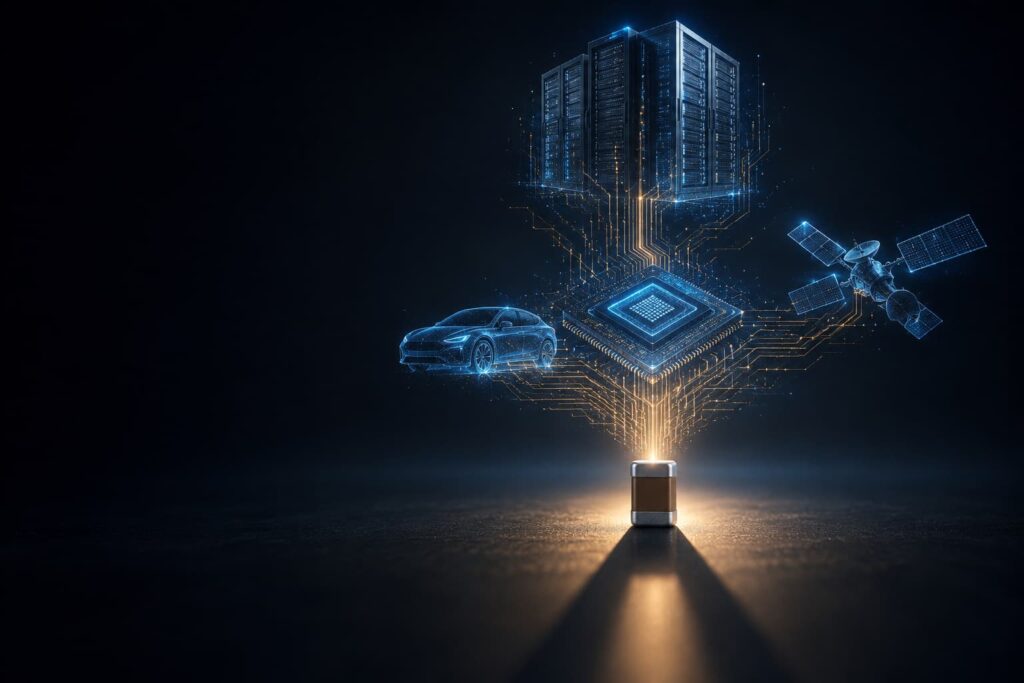
Three things are happening at the same time in the 2026 MLCC market. None of them are subtle.
One: demand is making an order-of-magnitude jump. This is not “20% more than last year.” This is “from two thousand capacitors per server to hundreds of thousands per rack.” Morgan Stanley’s BOM teardown proved it with numbers: MLCC value per rack went from $1,530 to $4,320. That’s not a cycle. That’s a platform shift.
Two: supply is an oligopoly with a lid on it. Four Japan-Korea firms control 97% of the high-end market. Murata’s own management told the Nikkan Kogyo Shimbun that capacity is “still very much insufficient.” Goldman Sachs frames the mismatch as 34% demand CAGR against 10% supply growth. This is not going to resolve itself in a quarter or two.
Three: geopolitics has handed domestic substitution a fast-forward button. China’s rare-earth export controls—documented by Reuters , the Wall Street Journal , and MOFCOM’s own announcements —are squeezing Japan’s MLCC powder supply chain in ways that are structural, not temporary. The 0.1% origin-tracing rule and the shutdown of dysprosium and yttrium exports to Japan mean Sakai Chemical and Nippon Chemical are running on 30-to-45-day inventory clocks. Murata itself has maybe 30 days. This is not subtle either.
The window for Chinese manufacturers to qualify into high-end supply chains is open. It will not stay open forever—CSIS and JCER are both tracking the counter-moves—but for the next 12 to 24 months, the incentive structure for downstream customers to find and qualify second sources is as strong as it has ever been.
For the industry: this is the kind of rare alignment—secular demand, oligopolistic supply constraints, geopolitical disruption—that creates genuine opportunities to break into systems that have been closed for decades.
For investors: good narratives and good prices are different things. The trend is backed by Bloomberg, Morgan Stanley, and Goldman Sachs. The valuations have already priced in most of the upside. The gap between those two things—trend and price—is where judgment actually matters.
Reference Links
- Bloomberg — Murata Explores Raising Prices of Key AI Server Component, Feb 17, 2026
- TrendForce — MLCC Giant Murata Confirms April 1 Price Hike, Mar 17, 2026
- Digitimes — AI server MLCC orders double capacity, Feb 18, 2026
- Digitimes — Taiyo Yuden raises MLCC prices, Apr 17, 2026
- Digitimes — MLCC, inductor prices climb, Apr 16, 2026
- Nikkan Kogyo Shimbun / Banyan Lane Capital — Murata: More Signs of Tightening, May 2026
- passive-components.eu — MLCC Consider Price Increase, 2026
- passive-components.eu — Why One AI Rack Needs So Many MLCCs, 2026
- The Korea Herald — Nvidia’s Vera Rubin uses 182% more capacitors, 2026
- The Korea Herald — SEMCO pours W1tr into AI substrates, 2026
- Morgan Stanley / Futunn — Morgan Stanley dissects NVIDIA’s Rubin, May 2026
- Morgan Stanley / BigGo Finance — Nvidia’s Vera Rubin Rack Price Soars to $7.8M, May 21, 2026
- Goldman Sachs / BigGo Finance — AI Supply Chain’s Scarcest Puzzle Piece, 2026
- Goldman Sachs / Futunn — Goldman Sachs: MLCC the next memory, 2026
- Goldman Sachs / 36kr — MLCCs, GPUs, and HBMs Rally, 2026
- Reuters — China squeezes Japan over rare earths, May 22, 2026
- Wall Street Journal / TaiwanPlus — China Moves To Cut Off Rare Earth Exports to Japan, Jan 9, 2026
- MOFCOM Announcement No. 18 — Export controls on medium and heavy rare earths, Apr 4, 2025
- MOFCOM Announcement No. 62 — Rare earth technology export controls, Oct 9, 2025
- S&P Global — Rare earth supply bottlenecks set to persist in 2026, Jan 2026
- Pillsbury Law — MOFCOM & GAC Dual-Use Export Control Regulations, 2026
- CSIS — Rare Earth Export Restrictions One Year Later, 2026
- JCER — How Can Japan Cope with Rare-Earth Supply Disruption
- Indo-Pacific Defense Forum — France, Japan seek alternate supplies of rare earths, Apr 2026
- Caixin / CLS — AI Server MLCC Usage Doubles, May 26, 2026
- Dongxing Securities — Sinocera (300285.SZ) Research Report, Apr 28, 2026
- Orient Securities — Boqian New Materials: MLCC Nickel Powder Leader
- Sohu Securities — Boqian New Materials (605376) Financial Data
- Sensorexpert — Fenghua 2026 Q1 Report Analysis
- Eastmoney — Fenghua Deep Dive, May 31, 2026
- Investing.com — Murata and Taiyo Yuden shares surge, 2026