
Table of Contents
PMIC Explained: Basic Types, Core Functions, and Industry Applications
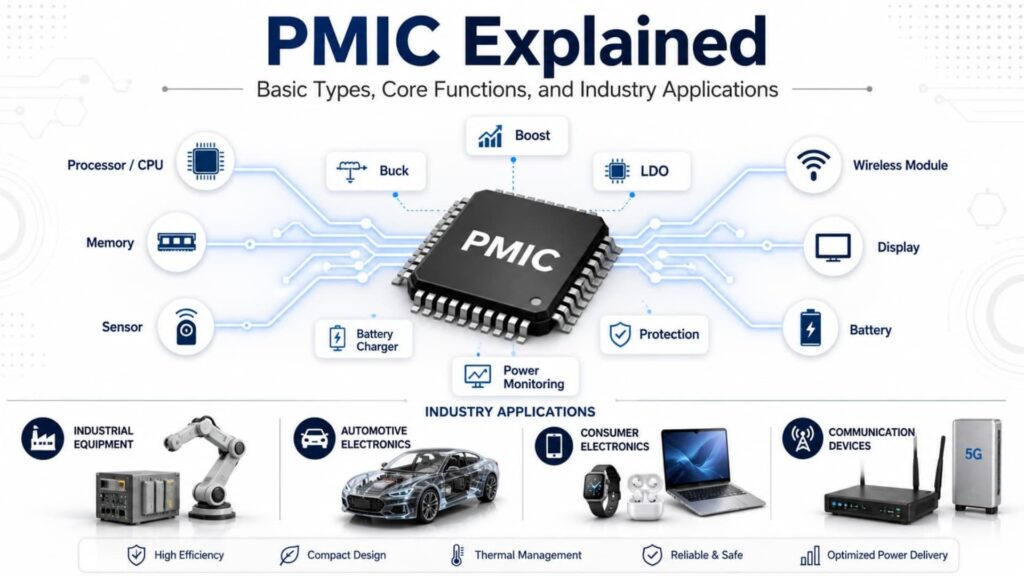
1.Introduction
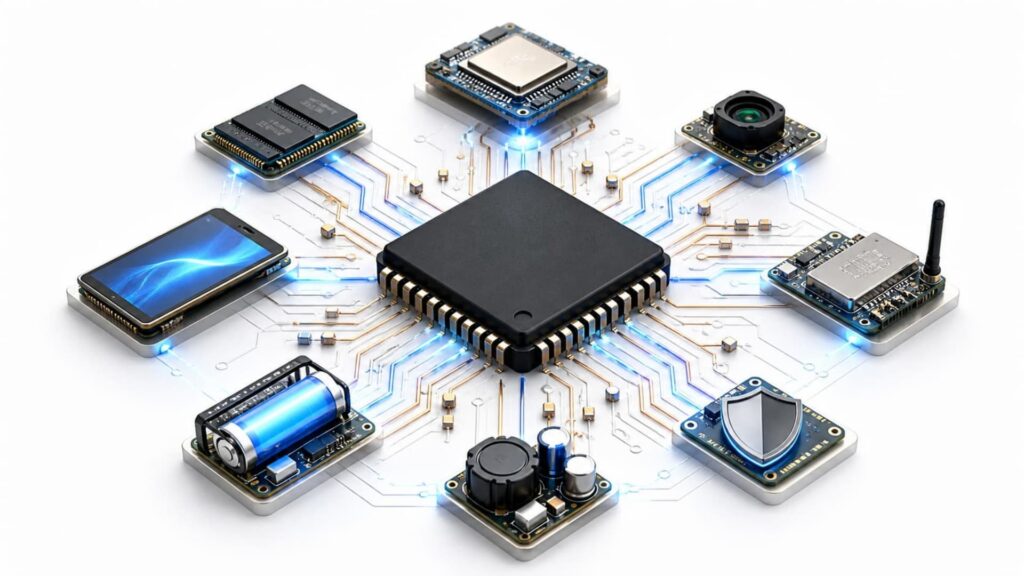
Modern electronic products need stable power to work correctly. A processor, memory chip, sensor, wireless module, display, and battery section may all need different voltage levels. If the power supply is unstable, the product may restart, overheat, lose data, or stop working.
This is why the Power Management IC, also called PMIC, is important.
A PMIC is an integrated circuit that manages power inside an electronic system. It can convert voltage, control power rails, charge batteries, protect circuits, and monitor system status. For engineers and procurement teams, choosing the right PMIC is not only a design decision. It also affects product reliability, component cost, sourcing risk, and long-term supply.
This article explains what a PMIC is, how it works, common PMIC types, main applications, and what buyers should check before sourcing PMIC components.
2.What Is a PMIC?
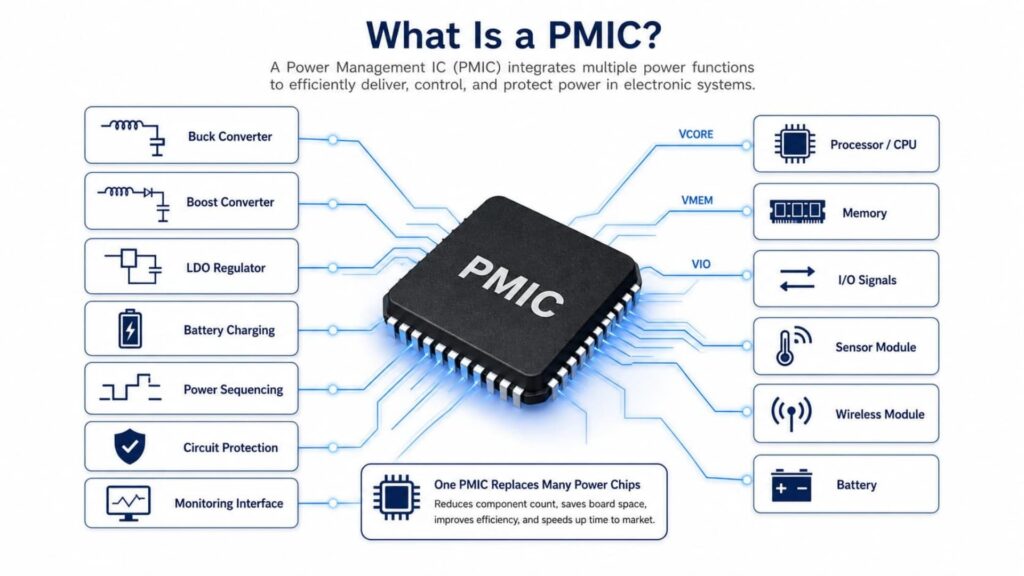
A Power Management IC (PMIC) is a semiconductor device used to manage power in electronic products. Instead of using many separate power chips, a PMIC combines several power management functions into one chip.
A PMIC may include:
Buck converters
Boost converters
LDO regulators
Battery charging circuits
Power sequencing logic
Protection functions
Monitoring and control interfaces
In simple terms, a PMIC helps send the right voltage and current to different parts of a system at the right time.
For example, a processor may need one voltage for its core, another voltage for memory, and another voltage for I/O signals. A PMIC can provide these power rails and control their startup order.
3.Core Functions of PMICs
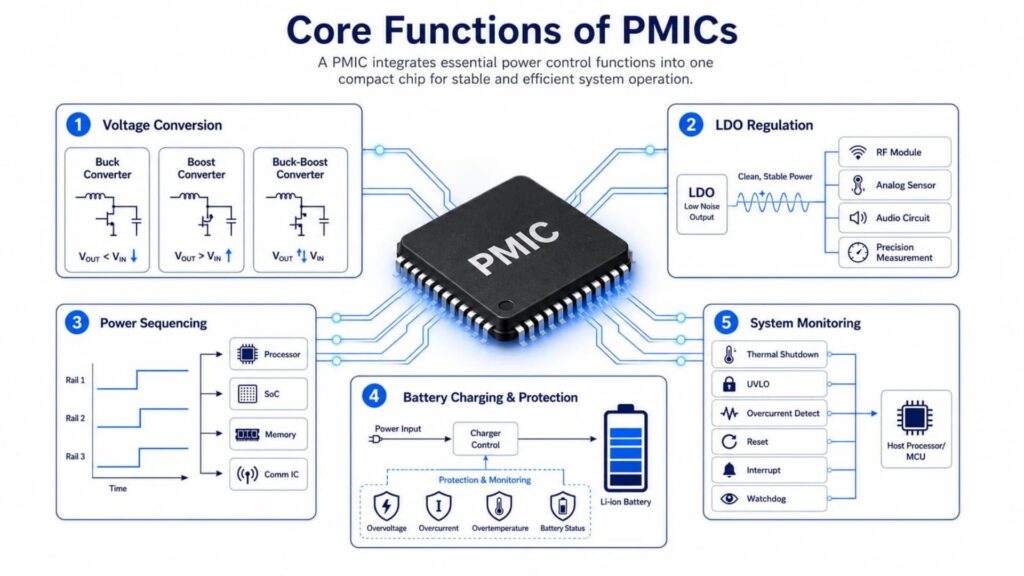
I.Voltage Conversion
One main job of a PMIC is voltage conversion. Many devices receive one input voltage, but internal components need different voltage levels.
Common voltage conversion blocks include:
Buck converter: reduces voltage
Boost converter: increases voltage
Buck-boost converter: increases or reduces voltage
For battery-powered products, efficient voltage conversion helps extend battery life. For industrial and automotive electronics, it helps provide stable power to controllers, sensors, memory chips, and communication modules.
II.LDO Regulation
An LDO, or Low-Dropout Regulator, provides clean and low-noise voltage. It is often used for sensitive circuits where power noise can affect signal quality.
LDOs are commonly used for:
RF modules
Analog sensors
Audio circuits
Precision measurement circuits
Compared with switching converters, LDOs are usually less efficient. However, they are useful when clean power is more important than maximum efficiency.
III.Power Sequencing
Many processors, SoCs, memory chips, and communication ICs need power rails to turn on in a correct order. If the startup sequence is wrong, the system may fail to boot.
A PMIC can manage this timing automatically. This helps reduce design risk and improve system stability.
IV.Battery Charging and Protection
Many PMICs are used in portable and rechargeable products. They may include battery charging and protection functions.
Common battery-related functions include:
Lithium-ion battery charging
Power path control
Overvoltage protection
Overcurrent protection
Overtemperature protection
Battery status monitoring
These functions are useful in wearables, handheld devices, smart meters, medical portable devices, and wireless equipment.
V.System Monitoring
Some PMICs can monitor system conditions and send fault signals to the main processor.
Monitoring functions may include:
Thermal shutdown
Undervoltage lockout
Overcurrent detection
Reset signal
Interrupt output
Watchdog function
These functions help protect the system and support safer operation
4.Main Types of PMICs
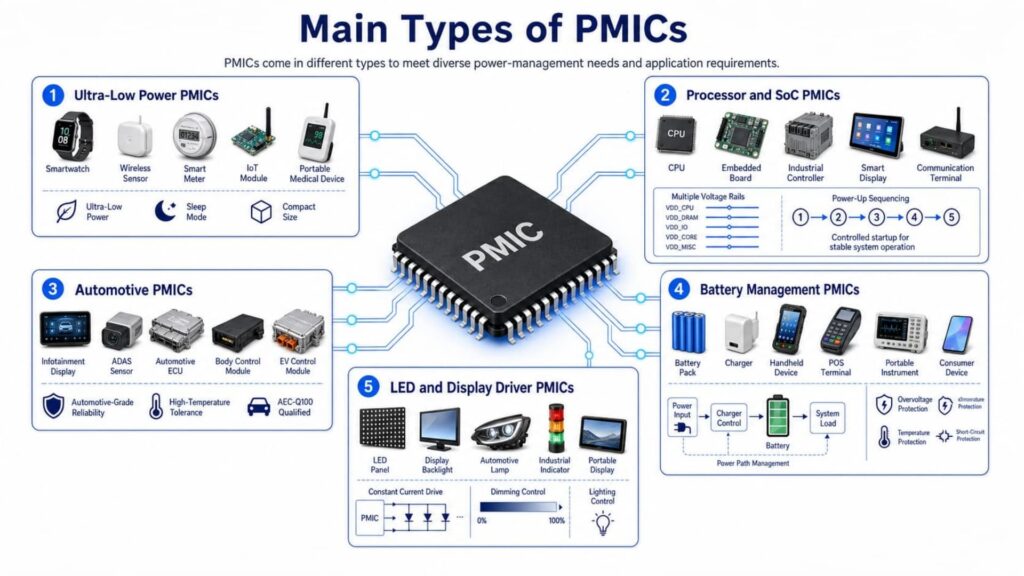
I.Ultra-Low Power PMICs
Ultra-low power PMICs are designed for devices that run on small batteries. Their main goal is to reduce power use during both active mode and sleep mode.
Typical applications include:
Wearable devices
Wireless sensors
Smart meters
IoT modules
Portable medical devices
When selecting this type of PMIC, engineers should check sleep current, battery charging support, efficiency, and package size.
II.Processor and SoC PMICs
Processors and SoCs usually need several power rails. A processor PMIC is designed to provide these rails and control the correct power-up sequence.
Typical applications include:
Embedded systems
Industrial controllers
Smart display devices
Communication equipment
Computing devices
For this type of PMIC, buyers should check whether the PMIC is recommended by the processor manufacturer. Some processors have companion PMICs that are already matched to their power needs
III.Automotive PMICs
Automotive PMICs are designed for difficult environments. They often need to support wide temperature ranges and strict reliability requirements.
Typical applications include:
Infotainment systems
ADAS modules
Automotive sensors
Body control modules
Electric vehicle control systems
For automotive projects, buyers should check AEC-Q100 qualification, temperature grade, functional safety support, traceability, and long-term availability.
IV.Battery Management PMICs
Battery management PMICs focus on charging, protection, and power path control.
Typical applications include:
Portable electronics
POS terminals
Handheld instruments
Rechargeable industrial devices
Consumer electronic products
Important parameters include charging current, battery type, input voltage range, thermal performance, and protection features.
V.LED and Display Driver PMICs
Some PMICs are used for LED driving, display backlighting, and lighting control.
Typical applications include:
Display backlights
Automotive lighting
Industrial indicators
Portable display products
For these parts, engineers should check output current, dimming method, efficiency, heat limits, and protection functions.
5.PMIC vs Discrete Power Components
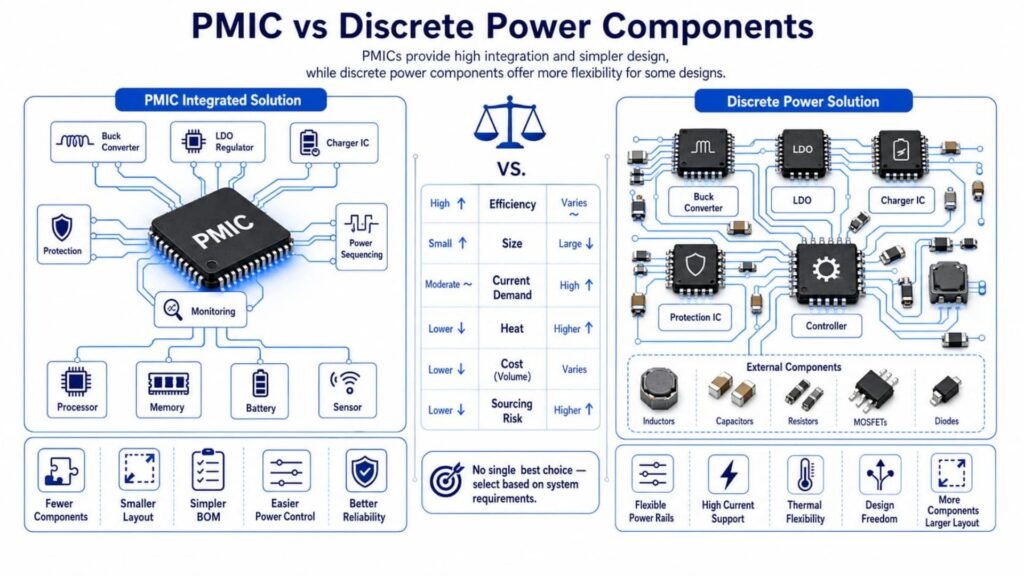
A power system can also use separate buck converters, LDOs, charger ICs, and protection ICs. This is called a discrete power solution.
However, many modern designs use PMICs because they provide higher integration.
I.Advantages of PMICs
| Advantage | Explanation |
|---|---|
| Fewer components | One PMIC can replace several separate power ICs |
| Easier power control | Startup timing and monitoring can be integrated |
| Smaller layout area | Useful for compact electronic products |
| Simpler BOM | Fewer part numbers are easier to manage |
| Better system reliability | Fewer components may reduce failure points |
II.When Discrete Solutions May Be Better
Discrete power components may still be suitable when:
The system needs very high current
Heat control is difficult
The design needs flexible power rails
A standard PMIC cannot meet all requirements
Cost control is more important than integration
There is no single correct choice for every project. Engineers should compare efficiency, size, current demand, heat, cost, and sourcing risk.
6.Key PMIC Selection Points
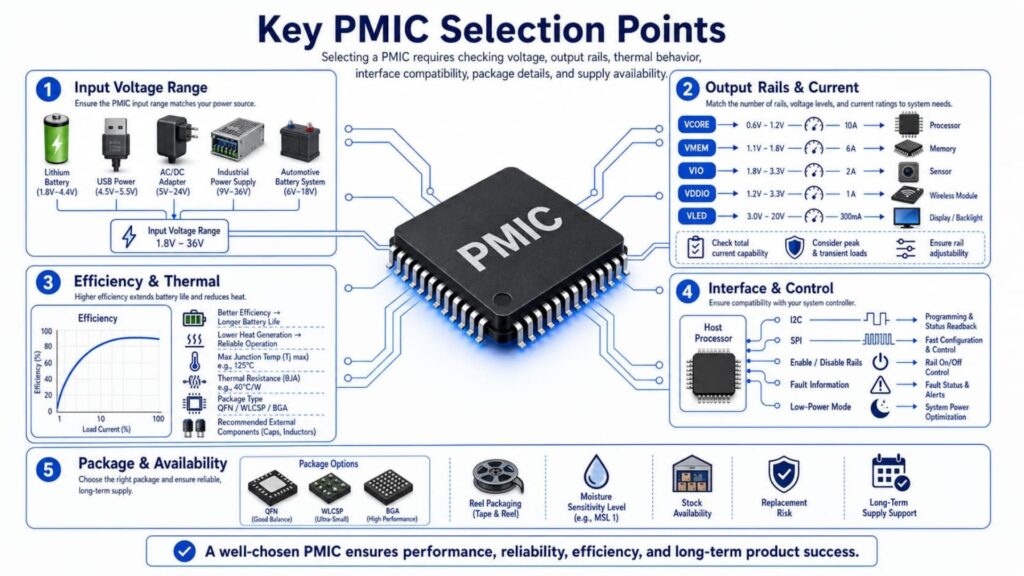
I.Input Voltage Range
The PMIC must support the system input voltage. Common input sources include lithium batteries, USB power, adapters, industrial power supplies, and automotive battery systems.
If the input voltage range is wrong, the PMIC may fail or work unstably.
II.Output Rails and Current Rating
Each output rail must match the load requirement. Buyers should check:
Output voltage
Output current
Voltage tolerance
Ripple requirement
Startup timing
Load condition
Do not select a PMIC only by the number of outputs. Each rail must be checked carefully.
III.Efficiency and Thermal Performance
Efficiency affects battery life and heat generation. A PMIC with low efficiency may cause overheating or reduce product runtime.
Important datasheet items include:
Efficiency curve
Maximum junction temperature
Thermal resistance
Package type
Recommended external components
IV.Interface and Control
Many PMICs support I2C or SPI control. These interfaces allow the main processor to set voltage, enable or disable rails, read fault information, and manage low-power modes.
For software-controlled systems, interface compatibility is very important.
V.Package and Supply Availability
PMICs often use compact packages such as QFN, WLCSP, or BGA. Before purchasing, buyers should confirm package type, packing method, reel quantity, moisture sensitivity level, and handling requirements.
Availability is also important. Some PMICs are closely linked to specific processors, so replacement options may be limited.
7.PMIC Sourcing and Quality Control Tips
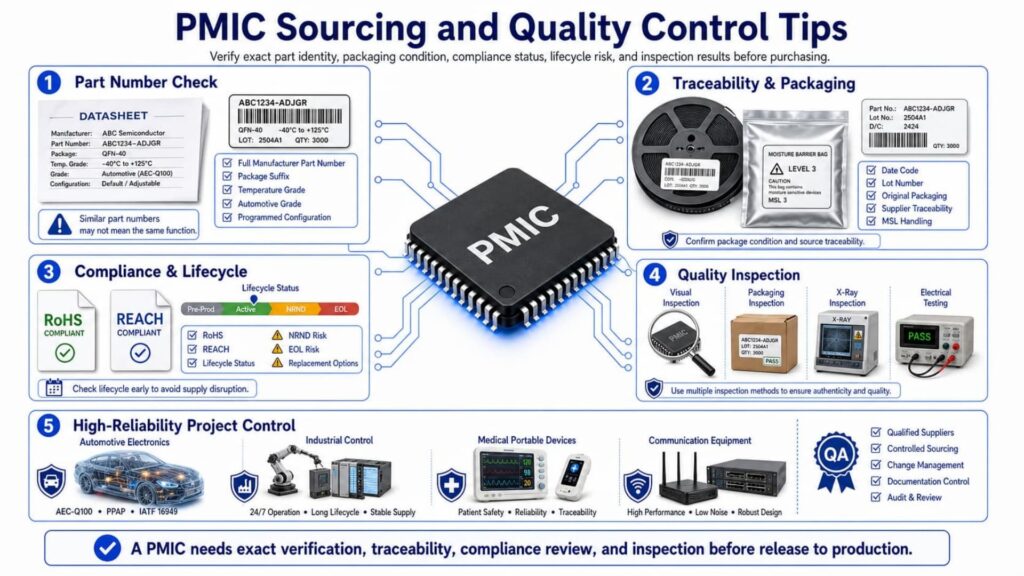
PMIC sourcing can be more complex than sourcing simple passive components. A similar part number may not always mean the same function.
Before purchasing PMICs, buyers should check:
Full manufacturer part number
Package suffix
Temperature grade
Automotive grade if required
Programmed configuration
Date code and lot numberz
Lifecycle status
RoHS and REACH compliance
Original packaging condition
Supplier traceability
For high-reliability projects, visual inspection, packaging inspection, X-ray inspection, and electrical testing may be required.
It is also important to review lifecycle status early. If a PMIC is not recommended for new designs or is close to end-of-life, buyers should prepare replacement options as early as possible.
8.Conclusion
A PMIC is a key power management component in modern electronic systems. It can integrate voltage conversion, LDO regulation, battery charging, power sequencing, monitoring, and protection into one chip.
For engineers, the right PMIC can improve efficiency, reduce component count, and simplify system power design. For procurement teams, PMIC selection affects sourcing stability, quality control, lifecycle management, and long-term supply planning.
When selecting a PMIC, do not only compare voltage values. Review the full power map, output rails, control interface, package, thermal performance, quality requirements, and supply availability.
For PMIC sourcing, BOM review, original component supply, alternative part recommendations, and inventory support, a professional component sourcing partner can help reduce purchasing risk and improve supply stability.
9.FAQ
1. What does PMIC mean?
PMIC means Power Management IC. It is an integrated circuit used to control, convert, distribute, and monitor power in electronic systems.
2. What is the difference between a PMIC and an LDO?
An LDO is a single voltage regulator. A PMIC may include several LDOs, switching converters, battery charging circuits, sequencing logic, and protection functions.
3. Why do processors need PMICs?
Processors often need multiple voltage rails for the core, memory, I/O, and analog sections. A PMIC helps provide these rails and control the correct startup sequence.
4. Can one PMIC be replaced by another PMIC?
Not always. PMIC replacement requires checking voltage rails, output current, package, control interface, power sequence, configuration, and thermal performance.
5. What should buyers check before sourcing PMICs?
Buyers should check the full part number, manufacturer, package, date code, lifecycle status, compliance documents, traceability, and whether the PMIC matches the system power requirements.
Want to learn more about PMIC? [PMIC — Power Management IC]