
Table of Contents
Potentiometer Explained: Working Principle, Types, Wiring, and Sourcing Tips
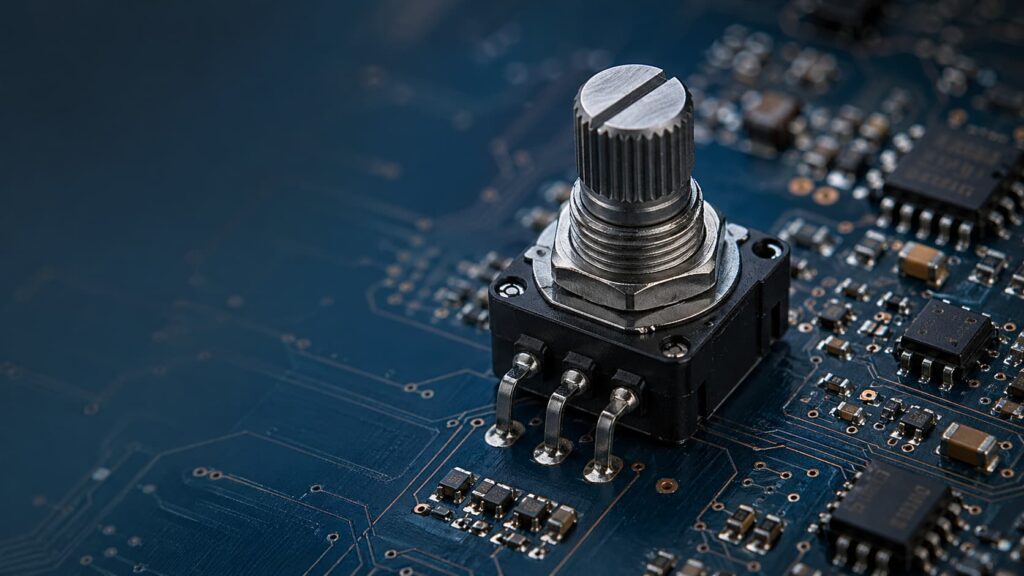
1. Introduction: The Ubiquitous Adjustable Resistor
In the sophisticated landscape of modern electronics, where high-speed processors and wireless protocols dominate the headlines, the humble potentiometer remains an indispensable cornerstone. From the precision calibration of medical imaging equipment to the tactile feedback of a high-end audio console, the potentiometer provides the vital bridge between human intent and electronic response.
For B2B procurement professionals and design engineers, a potentiometer is more than just a “volume knob.” It is a precision-engineered passive component whose material composition, mechanical endurance, and electrical characteristics can determine the success or failure of a multi-million dollar product line. This guide provides a deep dive into the engineering, types, and sourcing strategies for potentiometers in the professional market.
2. Anatomy of a Potentiometer: More Than Meets the Eye
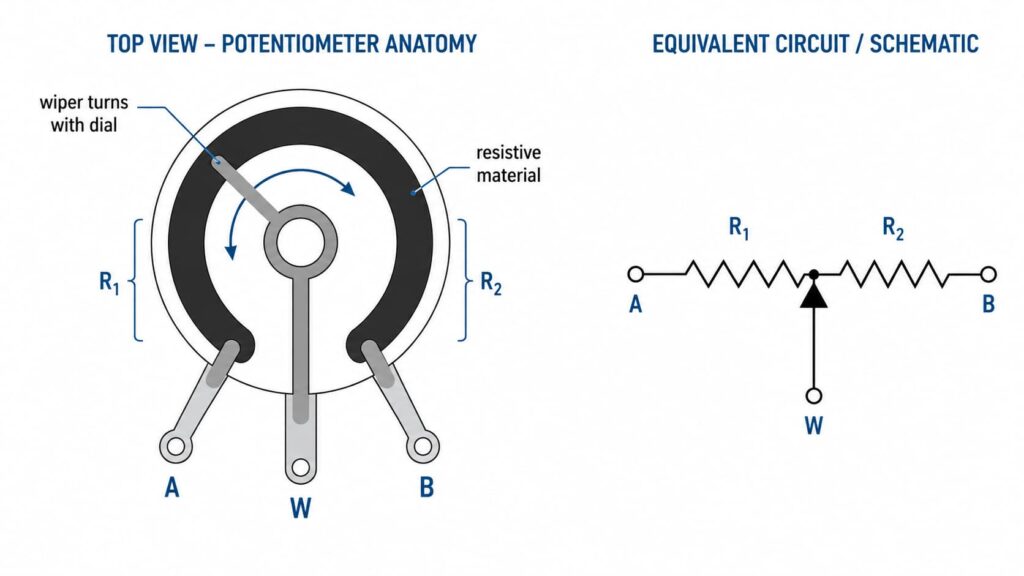
At its core, a potentiometer is a three-terminal resistor with a sliding or rotating contact that forms an adjustable voltage divider. However, the internal anatomy is where the complexity lies.
2.1 The Resistive Element
This is the “track” that provides the resistance. Its uniformity, surface roughness, and material density are critical. If the track has microscopic peaks and valleys, the adjustment will feel “scratchy” or inconsistent.
2.2 The Wiper (Collector)
The wiper is the moving contact. In high-quality potentiometers, the wiper is often made of multi-finger precious metal alloys to ensure consistent contact even after thousands of cycles.
2.3 The Housing and Seal
For industrial applications, the housing must protect the internal track from oxidation, dust, and moisture. This is why “sealed” vs. “open-frame” is a primary sourcing decision.
3. Physics and Working Principles
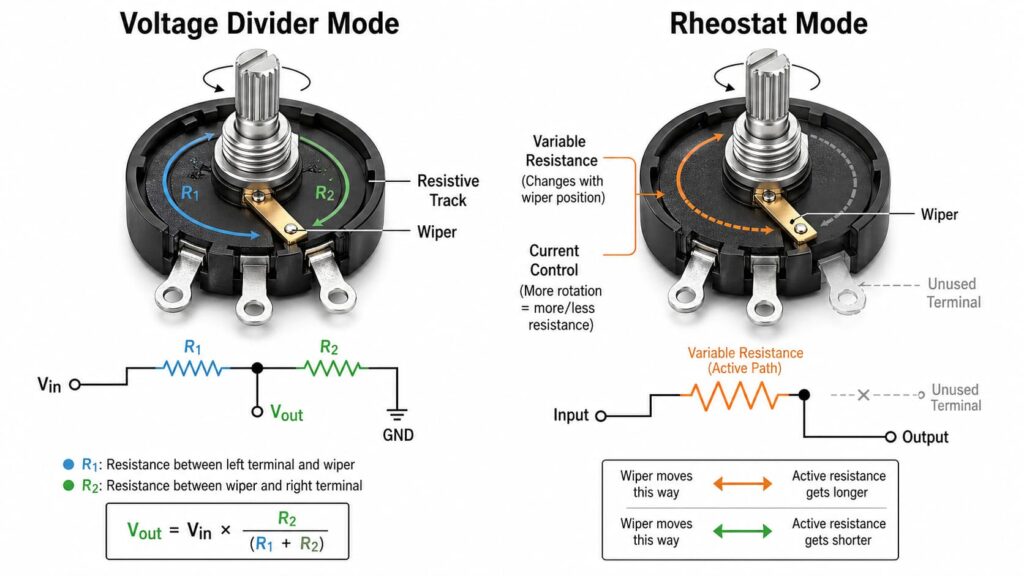
A potentiometer operates on the principle of resistance being proportional to length. By moving the wiper we effectively change the length ofthe resistive material through which the current flows.
3.1 Voltage Divider vs. Rheostat
Voltage Divider (Three-terminal): The most common configuration. It divides an input voltage into a variable output voltage. Vout=Vin×(R2/(R1+R2))Vout=Vin×(R2/(R1+R2)).
– Rheostat (Two-terminal): By connecting only the wiper and one outer terminal, the device controls the total resistance in a branch of the circuit, thereby regulating current.
4. Material Science: The Heart of Performance
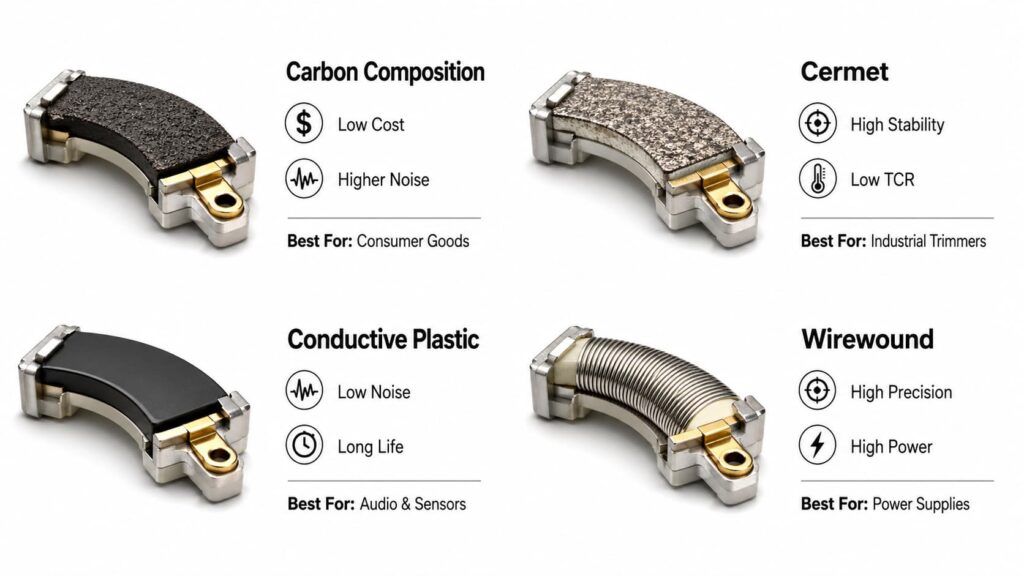
Choosing the right resistive element material is the most important technical decision in the sourcing process.
4.1 Carbon Composition
- Pros: Low cost, widely available.
- Cons: Higher noise, lower precision, susceptible to moisture.
- Best For: Toys, low-cost consumer goods, non-critical adjustments.
4.2 Cermet (Ceramic-Metal)
Cermet is a composite of ceramic and metallic particles.
- Pros: High power handling, excellent stability, low Temperature Coefficient of Resistance (TCR).
- Cons: Shorter rotational life compared to plastic.
- Best For: Industrial trimmers (Trimpots) where set-and-forget calibration is required.
4.3 Conductive Plastic
- Pros: Extremely low noise (Contact Resistance Variation – CRV), incredibly high life (often 2 million+ cycles).
- Cons: More expensive, lower power rating.
- Best For: Professional audio mixers, flight controls, and medical sensors.
4.4 Wirewound
- Pros: High precision, very high power handling (watts rather than milliwatts).
- Cons: High inductance, “stepped” adjustment (you can feel the wiper jumping between wires).
- Best For: Power supplies and precision industrial equipment.
5. Decoding Resistance Tapers: Linear, Log, and Beyond
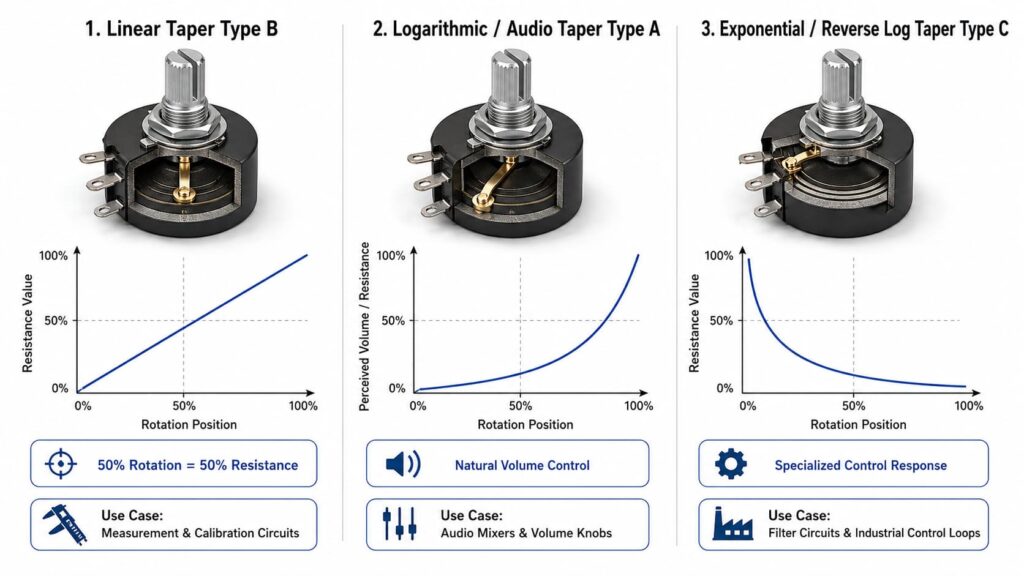
The “taper” defines the relationship between the mechanical position and the resistance value.
5.1 Linear Taper (Type B)
In a linear pot, 50% rotation equals 50% resistance. This is used for most measurement and calibration circuits.
5.2 Logarithmic / Audio Taper (Type A)
Human hearing is logarithmic. A linear volume control would seem to jump from silent to loud instantly. A log taper provides a “natural” feeling adjustment for audio applications.
5.3 Exponential / Reverse Log Taper (Type C)
Used in specialized filter circuits and certain industrial control loops where the response needs to be slow at the start and rapid at the end.
6. Categorizing Potentiometers by Application
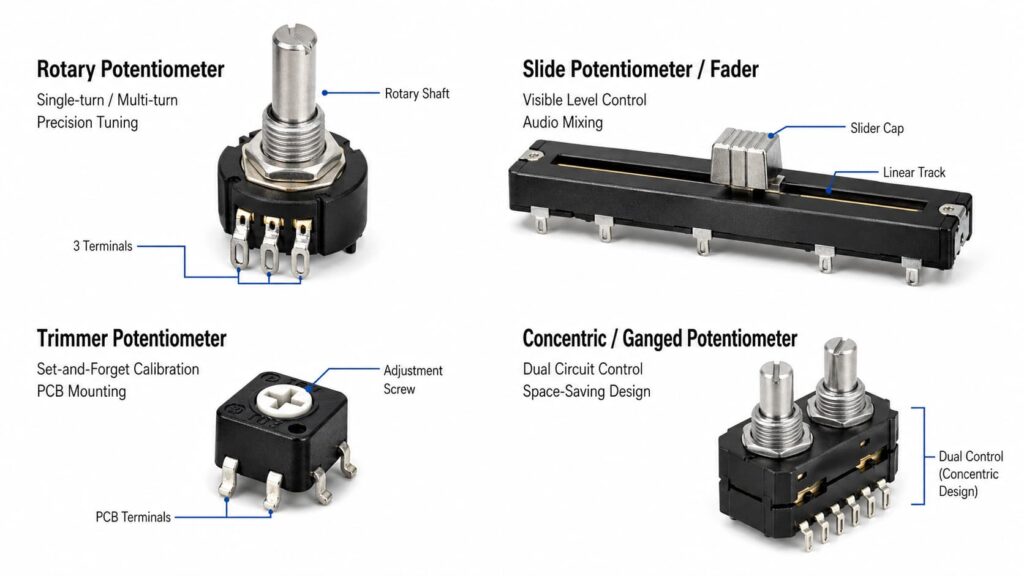
6.1 Rotary Potentiometers
The standard “knob” type. Available in single-turn (typically 270° to 300°) or multi-turn (typically 3, 5, or 10 turns) versions for high-precision tuning.
6.2 Slide Potentiometers (Faders)
Common in the music industry. They allow the user to see the relative levels of many channels at once.
6.3 Trimmer Potentiometers (Trimpots)
Miniature versions meant for PCB mounting. They are “set and forget” components used to calibrate a circuit during factory testing.
6.4 Concentric and Ganged Potentiometers
“Stacked” pots that allow two different circuits to be adjusted using a single shaft or two shafts in one footprint. Vital for space-constrained designs like handheld instruments.
7. The Digital Revolution: Digital Potentiometers (DigiPots)
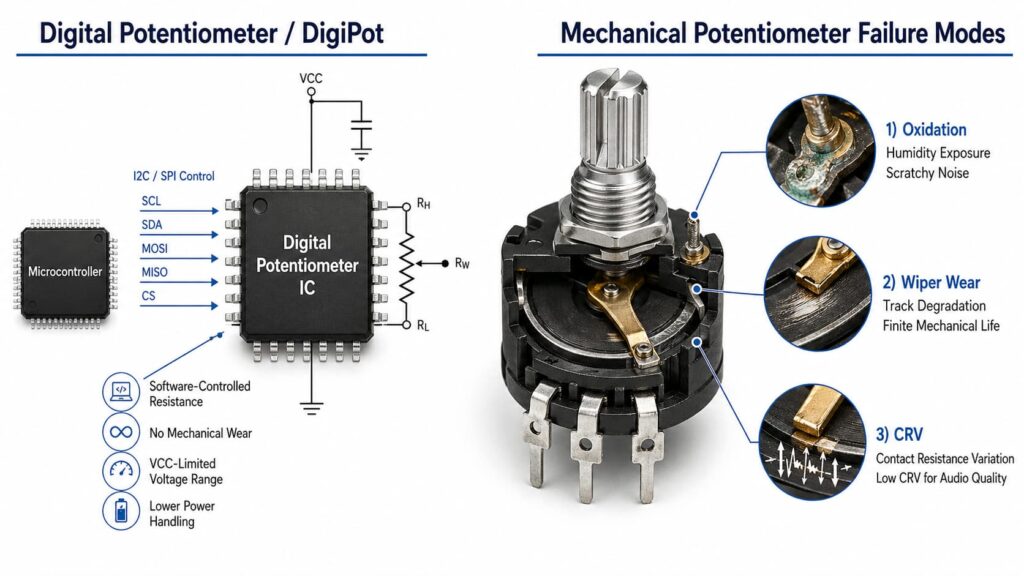
For modern B2B products, the Digital Potentiometer is a growing segment. These are integrated circuits (ICs) that mimic the behavior of a mechanical pot but are controlled via I2C or SPI.
– Advantages: No mechanical wear, immune to vibration, can be controlled by software/firmware.
– Limitations: Limited voltage range (usually tied to the VCC of the chip), lower power handling.
8. Common Failure Modes and Reliability
A potentiometer is one of the few electronic components with a finite mechanical life.
– Oxidation: Occurs in open-frame pots when exposed to humidity, leading to “scratchy” noise.
– Wear: The wiper eventually wears through the resistive track.
– Contact Resistance Variation (CRV): As the wiper moves, the resistance at the contact point fluctuates. In high-end audio, low CRV is the most sought-after spec.
9. B2B Sourcing Strategy: The Buyer’s Checklist
When sourcing for a Bill of Materials (BOM), a buyer must look beyond the basic resistance value.
9.1 Technical Specifications to Confirm
1. Tolerance: Standard is ±20%, but precision pots require ±10% or even ±5%.
2. Power Rating: Ensure the pot can handle the wattage (usually 0.05W to 0.5W for signals).
3. Rotational Life: Is the application a “set-once” (100 cycles) or a “user-interface” (100k cycles)?
4. Temperature Coefficient (TCR): How much does the resistance drift with heat? (Crucial for outdoor equipment).
5. Mounting Style: SMD (Surface Mount) for automation vs. Panel Mount for user chassis.
9.2 Key Manufacturers for Professional Sourcing
– Bourns: The gold standard for trimmers and industrial pots.
– Alps Alpine: Dominant in audio and automotive interface pots.
– Vishay / Sfernice: High-end precision and military-grade potentiometers.
– Noble: Highly regarded in the high-fidelity audio market.
– Murata / Panasonic: Reliable sources for board-level trimmers and consumer-grade pots.
10. Future Trends: Non-Contact Solutions
While the mechanical potentiometer is far from dead, we are seeing a shift toward non-contact Hall Effect sensors in high-reliability markets (like automotive pedals). These use magnets to sense rotation, meaning there is zero mechanical wear. However, for most analog circuits, the physical potentiometer remains the most cost-effective and electrically “clean” solution.
11. Conclusion
The potentiometer is a bridge between the physical and digital worlds. For the B2B buyer, success lies in balancing cost with the mechanical and environmental realities of the product’s end-use. By understanding the material science of Cermet vs. Plastic and the mechanical nuances of Tapers and Seals, you can secure a supply chain that ensures both performance and reliability.
Finding the perfect balance between mechanical endurance and electrical precision requires technical expertise and a reliable supply chain. Whether you are finalizing a new industrial design or optimizing your BOM for high-volume production, our team is here to provide the technical support and sourcing excellence you need. Contact us today to explore our extensive inventory of high-quality potentiometers or request a custom quote for your next project.