
Table of Contents
SFP Modules: A Complete Guide to Principles, Removal, and 2026 Maintenance Trends
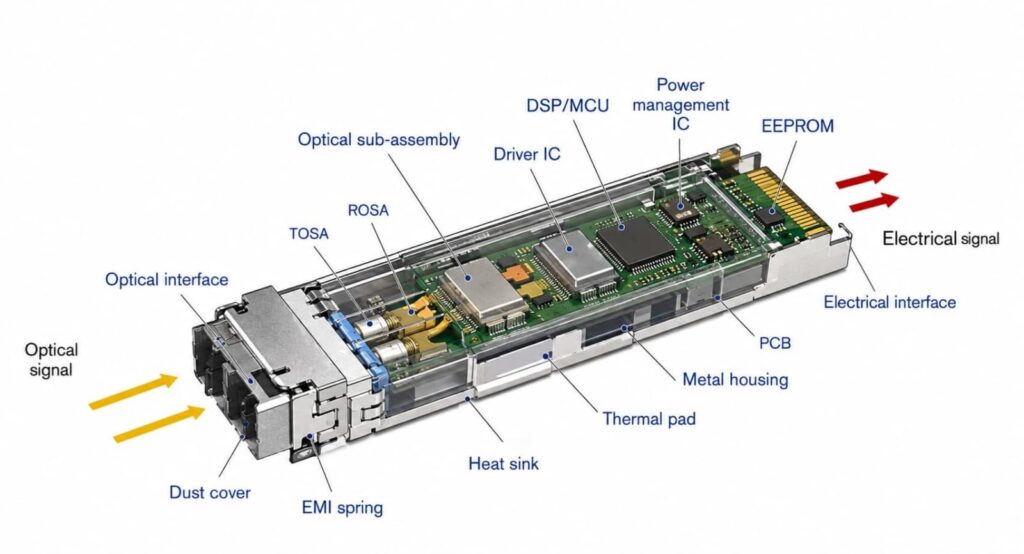
Introduction
In the rapidly evolving landscape of 2026 networking—driven by AI computing clusters and 5G-Advanced deployment—the Small Form-factor Pluggable (SFP) module remains the indispensable “joint” of digital infrastructure. These hot-swappable transceivers act as the bridge between network devices and fiber optic or copper cabling, enabling high-speed data transmission across distances ranging from meters to over 100 kilometers.
1.Understanding the SFP Ecosystem (2026 Perspective)
The SFP family has expanded significantly to meet the bandwidth demands of the modern era. While standard 1G SFPs are now reserved for industrial control, newer generations have taken center stage:
SFP28 (25G): The current “sweet spot” for data center server access, offering optimal price-to-performance.
SFP56 (50G): Designed for 5G mid-haul and high-performance computing.
SFP-DD (100G): The performance peak of the SFP form factor, utilizing double-density pins.
2.Key Components and Advanced Technologies
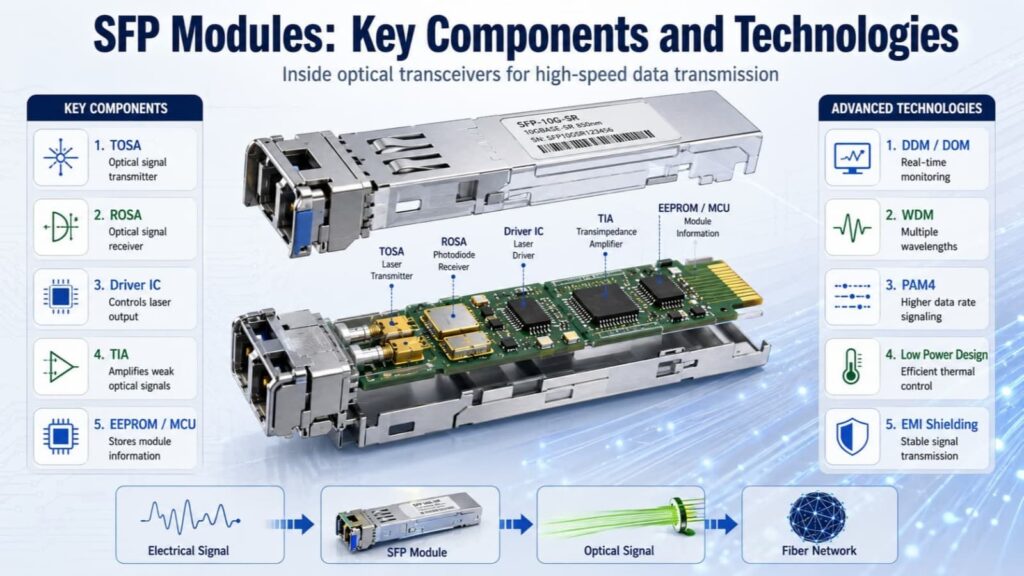
1. Optical Transmitters and Receivers (TOSA/ROSA)
The soul of any module is its optical sub-assembly. By 2026, Silicon Photonics has become mainstream, integrating lasers and modulators onto a single silicon chip to reduce power consumption and thermal footprint.
2. Digital Diagnostic Monitoring (DDM/DOM)
Modern DDM is no longer optional. It provides real-time telemetry on:
Optical Power Levels: Crucial for detecting link degradation.
Temperature and Voltage: Essential for predictive maintenance in dense AI racks.
3.How to Safely Remove an SFP Module
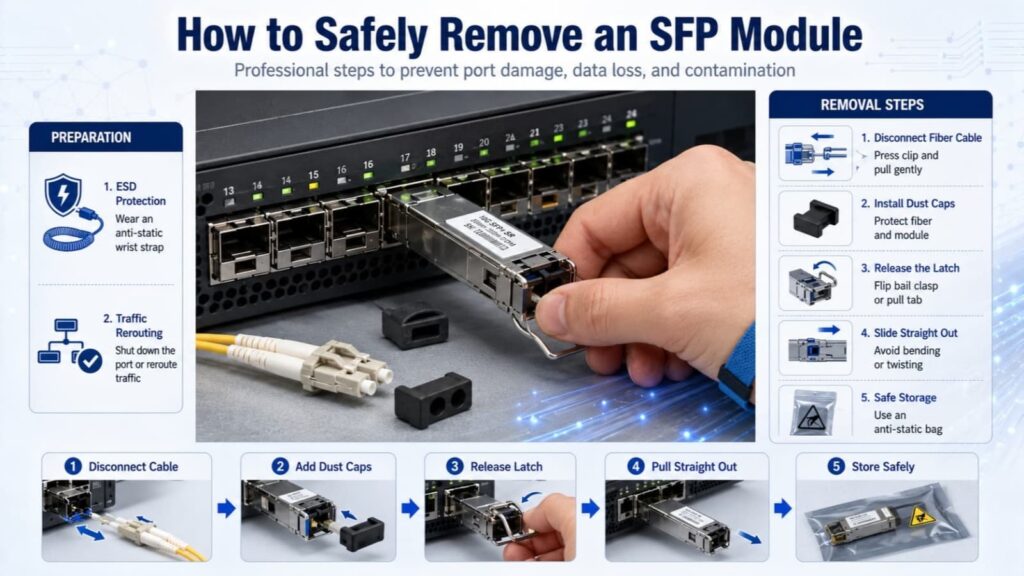
Improper removal can lead to permanent damage to the expensive switch backplane or laser eye safety risks. Follow these professional steps:
Preparation
ESD Protection: Always wear an anti-static wrist strap.
Traffic Rerouting: Ensure the port is administratively shut down or traffic is rerouted to avoid data loss.
Step-by-Step Removal
Disconnect the Cable: Gently press the clip on the fiber patch cord and pull. Immediately install dust caps on both the fiber and the module.
Release the Latch: Depending on the bail type:
Bail Clasp: Flip the latch down 90 degrees to the horizontal position.
Mylar Tab: Pull the tab gently outward.
Smooth Extraction: Grasp the sides of the module and slide it straight out of the port.
Safe Storage: Place the module into an anti-static bag.
4.Troubleshooting and 2026 Best Practices
“Cleanliness is Next to Godliness”: Over 80% of link failures are caused by end-face contamination. Use a one-click cleaner before every insertion.
Insertion Cycles: Most SFP ports are rated for 100-500 cycles. Avoid unnecessary plugging and unplugging.
Compatibility: Always verify the module’s EEPROM matches your hardware vendor’s whitelist to avoid “unsupported transceiver” errors.
5.Conclusion
The SFP module is a small but critical component of the modern digital foundation. As we transition toward 25G/50G standards in 2026, mastering the selection, installation, and maintenance of these modules is key to maintaining a stable and scalable network.
Managing a BOM with SFP modules or searching for high-reliability optical transceiver alternatives? Our team specializes in optical module cross-referencing, compatibility matching, and inventory support. Send us your SFP, SFP+, QSFP, or other optical transceiver part numbers today for a professional availability check and alternative sourcing analysis.
[Note on Image Copyright] Note: Some images in this article are sourced from the Internet. If there are any copyright issues, please contact us for removal.