
Table of Contents
STM32 Alternatives: How to Find Compatible or Replacement MCUs
introduction
STMicroelectronics’ STM32 family is a common choice for embedded systems. However, relying on a single manufacturer carries supply chain risks. Recent disruptions have made finding STM32 shortage alternatives a priority for hardware teams.
Whether you face long lead times, rising costs, or want to diversify your supply chain, this MCU replacement guide will help. Read on to learn how to evaluate and select reliable STM32 alternatives for your production lines.
1.Why Consider an STM32 Substitute?
Engineers and procurement teams actively look for microcontroller alternatives for three main reasons:
Supply Chain Stability: Single-source components cause production bottlenecks. Diversifying your MCU sourcing ensures your assembly lines keep running during shortages.
Cost Control: Competitor chips often provide similar specifications at lower prices. Switching can reduce your overall manufacturing costs without sacrificing performance.
Design Flexibility: Adding BOM alternative parts to your approved vendor list (AVL) early prevents rushed redesigns. If your primary MCU goes out of stock, you already have a backup ready for deployment.
Finding a reliable substitute protects your delivery schedules and your bottom line.
2.Key Factors When Choosing an STM32 Replacement
Swapping the main controller in your embedded systems MCU project requires careful technical evaluation. Review these criteria before purchasing new chips.
I. Core Architecture
The STM32 family uses the ARM Cortex-M microcontroller architecture (such as Cortex-M0, M3, M4, or M7). When selecting an STM32 equivalent, stick to the same core. This keeps your instruction set, processing power, and basic firmware logic as close to the original as possible.
II. Pin-to-Pin Compatibility
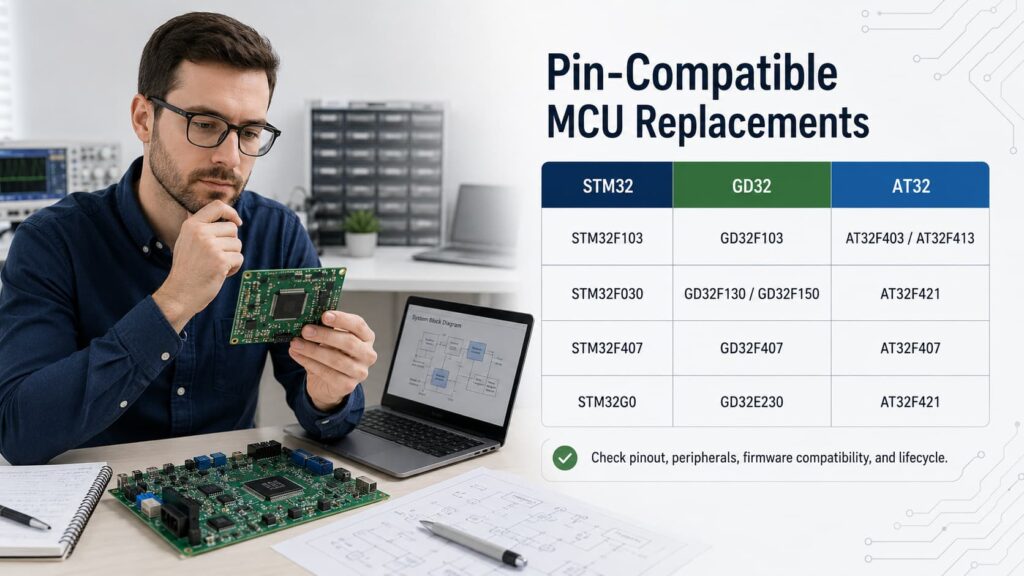
If your printed circuit board (PCB) is already manufactured, you need a pin compatible MCU. This means the new chip has the exact same physical footprint and pinout.
Understand the difference between a functional equivalent and a true drop in MCU replacement. A drop-in replacement requires zero PCB layout changes. A functional equivalent might require rerouting traces. Always verify power pins, boot pin configurations, and decoupling capacitor requirements.
III. Peripherals and Memory
Compare Flash and SRAM sizes. Check the availability of timers, ADCs, and communication interfaces (I2C, SPI, UART, CAN).
Even with an STM32 compatible MCU, memory mapping and peripheral registers will differ. You cannot assume identical internal operations. You will need to rewrite or adjust your low-level hardware drivers.
IV. Software and Toolchains
You cannot use STM32CubeMX to generate initialization code for non-ST chips. When migrating to an STM32 replacement, check the new vendor’s software ecosystem. Ensure the chip supports standard IDEs like Keil MDK, IAR Embedded Workbench, or GCC. Look for vendors that provide their own configuration tools and code generators.
3.Technical Deep Dive: Peripheral and Power Differences
When evaluating an STM32 equivalent, engineers must look beyond the core architecture and examine the specific peripheral implementations. Even if a microcontroller is marketed as a drop-in replacement, the internal IP blocks for ADCs, DACs, and advanced timers might behave differently. For instance, the conversion rates and resolution of an ADC on a substitute chip might not perfectly align with your original STM32 part, requiring adjustments in your sampling logic.
Power consumption is another critical metric, especially for battery-operated embedded systems. While the STM32L series is renowned for its ultra-low power modes, alternative chips might have different sleep, stop, and standby current draws. Always compare the wake-up times and power domain configurations in the datasheets. A chip that matches the processing speed but drains the battery twice as fast is not a viable long-term solution for portable devices.
4.The Firmware Migration Process: Step-by-Step
Transitioning your codebase to a new ARM Cortex-M microcontroller involves several distinct phases.
First, you must address the Hardware Abstraction Layer (HAL). If your original code relies heavily on ST’s proprietary HAL libraries, you will need to rewrite these sections using the new vendor’s equivalent libraries or standard CMSIS drivers.
Next, focus on the clock tree configuration. The internal oscillators and phase-locked loops (PLLs) often have different multiplier and divider limits. You must recalculate these values to ensure your system clock, USB clock, and peripheral clocks operate at the correct frequencies.
Finally, thoroughly test your communication interfaces. I2C and SPI timings can vary slightly between manufacturers. Use an oscilloscope or logic analyzer to verify that setup and hold times meet the requirements of your external sensors and memory chips. Rigorous testing during the migration phase prevents intermittent field failures.
5.Top STM32 Compatible MCU Brands
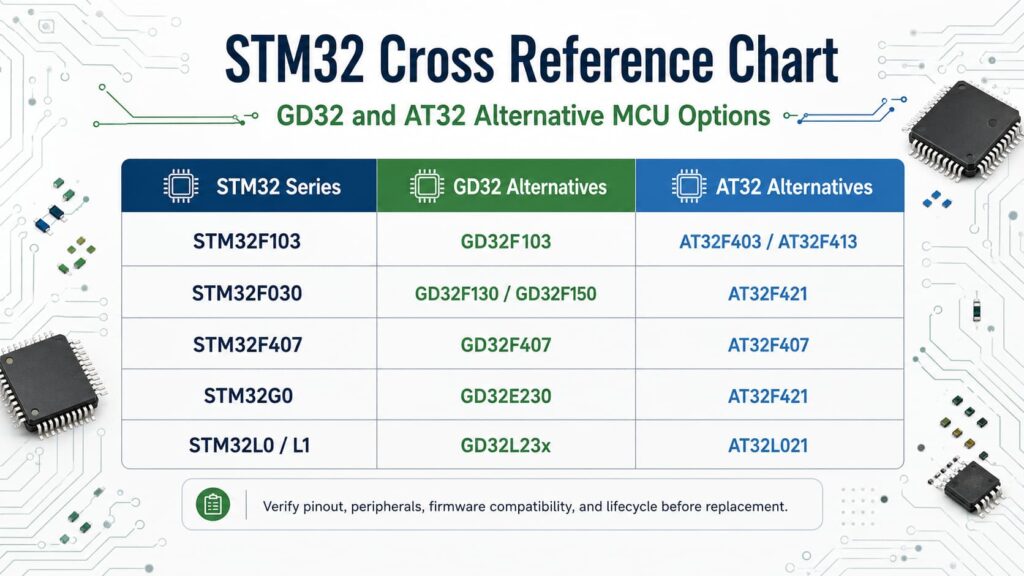
Several manufacturers offer reliable replacements. Options range from direct clones to major competitor equivalents.
GigaDevice (GD32)
[GigaDevice] is widely known as a reliable STM32 substitute. The GD32 family closely matches the STM32F1 and STM32F4 series.
GD32 microcontrollers often feature higher maximum clock speeds. They use zero-wait state technology for faster flash execution. Most importantly, they offer strong pin-to-pin compatibility, making them popular for teams avoiding PCB redesigns.
ArteryTek (AT32)
[ArteryTek] provides another strong option for a drop in MCU replacement. Their AT32 family is based on the ARM Cortex-M4 core.
AT32 chips match many popular STM32 pinouts and offer competitive pricing. ArteryTek also provides a proprietary migration tool. This software helps developers port existing STM32 code to the AT32 ecosystem, saving engineering time.
NXP, Microchip, and Texas Instruments
If you are designing a new board or are willing to rewrite firmware, consider other major semiconductor brands.
NXP: The LPC and Kinetis series are robust microcontroller alternatives with strong support and extensive documentation.
Microchip: The SAM series offers reliable, automotive-grade ARM Cortex-M options with excellent long-term availability.
Texas Instruments: The MSP432 series provides ultra-low power consumption, making it ideal for battery-powered IoT devices.
6.How to Perform an STM32 Cross Reference
Finding the exact replacement part requires a systematic approach. Follow these steps to perform an STM32 cross reference:
1. Decode the STM32 Part Number
Break down your current chip first. For example, STM32F103C8T6 can be decoded as follows:
- STM32 = Brand
- F103 = Core type, usually Cortex-M3
- C = Pin count, such as 48 pins
- 8 = Flash memory size, such as 64 KB
- T = Package type, such as LQFP
- 6 = Temperature range, such as -40°C to 85°C
2. Match the Naming Convention
Some compatible MCU brands use similar part number structures. For example, the GigaDevice equivalent may be GD32F103C8T6, while an ArteryTek alternative may be AT32F403C8T7.
However, the part number alone is not enough. Always verify the package, pinout, flash size, RAM size, clock speed, peripherals, voltage range, and temperature grade in the official datasheet.
3. Use Distributor Cross-Reference Tools
You can also use cross-reference search tools on B2B electronic component websites. Enter your STM32 part number to view compatible alternatives, datasheets, and current stock availability.
7.MCU Sourcing and BOM Management Best Practices
Proactive MCU sourcing protects your production lines.
First, design PCBs with multiple footprints if space allows. Second, qualify your BOM alternative parts early. Do not wait for a shortage. Buy development boards for GD32 or AT32 chips now and port your code.
Finally, build relationships with reliable B2B electronic component distributors. They provide early warnings about component obsolescence and lead time changes.
8.Conclusion
Finding an STM32 replacement requires technical diligence. Brands like GigaDevice and ArteryTek offer practical STM32 alternatives that minimize hardware changes. Major brands like NXP and TI offer stable options for new designs. By understanding your core requirements and qualifying alternative parts early, you can keep your manufacturing on schedule.