
Table of Contents
STM32F103C8T6 Alternatives: 4 Production-Ready Replacements Compared (2026)
Abstract
The STM32F103C8T6 has been a default choice in embedded design for over fifteen years. But the math is shifting. STMicroelectronics confirmed a price adjustment on May 28, 2026, taking effect June 28. Lead times for specific package-temperature combinations still stretch past 26 weeks. And while ST’s supply chain tightens, the ecosystem of validated STM32F103C8T6 alternatives has reached a level of maturity that would have been hard to imagine five years ago.
GigaDevice alone has shipped more than 2 billion GD32 MCUs. Artery, WCH, and Geehy each field their own production-hardened alternative parts with real toolchains and real supply stability. The question procurement teams face is no longer “is there an alternative” but “which alternative fits my project.”
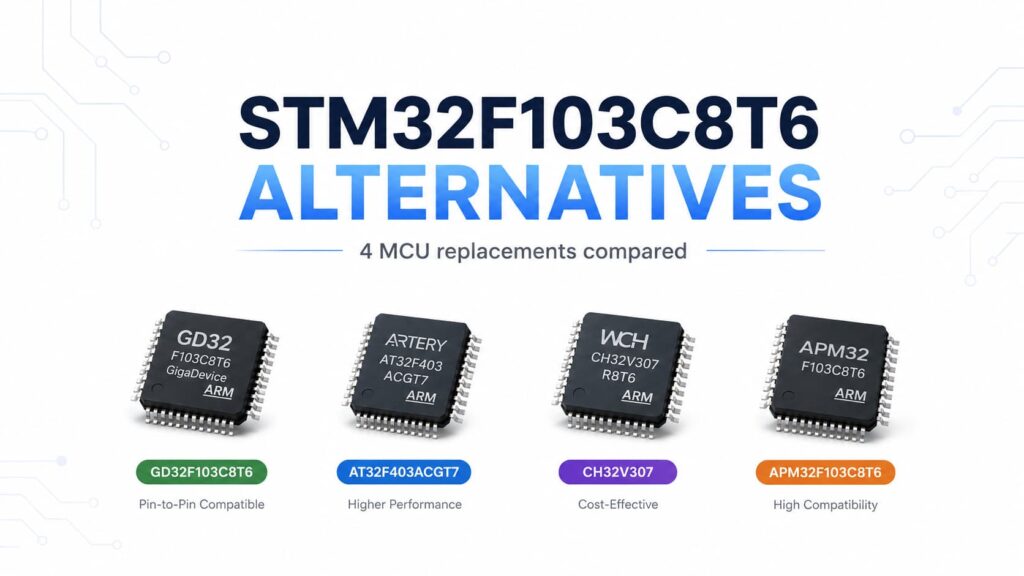
This guide compares four production-ready alternatives to the STM32F103C8T6—GD32F103C8T6, AT32F403ACGT7, CH32V307, and APM32F103C8T6—across compatibility, performance, cost, and migration effort. Every comparison assumes you need to ship a real product, not just pass a bench test.
1.Comparison at a Glance
| Parameter | STM32F103C8T6 | GD32F103C8T6 | AT32F403ACGT7 | CH32V307VCT6 | APM32F103C8T6 |
|---|---|---|---|---|---|
| Manufacturer | STMicroelectronics | GigaDevice | Artery | WCH | Geehy |
| Core | ARM Cortex-M3 | ARM Cortex-M3 | ARM Cortex-M4F | RISC-V QingKe V4F | ARM Cortex-M3 |
| Max Frequency | 72 MHz | 108 MHz | 240 MHz | 144 MHz | 96 MHz |
| Flash / SRAM | 64 KB / 20 KB | 64 KB / 20 KB | 256 KB+ / 96 KB+ | 256 KB / 64 KB | 64 KB / 20 KB |
| Package | LQFP-48 | LQFP-48 | LQFP-48 | LQFP-64 | LQFP-48 |
| Pin Compatible | — | ✓ Drop-in | ✓* See notes | ✗ Footprint only | ✓ Drop-in |
| Firmware Reuse | — | ~95% | ~80% | ~30% (RISC-V) | ~95% |
| IDE Support | STM32CubeIDE | Keil, IAR, GD32Cube | Keil, IAR, Artery DFP | MounRiver Studio | Keil, IAR |
| Price (1k units) | $2.50–3.50 | $1.20–1.80 | $1.50–2.20 | $1.50–1.90 | $1.00–1.50 |
2.GD32F103C8T6: The Safest Starting Point
GigaDevice is the reference brand in the STM32 alternative conversation. The GD32F103C8T6 uses the same ARM Cortex-M3 core and the same LQFP-48 pinout. It solders onto your existing PCB without any layout change.
Compatibility sits around 95% for most firmware. The package, power pins, reset, boot, and SWD debug interface are identical. The clock runs at 108 MHz instead of 72 MHz, giving you extra headroom at zero hardware cost.
What to validate before production:
| Area | STM32F103C8T6 | GD32F103C8T6 | Real Impact |
|---|---|---|---|
| BOOT0 | Tolerates floating | Needs 10 kΩ pull-down to GND | Most common migration trap |
| Clock | 72 MHz | 108 MHz | Timing-sensitive code needs recheck |
| Flash writes | Standard timing | Faster page writes | Flash driver retuning |
| I²C | Standard peripheral | Subtle timing differences | Bench-test I²C-heavy designs |
| Toolchain | STM32CubeIDE native | GD32Cube, Keil, IAR | No STM32CubeIDE support |
The BOOT0 issue deserves extra attention because it is the single most reported migration failure. STM32F103C8T6 tolerates a floating BOOT0 pin thanks to an internal pull-down resistor. The GD32F103C8T6 does not. If your PCB leaves BOOT0 unconnected, the GD32 will occasionally boot into its system bootloader and sit silent—no crash, no error, just a dead board. The fix is a single 10 kΩ resistor to ground, but you only discover the problem after power-up. Check this before ordering production quantities.
For most teams, GD32F103C8T6 represents the lowest-engineering-effort path to a stable STM32F103C8T6 alternative. It is the most widely validated swap in the industry.
3.AT32F403ACGT7: The Performance Upgrade
Artery’s AT32F403A series is not a clone. It is a Cortex-M4F device with DSP instructions and a single-precision FPU, running at up to 240 MHz. In LQFP-48, the AT32F403ACGT7 is pin-compatible with STM32F103C8T6, but the silicon underneath is a generation ahead.
Firmware reuse lands around 80%. The AT32F403A uses the Artery DFP (Device Family Pack) in Keil or IAR. There is no STM32CubeIDE path. The internal RC oscillator runs at 4 MHz instead of ST’s 8 MHz, which forces a PLL reconfiguration. Startup time stretches to 13 ms versus 2.5 ms for the STM32F103C8T6—this matters for designs that wake frequently from low-power states.
On the upside, 240 MHz with an FPU transforms what your board can do without a PCB redesign. Motor control loops, digital power conversion, and sensor fusion workloads that strained the 72 MHz Cortex-M3 run comfortably on this silicon. The AT32F403ACGT7 ships with 256 KB Flash minimum, eliminating the flash-size anxiety that comes with fitting firmware into 64 KB.
If your application outgrew the STM32F103’s compute envelope but you cannot afford a board spin, the AT32F403ACGT7 is the upgrade that keeps your PCB investment intact.
4.CH32V307: The RISC-V Bet
WCH’s CH32V307 takes a different path entirely. It runs a RISC-V QingKe V4F core at 144 MHz, packs 256 KB Flash and 64 KB SRAM, and includes an on-chip 10M Ethernet PHY—something none of the ARM alternatives on this list offer. The LQFP-64 package means it does not drop into an LQFP-48 STM32F103 footprint.
This is a platform change, not a chip swap. RISC-V code compiles with a GNU RISC-V toolchain. The peripheral register map and HAL library are entirely different from STM32’s. If your firmware is a few thousand lines of bare-metal C, migration is a manageable project. If your firmware is heavy STM32 HAL code, the CH32V307 may not be the right path.
The development experience is smoother than most engineers expect. MounRiver Studio is Eclipse-based, free, and ships with an example pack covering every peripheral. The WCH-Link debugger works out of the box. Independent reviews characterize the bring-up experience as unusually fast for a non-ARM platform.
The price is the headline: roughly $1.50 to $1.90 in volume, making the CH32V307 one of the cheapest MCUs with an on-chip Ethernet PHY available. For new connected designs—industrial gateways, CAN–Ethernet bridges, networked sensors—it is a compelling foundation that also hedges against ARM licensing cost escalation.
4.APM32F103C8T6: The Cost Play
Geehy’s APM32F103C8T6 runs a Cortex-M3 at 96 MHz in LQFP-48, fully pin-compatible with STM32F103C8T6. Firmware reuse approaches 95%. At $1.00 to $1.50 in 1k volumes, it is the lowest-cost alternative among production-validated options.
A compliance note matters here. Geehy’s earlier APM32F103 generations were near-register-level clones of STM32F103, and STMicroelectronics has publicly emphasized protection of its STM32 IP. Geehy has since released redesigned parts (the APM32E series) with a cleaner register map. For products sold domestically, APM32F103 remains widely deployed. For products exported to the EU or US, include APM32F103 in a trade-compliance review. This is not a confirmed legal barrier, but a risk procurement documentation should reflect.
5.How to Choose: A Decision Map
| Your Situation | Recommended Path |
|---|---|
| Minimum engineering effort required | GD32F103C8T6 |
| Need more performance without a board spin | AT32F403ACGT7 |
| New connected design, Ethernet, bet on RISC-V | CH32V307 |
| Cost-sensitive domestic production | APM32F103C8T6 |
| Zero firmware changes possible | Stay in STM32F103 family (e.g., STM32F103CBT6) |
6.What "Pin-Compatible" Actually Means
The most expensive phrase in the STM32 alternative conversation is “pin-to-pin compatible.”
It means the chip solders onto the same PCB footprint. It does not mean the chip behaves identically when powered on. Even with GD32F103C8T6—the most validated alternative—bench validation must cover at minimum these six areas:
BOOT0/BOOT1 behavior—floating pins on STM32 may not float on alternatives
Clock-tree defaults—internal RC frequency, PLL range, and startup latency vary
Flash timing—page size, write timing, and endurance curves differ by vendor
Analog accuracy—ADC sampling behavior and internal reference drift can shift
Brown-out thresholds—BOR behavior is vendor-specific and can cause silent resets
Peripheral timing at edge cases—I²C, SPI, and USART timing margins can narrow
A true production release requires prototype validation on the exact alternative part number. A datasheet comparison is not enough.
7.Sourcing STM32F103C8T6 Alternatives
At Apex Component, we work with OEM and EMS buyers to navigate MCU shortages with verified supply channels. Our support covers:
Inventory matching across STM32F103 and all four alternatives covered in this guide
BOM-level quotation with lead-time transparency
Alternative part identification and sourcing for parts on allocation
Pre-shipment quality verification including date code, lot code, and packaging inspection
Start with a BOM upload for a fast quote on your MCU requirements. For further technical reading, see our MCU Sourcing Guide for OEM and EMS Buyers and our Embedded MCU Selection Guide, or browse our 32-bit Microcontroller inventory.
Disclaimer: This guide provides sourcing and supply information. All alternative parts require independent engineering validation before production use. Apex Component does not provide design or compliance guarantees for third-party components.

Alice lee
Business Manager
Focused on the electronic components sector, the author shares industry knowledge, product insights, and sourcing perspectives related to modern electronics manufacturing. With close attention to market trends, component applications, and supply chain developments, the content is designed to support engineers, buyers, and businesses in making more informed decisions.