
Table of Contents
STM32F4 vs STM32H7: Key Differences in Performance and Applications
Introduction
When designing embedded systems, engineers often turn to STMicroelectronics’ STM32 family—a broad portfolio of ARM Cortex‑M based microcontrollers (MCUs) that balance performance, power, and cost. Two series that consistently draw attention for high‑performance applications are the STM32F4 and STM32H7. Both deliver impressive processing capabilities, but they are built on different architectures and target distinct tiers of embedded design.
This article provides a detailed STM32F4 vs STM32H7 comparison, covering key differences in performance and applications. You will learn how their cores, clock speeds, memory systems, power profiles, and peripherals differ, and which series fits specific real‑world applications. By the end, you will have a clear framework for choosing the right MCU for your next project.
1.What Are the STM32F4 and STM32H7 Microcontrollers?
The STM32F4 series is built around the ARM Cortex‑M4 core, which includes a single‑precision floating‑point unit (FPU) and digital signal processing (DSP) extensions. It operates at clock speeds up to 180 MHz and is widely regarded as a workhorse for general‑purpose embedded systems that need a blend of performance and efficiency. The F4 line has been a staple in industrial control, motor drives, and mid‑range IoT devices for years.
The STM32H7 series steps up to the ARM Cortex‑M7 core, featuring a superscalar pipeline, double‑precision FPU, and enhanced DSP capabilities. Clock speeds reach 480 MHz (and up to 550 MHz on some variants), and certain models even combine a Cortex‑M7 with a Cortex‑M4 in a dual‑core arrangement. ST positions the H7 as its highest‑performance MCU line for applications that demand real‑time processing, advanced control algorithms, and rich connectivity.
Both series are part of ST’s “high‑performance” segment, but the H7 pushes the boundary much further, targeting workloads that previously required a digital signal processor or a low‑end microprocessor.
2.Performance Comparison: Core, Clock Speed, and Benchmarks
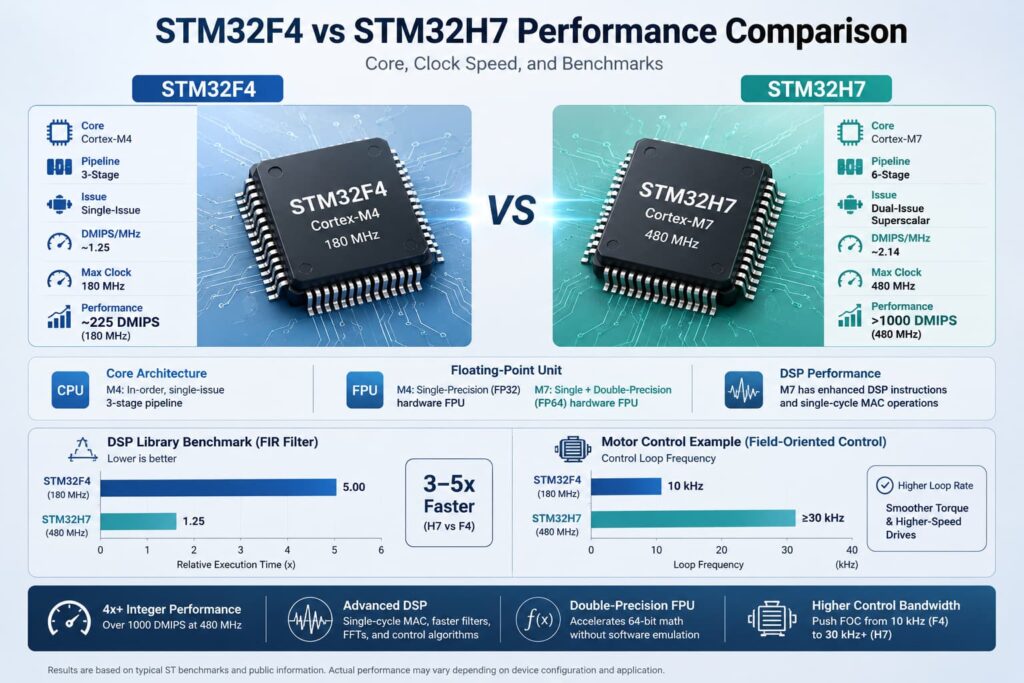
The most obvious difference is the processor core. This STM32 performance comparison starts with the Cortex‑M4 in the STM32F4, a single‑issue, in‑order core with a 3‑stage pipeline. It achieves about 1.25 DMIPS/MHz, so at 180 MHz you get roughly 225 DMIPS. The Cortex‑M7 in the STM32H7 is a dual‑issue, superscalar core with a 6‑stage pipeline, delivering around 2.14 DMIPS/MHz. At 480 MHz, that translates to over 1000 DMIPS—more than four times the raw integer performance, making the H7 a true STM32 high performance MCU.
Floating‑point operations see an even larger gap. The M4’s single‑precision FPU handles 32‑bit floats efficiently, but the M7’s double‑precision unit accelerates 64‑bit math without software emulation. For signal processing, the M7 adds a more powerful DSP instruction set and can execute certain multiply‑accumulate operations in a single cycle, dramatically speeding up filters, FFTs, and control loops.
In ST’s DSP library benchmarks, the H7 completes FIR filter operations 3–5 times faster than the F4 at equivalent clock-normalized rates. In a motor control scenario, a field‑oriented control (FOC) loop that runs at 10 kHz on an F4 can be pushed to 30 kHz or more on an H7, enabling smoother torque regulation and higher‑speed drives.
3.Memory Architecture and Cache
Memory organization is another critical differentiator. The STM32F4 uses embedded Flash (up to 2 MB) and SRAM (up to 384 KB) with zero‑wait‑state access at moderate clock speeds. The architecture is simple and deterministic—ideal for real‑time systems where execution time must be predictable.
The STM32H7 introduces a more complex memory hierarchy. It includes up to 2 MB of Flash and 1 MB of SRAM, but also adds L1 instruction and data caches (typically 16 KB each). The caches allow the core to run at full speed even when fetching instructions from slower Flash or external memories. However, cache misses can introduce jitter, so careful software design is needed for hard real‑time tasks. The H7 also supports external memory interfaces (SDRAM, SRAM, PSRAM) and memory‑mapped Quad‑SPI Flash, making it suitable for applications with large code bases or data buffers, such as advanced HMIs or edge AI.
4.Power Consumption and Efficiency
At first glance, the STM32H7 consumes more power than the STM32F4 simply because it runs at a much higher frequency. However, efficiency is more nuanced. The H7 is fabricated on a 40 nm process (versus 90 nm for many F4 parts), which reduces dynamic power per megahertz. When running at the same clock speed, an H7 can actually be more energy‑efficient.
Both series offer multiple low‑power modes: Sleep, Stop, and Standby. The STM32F4 excels in applications that spend most of their time in deep sleep and wake up periodically for short bursts of activity. Its low‑power consumption in Stop mode (a few µA with RAM retention) makes it a strong candidate for battery‑powered devices that do not need continuous high‑speed processing.
The STM32H7, while capable of similar low‑power states, is often used in always‑on systems where its higher performance reduces the time spent in active mode, potentially saving energy overall. For example, a sensor fusion algorithm that takes 10 ms on an F4 might take only 2 ms on an H7, allowing the system to return to sleep sooner. The H7 also supports voltage scaling, letting designers trade off speed for lower power dynamically.
5.Peripheral and Interface Differences
Both series share a common set of peripherals: UART, SPI, I2C, CAN, USB, and general‑purpose timers. The STM32F4 includes advanced‑control timers for motor control, 12‑bit ADCs with up to 2.4 MSPS, and a 12‑bit DAC. These are sufficient for most industrial drives, sensor acquisition, and communication gateways.
The STM32H7 expands this significantly. It offers faster ADCs (up to 5 MSPS in 12-bit mode, and 16-bit ADCs with up to 3.6 MSPS on some models), multiple DACs, and op‑amps for analog signal conditioning. Communication interfaces are upgraded: Ethernet with time‑sensitive networking (TSN) support, multiple CAN‑FD channels, and a camera interface for image sensors. The H7 also includes a Chrom‑ART accelerator for graphics operations, making it easier to drive displays without overloading the CPU.
For motor control, both series have high‑resolution timers, but the H7’s faster core and richer analog front‑end allow more sophisticated algorithms and higher PWM frequencies. In complex multi‑axis drives, the H7 can manage several FOC loops in real time while handling communication and diagnostics.
6.Application Suitability
Understanding where each series shines helps narrow the selection.
STM32F4 is a natural fit for:
– Industrial control (PLCs, I/O modules, simple motion controllers) – a proven STM32 for industrial control applications
– Motor drives (BLDC, PMSM up to moderate speeds)
– Mid‑range IoT gateways and sensor nodes
– General embedded systems that need a balance of performance and cost
– Products with long lifecycles where proven reliability matters
STM32H7 targets more demanding use cases:
– High‑end industrial automation (multi‑axis robots, fast control loops)
– Complex motor control (FOC with high‑speed sampling, predictive maintenance)
– Real‑time digital signal processing (audio, vibration analysis, software‑defined radio)
– Advanced human‑machine interfaces (touch displays, voice control)
– Edge AI and machine learning inference (keyword spotting, anomaly detection)
– Automotive and aerospace applications requiring high safety integrity (with lockstep cores on some variants)
Neither series is inherently “better”—they serve different performance tiers. The F4 remains a cost‑effective, reliable choice for millions of designs, while the H7 opens doors to applications that were once the domain of DSPs or application processors.
7.How to Choose Between STM32F4 and STM32H7
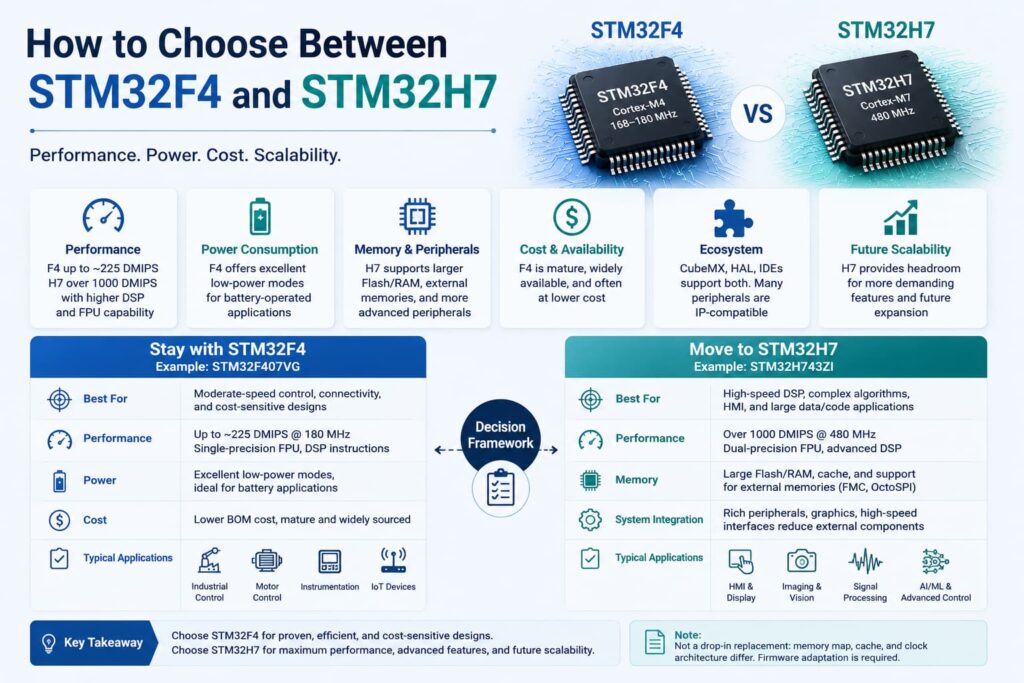
Start by defining your performance requirements. If your application runs comfortably on a Cortex‑M4 at 168–180 MHz, the STM32F4 will likely meet your needs with lower cost and simpler design. Consider the H7 when you need more than 200 DMIPS, double‑precision floating‑point, or large external memories.
Power budget is another factor. For battery‑operated devices with intermittent activity, the F4’s low‑power modes are hard to beat. If the system is line‑powered and performance is paramount, the H7’s efficiency at high speed becomes an advantage.
Cost and availability also matter. STM32F4 parts are mature and widely sourced, often at lower price points. STM32H7 devices carry a premium but can reduce system cost by integrating features that would otherwise require external components (e.g., external SDRAM, graphics accelerator).
Ecosystem compatibility is strong across both series. ST’s CubeMX, HAL libraries, and IDEs (STM32CubeIDE, Keil, IAR) support F4 and H7 uniformly. Many peripherals are IP‑compatible, and some packages are pin‑to‑pin compatible, easing migration. However, moving from F4 to H7 is not a drop‑in replacement—the memory map, cache, and clock tree differ, so firmware must be adapted. If you anticipate needing more performance later, starting with an H7 might save redesign effort.
A practical decision framework:
Stay with STM32F4 (e.g., STM32F407VG) if you need a proven, cost‑sensitive solution for moderate‑speed control, connectivity, and low‑power operation.
Move to STM32H7 (e.g., STM32H743ZI) if your application demands high‑speed DSP, complex algorithms, rich HMIs, or the ability to handle large code and data sets.
8.Conclusion
The STM32F4 and STM32H7 microcontrollers represent two tiers of high‑performance embedded computing. The F4, with its Cortex‑M4 core, delivers dependable performance for a vast range of industrial and consumer applications. The H7, powered by the Cortex‑M7, pushes the envelope with faster clock speeds, a superscalar architecture, double‑precision FPU, and a richer peripheral set.
Key differentiators come down to core performance, memory architecture, power profiles, and peripheral capabilities. Neither series is universally superior; the right choice depends on your specific application requirements, power constraints, and budget. By evaluating these factors against the strengths of each series, you can confidently select the MCU that will drive your embedded design to success. To find the right MCU for your next project, explore our STM32F4 and STM32H7 portfolio or contact our engineering team for a personalized recommendation.