
Table of Contents
STM32G0 vs STM32F0: Which Low Cost MCU Should You Choose
Introduction
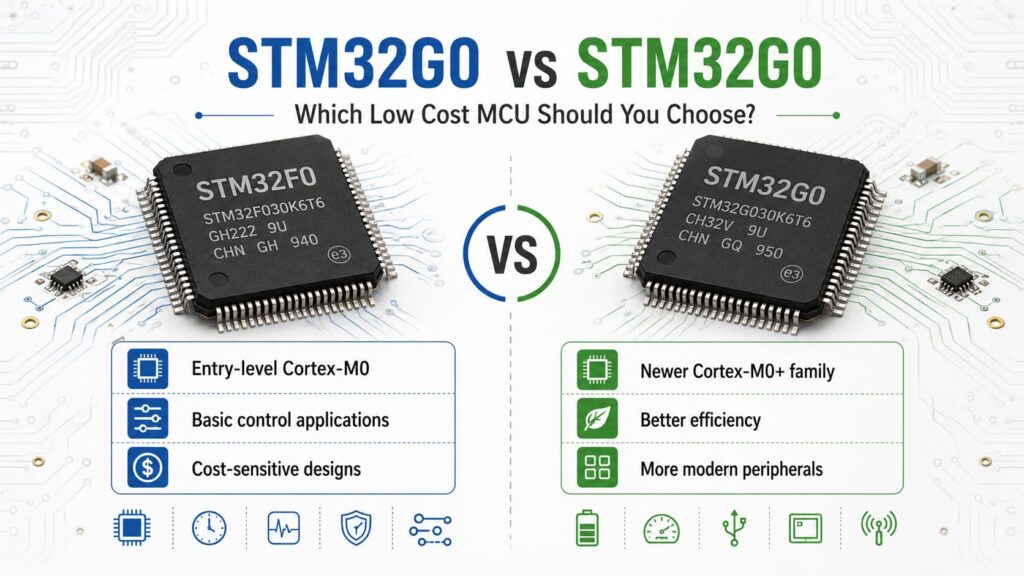
As the industry shifts from 8-bit to 32-bit architectures in cost-constrained IoT edge nodes, selecting the right microcontroller directly impacts your product’s viability. If you are working within a strict budget, you are likely evaluating STMicroelectronics’ entry-level options. A common dilemma today is the STM32G0 vs STM32F0 debate. Both families are designed to deliver solid performance at an affordable price point, but they belong to different generations of silicon technology.
Making the right choice in this STM32 MCU comparison affects your bill of materials (BOM) cost, power consumption, and the long-term availability of your product. In this article, we will break down the differences between these two families to help you select the best low-cost STM32 MCU for your next embedded design.
1.A Generational Shift in STM32 Low-Cost MCUs
STMicroelectronics has a long history of providing reliable microcontrollers for cost-sensitive applications. A low-cost STM32 MCU allows engineers to add smart processing to everyday objects, industrial sensors, and consumer gadgets without breaking the bank. When comparing the STM32G0 vs STM32F0, you are essentially looking at the past and the future of ST’s entry-level portfolio.
The STM32F0 microcontroller is ST’s first mainstream family based on the ARM Cortex-M0 microcontroller core. Introduced over a decade ago, it brought 32-bit processing power to applications that previously relied on 8-bit or 16-bit chips. Because it has been around for so long, the STM32F0 boasts a highly mature ecosystem with countless application notes, community forums, and proven reference designs. It comes in a wide range of packages and memory densities, making it a proven low-cost microcontroller for legacy projects and extremely cost-driven designs.
The STM32G0 microcontroller is the modern successor, built on the newer ARM Cortex-M0+ microcontroller core. ST designed this family to address the evolving needs of smart devices, IoT endpoints, and industrial systems. By utilizing a more advanced silicon manufacturing process, the G0 achieves better performance and lower power consumption simultaneously. The G0 series is not just a simple core upgrade; it also includes richer analog peripherals, faster communication interfaces, and enhanced security features. These improvements make it an excellent industrial control MCU, capable of handling complex motor control, power conversion, and smart sensor integration. Choosing the correct MCU for your embedded system impacts not just the upfront hardware costs, but also the software development time, power efficiency, and future-proofing of your design.
2.STM32G0 vs STM32F0: Technical Comparison
To truly understand the STM32G0 vs STM32F0 dynamic, we need to look under the hood. This STM32 MCU comparison reveals significant differences in architecture, peripherals, and efficiency.
Core Architecture and Processing Power
The most fundamental difference lies in the processor core. The STM32F0 uses the ARM Cortex-M0 microcontroller core, while the STM32G0 uses the **ARM Cortex-M0+ microcontroller** core. The Cortex-M0+ features a two-stage pipeline (compared to the three-stage pipeline of the Cortex-M0), which reduces latency and improves code execution speed.
Additionally, the STM32G0 can reach higher clock speeds—up to 64 MHz compared to the F0’s 48 MHz. This translates to a noticeable bump in DMIPS (Dhrystone Million Instructions Per Second)—the Cortex-M0+ delivers 0.95 DMIPS/MHz, while the Cortex-M0 delivers 0.84 DMIPS/MHz. The G0 also supports single-cycle I/O access, allowing for faster bit-banging and real-time GPIO toggling, which is crucial for time-sensitive embedded tasks.
Memory, Flash, and Peripheral Richness
When evaluating an MCU for embedded systems, the on-chip peripherals often matter more than raw CPU speed. The STM32G0 offers higher maximum Flash and RAM densities than the F0. But the real advantage lies in the quality of its peripherals.
For instance, the STM32G0 can be specified with up to 512 KB of Flash and 144 KB of RAM, whereas the STM32F0 tops out at 256 KB of Flash and 32 KB of RAM. This extra memory headroom is crucial for running RTOSes or complex communication stacks. The G0 features more advanced timers with better resolution, making it superior for motor control and digital power conversion. It also includes modern communication interfaces like CAN FD (Flexible Data-rate) with up to 8 MBd data rates, which is becoming mandatory in automotive and industrial applications, replacing the classic CAN 2.0B found in the F0. Furthermore, the G0’s analog-to-digital converters (ADCs) are faster and more accurate—offering 12-bit resolution at 2.5 MSPS compared to the F0’s 1 MSPS—providing better performance for sensor reading and signal processing. The G0 also allows independent clocking of communication peripherals, meaning UART and SPI can run at maximum speed without being limited by the system clock.
Power Efficiency and Operating Voltage
Power efficiency is critical for any low-cost microcontroller, especially in battery-operated or thermally constrained environments. The STM32G0 shines here thanks to its newer silicon process. It offers significantly lower active current consumption—typically around 85 µA/MHz compared to the F0’s 150 µA/MHz—and deeper low-power modes with faster wake-up times.
The G0 can also operate down to 1.7 V, compared to the F0’s 2.0 V minimum. This wider voltage range makes the G0 much more suitable for battery-powered applications where the supply voltage gradually drops as the battery discharges.
Security and Robustness
As embedded devices become more connected, security becomes a top priority. The STM32G0 includes several hardware security features that the STM32F0 lacks. The G0 offers a secure boot feature, ensuring that only authenticated code can run on the device. It also includes memory protection units (MPU) to isolate tasks and RTC tamper detection to protect against physical attacks. These features make the G0 a much safer choice for an industrial control MCU or an IoT edge node that requires protection against hacking and firmware tampering.
3.Cost and Availability of STM32 Low Cost MCUs
For B2B buyers and procurement specialists, component availability and pricing are just as important as technical specs. Both families are positioned as low-cost microcontroller options, but their market positions differ.
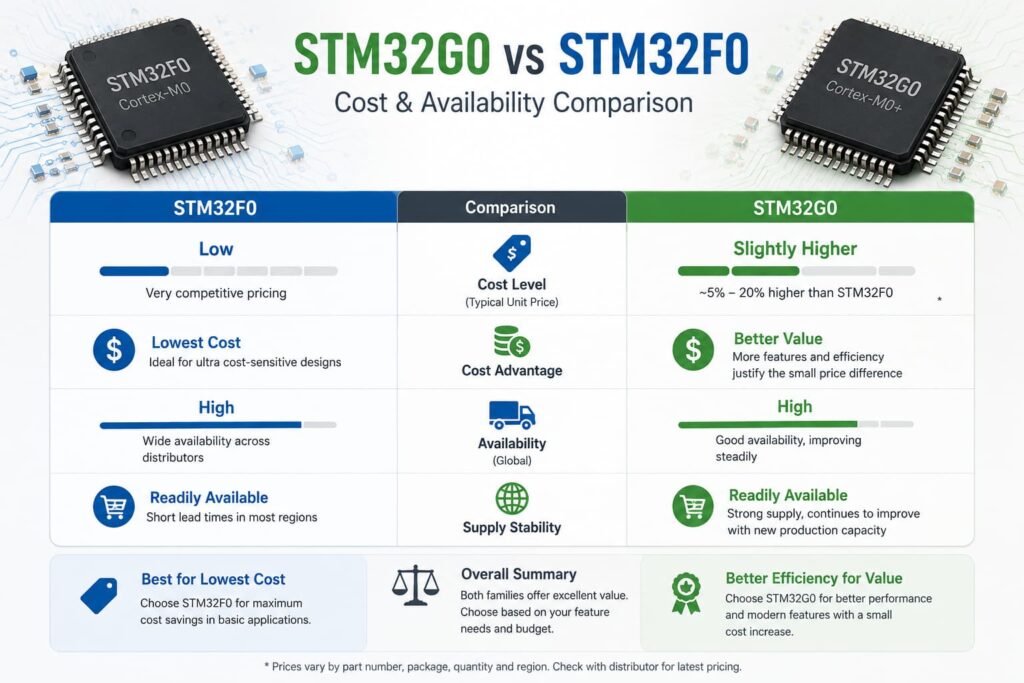
The STM32F0 has been in production for a long time. Its mature yields often result in highly competitive pricing, especially for high-volume, legacy packages. However, as the industry moves forward, the STM32G0 is becoming the focal point of ST’s entry-level roadmap. While the G0 might have a slightly higher list price in some configurations, it often delivers much better performance per dollar.
STMicroelectronics is committed to the long-term availability of both families, but the G0 is clearly the future. For new designs, the G0’s modern package options and active silicon process usually mean better long-term supply chain stability.
4.Migrating Your Embedded Systems MCU from STM32F0 to STM32G0
If you are considering upgrading an existing design from the F0 to the G0, the transition is relatively smooth. While the two families are not strictly pin-to-pin compatible across the entire portfolio, ST offers overlapping package sizes that make hardware redesigns minimal.
ST provides an ‘MCU Migration’ tool within STM32CubeMX that helps visualize pinout differences and generate the new initialization code. On the software side, migration is heavily simplified by using the STM32Cube HAL (Hardware Abstraction Layer). Since both families are supported under STM32CubeIDE, you can reuse a significant portion of your application code. You will mainly need to update low-level hardware initialization code to account for the G0’s advanced peripheral registers. For example, the G0 features a more flexible vector table that can be relocated in RAM or Flash, unlike the fixed vector table in the F0. Standard toolchains like Keil, IAR, and STM32CubeIDE fully support both devices, ensuring a seamless development experience.
5.Final Verdict
In the battle of STM32G0 vs STM32F0, both microcontrollers have their place in the electronics industry. The STM32F0 remains a viable and proven option for maintaining legacy products and hitting rock-bottom price points. However, for any new project, the STM32G0 is the clear winner. Its ARM Cortex-M0+ core, superior power efficiency, modern peripherals, and built-in security make it the ideal low-cost microcontroller for today’s demanding embedded and industrial applications. By choosing the G0, you are investing in a future-proof platform that will support your product for years to come.