
Table of Contents
What Is STM32 Microcontroller? A Complete Beginner Guide to STM32 MCUs
Introduction
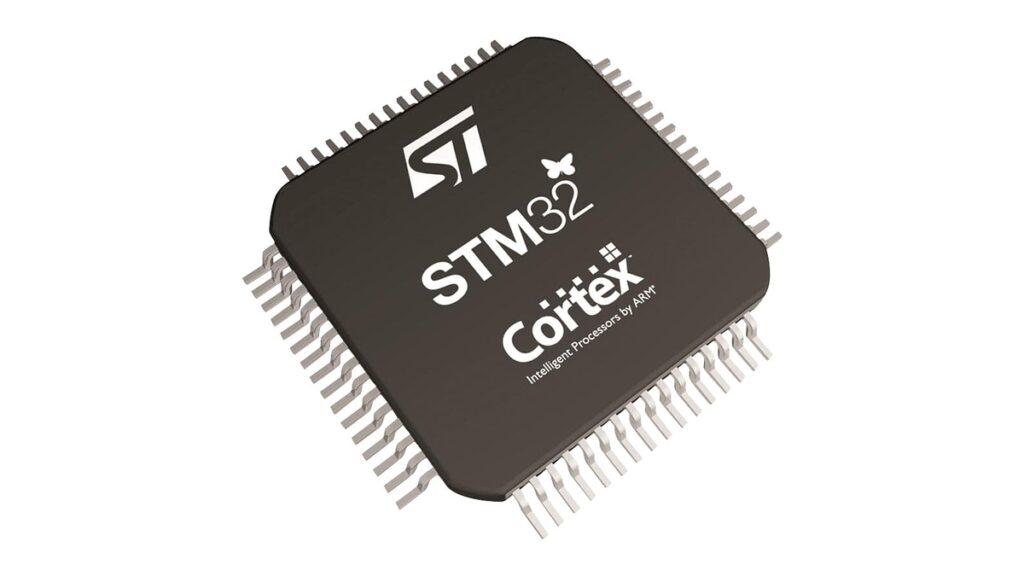
If you work in embedded design, hardware development, or electronic component sourcing, you’ve almost certainly come across the STM32 microcontroller. As one of the most widely adopted 32-bit microcontroller lines on the market, it powers everything from consumer wearables to industrial control systems, balancing performance, flexibility, and cost for thousands of projects. This guide breaks down everything you need to know about STM32 MCUs, from core functionality to procurement best practices.
1.What Is STM32 Microcontroller?
The STM32 microcontroller is a family of 32-bit embedded system MCUs developed by STMicroelectronics, built exclusively on ARM Cortex-M processor cores ranging from the entry-level Cortex-M0+ for low-power applications up to the high-performance Cortex-M7 and dual-core Cortex-M4/M7 combinations for compute-heavy workloads.
Unlike proprietary core MCUs that lock you into a single vendor’s toolchain, STM32 leverages the standard ARM Cortex-M ecosystem, so teams can reuse code, development tools, and engineering expertise across multiple product lines. Each STM32 part comes with a guaranteed 10-year production longevity commitment from ST, a critical consideration for industrial and automotive projects that require long-term supply stability.
2.Key STM32 Series and Core Specs
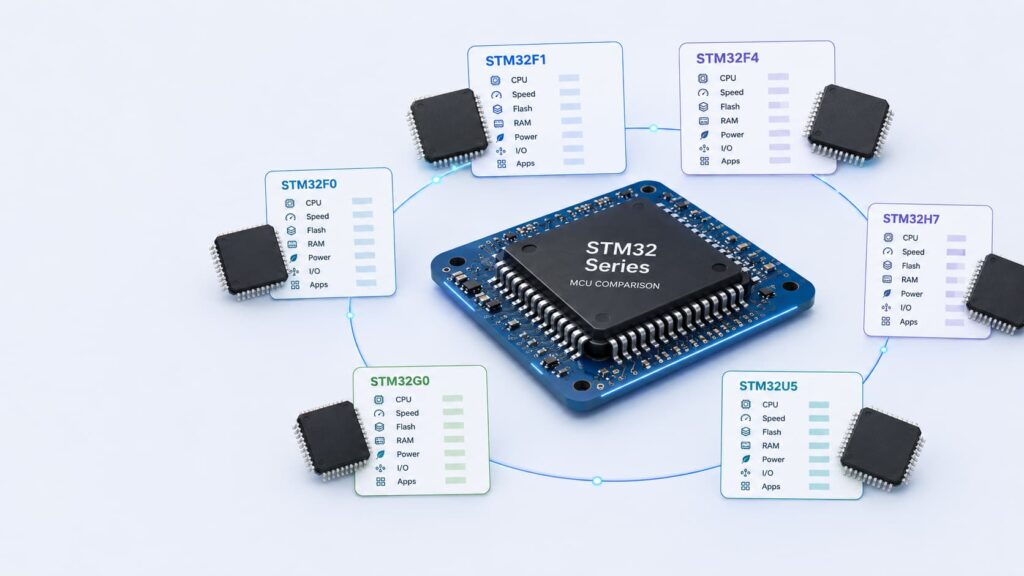
STM32 MCUs are organized into clearly defined series tailored to specific use cases, with consistent pinouts within each series to simplify board redesigns when scaling performance:
STM32F0/L0 Series: Cortex-M0/M0+ core, clock speeds up to 48 MHz, flash sizes from 4 KB to 256 KB, operating current as low as 0.23 µA in standby mode. Ideal for simple sensor nodes, low-cost peripherals, and battery-powered devices where bill of materials (BOM) cost is a top priority. Common part numbers include STM32F030F4P6 (TSSOP-20 footprint, widely available through distributors) and STM32L051C8T6.
STM32F1/F4 Series: Cortex-M3 (F1, up to 72 MHz) and Cortex-M4 (F4, up to 180 MHz with floating-point unit) cores, flash sizes from 64 KB to 2 MB. The STM32F103C8T6, often nicknamed the “Blue Pill” part, remains one of the most popular entry points for embedded beginners due to its massive community support and low cost, though designers should note the newer STM32F401RET6 offers better power efficiency and more peripherals at a comparable price point.
STM32H7 Series: Cortex-M7 core (up to 480 MHz) with optional secondary Cortex-M4 core, flash sizes up to 8 MB, and integrated peripherals including Ethernet MAC, USB 3.0, and MIPI CSI camera interfaces. Targeted at high-performance applications such as edge computing, industrial human-machine interfaces (HMIs), and digital signal processing workloads.
STM32U5 Series: Cortex-M33 core with TrustZone security extensions, operating current as low as 1.7 µA in stop mode with full RAM retention, and certified for PSA Level 3 and SESIP Level 3 security. Designed for IoT and medical devices that require both low power and robust data protection.
3.Common Peripherals and Design ConsiderationsCommon Peripherals and Design Considerations
All STM32 MCUs include a standard set of integrated peripherals, with exact counts varying by series: up to 16 UART/USART interfaces, 24 PWM channels, 3 SPI buses, 4 I2C interfaces, 12-bit or 16-bit ADCs with sampling rates up to 36 MSPS, and CAN/CAN FD controllers for automotive and industrial communication.
When designing with STM32, always cross-reference the part’s official datasheet for pin multiplexing constraints: many GPIO pins have up to 8 alternate functions, and some peripherals share internal clock lines that can cause conflicts if not mapped correctly during the schematic phase. ST’s free STM32CubeMX tool automatically resolves most pin conflicts and generates initialization code, but it is still best practice to validate peripheral assignments against the datasheet to avoid unexpected behavior during testing.
For high-volume production, you can opt for ST’s factory-programmed unique device ID (UID) and pre-flashed bootloader options to reduce in-house programming costs. Note that some low-cost STM32 variants have limited pin-compatible drop-in alternatives, so it is wise to select a series with at least two functionally equivalent part numbers from ST to mitigate supply chain risk.
4.Typical STM32 Applications
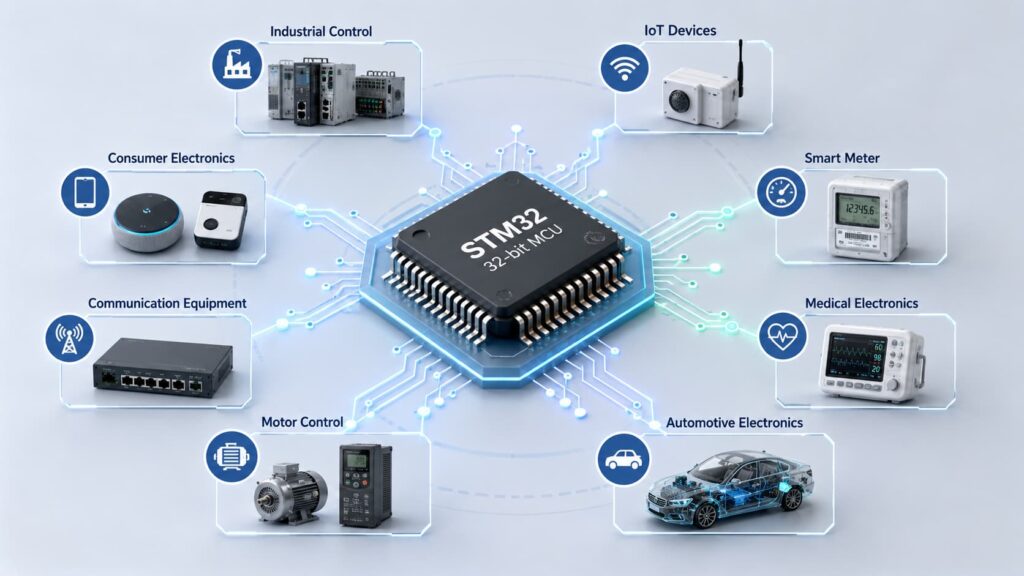
STM32’s breadth of configurations makes it suitable for nearly any embedded use case:
Consumer electronics: Smart watches, wireless earbuds, home automation hubs, and drone flight controllers
Industrial systems: PLCs (programmable logic controllers), motor drives, sensor data loggers, and edge gateways
Automotive: Body control modules, infotainment peripherals, and battery management systems for electric vehicles (all automotive-grade STM32 parts meet AEC-Q100 qualification requirements)
Medical devices: Glucose monitors, portable patient monitors, and infusion pumps (STM32L4 and U5 series are IEC 62304 compliant for medical software development)
5.STM32 Procurement Best Practices
When sourcing STM32 parts, always prioritize traceable and reliable supply channels to reduce the risk of counterfeit components, especially for high-demand series such as STM32F103 and STM32F407. For production orders, it is recommended to confirm stock availability, lead times, and sourcing stability at least 12 weeks in advance, as popular STM32 models may face extended delivery times during market shortages.
For prototyping, STM32 development boards are a practical option for early-stage testing and firmware validation. They allow engineers to quickly evaluate peripherals, test basic functions, and verify software logic before moving to a custom PCB design. However, the final hardware design should still be checked carefully against the selected production part’s datasheet, pinout, package, and electrical requirements.
If your preferred STM32 part is out of stock, consider checking for pin-compatible or functionally similar alternatives based on package type, core performance, memory size, operating voltage, peripheral set, and temperature grade. For example, when replacing an STM32F103 series device, engineers should compare the target alternative carefully to confirm whether the firmware, PCB layout, and peripheral configuration can be reused with minimal modification.
For buyers managing STM32 BOMs, working with a professional component sourcing partner can help verify availability, identify suitable alternatives, and reduce procurement risks before production.
FAQ
Q: What programming languages are used for STM32?
A: Most STM32 development is done in C, with C++ supported for more complex applications. ST’s STM32CubeIDE also supports Rust via third-party extensions, and MicroPython is available for most STM32 parts for rapid prototyping.
Q: Is STM32 better than Arduino?
A: Arduino is a development platform that uses specific MCUs (including some STM32 parts in Arduino Nano and Pro boards), while STM32 is a full family of MCUs with far more configuration options in terms of performance, peripherals, and power efficiency. For simple hobby projects, Arduino may be faster to implement, but STM32 is the better choice for production designs that require custom performance or cost targets.
Q: How do I choose the right STM32 part for my project?
A: Start by defining your core requirements: minimum clock speed, flash/RAM size, required peripherals (CAN, Ethernet, etc.), power consumption limits, and target BOM cost. Use ST’s STM32CubeMX part selector tool to filter parts that meet your specs, then prioritize parts with at least two alternate pin-compatible options to reduce supply chain risk.
Q: Are STM32 parts suitable for high-temperature industrial applications?
A: Yes, most STM32 series offer industrial-grade variants rated for -40°C to 105°C operating temperatures, with some high-temperature parts rated up to 125°C for automotive under-hood applications. Always confirm the temperature grade in the part’s datasheet before selecting it for extreme environment use.